The quiet widow said one sentence to the most powerful man in Detroit, and the old man gave way. Her brother-in-law remembered the words: “If this is not done, I shall sell my stock. ” Henry Ford was 82 years old, and the sentence his daughter-in-law spoke in September of 1945 had been growing for a very long time. Her name was Eleanor Luthian Clay.
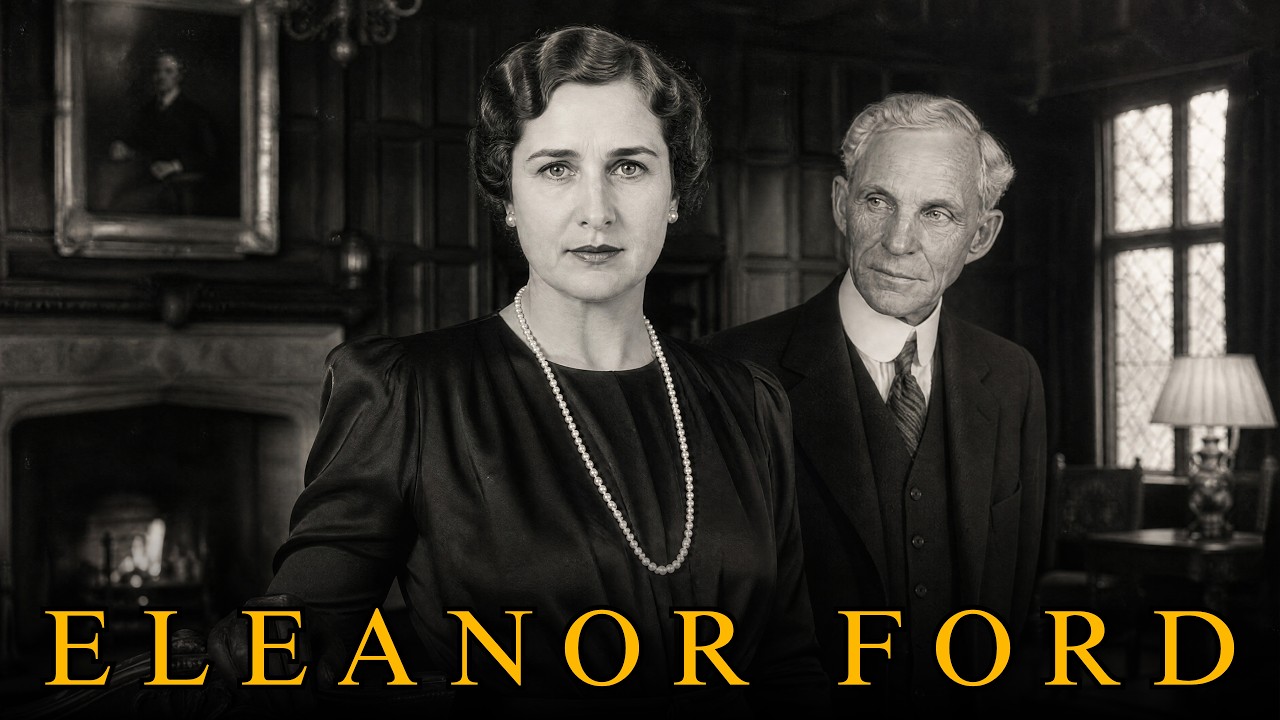
She was born in Detroit on the 6th of June, 1896, the same year a young engineer named Henry Ford drove his first experimental car. Nobody in the Clay household could have known what that small fact would come to mean. She was 12 when her father died, and the house she grew up in after that belonged to someone else. Her father was William Clay; her mother, Eliza, had been born a Hudson.
Eliza’s brother was Joseph Lotheian Hudson, the great department store magnate of Detroit, the city’s wealthiest merchant. When William Clay died, the widow Eliza moved with her two daughters, Eleanor and her older sister Josephine, into her brother’s roof. It was the ordinary thing for a family of that class to do. A widow of good family with no fortune of her own went where the money was and lived there by its goodwill.
The house was full of beautiful things. Eleanor grew up among paintings she did not own, in rooms she had not chosen, at a table where her uncle sat at the head. She learned the manners of a great house and how early to be useful in it. There is a photograph at The Henry Ford, taken around 1905, of a small girl on holiday on Mount Desert Island in Maine, where J.
L. Hudson took his extended family every summer. The child is Eleanor. She was nine or so, and she did not know she would one day build a house of her own on that same island with money that had nothing to do with her uncle.
While still a schoolgirl at the Detroit Home and Day School, she taught tap dancing at the Franklin Settlement, an immigrant aid house in the city. A girl who spends her own girlhood as a guest in a rich relation’s house learns certain things very young. She learns that kindness and power usually live in the same person, that the one who pays for the house decides what happens in it, and she learns to watch closely, because watching is what a guest can do. Across Detroit in those same years, a boy three years older than Eleanor was learning that he would inherit everything and decide nothing.
His name was Edsel Bryant Ford, the only child of Henry and Clara Ford. He was gentle, artistic, a designer at heart, drawn to the shape of a car as much as the engine inside it. His father loved him, and that makes the rest of this story harder to tell. What Henry Ford wanted was a son who would become Henry Ford.
The historian Frank Ernest Hill put it in a single line in 1962: his father had an unshakable conviction that the son lacked the steel needed to drive the company forward. Clara Bryant Ford almost never appears in the record raising her voice. When she did, it counted. The accounts differ a little on how Eleanor and Edsel met.
The Detroit News, drawing on the family’s own story, says it was at the dancing school of Annie Ward Foster around 1911. Ford House places the first meeting at the Franklin Settlement, where Eleanor taught. Both put the two in a room where young people were learning to dance. What the accounts agree on is that the courtship lasted about five years.
Nobody rushed. Nobody eloped. For Eleanor, it must have been a strange match to consider, and a very bright one. The Hudson house had money, but it was her uncle’s money.
The Ford fortune was growing faster than almost any fortune in the country, and Edsel was its only heir. Marrying him meant one day a house of her own, a name of her own, a place in the world that did not depend on anyone’s generosity. For Edsel, the courtship ran alongside his first steps into his father’s company. He became secretary of the Ford Motor Company on the 1st of November, 1915, not yet 22.
It was a real post with a real title, and it was the first rung of a ladder his father had built for him. At the very start, the pattern shows itself. Henry Ford wanted his son in the company. He gave him titles early and generously.
What he did not give him, then or ever, was the thing a title is supposed to carry with it: the right to decide. On the 1st of November, 1916, about a hundred guests came to J. L. Hudson’s house for a wedding one paper later called almost informal.
The house stood on East Boston Boulevard in Detroit. The bride was 20. The groom was not quite 23. The heir to the Ford fortune could have been married in any cathedral in America.
He was married instead in the bride’s uncle’s house with a guest list the size of a large dinner party. Her gown came from the house of Lucille, the fashion house of Lady Duff Gordon, cut in the Russian style. Our Detroit adds a sentence no historian has ever had reason to dispute: they were by all accounts truly in love. The honeymoon took them to the Grand Canyon, to Pasadena, and then to Hawaii.
Edsel wrote home to his parents, and the letter survives in the collections of The Henry Ford, dated the 8th of November 1916. “A week ago today, we were all getting ready for the big event and now it is all over. ” He told them about the country. “Yesterday, we motored over to Grand View Point and on the way back were caught in a blinding snowstorm.
” He told them what it was like to be a Ford on a train: “Of course, everyone had us spotted on the train and in the hotel at Toledo, but not in Chicago or out here. ” And he signed off for both of them: “Eleanor and I send loads of love and will be glad to hear from you at Pasadena. ”
They came home to Detroit and set up house at 2171 Iroquois, in the neighborhood called Indian Village, in a six-bedroom house. It was the first home Eleanor had ever lived in that was not someone else’s.
On the 4th of September, 1917, their first son was born. They named him Henry, after his grandfather. A second son, Benson, followed on the 20th of July, 1919. Later there would be a daughter, Josephine, in 1923, and a last son, William Clay, in 1925.
That same summer, in June of 1917, Eleanor’s sister Josephine married a young man named Ernest Kanzler. Remember that name. The two sisters had married into the same company. Edsel’s rise went on at astonishing speed.
He became vice president in January of 1917. On the 30th of December, 1918, Henry Ford resigned the presidency, and his son was elected in his place, from the 1st of January, 1919. Edsel was 25 years old. The move that followed was pure Henry Ford.
In March of 1919, he announced he was going to start a new rival car company of his own. While that announcement hung in the air, Henry Ford’s agents were quietly buying out the shareholders. By July, the trick was revealed: for the first time, the Ford family controlled every last share in the Ford Motor Company. The Fords bought 8,300 shares at $12,500 a share, about $15 million in all.
The Dodge brothers alone walked away with $25 million for their 2,000 shares. When the dust settled and the company was reorganized, there were 172,645 shares, and three people held them all. Henry held 95,321. Clara held 5,413.
And Edsel, at 25, held 71,911—a little more than four in every ten. There was no board of outside investors to answer to. The Ford Motor Company belonged to the Fords. It should have meant that Edsel was free.
The shares said he owned four-tenths of the company. The title said he ran it. Eleanor had grown up in a house where the man who owned things decided things. What she found instead would take her the next 24 years to understand and two more to answer.
The story Harry Bennett told years later was about a row of coke ovens at the Rouge. Time magazine reviewed Bennett’s memoir in 1951 and preserved the story in a few plain lines. “Once,” said Bennett, “Edsel over Ford’s objections decided to build a row of coke ovens. Ford told Bennett, ‘Harry, as soon as Edsel gets those ovens built, I’m going to tear them down.
‘” And, said Bennett, Ford did. The story is Bennett’s, and Bennett had his own reasons to paint the old man as a tyrant. But the rest is not in doubt. The disagreements between father and son ran through almost every important decision the company made in those years.
Take the brakes. Edsel wanted modern hydraulic brakes. The story told afterwards is that when he raised the question in a board meeting, his father shouted at him to shut up. Ford did not adopt hydraulic brakes until 1939.
Take the engine. Edsel believed Ford needed a six-cylinder car to compete. Henry’s only concession was to allow some preliminary work. So Edsel quietly had an engineer named Lawrence Sheldrick design a six-cylinder engine.
Henry viewed this as treachery on Sheldrick’s part, and it probably contributed to Sheldrick’s firing in 1943. The same writers sum up the pattern in one sentence: Henry bullied Edsel relentlessly, apparently hoping it would somehow toughen him up. Now think about what all of this looked like from the other side of the dinner table. Eleanor had married the president of the Ford Motor Company.
She saw her husband come home from a day on which he was overruled in front of the men who were supposed to answer to him. She heard which projects were quietly dead. She learned which names were no longer mentioned, because the men who belonged to them had been let go for agreeing with him. And Eleanor had one great advantage in reading it.
She had grown up in a house where the man at the head of the table owned everything, and everyone else lived by his leave. What she was seeing now was the same arrangement, only larger, and turned on the person she loved most. Ernest Kanzler had married Eleanor’s sister Josephine in the summer of 1917, and by the early 1920s he was one of the most important men at Ford. His record shows him as production manager from 1920 to 1926 and as second vice president from 1923 to 1926.
He was also, and this is what matters, Edsel’s closest ally. Frank Ernest Hill called him Edsel’s brother-in-law and co-planner. Kanzler saw the danger of the aging Model T and put it on paper. He wrote Henry Ford a memorandum arguing forcefully that the company had to design a replacement.
The historian John Steele Gordon recorded the old man’s reaction: “That young man is getting too big for his britches,” Ford said. And soon he fired him. Hill tells the same story from inside with a detail that makes it even stranger. When Ford told Harry Bennett to get rid of Kanzler, Bennett refused.
Even the old man’s most loyal man would not do this particular job. It was done anyway. Hill describes the effect: “When Kanzler was abruptly ejected, close observers were startled by the sudden glimpse of a deep gulf opening between father and son. ” The gulf ran straight through the middle of the Clay sisters’ lives.
The years around that ejection were not all defeat for Edsel. There was one great purchase that was truly his. On the 4th of February, 1922, Ford bought the Lincoln Motor Company for $8 million. Edsel had pushed for it more than anyone.
There is a photograph at The Henry Ford taken that very day at the Lincoln factory, with Henry, Clara, Edsel, and Eleanor standing with the Leland family. Lincoln became Edsel’s own domain, the one corner of the empire where his taste could rule. Years later, the most admired car to come out of it, the Lincoln Continental, would carry his eye in every curve. The last Model T came off the line on the 26th of May, 1927.
The plants shut down in early June. About 60,000 workers were laid off while the company retooled. The Model A was released that December. The division of labor tells its own story: Henry Ford took charge of the mechanics; his son was allowed to design the body.
That date, the 26th of May, will come round again in this story twice, and neither time will it bring anything good. In 1925, Edsel bought a stretch of shore on Lake St. Clair that his own parents had once owned and walked away from. The land was called Gaukler Point.
Henry and Clara Ford had bought it in 1911, meaning to build there, and had then chosen Dearborn instead. So in 1925 their son bought the lake shore from them and began to build on the very spot his parents had left behind. The architect was Albert Kahn, the man who designed the great Ford factories. At the Fords’ request, Kahn designed the home in a style reminiscent of stone houses in the Cotswolds region of England.
The outside went up in 1926 and 1927; the inside took until 1929. Whole rooms and pieces of rooms were brought across the Atlantic and fitted in: 16th-century oak paneling carved to look like folded linen, a chimney piece from an English house called Wollaton Hall, a staircase from Liverdan Manor, stained glass centuries old. The landscape designer Jens Jensen laid out meadows and lagoons along the lake. The house has about 30,000 square feet and 60 rooms.
The estate ran originally to more than 125 acres along the water. It was only one of their houses. In 1922 they had bought 80 acres on a hilltop at Seal Harbor on Mount Desert Island, where Eleanor had spent her girlhood summers, and built a house there called Skylands of pink granite quarried on the site, with 12 bedrooms. John D.
Rockefeller Jr. wrote to Edsel with advice about where the house ought to stand. Edsel answered politely and built where he meant to, about 100 feet below the top of the hill, to blend the house with the hill. At home in Dearborn, he could not have done it.
Inland in Michigan, they gathered a country retreat called Haven Hill, 2,422 acres, with a lodge and a toboggan run 3,000 feet long. For their daughter Josephine’s 7th birthday in 1930, her grandmother Clara gave her a playhouse on the grounds, a real Tudor house at two-thirds scale with nursery rhyme figures carved on its gables. The home movies that survive from those years show trips to the beach, tennis, impromptu dance parties, and snowball fights. The girl who had taught dancing at the settlement house now held dances of her own in a house nobody could take away from her.
Eleanor studied the history of art with William Valentiner of the Detroit Institute of Arts, and she and Edsel traveled Europe together looking at great paintings. From 1924 she was one of the steady funders of the Detroit Institute of Arts and helped pay for its south wing. In 1932 and 1933, the painter Diego Rivera covered the walls of a great court at the institute with his murals called Detroit Industry. Edsel paid the entire bill, the museum records the sum as $20,889.
Rivera also painted Edsel’s portrait in 1932. It shows him at a drafting table sketching a car. That portrait is the truest picture of him that survives. The man at the drafting table designing was the man Eleanor married.
The man at the board table being told to be quiet was the one his father saw. In those same years, as the stone walls went up on the shore, a new figure was rising at the Rouge. Harry Bennett had been a sailor and a boxer, and from 1921 he was the man Henry Ford trusted most. He came to run what was called the service department, a mild name for a private force.
By one account it grew to some 3,000 men, recruited from boxers, wrestlers, and members of Detroit’s gangs. The father who would not take his son’s advice took Bennett’s every day. There is one moment in the record where Edsel’s patience breaks and his own words survive. He had tried to protect an executive named A.
M. Wibel from Bennett, and he had failed. Afterwards he said, as Hill records it: “The hurtful thing about all this is that father takes Harry’s word for all this and he won’t believe mine. Who is this guy anyway?
Where did he come from? He is nothing but a gob. ” Gob was slang for a sailor. It is almost the only time the gentle, careful man lets his anger show.
Bennett’s methods reached their darkest point outside the gates. On the 7th of March, 1932, in the worst years of the Depression, a crowd of marchers came to the Ford plant. It became known as the Ford Hunger March, and it ended in gunfire. Four men died that day: Joseph York, 20; Kelman Leanie, 26; Joseph Delasio, 31; Joseph Busel, 16.
A fifth man, Curtis Williams, died of his wounds months later. Bennett himself was struck by a rock and taken to the hospital. Five years later, on the 26th of May, 1937, union organizers came to the Rouge, and service department men beat them, among them Walter Reuther and Richard Frankensteen. Seven times, Reuther later said, “they raised me off the concrete and slammed me down on it.
” Edsel recognized that the new labor law had made the union inevitable and that fighting it would only make things worse. His father did not agree, and Bennett was there to make sure the father’s view prevailed. In the end, it took Clara. In June of 1941, Henry Ford at last signed a contract with the autoworkers union.
His wife reportedly feared that more riots and bloodshed would result from her husband’s refusal, and threatened to leave him if he did not sign. “Mrs. Ford was horrified,” Henry said later. “She insisted that I sign what she called a peace agreement.
I felt her vision and judgment were better than mine. ” And he added a line he may not have known would come back to him: “Don’t ever discredit the power of a woman. ” His son’s reasoning about the union had not moved him. One threat from his wife did.
By then the harm to Edsel had been done over 20 years. Every quarrel, every reversal, every Bennett victory had worn at him. In January of 1942, surgeons who opened him for stomach ulcers found something worse: a cancer that could not be cured. That was not the only thing wrong with him.
Hill goes on: Edsel fell ill with undulant fever contracted from non-pasteurized milk from Henry Ford’s farm. Henry Ford, with his strong opinions about diet and health, did not believe milk needed to be pasteurized. The heir to one of the greatest industrial fortunes on earth, the president of the company, was being made sick by milk from his own father’s cows. What his father believed about the illness is the hardest part of the whole story to hear.
Hill set it down with great care. “His father refused to believe he was in danger. ” And he recorded what Henry Ford thought the cure would be: if Edsel would only change his diet and mode of life to that which Henry Ford had found best, if he would stop worrying, listening to men of the wrong type, and opposing Henry and Bennett, he would soon get well. The father’s cure for his son’s cancer was obedience.
Henry blamed his son’s illness on the life of Grosse Pointe, on the parties, on alcohol, on smoking. The lake house, the dances, the friends, the whole world Edsel and Eleanor had built on the shore at Gaukler Point stood accused in the old man’s mind. Edsel Bryant Ford died at Gaukler Point, in the house on the lake they had built together. Hill gives the hour: 10:01 in the morning, on the 26th of May, 1943.
And then he gives the cause in a phrase a careful historian does not use lightly: “a complication of ailments, stomach cancer, undulant fever, and a broken heart. ” He was 49 years old. Eleanor was 46. Think of the letter he wrote home from the honeymoon, 26 and a half years before: the young man in the snowstorm at Grand View Point telling his parents that the big event had come and gone, and now it is all over.
The same words now fitted his whole life. On the 26th of May, 1927, the last Model T had come off the line. On the 26th of May, 1937, the service department had beaten the union men outside the Rouge. On the 26th of May, 1943, at 10:01 in the morning, Edsel died.
Three May 26ths across 16 years. The calendar has a way of keeping score that no one intends. What Eleanor felt about who was to blame was reported afterwards. The account is that she blamed Harry Bennett for her husband’s early death.
There is a famous line often repeated in which she is supposed to have said so aloud; it has no source anyone has been able to find, and it does not belong in her mouth. The honest record is quieter. She blamed Bennett. What she thought of her father-in-law, she did not say where anyone could write it down.
There was another woman in mourning that week, and it is easy to forget her. Clara Ford had lost her only child. In the months that followed, Clara and Eleanor would find themselves on the same side, against the same man. On the 27th of May, the day before his son’s funeral, Henry Ford telephoned Charles Sorenson to say he would take the presidency himself.
On the 1st of June, 1943, the board elected Henry Ford president again. He was 79 years old, and he had suffered two strokes. It was the middle of the Second World War. The Ford Motor Company was one of the great arsenals of the Allied cause, building bombers at a vast plant called Willow Run.
In Washington, people were worried. Hill is direct about it: President Roosevelt and the war production chiefs wished to see Henry Ford set aside by able, earnest, trustworthy men. Eleanor’s eldest son, Henry Ford II, was released from the Navy so that he could return to the company. Some say July of 1943; Hill says it was Secretary Knox who approved the release in the hot August days of 1943.
Either way, a young man of not quite 26 came home to a company run by his grandfather and by Harry Bennett, and to a mother who had just buried his father. The board made him a vice president on the 15th of December, 1943. On the 10th of April, 1944, the board appointed him executive vice president. On paper the grandson was rising fast, just as his father had once risen fast.
His mother had seen exactly that happen before. She knew better than anyone what a title at Ford was worth when the old man and his closest man did not want you to use it. In November of 1943, Sorenson asked to be relieved of his duties. On the 4th of March, 1944, he was formally let go, and he learned the reason through an intermediary: Henry Ford wished him to resign because he had been ambitious for the company presidency.
In less than a year, almost every strong man who might have stood between Harry Bennett and the running of the company had been removed, and the only one left was a young man the old man did not yet take seriously. Before Eleanor could act, her son discovered that his grandfather’s people had been planning for a future in which no Ford grandchild would have any say at all. The codicil, as Hill later described it, would have put the company in the hands of trustees for 10 years after Henry Ford’s death. None of the grandchildren appears in the list of trustees.
Harry Bennett, according to Hill, was to be the secretary of the trust. A Ford man named John Bugas, on the young Henry’s side, went to Bennett about the document. Bennett’s response was theatrical. He took the original, laid it on the floor, and set a match to it.
When it had burned, he swept the ashes into an envelope and handed the envelope to Bugas. “Take this back to Henry,” he said. Bennett later tried to make the whole thing sound unimportant. “It wasn’t any good anyway,” he said.
“Mr. Ford had carried the instrument around in his pocket. ” Whatever it was worth in law, it had frightened the family badly enough that it had to be burned in front of a witness. To understand why Eleanor’s next move would carry such weight, it helps to know how the company’s shares were arranged by then.
In 1935, the company’s stock had been converted into 3,452,500 shares, split into two kinds. Ninety-five percent were Class A shares, which carried no vote at all. Only 5 percent, the Class B shares, carried votes. Of the whole, Edsel held 1,432,787.
In 1936, the Ford Foundation was set up with a gift of $25,000, as a means of retaining family control of the firm. The great estate taxes of those years threatened to force a family like the Fords to sell off its company to pay them. The answer was to send the non-voting shares to the foundation and keep the voting shares in the family. Almost all of the company’s value would in time belong to a charity, but the tiny slice of voting stock would decide everything: who ran the company, who sat on its board, who could be hired, who could be fired.
So when Edsel died, his non-voting shares went to the foundation. His voting shares, the ones that decided who ran the company, went to his heirs: his widow and his children. Eleanor Clay Ford, who had lived her whole girlhood in her uncle’s house and her whole married life beside a man who could not use what he owned, was now at the center of a great block of the Ford Motor Company’s voting stock. That block was the one thing the codicil could not burn.
It was the thing Henry Ford, for all his power, could not simply order away. By the late summer of 1945, Clara Ford had been working on her husband for some time, and he was, in Hill’s word, peevish. Henry Ford was 82. He had been president again for more than two years, and in that time Bennett’s grip on the company had only tightened.
Clara had done this once before. In 1941 she had threatened to leave him unless he signed with the union, and he had signed. This time she needed help, and she got it from the one person who had even more reason than she did. “Finally,” Hill writes, “Mrs.
Edsel Ford, according to her brother-in-law, took decisive action in support of Clara. ” And then comes the sentence the whole of this story has been leading to: “If this is not done,” she proclaimed, “I shall sell my stock. ” Hill finishes his own sentence in six words: “And the old man gave way. ” The accounts differ on who spoke first.
They agree on who won. The sources differ, too, on how large the threat was. One says she held nearly 41 percent of the company’s shares through Edsel. Another says nearly half.
Time, writing at her death, said she controlled 54 percent of the voting stock. What matters is what all of them agree on: it was enough. She was threatening to do to him the one thing he could never undo: to break his company open, to give the kingdom Henry Ford had made wholly his own in 1919 outside owners, strangers with votes. The young Henry did not take the presidency on any terms.
He described the meeting at Fair Lane himself. “I told him I’d take it only if I had a completely free hand to make any changes I wanted to make. We argued about that, but he didn’t withdraw his offer. ” The board met on the 21st of September, 1945.
Hill calls it one of the most important sessions in its history. The old man’s resignation had been prepared in advance. As the letter was read aloud, Harry Bennett understood what was happening. According to Hill, he rose abruptly, hurled an angry word of congratulation at Henry II, and started to bolt for the door, but others prevailed on him to stay until the decisive vote was taken.
The vote was taken. Henry Ford II was president of the Ford Motor Company. He had turned 28 only a few weeks before. His father had been 25 when he took the same title in 1919, and his father had held it for 24 years without ever being allowed to use it.
The grandson had asked for a free hand and had been given one. Hill gives a closing image of the broken old man led from the director’s room. An era terminated. Then the new president did the thing his father had never been able to do.
Before the director’s meeting had completely broken up, young Henry strode down the mahogany-paneled corridor to Bennett’s office. When he came out, Bennett was no longer the boss of Ford. Bennett had one last thing to say: “You’re taking over a billion dollar organization here that you haven’t contributed a thing to. ” There is a story told afterwards that Bennett reached for a pistol that day and that John Bugas faced him down.
It may be true; it is the sort of story that gathers around a man like Bennett. It was also reported that Bennett burned his own files before he left. Whatever happened in that office, the result is not in dispute. The man who had held Henry Ford’s ear for a quarter of a century, the man who had beaten Edsel in argument after argument, the man Eleanor had reportedly blamed for her husband’s death, was out on the same day her son took the chair.
She never took a title. She never sat on that board in person. She never gave an interview about any of it. And yet it was her sentence that made it happen.
The power had never belonged to the man in the president’s chair. It had belonged all along to whoever held the stock. In April of 1947, the Rouge River flooded, and at Fair Lane the lights went out. On the night of the 7th of April, the great house in Dearborn was lit by candles and kerosene lamps.
At 11:40 that night, Henry Ford died there of a cerebral hemorrhage. He was 83, and he had lived 19 months after the board meeting that took the company out of his hands. At his funeral, it was Eleanor’s second son, Benson, who helped his mother out of the church. Clara Bryant Ford lived three years more.
She died on the 29th of September, 1950. With her went the last of the generation that had built the company. Eleanor never remarried. Time, writing at the end of her life, found a phrase that fits almost everything the record shows: she was strong-willed in private but self-effacing in public.
Ford House calls her the strong-willed matriarch of Detroit’s famous automotive family and a dedicated patron of the arts. She stayed on at Gaukler Point, in the stone house they had built on the lake, for 31 more years. When she needed a new car, she had one built to suit her: a 1952 Lincoln Town Car, made so that she could step in without stooping. It was a Lincoln, of course.
It was the company her husband had fought to buy. She let go of some of what they had shared. Haven Hill, the great country retreat with its toboggan run, she sold to the state of Michigan three years after Edsel died. It became the Highland State Recreation Area.
What she had, she gave away, and she gave it to the public. Ford House records that after Edsel’s death in 1943, Eleanor increased her annual giving, often donating anonymously. At the very end, in 1976, she gave $1 million to found a new department at the museum for the arts of Africa, Oceania, and the Americas. Her son ran the company she had won for him until 1979.
In 1956, Henry Ford II took the Ford Motor Company public. The price at the offering was $64. 50 a share. The thing his grandfather had feared most, outside owners, had arrived at last, and it had arrived on the family’s own terms, by the grandson’s choice.
The rest of her children made their own lives. William Clay, the youngest, bought the Detroit Lions football team. Josephine lived until 2005. Benson died in 1978 aboard his yacht; Eleanor did not live to see that loss.
Across those three decades, she did not write a memoir, did not give interviews about her husband or her father-in-law, did not tell the story of the sentence she had said in 1945. Everything she thought about the years of the torn-down ovens and the milk from the farm, she kept inside the house on the lake. In June of 1976, at the age of 80, she sat down to decide what would become of the house. Her will is dated the 16th of June, 1976.
Time had estimated her fortune at between 100 and 200 million dollars. But the passage from her will that has come down to us is about a house, and it is the closest thing to her own voice that survives. “Elsewhere in our country and in England and other parts of Europe,” she wrote, “ways have been found to preserve such residences for some form of public use, and they remain as witnesses to the past, as part of the history of the area, and as an enrichment in the lives of future generations. ” So she left Gaukler Point to the public, to be used for the benefit of the public as a historical property and cultural center.
And she left $15 million to keep it standing. She died four months later, on the 19th of October, 1976, at Henry Ford Hospital in Detroit. She was 80 years old. She was buried at Woodlawn Cemetery under a stone that reads simply: Eleanor Clay Ford, 1896–1976.
Two dates and a name. The first is the year a young engineer in Detroit drove his first experimental car. The second is the year the last person who had stood up to its founder and made him give way was laid to rest. Her paintings went to the museum she had loved.
The Detroit Institute of Arts still labels them with the words “bequest of Eleanor Clay Ford. ” The Holbein portrait of a woman that she and Edsel had bought in 1930 is there. The nativity from Florence is there. And so is Diego Rivera’s portrait of her husband at his drafting table, sketching a car.
The house opened to the public in 1978. It was placed on the National Register of Historic Places in 1979. And in 2016 it was named a national historic landmark. Today strangers walk through the rooms Albert Kahn built along the shore Jens Jensen shaped, past the playhouse Clara gave a 7-year-old girl.
The estate that remains covers 87 acres today, less than the 125 it once ran to, but still a long green reach of lakeshore. The playhouse still stands, two-thirds the size of a real house with its carved nursery rhymes. The Detroit Historical Society, which keeps the record of her life, is careful about her part in the events of 1945. It says only that she is said to have pressured Henry Ford to make his grandson president.
That is the whole of her public reputation for most people who know the name at all. “Said to have” is a very small phrase for a very large act. She won the company for her son, and with it the future of the family. She broke the hold of Harry Bennett in a single afternoon after he had held it for a quarter of a century.
She did what her husband had never been able to do, and she did it with the very thing he had owned and never used. And she lost almost everything that mattered to her before she ever got the chance. Her victory came two years and four months after the only person it was really for was gone. She outlived him by 33 years.
She kept the house they built, and at the very end she gave it away so that it would stand when there were no more Fords living in it, as a witness to a marriage and a life that the rest of the world had mostly forgotten to notice. She had grown up in another man’s house, living by his leave. She had watched her husband live the same way in his father’s company. And when her own turn came to decide who could enter the house that was finally hers, she chose everyone.
In September of 1945, the quiet widow of Edsel Ford said one sentence to the most powerful man in Detroit, and the old man gave way. It was the only time she ever used what her husband had left her. It was enough.
If this is not done, she said, I shall sell my stock.






