Lillie Langtry died at dawn on 12 February 1929, in a cliff-top villa in Monaco. In her final moments, only a paid nurse and two poodles in the next room kept her company. Her daughter refused to visit. Her husband lived in another city.
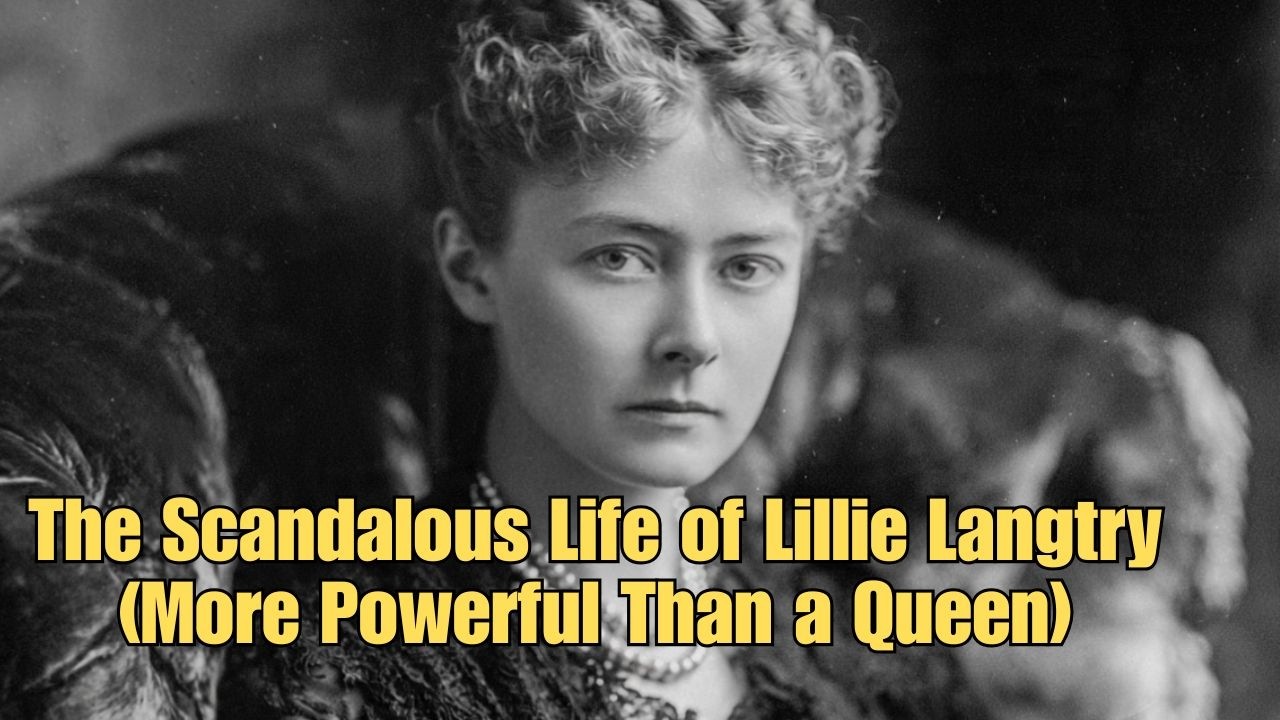
Yet when the news reached London, the newspapers gave her the same space usually reserved for royalty. She had once stopped traffic on Piccadilly simply by walking down the street. She had been the lover of a future king, the first celebrity to endorse a commercial product, and the owner of a fortune worth seventy million in today’s money. Every penny of it she had earned herself.
She was born Emily Charlotte Le Breton on 13 October 1853, in the rectory of Saint Saviour’s parish on Jersey, an island eleven miles long and five miles wide, closer to France than England, governed by its own ancient laws and surrounded by tides that could trap a traveler for hours. Her father was the Dean of Jersey; her mother a woman of modest roots and firm beliefs. She was the only girl among six brothers, and she was raised among them. She climbed trees, jumped fences, swam in cold water, and studied Latin, Greek, and mathematics alongside them.
No one thought to stop her. By fourteen the men of the island had noticed her. By sixteen she had learned that the way people looked at her was a form of power. But power without an outlet is only frustration, and Jersey offered her nothing.
The island’s social calendar revolved around church services and garden parties. Marriage was the only door, and the men who came through the rectory were too old, too poor, or too dull. She read constantly, rode recklessly, and sailed in boats her brothers considered dangerous. Every horizon reminded her that beyond the water lay a world that did not care whether her father was the dean.
In 1874 a way out sailed into the harbor. Edward Langtry was an Irish widower with a private income and a taste for sailing. He was not handsome, clever, or ambitious, but he owned an eighty-foot yacht, the Red Gauntlet, and the Red Gauntlet could take a woman anywhere. She married him on 9 March 1874.
She was twenty years old. They sailed to places she had only read about, and then they moved to London in 1876, where they discovered that society was a fortress whose gates did not open to unknown couples from Jersey. Then came the evening in the spring of 1877 when everything changed. At a reception at Lady Sebright’s home, every woman wore silk, satin, and diamonds.
Lillie arrived in a plain black dress, no jewelry, no embroidery, her hair pulled back simply. In a room full of decorated women, she was the only one who looked like a painting. Conversation stopped. A society artist asked to sketch her.
Within days his drawings were reproduced on postcards and sold in every stationer’s shop in London. John Everett Millais, the most celebrated painter of the age, asked her to sit for him. His portrait, titled A Jersey Lily, drew such crowds at the Royal Academy that a policeman had to be stationed beside it. She had become what the Victorians called a professional beauty, a phenomenon made possible by new advances in photographic reproduction and mass printing.
Her face appeared on more postcards than any other woman in England. Crowds gathered outside theaters where she was expected to appear. On at least one occasion, traffic on Piccadilly stopped because word had spread that she was walking down the street. She earned nothing from the postcards directly, but the fame they generated was its own currency.
Doors that had been closed to Mrs. Edward Langtry of Eaton Place now flew open for the Jersey Lily. Edward watched with bewilderment and began to drink. Lillie barely noticed.
Among the powerful men now desperate for her attention, one stood above all others: the Prince of Wales, heir to the throne, future King Edward VII. When the Prince wanted Lillie beside him, he simply moved her husband to the other end of the table. The dinner took place on 24 May 1877, at the home of Sir Allen Young. Within weeks, they were inseparable.
The mechanics of a royal affair in Victorian England required elaborate coordination. The Prince appeared with her at dinners, at the theater, at country house weekends, and society’s response was acceptance. More remarkably, Princess Alexandra, who had long made peace with her husband’s infidelities, received Lillie warmly and invited her to events, sending a clear message that if the Princess accepted Mrs. Langtry, Mrs.
Langtry was acceptable. In 1878 Lillie was presented at court, wearing the Prince’s own emblem, three ostrich feathers arranged in her hair. Queen Victoria, who deplored her son’s morals and could do nothing about them, received her without comment. Edward Langtry became a ghost in his own marriage, seated far from his wife at dinners, expected to be present enough to maintain the fiction of respectability and absent enough to allow the Prince his pleasures.
The affair lasted roughly three years, and then it followed the predictable arc of all royal affections. By 1880 the invitations grew less frequent, the Prince’s attention drifted elsewhere, and when he withdrew his favor, the consequences arrived with the precision of a foreclosure. The gifts stopped. The invitations dried up.
And the creditors who had extended generous terms to a woman under royal protection suddenly remembered that generosity has limits. The debts were significant. Edward was useless, his inheritance largely spent, his drinking a daily necessity. Lillie sold her possessions.
Then she discovered she was pregnant, almost certainly not by her husband. She crossed the Channel to Paris and gave birth to a daughter on 8 March 1881. The baby was named Jeanne Marie. Within weeks she was sent to Lillie’s mother in Jersey, to be raised as the daughter of one of Lillie’s brothers, a brother who had conveniently died young.
Lillie would visit as an aunt. The child would never know. It was the deepest deception of her life. In the spring of 1881, she needed money.
On 15 December 1881 she walked onto the stage of the Haymarket Theatre as Kate Hardcastle in She Stoops to Conquer, the first society woman in living memory to become a professional actress. The reaction was volcanic. Society women did not work. But the box office was excellent, and Oscar Wilde, an early admirer, encouraged her theatrical ambitions.
Then she made the decision that transformed her from a disgraced society beauty into one of the wealthiest women of her generation. She booked a passage to New York. America had been waiting for her. Her opening at Wallack’s Theater on 30 October 1882 was a phenomenon, attended by the Vanderbilts and the Astors.
The house was sold out. The receipts totaled $6,800. Sarah Bernhardt, the greatest actress of the century, had earned $5,800 on her own New York opening. Lillie had beaten her by a thousand dollars, and she could not act half as well.
The point was never the acting. Americans wanted proximity to fame, to sit in a darkened theater and watch a woman who had kissed a future king. She launched her first coast-to-coast tour and invested her earnings in Fifth Avenue real estate. Then came the endorsement that changed advertising forever.
In 1882, the managing director of Pears’ Soap asked her to lend her face and name to his product. No woman of social standing had ever endorsed a commercial product. It was considered vulgar and dangerously close to the behavior of women who sold things other than soap. Lillie said yes.
The advertisement ran millions of times, the foundational moment of modern celebrity endorsement. Every perfume advertisement and celebrity fragrance line can trace its lineage to Lillie Langtry holding a bar of soap. She earned from seven distinct streams: theatrical performances, real estate, endorsement fees, gifts from admirers, prize money from horse racing, and rental income. By 1898 her personal fortune was approximately two million pounds.
She commissioned the Das Lillie, a private Pullman railroad car sixty feet long, upholstered in velvet, decorated with brass lilies, containing a drawing room, a bedroom, and a kitchen, and traveled across America arriving at each city like a head of state. But every fortune built on the patronage of men carries a hidden cost. Squire Abington, one of several wealthy men in her orbit, was possessive, violent, and rich. He beat her in hotel rooms, and on at least one occasion struck her in the face hard enough to blacken her eye, a catastrophe for a woman whose face was her fortune.
She spent ten days hidden from public view, canceling performances, losing income. And she kept going back. Her explanation, reported by contemporaries, was a cold calculation: every time he does it, he gives me a check for five thousand pounds. A black eye healed in two weeks.
The money lasted considerably longer. In 1892 she found a new arena. The Jockey Club’s regulations assumed no woman could own a racehorse, so Lillie registered her horses under the name Mr. Jersey, with racing colors of turquoise and fawn.
The alias was transparent. Everyone in the racing world knew who Mr. Jersey was. Nobody objected, because by adopting a male pseudonym Lillie had given the Jockey Club the deniability it needed.
In 1897 her horse Merman, purchased for six hundred guineas, won the Cesarewitch at odds of 100 to 7. She had backed her horse heavily, and collected approximately 120,000 pounds, more than fifteen million in today’s money, won in a single afternoon by a rector’s daughter who was not officially permitted to own the horse that earned it. In 1900, at odds of 20 to 1, she won the Ascot Gold Cup. She was forty-six years old, and stood in the owner’s enclosure accepting congratulations from the same aristocrats who had cut her from their guest lists when the prince grew tired of her.
On 27 July 1899 she married Hugo de Bathe, a young man nineteen years her junior, heir to a baronetcy. It was a transaction. Hugo got a famous wife. Lillie got a title, eventually becoming Lady de Bathe.
They occupied separate residences for most of their marriage. It was, by her standards, a perfectly satisfactory relationship. But her daughter had been growing up in secrets. At a party, Jeanne Marie learned that the woman she called aunt was actually her mother, when someone who assumed she already knew mentioned the truth.
She made no scene. She politely left, and then began a withdrawal that lasted for the rest of her mother’s life. There was a confrontation, but the details are sparse. Jeanne Marie married a Scottish politician, had four children, lived in Scotland, and the door between mother and daughter closed with a soft, irreversible click.
Lillie never acknowledged her daughter publicly and never corrected the official version of events. The world that had made Lillie Langtry possible was disappearing. Motion pictures arrived in London in the late 1890s. By 1910, picture palaces were opening across Britain.
A beautiful woman in a theater cost a ticket. A beautiful woman on a screen cost a penny. In 1913 she made a single silent film, a gesture toward the future, but the camera could not capture the quality that had stopped traffic on Piccadilly. In person she had been a force of nature.
On film she was just a woman. The men who had shaped her life reached their ends. Edward Langtry was found demented at Crewe railway station in October 1897, committed to Chester County Asylum, and died there days later. The Prince of Wales ascended the throne as King Edward VII in 1901 and died in 1910.
Lillie continued to perform in smaller theaters and vaudeville, and the reviews began to include the word still, as in she still has presence. The Manchester Guardian captured the shift in a single sentence: a world with the movies and the wireless has more to do than mob a handsome woman. By 1920 she was sixty-six, retired from the stage, living in Monaco. In her final years she dyed her hair, danced with gigolos, and kept a room adjoining her bedroom for her dogs.
The Villa Lellis sat on the cliffs above Monte Carlo, its windows facing the Mediterranean. Hugo lived in Nice, fifteen miles away. They saw each other occasionally. She published a memoir in 1925, notable more for what it omitted than what it included.
She never confirmed her affair with the prince, never acknowledged her daughter, never discussed the men who had beaten her. In her will, ten thousand pounds went to her paid companion. Nothing went to Jeanne Marie. She died at dawn on 12 February 1929, aged seventy-five.
Snow and blizzards swept across the Channel, and her coffin crossed to Jersey aboard the steamer Sambrieux in violent seas. Saint Saviour’s Church, where her father had preached and where she had been christened, was prepared for the funeral. Flowers arrived from London, Paris, and New York. Hugo was present.
Jeanne Marie was not. Among the mourners was an aged man who attracted little attention, the former captain of the yacht Red Gauntlet, the yacht that had brought Edward Langtry to Jersey more than fifty years before. He walked slowly, leaning on a stick, and carried a bouquet of red Jersey lilies, the flower that grows wild on the island she had spent her life leaving and to which she now returned for the last time. He placed the flowers on her grave.
She was buried in her parents’ tomb in the churchyard of St. Saviour’s, on the island that measured eleven miles by five. A contemporary once said it would be hell to be married to her because she was too damn bright. He was right about the brightness.
He was wrong about the hell. The hell was not being married to Lillie Langtry. The hell was being Lillie Langtry, and knowing that the very qualities that made you extraordinary were the same qualities that guaranteed you would end up at last alone. She had outrun every boundary drawn around her.
Every boundary except the last.
