The shaft opens in the middle of an ordinary clearing, a dark mouth tilted into the hillside at a slant, framed by a railing. Families walk past it on weekend afternoons without stopping, because nothing on the surface suggests what lies beneath. The hillside is hollow. California State Parks counts 367 miles of passages in the workings under that gravel path, and by 1956 the deepest of them plunged 117 feet further down than two miles straight.
The gold that came out of that ground, between 5. 6 and 5. 8 million ounces depending on the source, would fit inside a cube seven feet on each side. The tunnels are flooded now.
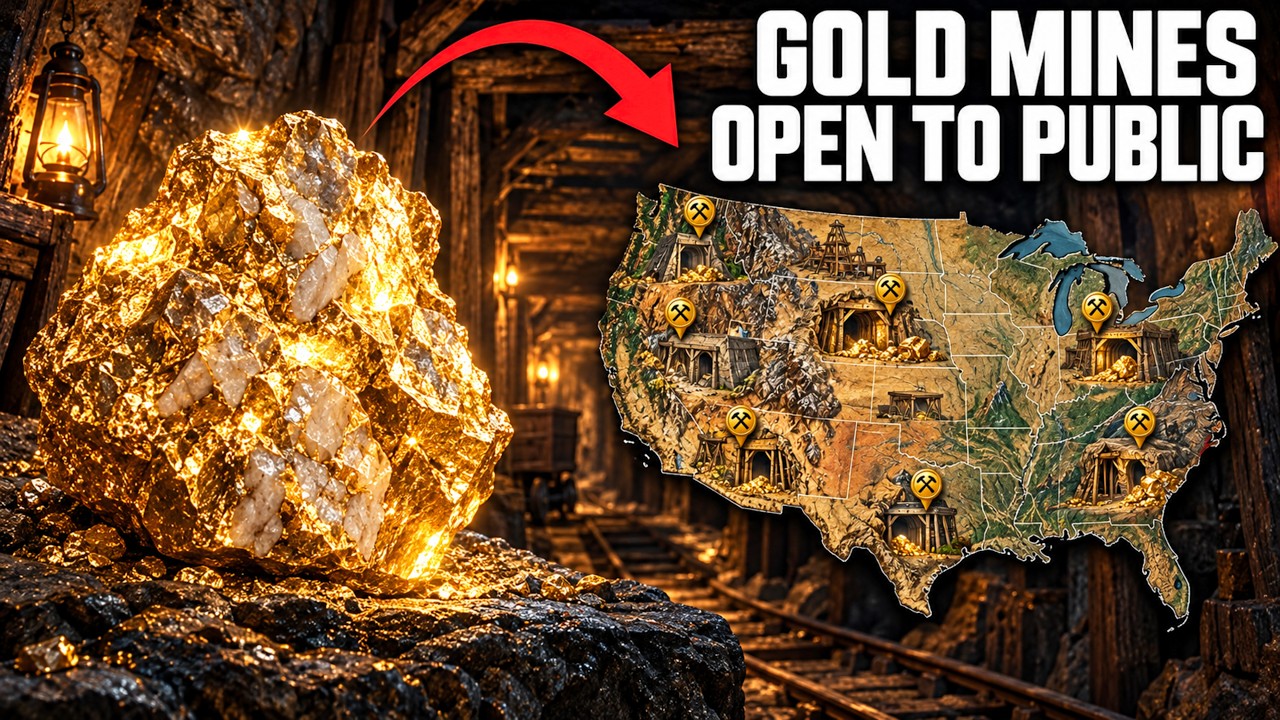
The clearing is the Empire Mine in Grass Valley, California, and it is the first of seven places that all share the same strange second life. All seven were working gold mines. All seven shut down between 1906 and 2002. And all seven now let ordinary people through the gate.
What open means changes from one site to the next. At three of them, you can walk into restored tunnels. At one, you step a short distance into a famous tunnel. At the remaining three, you stand at the rim of a shaft, a pit, or a ghost town, and look.
None is an unmarked hole in the hills. Each has staff, rules, and in most cases a ticket, because a mine that is abandoned is not the same as a mine that is safe. Most people picture California in 1848 when they think of American gold. But the famous rush was not the first.
A twelve-year-old found a seventeen-pound nugget in North Carolina in 1799, and Georgia’s rush began in 1829, about two decades ahead of California’s. The places in this story belong to that older, deeper chapter, where the gold had to be chased through solid rock and where the tunnels still exist to be walked. Start in North Carolina. On a Sunday in 1799, a twelve-year-old named Conrad Reed skipped church to go fishing in Little Meadow Creek, which ran through his family’s farm in Cabarrus County.
In the water he spotted something yellow and heavy, a rock that weighed seventeen pounds, and he carried it home. His father, John Reed, a farmer and former Hessian soldier who had Americanized his name, could not say what it was. A silversmith in Concord could not say either. So the rock became a doorstop, and it held doors open for about three years.
In 1802, on a selling trip to Fayetteville, John Reed showed it to a jeweler who recognized gold on sight, asked Reed to name a price, and bought it for $3. 50, about a week’s wages. Researchers estimate that nugget was worth around $3,600 at the time. Reed learned the truth the hard way.
About 1803, he organized a small mining operation with several local men. Soon afterward, a man named Peter, who was enslaved on the property, pulled a twenty-eight-pound nugget out of the creek. For years the work stayed in the creek gravel. By 1831 it had gone underground.
At its peak, gold mining was second only to farming in the number of North Carolinians it employed, and the state led the nation in gold production until 1848. The last underground mining at Reed’s Mine happened in 1912. By one estimate, the property yielded about $10 million in gold before 1853, making it the first commercially successful gold mine in the United States. It was designated a National Historic Landmark in 1966 and became a state historic site in 1971.
A restored ten-stamp mill still stands on the grounds, a battery of heavy hammers that crush ore the way a pestle crushes grain. Today it sits at 9621 Reed Mine Road in Midland, open Tuesday through Saturday with no general admission fee. The underground mine opens only on a guided tour, five dollars for adults, through restored tunnels that date to the 1830s. Staff teach panning at waist-high wooden troughs from April through October, using gravel the site supplies.
Next, Georgia, and a rush that cost far more than money. On August 1st, 1829, the Georgia Journal ran a notice about gold in the north of the state, and within months thousands of prospectors had crowded into Cherokee territory around what is now Dahlonega. The town’s name comes from a Cherokee word for yellow or golden. Georgia distributed Cherokee land through lotteries.
The US Supreme Court ruled that Georgia’s encroachment on Cherokee sovereignty was illegal. And in 1838, the state expelled the Cherokee from their ancestral lands, with the discovery of gold counted among the major reasons. That same year, a federal branch mint opened in Dahlonega. By the time it closed in 1861, it had struck almost 1.
5 million gold coins with a face value above $6 million. Surface gold played out. By the 1840s the easiest gold was gone, and many Georgia miners left for California. What remained was locked in rock.
In 1895, Northern investors bought about 7,000 acres around the discovery site and formed the Dahlonega Consolidated Gold Mining Company. It built the largest gold processing plant east of the Mississippi, a four-story mill with 120 stamps, heavy hammers that pound rock to powder like a mortar and pestle the size of a building. Its prize was a quartz vein twenty-two feet thick, called the Glory Hole. In 1906, like most plants of that boom, the company folded at a great loss to its investors, and the tunnels sat abandoned for roughly seventy-five years before a coal-mining family from Kentucky bought the property.
It was one of roughly 100 mines built near Dahlonega in the latter half of the nineteenth century. One travel account says the company dynamited the entrance shut when the price of gold fell, leaving its tools where they lay. Today, at 185 Consolidated Gold Mine Road, a forty-minute guided tour takes you down three flights of stairs and two ramps to about 200 feet underground, where the air holds near sixty degrees all year. Some guides are former miners.
Gold panning is included, and the mine is open seven days a week. The lower levels are flooded, so what you see are the upper workings of a mine listed on the National Register of Historic Places. Now west, to the northern Black Hills of South Dakota, to the town of Lead, pronounced Leed. In 1876, the brothers Fred and Moses Manuel, prospectors, found a promising vein near the spot where the open cut now yawns.
The next year, George Hearst, a businessman and politician and the father of William Randolph Hearst, bought their claim and expanded it past 8,000 acres. What grew out of it was Homestake. Over roughly 126 years, it dug an underground mine 8,000 feet deep, a surface pit about 1,000 feet deep, and more than 370 miles of shafts, drifts, and ramps. It produced close to 40 million ounces of gold, between 39.
6 and 41 million depending on the source. At early October prices near $4,000 an ounce, that is more than $160 billion in metal. When it stopped in January 2002, it was the deepest gold mine in the Western Hemisphere. Then the mine did something unusual.
It kept being useful. In the mid-1960s, Raymond Davis Jr. , a scientist, built a detector deep inside it to count particles called neutrinos streaming from the sun. He consistently counted only about a third of the number theory predicted.
The puzzle was not resolved until 2002, the year his work earned a Nobel Prize in physics. The mine itself was allowed to flood after its pumps were shut off in 2003. In 2006, Barrick Gold, the owner, donated the property to the state of South Dakota. With a $70 million gift from T.
Denny Sanford, it became the Sanford Underground Research Facility, the deepest underground laboratory in the United States. What you can visit is the Sanford Lab Homestake Visitor Center at 160 Main Street in Lead. Admission is free, and a deck looks out over the open cut. It opens 9 to 5 daily from May through September and 9 to 4 Monday through Saturday the rest of the year.
Fee-based tours last about an hour and include the Yates hoist room, where hoists that have run since 1939 lower people on more than 5,000 feet of rope. The lab itself is not open for general underground tours. Put the seven on one scale and the spread is enormous. Homestake produced roughly 40 million ounces.
Empire produced between 5. 6 and 5. 8 million, so Homestake alone is about seven times larger. Vulture produced 340,000 ounces of gold, which means Homestake is more than a hundred times its size.
Reed’s estimated $10 million was a fortune in the early 1800s when gold was a fraction of its present price. These are not equals, and nobody should pretend they are. What they share is not size. It is that each one is a real working mine now readable by anyone who buys a ticket.
Colorado comes next, and there the enemy was water. Gold was struck in what is now Idaho Springs soon after 1859, and at least 100 hard-rock mines were worked in the little more than four miles between Idaho Springs and Central City. Their shafts kept flooding. So in September 1893, crews began cutting the Argo Tunnel from Idaho Springs, angled upward at one-half percent so that water would drain out of the entrance without pumps.
The work took seventeen years. In November 1910, the tunnel reached its final length of 4. 16 miles, 6. 69 kilometers, and it crossed nearly every major mine along the way.
Ore rode rails to the five-story Argo Mill, completed in 1913, where each mine had its own storage bin. On January 19th, 1943, four miners working in the tunnel blasted into an old shaft full of water that had never drained. The wave burst out of the entrance and drowned all four. The mine and tunnel never operated again.
The mill was placed on the National Register of Historic Places in 1977 and opened for tours in 1978. At 2350 Riverside Drive, a guided tour walks you through the mill and a short distance into the tunnel, anywhere from about forty feet to sixty yards, a sliver of the 4. 16 miles. Panning is included, and tours leave on the hour.
The tunnel’s second life is less romantic. It still drains acidic water with a pH between 2 and 3 before treatment, and in May 1980 a surge turned Clear Creek orange. The Environmental Protection Agency listed it in 1983 as part of the Central City/Clear Creek Superfund site, and a treatment plant began operating in 1998. Colorado’s health department calls the tunnel the largest single source of metals contamination to Clear Creek, whose watershed affects more than a quarter million people near Denver.
At the Argo, the heritage site and the cleanup site share an address. That leaves the question underneath every tunnel on this list. Why is there gold here at all? For the vein deposits like those at Grass Valley, the US Geological Survey has pieced together a detailed answer, and it unfolds in order.
It begins with a fluid. Deep in the crust, where colliding landmasses have squeezed and heated rock, minerals that hold water in their crystals break down and let it go. Picture wringing out a wet sponge, except the sponge is stone at roughly 300 degrees Celsius, and the water that comes out carries carbon dioxide and traces of dissolved metal. USGS studies of gold veins across the North American Cordillera trace this fluid to deep metamorphic reactions and rule out magma and surface water as the main supply.
Next comes the plumbing. The fluid does not seep evenly. It climbs along faults that cut deep through the crust, the way water finds the one crack in a wall. Then comes the pressure cycle.
Inside those faults, fluid pressure can climb high enough to prop the rock apart, and quartz crystals grow into the open cracks, a little like the crystals lining a geode. Later the pressure drops. At Grass Valley, USGS researchers found that early quartz formed while pressure swung up and down, and that the bulk of the gold arrived late, once the system had settled to lower pressure. The gold sits along grain boundaries and fractures in the quartz, never wrapped inside it.
The quartz came first as a skeleton, and the gold moved in afterward. Finally comes the chemical window. As the fluid touches the surrounding rock, it reacts. Sulfide minerals, pyrite and arsenopyrite, crystallize, and gold drops out of solution along with them.
The USGS calls this wall-rock sulfidation. The fluid changes character and can no longer hold its metal. Then comes the long wait. Uplift and erosion strip away the rock above, and the veins surface.
Weathering frees gold from quartz and carries it into creeks, which is how a boy found a nugget in Little Meadow Creek and how Georgia’s first miners could work gravel with pans. The Grass Valley District, the USGS notes, is the largest historical gold producer in the North American Cordillera. Homestake plays by a different rule book. Its gold sits in a layer of iron-rich rock, the Homestake Formation, roughly 1.
9 to 2. 0 billion years old, folded and squeezed until the ore collected in the troughs of the folds, like water pooling in the dips of a crumpled rug. Most of the ore came from those trough hinges. Geologists still argue over where the gold came from, an outside fluid or the rock itself.
A 2016 study in Economic Geology suggested that a significant share may have been drawn from black shale beneath the host layer. It is the largest deposit of its kind in the world. Arizona turns the story toward a man who did not get rich. In 1863, Henry Wickenburg, a prospector who had come from the California Gold Rush, found a quartz outcrop in the Vulture Mountains and began mining it himself.
By 1942, the Vulture Mine had produced 360,000 ounces of gold and 260,000 ounces of silver, about $1. 4 billion in gold alone at today’s prices. A town of up to 5,000 people had grown beside it. Wickenburg never shared in the wealth.
By one account, he sold the mine in 1866 for $85,000 and was cheated out of all but $20,000 after the buyers questioned his title. He died in 1905. Feeding the town helped revive old irrigation canals in the Phoenix Valley, and one history credits the mine with giving rise to the farming economy that Phoenix grew from. Legend says an ironwood tree beside his cabin served as a hanging tree for eighteen men accused of stealing ore, though one historian notes there is no record that any such hangings took place.
In 1942, the wartime government shut down non-essential gold mining, and after a brief reopening, the Vulture closed for good. The site today is Vulture City Ghost Town, privately owned and open seasonally from October through May, 9 to 4, closed Wednesdays, at 36610 North 355th Avenue near Wickenburg. More than eighteen restored buildings stand there, including the assay office built in 1884 and Wickenburg’s own cabin, along with the headframe. Most of the old shafts have caved in, so this is a place to walk the town above the mine, not to go down into it.
California offers two very different visits, and the first is the smallest. Placerville, once called Hangtown, owns Gold Bug Park, and by its tourism board’s account it is the only municipality in California that owns a gold mine. The nearby Priest Mine dates to 1849. The Hattie Mine opened in 1888, named for Hattie Ricks.
In 1928 it was renamed the Gold Bug, and in 1939 it closed. White quartz veins cut through the local slate and sandstone, and the gold rides in the quartz. Today you can walk a 352-foot horizontal tunnel called a drift by yourself, wearing a hard hat and listening to an audio tour on your phone. The floor is wooden and the tunnel is lit.
Admission runs about $12 for adults, according to the county tourism board, and includes the Hendy Stamp Mill. The mine opens daily from April through October, 10 to 4, and on weekends the rest of the year. The park’s 61 acres are free to enter, and they hold a stamp mill, a blacksmith shop, a small museum, gem panning, and two miles of hiking trails. Above the Gold Bug sits the older Priest Mine with a dirt floor, open only for guided tours booked in advance on weekdays.
And that brings the story back to the clearing, the railing, the opening that slopes into the dark. Empire opened in 1850. William Bourn Jr. owned it from 1879 to 1929, and his younger cousin George Starr is tied to the mine’s reputation for technology, while Cornish miners did the work underground.
A cyanide plant arrived in 1910. Newmont Mining bought the mine in 1929, and it closed in 1956. California State Parks bought the surface in 1974 for $1. 25 million, but Newmont kept the mineral rights beneath it and 47 acres, in case it ever chooses to reopen.
The park was meant to offer more. For more than two decades, supporters planned an underground tour. California spent $3. 5 million on a visitor center, battery-powered mine trains, and a new tunnel.
Then, after a 2012 inspection by the state fire marshal, parks officials concluded that as many as one-third of the beams supporting the tunnel might be weakened by corrosion. Repairs would cost $1. 4 million or more, with upkeep on top, in a park system facing a $1 billion maintenance shortfall. Larry Skinner, president of the Empire Mine Parks Association, called the decision an enormous loss to the community and to taxpayers, and supporters questioned the safety findings.
Parks officials said they would spend no more. So at Empire, you see the mine yard, the machine shop, and the shaft viewing area. In the visitor center is the secret room, a scale model of five square miles of workings that for almost 100 years only the owners and the board knew about. State Parks says that when visitors look down the real shaft, they have followed about one inch of the model.
The park draws roughly 110,000 visitors a year and spans more than 800 acres with miles of trails for hikers, bikers, and riders, and dogs are welcome on leash outside the mine shafts. One more mine belongs in this conversation, even though it is not among the seven. The Mollie Kathleen Gold Mine near Cripple Creek, Colorado, closed as a working mine in the 1960s, and its owners kept running tours, taking visitors down a vertical shaft in a hoist elevator. On October 10th, 2024, an equipment malfunction killed Patrick Weir, a 46-year-old tour guide, and 23 people were rescued, one group stranded underground for about six hours.
State regulators ordered tours halted during the investigation. In 2025, the Teller County Sheriff’s Office announced the case was closed as an accidental death, and state inspectors found the mine met the regulations for tourist mines. Tours resumed for the 2025 season. Whatever else is true of that day, it is a reminder of why caution shapes what a place like these can offer.
Look across the seven and the same obstacle repeats: water and cost. Consolidated’s lower levels are flooded. Empire’s passages are flooded, and while the mine ran they were pumped continually. Homestake flooded after its pumps stopped, and the lab still dewaters the mine and treats the water.
Argo drains acid. A history site on Consolidated notes that gold remains on the property, but that reaching it costs more than it is worth. In several of these mines, the arithmetic of price against cost stopped working, and the water that flooded the lowest rooms is part of what turned working mines into places you can visit. If you go, a few practical facts will save a wasted trip.
Schedules change, so confirm hours before you drive, especially at Vulture City, whose season runs only from October through May. Wear closed-toed shoes at Consolidated, where the air stays near sixty degrees and the walk down is three flights of stairs and two ramps, and strollers are not allowed. At the Argo, dress in layers as if for a hike, and children under forty inches tall must be held or carried through the tunnel. Reed’s panning season is April through October and stops in heavy rain or lightning.
What comes next is mostly quiet. Reed tried Sunday hours as part of a state pilot that ran from June 14th to August 2nd. Vulture City reopens each October. At Lead, the experiments continue miles below the visitor deck.
At Argo, the treatment plant keeps running. And beneath Empire, the mineral rights sit with Newmont. Every tunnel in this story is underneath a record of water. Hot fluid once climbed through cracked rock, cooled, reacted with its walls, and left a thread of metal behind, and then people spent a century and a half following that thread into the dark.
The mines are silent now, and the water that made them is already reclaiming the lowest rooms. A gold mine seen that way is a fossil of plumbing, the shape of a flow that stopped long ago, preserved in stone for anyone patient enough to walk inside.
