The night watchman at the Crescent Hotel had worked there for nine years, and by then the building no longer frightened him. That was the first thing he said to the young assistant manager who approached him with a notebook, asking what the older employees had witnessed. You couldn’t work nights in a place like that and remain afraid of it, the watchman said. You either grew accustomed to it or you went looking for other work.
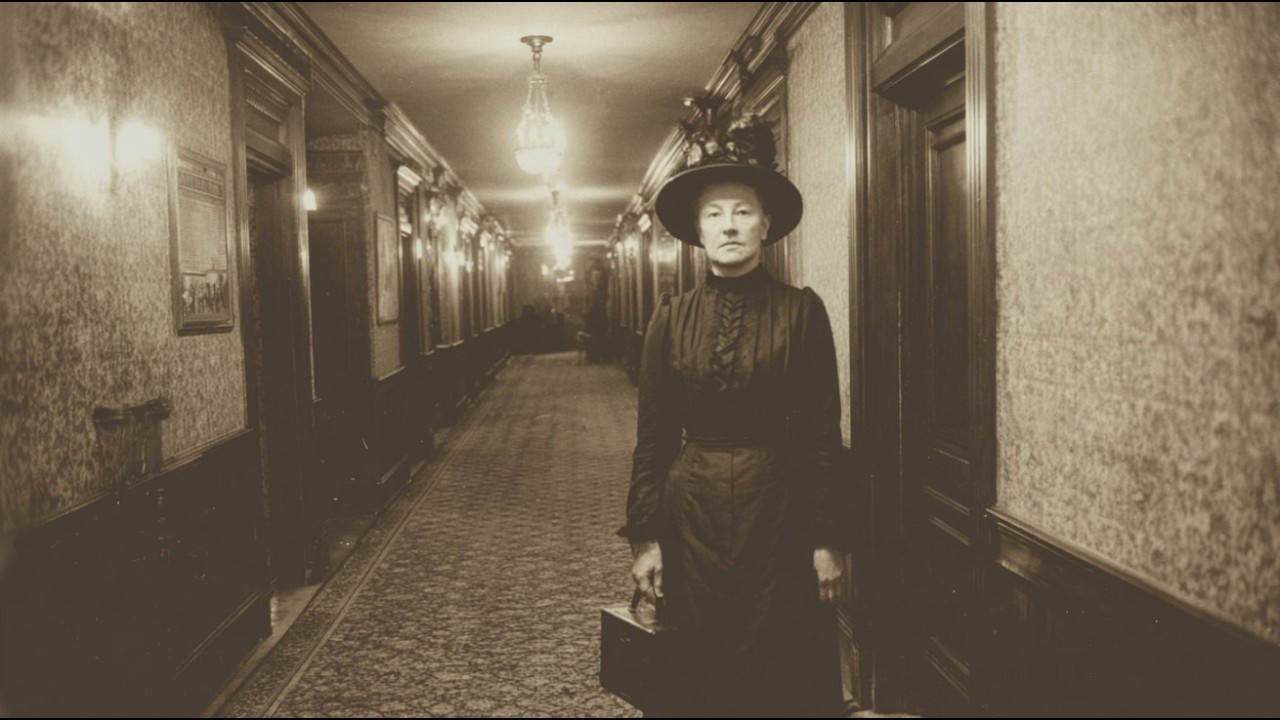
His name was Tuckerman Olcott Brace. He was sixty-one when he joined the hotel, after twenty-eight years on the railroad, and every night since he had carried a thermos of coffee on his rounds. His wife painted china. They lived in a small house in town.
He was not a man inclined toward fancies. But he told the assistant manager that the most constant presence in the building was the lady with the doctor’s case. She came up the stairs from the lobby perhaps once a week. She walked the fourth floor first, and then the fifth.
She never came up to the sixth or the seventh. She didn’t disturb him, and he didn’t disturb her. One night, he said, he wished her good evening the way he would any guest. She tilted her head and replied, “Good evening, Mr.
Brace.” She had used his name. He stood in the corridor for a while after she passed. It was the only time in nine years that he was truly afraid.
He told the young man that the building contained something, something that wasn’t a ghost, or perhaps it was. He didn’t know the difference. He had been in a derailment during his railroad years, the only man in his car to walk out, and he had stood by the wreck for hours afterward waiting for the doctor to arrive. The doctor had been delayed.
By the time he got there, the people Brace had been sitting with were beyond help. He sometimes thought about that doctor, about how long he took to come. The lady in the hotel, the one with the case, was a person who had been on her way somewhere and had never quite arrived. He didn’t believe she was angry.
He didn’t believe she was lost. He believed she was working. The building had given her something to do. That conversation was the last interview Tuckerman Brace ever gave.
He died of a heart attack in his own kitchen about three months later, in the spring of 1960. The young assistant manager wrote his article, but none of the ghost stories made it in. He wrote about the architecture, the limestone, the springs. His editor had cut all the rest.
The hotel didn’t want that kind of attention. The past should stay in the past. The article ran in the summer issue, and the hotel sold copies of it in the lobby. To understand what the night watchman was talking about, you have to go back to the beginning, to a building that was never meant to hold what eventually moved into it.
The men who poured its foundation believed they were laying the cornerstone of a grand mountain resort. White limestone was hauled by mule from a quarry less than a mile away. Eight stories of native stone rose out of the Ozarks like a cathedral that had wandered too far from any city to remember why it had come. They called it the Crescent.
The grand opening was set for the twentieth of May, 1886. The newspapers in Little Rock called it the most luxurious hotel built west of the Mississippi. The owners called it a temple to health and refinement. The people who worked there after a year or two started calling it other things.
The Crescent sat on a ridge above the town of Eureka Springs, Arkansas. The town itself was a strange one, built around mineral springs that local people had used long before any surveyor came through with chains and compasses. The water was supposed to cure things: rheumatism, skin complaints, whatever was wrong with you. By 1886 the town had grown around that promise.
Boarding houses, bathhouses, a new opera house, every kind of small business that could survive on the steady traffic of the unwell and the curious. The hotel was the crown of all of it. Two hundred guest rooms. Steam heat.
Hydraulic elevators. A ballroom on the top floor with a hand-painted ceiling. A staff of more than a hundred. The first guests arrived in carriages from the railway station at the bottom of the hill, and the orchestra played in the lobby until midnight.
For about three years, it was everything the brochures had promised. Then it wasn’t. The man at the center of what happened there was named Wilcom Henshaw Pettigrew. He was forty-four years old, hired in the autumn of 1888 as the night porter.
The position meant he sat at a small mahogany desk near the service stairs from ten in the evening until six in the morning, dealing with anything that needed dealing with: a guest who had lost a key, a guest who had had too much wine and couldn’t find their floor, a faucet running in an empty room, a complaint about footsteps. Pettigrew was a heavy man, tall in the shoulders, with a long, sad face and hands that had spent thirty years doing manual labor before he traded them for a porter’s coat. He had been a teamster, then a foreman at a sawmill in Missouri. After an accident with a chain left his left leg shorter than his right, he had come south looking for indoor work.
The hotel hired him because he didn’t mind the night shift and didn’t drink. Both were rarer qualifications than you’d think. For the first month, Pettigrew thought the job was a small piece of heaven. Warm in winter.
Quiet most of the time. The kind of work where you sat with a newspaper and a pot of coffee and let the building hold itself up. The first thing that struck him as strange was the elevator. There were two elevators in the hotel, both hydraulic, with brass cages and lacquered wood interiors.
At night, after the last guests had gone up to their rooms, they were supposed to sit at the lobby floor, doors open, lamps low. That was the rule. In Pettigrew’s third week, around two in the morning, he heard the hum of the south elevator starting up. He looked.
The doors were closing on an empty cage. The needle on the floor indicator above the door began to climb. Second floor. Third.
Fourth. It stopped on the fifth. He sat very still and listened. After about a minute, the cage came back down on its own.
The doors opened. There was no one inside. He wrote it in the night log the way he was supposed to. The morning manager, a Mr.
Oberon Crisp examined the note, exhaled heavily, and rubbed it out with a pencil. “Leave that out of the book,” Crisp told him. “This is an old building. Old buildings shift, cables give a little.
Now and then the cage travels by itself.”
“It climbed five floors, sir.”
“Then it climbed five floors. Don’t put it in writing.
“
Pettigrew had once been a foreman, and he understood what a man means when he says a thing must not be written down, so he left it out of the book. Three more times that month the elevator did the same, always somewhere between two and three in the morning, always to the fifth floor. He quit recording it. He began keeping watch for it.
One night late in October, he was watching when the south elevator started to rise. He put down his coffee, crossed the marble floor with his bad leg, and climbed the service stairs after it. He had reached the fifth floor when the car came to a stop. He waited at the far end of the long hallway and watched the doors part.
A woman stood inside the elevator. She was elderly. She wore a high-collared dress of a style that had gone out of fashion twenty years before. Her hair was pinned up beneath a small dark hat.
She paid him no attention. She came out of the car, turned to her right, and walked the whole length of the corridor, away from him. She did not limp. She did not rush.
She moved the way a woman moves who has made that walk a thousand times. Somewhere near the middle of the corridor she turned and entered a room. He could not tell which. The corridor was poorly lit, the gas lamps turned down for the night.
He followed her. His leg ached on the carpet. When he came to the spot where she had turned, he stopped and looked at the door of room 518. It was shut.
No light showed beneath it. He knocked. He waited. He knocked once more.
Then he took out his master key, as he was meant to do in an emergency, and unlocked the door. The room was empty. The bed was turned down and made. The curtains were closed.
The air was bitterly cold, the way a room goes cold when nobody has slept in it for a long while. Nothing suggested that any woman had entered the room for any purpose whatever. He stood in the doorway and felt something he had not felt since he was a young man in a logging camp, the year fire took the bunkhouse and four of his friends along with it. It was the sensation of being gripped by something, of being observed.
He locked the door after himself. He returned downstairs. None of it went into the log. The second strange matter started in the kitchen, a place Pettigrew normally had no reason to enter.
The hotel kept a basement kitchen the size of a small armory, all copper and iron and tile, and at night it was meant to stand empty. The cooks were finished by midnight. The dishwashers were through by one. By two o’clock the kitchen ought to have been silent.
One night in November, a maid called Loveday Quint came up the service stairs in tears. She was a young woman of about twenty-two, slender and dark-haired, with the sort of pale complexion that betrayed every emotion. She had been carrying a pail of cold tea to the second-floor pantry and had paused at the kitchen door because she heard a man singing. A low voice, she said, a man’s voice, singing in a tongue she did not recognize.
Not French, not German. She had grown up in a town full of both. This was something older. She nudged the kitchen door open with her foot because both hands were occupied.
The kitchen was dark apart from the watchman’s lamp at the far end. The singing ceased the instant the door swung open. She remained there long enough to see that the lamp at the far end hung on its hook, and no one stood within twenty feet of it. Then she heard the singing once more, this time behind her, from the corridor she had just come through.
She let the bucket fall and fled. Pettigrew came upon her at the top of the service stairs, trembling. He seated her, brewed her a strong cup of tea from the porter’s pot, and listened. He believed what she told him.
He had been waiting for someone else to notice these things, and now someone had. The following morning he asked the head cook, a Norwegian woman named Sigrun Halvorsen, whether anyone had ever sung in the kitchen at night. She studied him for a long moment. She was a tall woman in her fifties, wide across the shoulders, with hands cracked brown from a lifetime of hot water and lye.
“You have heard him,” she said. “No, ma’am. One of the maids. Loveday.”
“
Sigrun Halvorsen drew a long breath and released it. She set down the knife in her hand. “There is a man who sings in the kitchen at times. He was here before I came.
He will be here after I go.”
“What does he sing?”
“I don’t know. I have stopped listening.”
“
She took up her knife again. As far as she was concerned, the conversation had ended. By the spring of 1889, Pettigrew had reached a quiet understanding with several members of the staff: with Loveday Quint, the maid; with Sigrun Halvorsen, the cook; with a porter named Easton Bramwell who worked the day shift; and a laundress named Verity Spurlock who came in three times a week. None of them spoke of what went on in the hotel.
None of them wrote it down. But when one of them caught another’s eye in a corridor or over a pile of folded linens, they understood one another. The hotel held something within it. What it was, they did not know.
Without ever putting it into words, they had agreed to keep it to themselves. Guests arrived and departed. A few of them complained. The complaints were always vague.
A guest from Memphis said her water glass had slid across the nightstand while she watched it. A guest from St. Louis said the man in the adjoining room had quarreled with a woman all night, though the room beside his had stood empty and locked. A guest from Galveston said she had woken to find the bedclothes drawn down to the foot of the bed, neatly folded, with her own hands resting on top of them.
A guest who had served as a Confederate cavalry officer, now in his seventies, said he had seen a man in the corner of his room with no face at all, only a shape where a face should have been. He had laughed at the figure and gone back to sleep, because he had witnessed worse at Shiloh. Mr. Oberon Crisp settled every one of these complaints with brandy and reduced bills.
He never brought it up with the owners. He had a boy in college and a wife with a taste for fine furniture, and he wasn’t the kind of man to risk his living over things he couldn’t see. The first time Pettigrew got a clear enough look at the woman from the elevator to remember her face was the night of February eighteenth, 1890. A heavy snow had fallen that day, the sort that heaps itself against the second-floor windows of a building set into a hillside, and by the time his shift began, the hotel was nearly empty.
Twelve guests on the second floor, four on the third, a small gathering of railroad investors on the sixth. Every other room stood dark. He was at the desk a little past one in the morning when the south elevator started up. This time, rather than waiting for it to return or trailing it upward, he walked over and planted himself in front of the doors as they parted on the lobby level.
She was inside. She met his eyes. A woman of perhaps fifty. Her hair was iron gray, pinned up beneath that same little dark hat.
Her face was lean, with sharp cheekbones, a long mouth, and very large pale eyes that never blinked the whole time he held her gaze. In her right hand she carried a small leather case, the sort a doctor might use. She said nothing. He removed his porter’s cap.
He couldn’t have said why; he simply did it. “Ma’am,” he said. She tipped her head the smallest degree. It was the way a woman acknowledges a porter, a gesture he had received a thousand times over.
It was so utterly ordinary and so wholly wrong that he had nothing to say to it. She walked past him. She did not walk through him. She went around him the way any woman would step around a man standing in her path.
She made her way across the lobby to the main staircase, gripped the banister, and climbed. This time he went after her, following all the way to the fifth floor. She appeared not to object. He kept two or three paces back, the way a porter trails behind with the luggage.
She walked the corridor he already knew by heart. At the door of room 518 she halted. She turned and looked at him. “He’ll be here soon,” she said.
Her voice was low and dry, like a woman speaking through wool. “Who, ma’am?”
She gave a very faint smile. It was the smile of patience, of someone who has fielded the same question many times and is willing to field it once more.
“The doctor.”
Then she opened the door of room 518, passed through it without touching the handle, and was gone. He stood in the corridor a long while. The door was shut.
The hallway was bitterly cold. After a time, he went back down to his desk. When the morning manager arrived, Pettigrew said nothing to him. But the following afternoon, on his way home, he stopped at the library in the railway station and asked the station master’s wife, who kept the lending books, whether the hotel had been something else before it was a hotel.
She told him it had been a hotel since the day it opened, always. And before that? Before that, it was a ridge. Nothing on it but trees.
She paused. There was a sanatorium that was supposed to go up here years ago. Before the hotel, the land had been bought for it. There were plans.
Money was raised. Then the railway came through, and the investors decided a hotel would turn more profit. The sanatorium plans were sold off to a man in Hot Springs. What kind of sanatorium?
She considered it. The kind for women, I believe. For women’s nerves. I don’t rightly remember.
My mother might know. She’s the one who told me. Pettigrew went home that day and sat at his small kitchen table for a long while. He was a widower, and had been for close to ten years.
His wife had died in the same accident that had shortened his left leg, and he had never quite gotten over either loss. He thought about a woman with a doctor’s case stepping out of an elevator in a hotel that had once been planned as a sanatorium for women’s nerves. He thought about what it meant that the plans had been sold but the land had been built on regardless. He thought about Loveday Quint, who was twenty-two years old and had been crying when he handed her a cup of tea.
He thought about whether buildings remember what they were almost made into. He had no answers for any of it. He went back to work that night. He kept watching.
There is no single great event that happened in 1890. No fire, no murder, no newspaper article. The hotel went on being a hotel. The guests came and went.
The strange things happened more or less the way they always had. The woman with the doctor’s case rode the elevator up. The man in the kitchen sang his song. Now and then a guest would come downstairs at three in the morning saying she couldn’t stay in her room, and Mr.
Oberon Crisp would move her to a different one and offer her brandy. This went on for years. The Crescent passed through a slow decline that nobody outside the building noticed for a long time. The railway investors stopped coming.
The wealthy from Memphis and New Orleans found newer places to spend their summers. By the late 1890s, the hotel was operating as a women’s college part of the year and a summer resort the rest. By 1910 it had been sold twice and was struggling at either function. In 1911, it became something else.
A man named Cassius Valoren Trumbo bought the building, the grounds, and the right to use the springs. He was a heavy man in his sixties with a white mustache that hung to his collar. He had made his money in patent medicines in Kansas City. He was not a doctor.
He had never been a doctor. But he had read enough medical books, he said, to know more than most of them. He believed he had a cure for cancer. He renamed the Crescent the Baker Cancer Hospital.
He placed advertisements in newspapers across eight states. He filled the rooms with patients who came to him with diseases other doctors had given up on. Because of what was done in that building during the Trumbo years, the records that survived were sealed for decades. What people remember of it now, they remember through what the staff told their grandchildren.
When the papers at last caught up with what had gone on there, they reached for words like “fraudulent” and “unfit.” When the federal authorities finally descended on the place, they hauled crates of records off in wagons. Most of those records were later destroyed on account of what they contained. One nurse who worked at the Baker Cancer Hospital in its first year was a woman by the name of Idalene Chesterfield Pruitt.
She was thirty-one, and she had trained at a proper hospital in St. Louis. She had taken the position because her father, who lived in Berryville, was dying of consumption and she wanted to be near him. She had been told the hospital was a real one, and for the first three weeks she had believed it.
At some point in the autumn of 1911 she wrote a letter to her sister in Indiana. That letter survived, and it is one of the few first-hand documents from inside the place that has come down to us. In it she wrote that she had started to dream about the building, not the way an exhausted nurse dreams of her ward, but in another way altogether. It was as though the building knew her.
On her night shifts she had grown aware of being followed from floor to floor by something that was neither a patient nor a colleague. Now and then the elevator went up on its own, to the fifth floor. One of the older orderlies had told her not to trouble herself over it. He had been there since the Crescent days.
“There is a lady who rides up to the fifth floor. She has been doing it as long as anyone has worked here. She doesn’t trouble anyone. Don’t trouble her.
“
Idalene Pruitt wrote that one night in October, a little past two in the morning, as she sat at the nurse’s desk on the fourth floor, a woman in a high-necked dress and a small dark hat came up the stairs from the lobby. She carried a doctor’s case in her right hand. The woman walked the whole length of the corridor to where Idalene sat. She set the case down on the desk.
She opened it. Inside lay a stethoscope, a small bottle of something dark, and several instruments Idalene did not recognize. They were not modern. They belonged to no hospital catalog she had ever laid eyes on.
The woman looked at Idalene and said, in the same low voice Pettigrew had heard twenty years earlier, “There is nothing in this building that helps them.”
Then she picked up her case, walked back down the corridor, and descended the stairs. Idalene did not move from her chair for the rest of the shift. When the morning nurse came on, she went straight to Cassius Trumbo’s office and gave her notice.
He laughed at her. He told her she would be replaced by the end of the week. He told her that hysterical women were not welcome at the Baker Cancer Hospital. She walked out of the building with whatever she could carry.
She never went back. The letter closed with a sentence that has stayed with everyone who has read a copy of it. She wrote: “I do not know whether the lady on the stairs was a ghost, but I know that she was there before that man, and she will be there after him, and she was telling the truth.”
The Baker Cancer Hospital ran for roughly seven years.
The federal authorities got involved. There were court proceedings. There were findings. Cassius Valoren Trumbo died of natural causes not long before he was to stand trial.
His son attempted to keep the operation going for another year and was in the end shut down as well. After that the building stood empty for a long while. The staff who worked there during those years all reported, in one form or another, the same set of things. A woman who came up the stairs at night carrying a doctor’s case.
A man who sang in the kitchen in a language nobody understood. The south elevator rising to the fifth floor by itself between two and three in the morning, with no use in trying to stop it. And the patients in their final hours sometimes spoke to someone the staff could not see. They would look at a chair by the window and hold a long, quiet conversation.
They would seem comforted by it. Afterwards they would tell the staff that the lady had come to sit with them, and the staff would set it down as a fever or a sedative, anything else they could think of to write. Once the hospital closed, the building changed hands again. For a few years it was a junior college.
It was a hotel once more. Bought and sold, renovated and renovated again. Walls came down. New wings went up.
The lobby was redone in 1946 and again in 1958. The kitchen was modernized. The hydraulic elevators were replaced with electric ones. The fifth floor was not renovated as often as the others.
When the staff were asked why, they would say the fifth floor didn’t need it. That was the answer always given. The fifth floor didn’t need it. The hotel is still standing.
It is on the National Register of Historic Places. People go there now for weekend getaways and weddings. The staff, when asked, will tell you very pleasantly that the building has a reputation for being haunted, and they will smile the way staff smile when they have been asked the same question seventeen thousand times. But every so often, if you stay long enough and you are in the right corridor at the right hour, you will see something.
A man who is not the sort to make things up stayed in room 318 over a long weekend in the autumn of 2001. He had gone there for his anniversary, with his wife. They were in their fifties. In their married life they had been to forty hotels and had never had any kind of experience.
He woke at two in the morning. He didn’t know why. The room was dark. His wife was asleep beside him.
He sat up and looked toward the door, the way you do when something has woken you and you don’t know what. A woman was standing in the corner of the room. She was older. She wore a high-necked dress.
A small dark hat. A leather case in her right hand. She looked at him for what felt like a long time. He said he was not afraid.
No, he was, he said, surprised. The strangest thing about her was that she looked tired. She looked like a woman who had been working a very long shift and was not yet finished. She nodded to him.
He nodded back. She turned and walked out of the room through the door without opening it. He sat there a while looking at the door. He turned to see whether his wife had woken.
She hadn’t. He settled back down and drifted off, and that night his sleep came easier than it had in ages. Come morning, he recounted the whole thing to his wife over breakfast in the lobby. She listened.
She didn’t laugh. When the waitress arrived to top off their coffee, his wife asked her, in a very offhand way, whether a woman carrying a doctor’s case had ever lived in the building. The waitress was around forty. She put the coffee pot down on the table.
She looked at the wife. She looked at the husband. “You saw her,” she said. “My husband did.
“
The waitress paused a moment. “That’s nice,” she said. “She favors the third floor. Some weeks she’s up on the fifth, and some weeks she’s right down here.
She generally won’t let you see her unless you’re meant to. ” She lifted the coffee pot again. “I hope you both had a good night. “
Not once in eighty years of stories has anyone who saw her called her cruel.
They call her patient. They call her busy. They call her a woman with work to do who is doing it, happy to nod at you as she passes by. She was the doctor who was meant to run the sanatorium that was never built.
She was a real person, or the memory of one, who had been promised work in a building that was sold out from under her before she ever set foot inside. She came regardless. When the Baker Cancer Hospital opened, at last she had patients to care for. She is still there.
She is still working. What she guards is not a room. What she guards is a promise.
