At its peak in the early 1990s, Ponderosa Steakhouse was the largest steakhouse chain in the United States, with more than 700 locations. On a Friday night in small towns and suburbs across the American heartland, its parking lots were full. Families streamed in under the glowing sign, past the horse statues and wagon wheels, and lined up with trays for a hot grilled steak, a baked potato, and a salad bar that seemed endless. It was affordable, abundant, and for a working family, it felt like prosperity.
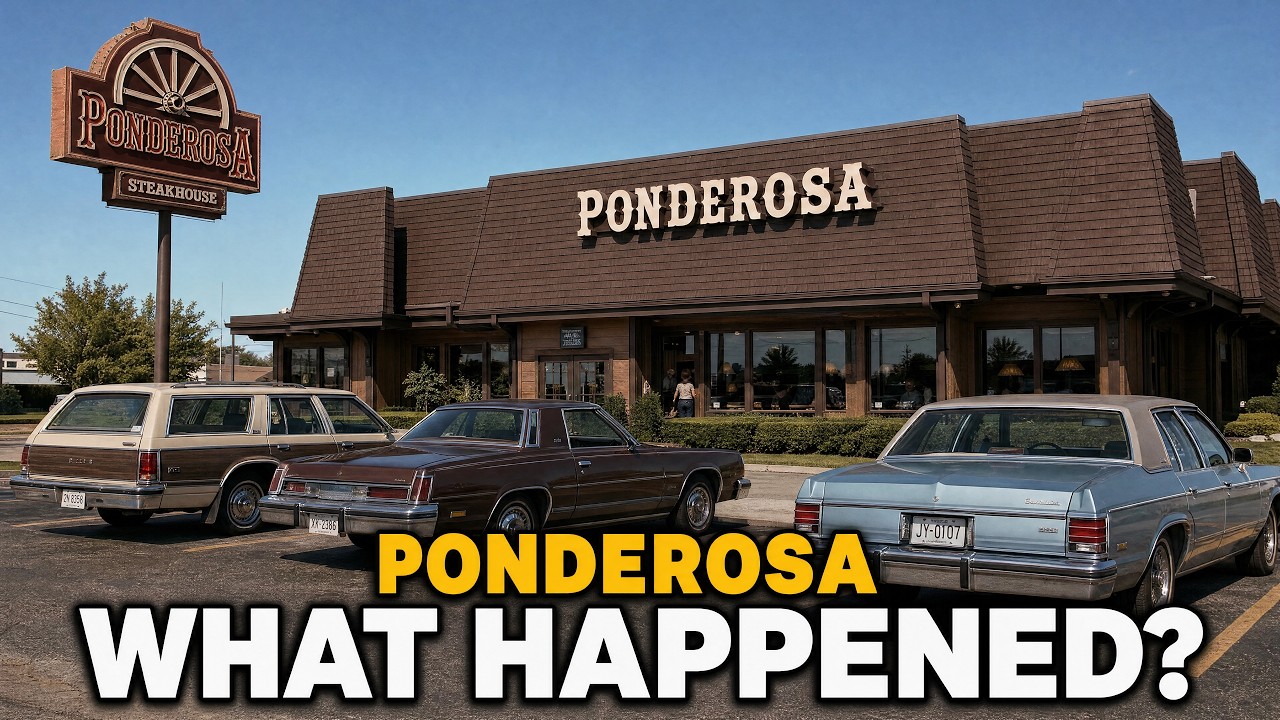
Today, there are fifteen Ponderosas left in the country. The collapse was not sudden, dramatic, or driven by any single scandal. The chain died the way a species goes extinct, slowly, from many directions at once, as the world that created it rearranged itself into one with no room for it. Ponderosa was born of a television cowboy.
In the 1960s, America was obsessed with Westerns, and the most popular of them all was Bonanza, which followed the Cartwright family and their sprawling Nevada cattle ranch. The name of that ranch was the Ponderosa, and tens of millions of Americans tuned in every week. The word meant something warm: family, horses, the reassuring rhythm of a show watched with your parents. Two restaurants were born from that one show.
In 1963, Dan Blocker, the actor who played Hoss Cartwright, lent his fame to a chain of steak houses called Bonanza. He soon sold his stake to two Texas brothers who built it into a real chain. Two years later, in 1965, in Kokomo, Indiana, three businessmen looked at what Bonanza was doing and built a nearly identical competing version. They took the name of the ranch rather than the show and called it Ponderosa.
The Westport Bonanza and the Kokomo Ponderosa were almost indistinguishable in product: the same Western theme, the same limited menu of affordable steaks with potato and salad. The rivalry that followed was genuine and fierce. The two chains spent twenty-five years competing across the same Midwestern towns, each convinced the other was a copycat, each racing to plant its flag in the next city first. One founder, Dan Lassiter, was a wheeler-dealer with a taste for risk who made a fortune young and later moved on to a life involving fast horses, faster money, and eventual legal trouble.
That grow-at-all-costs energy was baked into Ponderosa from the start. This was never a patient family business built to last generations. It was a machine built to expand as quickly as franchising would allow. The concept worked because it solved a very specific problem: how to let an ordinary working family with kids eat out affordably and still feel like they had gotten a real treat.
The answer was brilliant in its simplicity. In the early days, a basic dinner at Ponderosa cost a dollar thirty-nine. The price was the entire pitch. Service was cafeteria-style, which slashed labor costs.
The menu was deliberately limited, a few steaks, potato, salad, roll, which kept the kitchen simple and cheap. The steaks were lower-grade cuts tenderized with enzymes to make them palatable. The company eventually bought its own beef processing operation to squeeze the margins even further. Every part of the machine was engineered around one goal: keep it cheap enough that a family could afford a night out and still turn a profit.
It was not about being the best. It was about being the best value. The thing people actually remember, the thing that turned a cheap steak dinner into a genuine childhood memory, was the buffet. Over the years, the family steakhouse buffet grew into a sprawling, abundant spread: hot dishes, chicken, rolls, mac and cheese, and gloriously for the kids, the dessert bar with the soft serve ice cream machine you could work yourself.
For a child in 1978, the fundamental rule of childhood eating, that there is a limit, was suspended. You could go back for seconds and thirds. The buffet was the main event. This was aspirational and accessible at the same time.
A steakhouse sounded fancy, like a special occasion. Ponderosa took the idea of going out for a steak dinner, something that used to belong to people with money, and handed it to everyone: the factory worker, the school teacher, the family with four kids on a tight budget. It was affordable enough to be frequent and nice enough to feel like an occasion. That sweet spot between everyday and special was exactly why people loved it.
Ponderosa began franchising almost immediately in 1966, and the model spread across the Midwest and into Canada. Bonanza grew right alongside it, approaching 600 locations. By the early 1990s, Ponderosa stood at more than 700 restaurants. But even at that peak, cracks were already showing.
The company struggled to hold on to stable leadership, cycling through management without ever settling into steady stewardship. The dining rooms were looking dated, the menu tired. The number of locations is a lagging indicator; it tells you how well you did over the past decade, not how healthy you are right now. Ponderosa hit its all-time high at the exact moment its foundations were beginning to rot.
No single thing killed it. Several forces worked at once. The first was the buffet itself. As America grew more health-conscious through the 1980s and 1990s, the all-you-can-eat buffet became faintly shameful, a monument to overconsumption.
Ponderosa, built on steak, baked potatoes, and a dessert bar, had little to offer a culture that now wanted something lighter. The second was food safety. Around 1970, health authorities began tracking outbreaks of foodborne illness, and the connection between self-serve buffets and contamination came into sharper focus. Major buffet chains became the sources of highly publicized E.
coli and hepatitis outbreaks. People got seriously sick, and the fear attached itself to the entire format. Ponderosa did not need to have an outbreak of its own to be hurt. The magic curdled, and abundance started to look like risk.
The third wound came from an unexpected direction. In the late 1980s, a Texas conglomerate called Metromedia Restaurant Group went on a buying spree. In 1988, it bought Ponderosa. In 1989, it bought Bonanza.
After a quarter century of open war, the two bitter rivals were forced under one corporate roof. On paper it looked smart: combine the two biggest players, eliminate the rivalry, dominate the market. In reality, it was a merger of two aging, struggling companies that mostly combined their problems. Because the chains had grown up as independent rivals, they often sat in the same towns, sometimes practically down the road from each other.
One company now owned two nearly identical chains that were directly competing for the same customers. It was cannibalizing itself. For twenty-five years, the rivalry had kept both companies sharp. Once it was switched off, there was no enemy left to beat, and the company settled into the defensive, cost-cutting logic of a conglomerate managing a portfolio of tired brands.
Underneath it all, the economics of cheap beef were grinding away. Beef is a commodity, and when cattle prices climbed, Ponderosa was trapped. It could not raise prices much because its entire identity was built on being cheap, and its clientele was famously price sensitive. A rise in beef prices squeezed the margins directly, with no easy way to pass the cost along.
The broader world of dining moved on. Casual dining exploded with new competition, Applebee’s, Chili’s, Outback Steakhouse, offering table service and a livelier atmosphere and pulling away families who wanted a real sit-down night out. From the other direction, fast casual and fast food got better and cheaper. Ponderosa, sitting in the middle, not as nice as the casual chains, not as fast or cheap as fast food, and built around a buffet concept people increasingly viewed with suspicion, found itself with fewer and fewer reasons for anyone to choose it.
The middle had once been the best place to be. But when the market pulls apart at both ends, the middle gets hollowed out. Ponderosa was not beaten by one superior competitor. It was slowly abandoned as the ground it stood on eroded away.
The numbers tell the decline with brutal clarity. More than 700 locations at the peak. Fewer than 400 by 2003. The closings hit hardest in the small towns and working-class suburbs where a Ponderosa had not just been a restaurant but a gathering place, the spot for the church group, the retirees breakfast, the kids birthday.
When the local Ponderosa went dark, the town lost a little piece of its shared life, often replaced by nothing at all. The horse statues hauled away, the sign taken down, the salad bar sold for scrap. The corporate story limped along. In 2008, hammered by the recession, the parent company filed for bankruptcy.
The shrunken chains were passed along, and in 2017, what was left of Ponderosa and Bonanza was acquired by Fat Brands. The two old rivals are now managed together as essentially the same restaurant under two different names, the war between them rendered meaningless. Fewer than four dozen locations remain worldwide, with just fifteen Ponderosas left in the United States. There is a bleak irony in the 2008 recession breaking the company’s back, because a recession is exactly when a cheap family steakhouse should have shined.
But when families are truly squeezed, eating out at all is the first thing cut, not traded down to a cheaper restaurant. The recession delivered the final push to a company already mortally wounded. Those fifteen surviving Ponderosas are not empty. Many are beloved, fiercely, by the people who still have one.
There are servers who have worked forty years at the same location and know their regulars by name. There are customers who drive an hour or two, past a hundred other restaurants, specifically to eat at the last Ponderosa within reach, because it is the steak they grew up on and eating it puts them back inside a memory they cannot get anywhere else. When one of these last locations announces it is closing, people show up in droves, lines out the door, grown adults getting emotional over a buffet. Ponderosa was never a great restaurant in the way a food critic means great.
The steak was cheap and tenderized. The buffet was mass produced. But it was a great institution, a place where a whole slice of America, the working and middle class heartland, got to feel for a couple of hours on a Friday night that life was good and there was plenty to go around. That feeling was the real product, and the steak was just how they delivered it.
The reason seven hundred restaurants could shrink to fifteen is that, over forty years, America stopped being the country that needed that particular feeling delivered in that particular way. One by one, the parking lots emptied, the lights went off, and the horse statues came down. The buffet is still warm for now, but the lamps are burning low.
