On the morning of April 5, 1909, readers of the Arizona Gazette opened their newspapers and found a headline announcing an archaeological discovery of extraordinary scale. The article named the man responsible: G. E. Kinkaid, an explorer who identified himself as part of a government-backed expedition connected to the Smithsonian Institution.
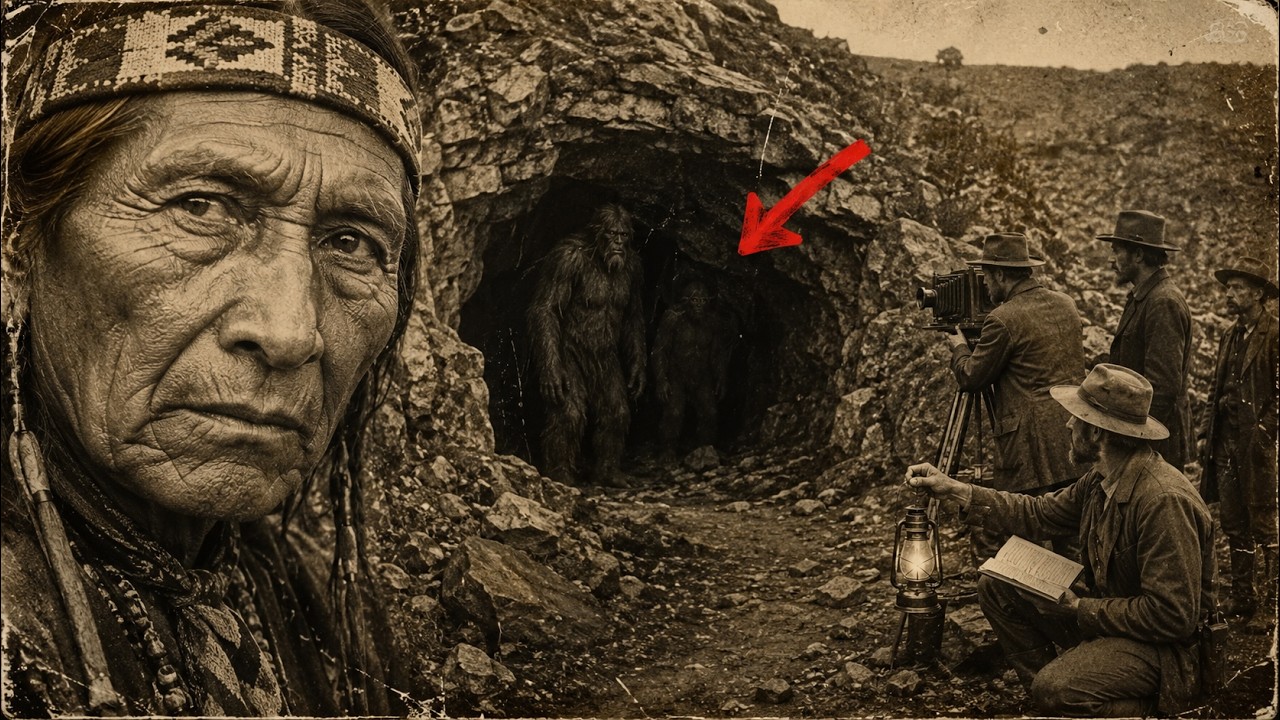
According to the newspaper, he had found a hidden cave carved high into the wall of the Grand Canyon. The entrance could only be reached by boat along the Colorado River, because it sat hundreds of feet above the water on a nearly vertical cliff face. But it was not the location that stunned readers. It was what Kinkaid claimed was waiting inside.
The article described a massive complex carved deep into solid rock. A central passageway reportedly extended more than a thousand feet into the cliff, with dozens of chambers branching off in every direction. Some of those chambers contained stored grain that had somehow survived intact. Others held pottery, copper tools, weapons, and carvings unlike anything archaeologists had linked to the ancient cultures of the American Southwest.
Then the account took an even stranger turn. Kinkaid described finding mummies, not laid out as expected, but seated, carefully wrapped, precisely preserved, and arranged within the chambers. Beside them stood statues and carved figures in a style the article compared not to North American prehistory, but to Egypt or Asia. The walls were covered with writings, symbols, and inscriptions that neither Kinkaid nor the expedition’s archaeologist could read or match to anything known.
They measured what they could reach, photographed the site, and returned on multiple visits to continue documenting it. Four days later, on April 9, the Arizona Gazette published a second article. It was not a retraction or a hint to the reader, but an expansion, adding details about the expedition, the layout of the cave, and the collection said to be inside it. For any reader in 1909, this no longer seemed like a mere curiosity.
It looked like the opening announcement of a discovery that would rewrite the deep history of the continent. Then the story simply stopped. No photographs of those chambers were ever published. No artifacts ever appeared in any museum.
No scientific report followed. The expedition that was said to have achieved one of the greatest archaeological discoveries in American history vanished almost as quickly as it had appeared. That disappearance eventually became as strange as the cave it left behind. To understand why the story of 1909 refuses to die, you have to go back further than any explorer, further than any surveyor’s rope or archaeologist’s trowel.
Long before the cliffs were fenced with barriers, long before the land was marked on federal maps as a national park, and decades before a newspaper story ever stirred fear in the American public, the Hopi were already carrying an account of what lay beneath their feet. It was not a metaphor for the afterlife, nor a poetic underworld invented to comfort the grieving. The Hopi spoke of a physical place, vast chambers under the canyon where their ancestors had taken shelter and once lived, and where other beings, older than the current age, were said to be waiting long before human memory began. Those beings were described in specific terms.
They were tall, taller than ordinary people, covered in hair, dwelling in the depths of the rock in a world with its own passages and its own laws. They were not remembered as monsters, nor treated as children’s stories. They were part of the oldest history the Hopi possessed, passed down through the Bear Clan across generations no one had ever precisely counted. The Hopi oral traditions describe humanity moving through a series of worlds before reaching this one.
The present world, according to those accounts, is not the first. Earlier worlds ended in catastrophes, one after another. Each time, a group of survivors was led to safety before they all emerged into a new age. That emergence lies at the foundation of Hopi belief.
The place where it happened has a name: Sipapu, the sacred opening through which the ancestors climbed from underground into the world we now inhabit. What makes this tradition unusual among the origin stories of the world is how closely it is tied to a real landscape, not a distant paradise attained through faith, but northern Arizona, terrain you can walk across. The most interesting part is not the emergence itself, but what the ancestors were said to have faced before that journey was complete. According to the Bear Clan, whose oral history preserves many of the oldest Hopi teachings, the underworld was already inhabited.
There were beings living below before the ancestors arrived. The Hopi called them the Ant People. That name misleads almost everyone who hears it for the first time, because the descriptions have nothing to do with insects. They were remembered as intelligent beings, guardians of the underground chambers, creatures who understood the underworld in a way surface dwellers could never grasp.
When catastrophe struck, they received the ancestors. They sheltered them, protected them, and kept them alive until the upper world had recovered enough to return to. Some accounts insist they were taller than ordinary people. Others describe them as covered in hair.
On one point nearly all versions agree: they lived beneath the canyon. For successive generations, this was preserved by voice alone, long before any anthropologist arrived with a notebook. It existed in complete isolation from newspapers, archaeology, and government expeditions. It was part of the Hopi cultural memory and needed no external confirmation to survive.
The timing of the 1909 story makes this harder to dismiss. Just three years before the Arizona Gazette published its account, the Antiquities Act of 1906 had taken effect. That law gave the federal government authority over significant archaeological discoveries made on federal land. The Grand Canyon was already under federal protection, which meant a major discovery within those cliffs would not have been a private matter at all.
It would have fallen under federal oversight the moment it was reported. And the Smithsonian, during that period, routinely worked alongside government agencies in archaeological investigations. So the newspaper’s reference to a government-sponsored expedition linked to the Smithsonian was not the wild exaggeration a modern reader might assume. It described exactly the arrangement that existed at the time, even though no records for this particular expedition have ever been publicly confirmed.
As curiosity about the Arizona Gazette report grew, researchers began circling around one question that any real expedition should have been able to answer easily. If men had truly worked inside a chamber system hundreds of feet up a cliff face, where were the official papers? The newspaper provided names, and names are verifiable. It identified the explorer as G.
E. Kinkaid and tied the work to the Smithsonian through an archaeologist it called Professor S. A. Jordan.
Had a discovery of that magnitude actually occurred, it should have left behind a trail as wide as the passageway itself. Photographs, excavation reports, correspondence between the field and the institution, records logging artifacts into a collection, and at least some official lines confirming the expedition had actually launched. What researchers found instead was close to nothing. Historians and independent investigators combed the archives for years looking for anything that could link the account to reality.
The Smithsonian’s answer has never changed. It holds no record indicating G. E. Kinkaid was ever employed by the institution.
There is no record of any professor named S. A. Jordan connected to such an expedition, and no record of any artifacts resembling those the Arizona Gazette described in such precise detail. For many historians, that closed the file.
An invented explorer, an invented professor, an invented cave, printed to sell newspapers. Case closed. But others noticed something this dismissal ignores. However uncertain everything else was, the newspaper was not.
The April 5 and April 9 editions demonstrably existed. Researchers returned to the physical records and confirmed that both articles were actually printed in 1909. The mystery was never about whether the story was published. The mystery is whether anything described in it actually happened.
Those are two completely different problems. During the late nineteenth and early twentieth centuries, newspapers operated in a gray zone. Sensational and partly invented stories ran on the same page as ordinary civic reporting, and readers had to sort one from the other themselves. Yet in that same era, real archaeological discoveries were first announced through newspapers, long before any official scientific paper appeared.
Publication proved nothing. It also disproved nothing. Decades passed, and researchers kept trying to trace the threads. Some reported finding scattered references to a man named G.
E. Kinkaid in unrelated historical documents, suggesting someone by that name may have actually existed. Others pointed to gaps in the archival collections from those years, gaps where papers should have been. But an honest investigation must state the next part plainly.
Missing records are common, and they are lost for entirely ordinary reasons. Preservation was incomplete. Staff misfiled things. Fires, floods, and simple neglect swallowed vast quantities of material across the twentieth century.
A gap in the archive is not a fingerprint. It is merely an absence. And it is easy to fill gaps with whatever we already believe. None of these findings, taken alone or together, confirms that anyone descended into a hidden chamber above the Colorado River in 1909.
So, after more than a hundred years, the story hangs between two possibilities, neither of them comfortable. Either the Arizona Gazette published one of the most elaborate archaeological hoaxes of its era, complete with measurements, chamber counts, and artifact lists that no ordinary forger would have bothered to invent, or it reported the news of an expedition whose full history was never recovered and never will be. The case ceases to be merely a matter of one newspaper’s honesty when that uncertainty is set beside something already ancient when the presses began to run. The Hopi have spoken of underground chambers and unusual beings below the Grand Canyon for generations.
Not for a decade-long rumor, but for a stretch reaching far before the newspaper, before the territory, before the surveys. Long before any man claimed to have found a hidden chamber inside those cliffs, the Hopi were telling a story that matches his in ways difficult to ignore. Their method of preservation was different from ours, and in certain ways, more durable. Hopi elders carried these traditions through a clan system, handing them down with care from one generation to the next.
Written dates can be burned, lost, or quietly removed from the records. Hopi knowledge survived through continuous oral transmission, held by elders whose specific responsibility was to remember accurately and teach what they remembered to those who would carry it after them. This raises a question archives cannot answer. If the newspaper had invented its underworld, why did it match a world the Hopi were describing before anyone thought to print it?
The answer, if one exists, may depend less on what was printed than on what was remembered. The more closely you read the tradition of the Ant People, the less it resembles popular folklore. They are not insects, not creatures invented to explain a hole in the ground. They were described as intelligent beings who lived underground inside chambers beneath the surface.
When the earlier worlds were destroyed, these beings received the Hopi ancestors, sheltered them, and protected them until it became possible to return above. When the time came, humanity entered this present world through the Sipapu, the sacred opening that represents the passage from the underworld to the world we stand in now. What makes these traditions hard to dismiss is that they describe the underworld as a real place, not a symbol. They speak of underground chambers, of long migrations through subterranean passages, and of guides who knew those hidden routes long before the ancestors set foot in them.
For the Hopi, this is history and identity, not entertainment. Anthropologists have generally treated this material as cosmology and religious tradition, while many Hopi consider it sacred teaching. The accounts vary, but some threads recur. Several versions describe the beings as larger than ordinary humans.
Others remember them as covered in hair. Nearly all place them in the underworld beneath the canyon, not in the villages later built on the mesas above. The canyon itself refuses to make the matter easier. It is not a single open gorge.
It is a landscape filled with vast natural cave systems, particularly within the Redwall limestone, and many of those sections are exceptionally difficult to reach. Even now, large portions of its cliffs and cave networks have not been comprehensively explored. More than a century has passed since that story was published. Millions of visitors have stood on the rim of one of the most studied landscapes on Earth.
Geologists have spent decades reading its rock layers. Archaeologists have catalogued the villages, trails, and artifacts left by the many native peoples of the region. Yet the April 1909 account has never entirely died because it keeps raising a question no one has answered to everyone’s satisfaction. If the expedition was real, where are the photographs, the field notes, the recovered artifacts?
And if it was pure invention, why was it built with such exacting detail, the chamber measurements, the artifact descriptions, the references to locations that remain nearly unreachable even today? Three kinds of evidence have passed through this investigation: a newspaper report, the geological and archaeological knowledge of the canyon, and an oral tradition preserved within Hopi culture. Each carries a piece of the truth. None alone settles anything.
Sometime in the future, high-resolution laser scanning, advanced cave mapping, or a future survey might settle what was raised in 1909. Or perhaps the answer was never hidden inside the rock at all. Perhaps it always lived in the memory of the people who knew this land before the newspapers, before the surveys, before the national parks. The Hopi have never claimed to hold all the answers.
What they hold is memory. A memory of coming out from underground, a memory of chambers beneath the earth, and a memory of unusual beings who were already there when the ancestors began their journey upward. Whether that is literal history, sacred tradition, or a mixture of both is something each generation debates anew. What is beyond dispute is that these traditions have outlasted the newspapers, the modern state of Arizona, and every investigation of the 1909 expedition.
In 2000, the Hopi Tribe’s Cultural Preservation Office issued a statement concerning sacred places within the Grand Canyon. The statement did not encourage exploration. It affirmed that certain sites within the gorge hold spiritual significance and should not be subject to public investigation. It confirmed nothing.
It proved nothing. It asked for respect. That returns us to where this began, to the Bear Clan, which maintains an account of tall, hair-covered beings in chambers beneath the rock, generations before an explorer claimed to have climbed a vertical cliff and found mummies sitting upright in the dark. The Grand Canyon has done both things a discovery can do.
It has revealed civilizations, villages, passageways, and sacred places that reshaped our understanding of the American Southwest, while keeping other places beyond reach. Perhaps that is why it still captivates us. Not because the mystery has been solved, but because every generation walks to the same rim and asks the same question.
What, if anything, is still down there?






