She was putting on her boots when her heart stopped. It was a Tuesday morning in May, a fine spring morning in West Sussex, and she was on her way to the horses. She was Lady Dorothy Macmillan, daughter of the Duke of Devonshire, wife of a prime minister, and at sixty-five she was still always on her way somewhere. Harold Macmillan found her there, one boot half on, the other off, and he never moved them.
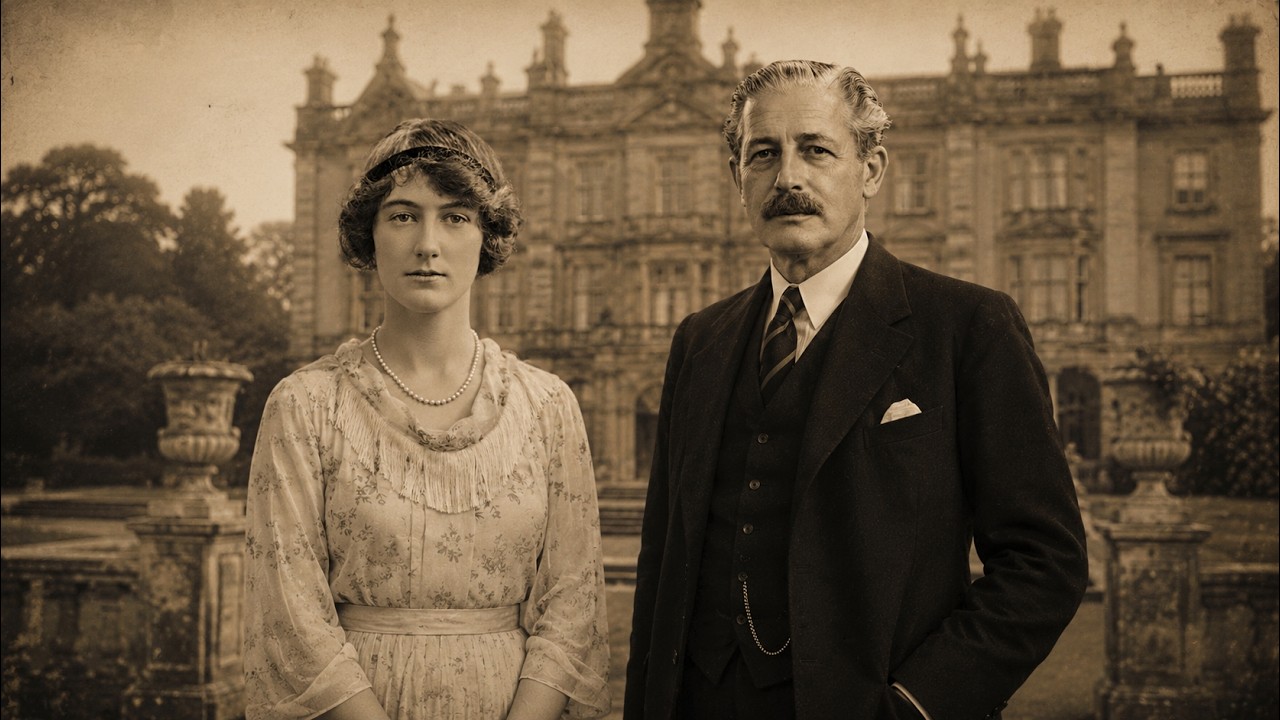
For the twenty years he outlived her, the boots stayed where she had left them. To understand what that meant, you have to understand what came before. There is a house in West Sussex called Birch Grove. It is not grand by the standards of the world she came from—no gilded ceilings, no portrait gallery stretching the length of a city block—just a Georgian manor set among old oaks, the kind of English country house that on a summer morning feels like an answer to every question you have ever asked about beauty and order and permanence.
Harold loved it more than anywhere on earth. Dorothy lived there with him, in a separate wing, for more than thirty years. Dorothy was born into a world that arranged itself around her with automatic precision. In the summer of 1908, at eight years old, she walked the length of the long gallery at Chatsworth House for the first time as the daughter of a duke.
Her father, Victor Cavendish, had just inherited the title, and Chatsworth—297 rooms, 17,000 acres, a library that would take a scholar a lifetime to exhaust—was now hers in the particular way English aristocratic inheritance worked. Not hers to own, hers to belong to. She was Dorothy Evelyn Cavendish, the third daughter, with two older sisters and a brother who would inherit the whole magnificent weight of it. She learned French, German, riding, and how to maintain composure in large rooms full of important people watching her from behind their crystal glasses.
She did not learn what to do when none of it was enough. The family moved between houses the way other families move between moods: Chatsworth for the summer, Holker Hall in Lancashire, Lismore Castle in Ireland, where the River Blackwater ran cold and green beneath the walls and the rain came sideways off the Atlantic. Each house said, in its own architectural language, *we have been here before you, and we will be here after you. * Dorothy learned that language early and fluently.
In 1916 everything moved. Her father was appointed Governor General of Canada, and the family crossed the Atlantic to Rideau Hall in Ottawa—a residence that managed, in the particular way of British imperial architecture, to be simultaneously imposing and slightly forlorn, planted in the middle of a continent that had its own ideas about grandeur. Dorothy was sixteen. She helped her mother receive dignitaries, opened fêtes, smiled for the social pages.
She was considered charming, handsome in the way of Cavendish women—tall, energetic, the kind of presence that fills a room without meaning to. Beneath it all, she was waiting for something she could not have said precisely. Her world had a plan for her, as it had for generations of women exactly like her. The plan was marriage.
The man arrived from England in the winter of 1916, brought in on her father’s staff. His name was Harold Macmillan. He was twenty-two, with a slight stiffness in his right leg from the Somme, where shrapnel had found him and taken something he would never entirely get back. He had studied classics at Balliol, had an American mother, a Scottish crofter grandfather, and a family that had built a publishing house from nothing.
By every measurable standard of Dorothy’s world, he was not quite right. Not the wrong class exactly, but not the right one either. He was acutely, painfully, chronically aware of the distance between where he had come from and where he now found himself standing. And yet he was genuinely in love with her—in love with her directness, the way she moved through her father’s grand official rooms without a trace of self-consciousness, as if the business of being grand had never occurred to her as a thing requiring effort.
He was bookish, introspective, bruised by the war in ways he had not yet found language for. She was the opposite of every difficulty that lived inside him. They were engaged within months. The Duke gave his consent.
The wedding took place on 21 April 1920 at St. Margaret’s, Westminster, the church in the shadow of the abbey where Parliament married its daughters. Royalty attended. Aristocracy attended.
The society press called it the social event of the London season. Dorothy was twenty years old. For nine years, she was a very good wife. She traveled with Harold to his constituency at Stockton-on-Tees, a working-class town in County Durham where unemployment would reach thirty percent, and she canvassed, charmed, and remembered names in the way Cavendish women had always remembered names—with a tenacity almost royal in its precision.
She ran the household and raised the children: Maurice in 1921, Caroline in 1923, Catherine in 1926. By every external measure available to their world, she was exactly what she was supposed to be. Then, in 1929, she went to a dinner in Westminster, and something in her woke up. The man who woke her was named Robert Boothby.
He had entered Parliament in 1924, the same year as Harold, part of the same intake of Conservative MPs who would shape British politics for the next three decades. He was young, ambitious, clever—but where Harold carried his ambition quietly, like something he was ashamed of wanting, Boothby wore his in the open, like a coat he had chosen specifically to be admired. He talked more, laughed louder. He was not precisely handsome, but so intensely present that the room reorganized itself around him without anyone noticing it had happened.
Winston Churchill had spotted him early and made him his parliamentary private secretary. At twenty-six, he was already spoken of as a future prime minister. He was also a man of considerable private appetites, who took what he wanted from men and women both, and had the gift of making the people he chose feel as if they had been truly seen for the first time in their lives. No one recorded the exact evening Dorothy met him.
No one wrote down who sat where or what was served or what was said across the candlelight. But the biographers who came later, working from letters and private papers and the long interviews Harold eventually gave near the end of his life, all circle around the same conclusion: something happened at that dinner, or at one of the dinners like it during that period, that Dorothy Cavendish Macmillan had not been prepared for and could not undo. She was twenty-nine. Harold was thirty-five.
They had three children, two houses, and a political career that was, in 1929, in the middle of its first serious setback—Harold had just lost his parliamentary seat. Dorothy, who had spent her entire life moving through rooms arranged for her, found herself in a room she had not arranged at all. What followed was not subtle. Dorothy began seeing Boothby at dinners, at weekends, at the country house parties where the English upper classes conducted their complicated private lives beneath the cover of elaborate social ritual.
She made no serious effort to conceal it. As Harold’s official biographer, Alistair Horne, would later put it, the arrangement was *in full public view of Westminster and established society. * Harold knew. He must have known almost immediately—he was one of the most acute readers of human behavior in English public life.
He noticed everything, recorded everything, carried everything. What he said to Dorothy in the conversations that must have happened in the bedrooms of Birch Grove or the hallways of their London house in Chester Square is not recorded. What we know is what Dorothy told Boothby in those early months. She said, *Why did you ever wake me?
I never want to see any of my family again. * She had four young children. She said it anyway. She wanted a divorce.
Harold’s solicitor, Philip Frere, sat him down and explained the mathematics. Divorce would end his political career—not wound it, not complicate it, end it. This was 1930, 1931. A Conservative politician, even the innocent party, could not survive the scandal.
There was another way, Frere said. It was the way the upper classes had always managed these things when the houses were large enough. They called it the west wing and the east wing: two people living in the same house, meeting for dinner, maintaining the public surface, going their entirely separate ways beneath it. Harold agreed.
He always said later that he agreed because he loved her—that even knowing what everyone knew, he could not bring himself to let her go. In 1930, Dorothy gave birth to their fourth child, a girl. They named her Sarah. The whispers began almost immediately.
Boothby was rumored to be the father. The timing was suggestive. Dorothy herself, in those years of intensity and recklessness, apparently said as much, taunting Harold with it in moments of cruelty that even her defenders find difficult to defend. Harold looked at the child.
He did not ask the question out loud. He went back to work. But the work was getting harder. In 1931, Harold Macmillan suffered a nervous breakdown.
His biographer Horne, who had access to his private papers, was direct about the cause: the anguish of Dorothy’s affair had taken something from him that he could not replace through sheer force of will. *It took a lot out of me physically,* Harold told Horne decades later—the only time in all their long conversations that he came close to describing what those years had actually felt like. He recovered. He always recovered.
He won back his parliamentary seat in the election of 1931 and spent the rest of the decade on the backbenches, a slightly anomalous figure—too independent for the party managers, too principled for the appeasers, too hurt by things he never talked about to quite fit the silhouette of the ambitious Tory he had once imagined himself becoming. At Chatsworth, at the country weekends, at the parties where Dorothy moved through the rooms with Boothby at a careful but legible distance, Harold was observed to be, as Horne recorded it, a sad and isolated figure. Her aristocratic relations, who had never quite accepted him, had even less reason to go out of their way for him now. He was the son-in-law who had not been enough.
He was the man who had stayed when leaving would have been easier. He was the man everyone felt slightly sorry for. He endured. He kept going.
He had in the end nowhere else to go. The years between 1930 and 1939 were the years of the arrangement—the long, careful management of two realities inside one household. According to Horne’s authorized biography, Dorothy had been virtually living with Boothby for five years during the most intense early phase, though the arrangement settled into something slightly less consuming as the decade progressed. The correspondence continued, the meetings continued, the emotional hold Boothby had on her did not diminish.
Boothby, for his part, had a complicated relationship with what he had created. He was a man of extraordinary gifts and considerable personal disorder. He liked the story of it—that Dorothy had chosen him, that Harold knew, that everyone in Westminster knew, that the whole elaborate arrangement continued year after year with the particular English combination of genteel denial and very precise private understanding. What he felt about her beneath the theater of it is harder to establish.
Decades later, when Dorothy was dead and Harold was very old, Boothby described her to the people who asked as *on the whole the most selfish and possessive woman I have ever known. * It was not exactly a love letter. And yet he stayed beside her for thirty-six years. The war came in 1939 and remade everything.
Harold went to North Africa and then Italy as resident minister—essentially Churchill’s political viceroy in the Mediterranean theater. The job required exactly the qualities he had spent the previous decade building in private: composure under pressure, the ability to manage difficult men simultaneously, the gift of remaining calm when everyone around him was not. He was extraordinarily good at it. Dorothy remained at home, ran the household, managed Birch Grove—lent out during the war to a school, accumulating the particular damage institutions inflict on beautiful old houses—and campaigned in Harold’s constituency.
She was a woman of practical competence and restless energy, happiest when there was something to organize, something to move toward. She was not a woman who sat still. He came home from the war a changed man. Not visibly, but harder inside, clearer about what he wanted.
He wanted to be prime minister, and the long, quiet, unacknowledged wound of a marriage that had become something other than a marriage had burned away everything in him that was not equal to that ambition. In January 1957, Harold Macmillan walked through the door of Number 10 Downing Street as prime minister of the United Kingdom, following Anthony Eden’s collapse after Suez, through the quiet maneuvering of a man who had learned how to remain standing when everyone around him was falling. The cabinet, with only two exceptions, had preferred him to Rab Butler. The Queen had sent for him.
Dorothy walked through that door beside him. She was fifty-six. She had spent thirty-seven years married to this man, nearly three decades of them living a second life alongside her first. She stood at the threshold of the most famous address in England and smiled for the cameras.
Harold put his hand briefly on her arm. The cameras went off. From the outside, the Macmillan years looked like a triumph, and in many respects they were. Harold rebuilt the special relationship with America after Suez.
He sat across the table from Khrushchev and Eisenhower and Kennedy and held his own—an Edwardian Englishman in a Cold War world. He presided over an age of affluence Britain had not seen in living memory. On 20 July 1957, he stood before a crowd in Bedford and told them: *Indeed, let us be frank about it. Most of our people have never had it so good.
* The phrase went around the world. *Supermac*, the cartoonists called him—first as mockery, then as something approaching genuine admiration. He won the 1959 election with an increased majority. He delivered the wind of change speech.
John F. Kennedy, connected to Harold by marriage through the Cavendish family tree, took to calling him Uncle Harold and treated him as a mentor. In public, Harold Macmillan was unflappable. At home, in the west wing of Birch Grove, while Dorothy was in the east wing, the arrangement continued exactly as it had always continued.
In 1958, Harold Macmillan appointed Robert Boothby to the House of Lords. He gave him a life peerage. Baron Boothby—the man who had spent the better part of three decades in love with his wife, the man about whom the whispers regarding Sarah had never entirely died—received from the prime minister of Great Britain one of the highest honors the political system could bestow. Harold was asked about it later.
He said something about good government, about rewarding service to the country, about Boothby’s record in Parliament. No one who knew the full story quite believed any of those explanations. They were not wrong exactly—Boothby had served and contributed—but the timing, the particular person, the fact that it was Harold’s hand that signed the papers. Was it forgiveness?
Was it the final, definitive performance of an English dignity so extreme it had become its own kind of cruelty? No one knew. Harold never said. Dorothy, if she had feelings about it, kept them where she kept everything else.
The Kennedy years brought a brief, strange warmth to Harold’s public image, and then 1963 arrived. John Profumo, the Secretary of State for War, had been sleeping with a nineteen-year-old model named Christine Keeler. Keeler had also been sleeping with a Soviet naval attaché. What ended careers faster than the potential security implications was the lie Profumo told the House of Commons and its subsequent collapse.
The scandal brought down Harold’s government with a slowness almost worse than a sudden fall. He watched it from the inside—the drip of revelations, the collapse of trust. He was reportedly deeply affected by it. One historian observed that he found the whole sordid business too troubling, too close perhaps to things he understood in ways that had nothing to do with national security.
A man who had spent thirty years quietly containing a private scandal of his own does not easily watch a public one detonate. In October 1963, Harold Macmillan resigned as prime minister. The official reason was ill health, a prostate diagnosis subsequently found to be incorrect. He was sixty-nine.
He retired to Birch Grove, took up the chairmanship of the family publishing house, and wrote his memoirs—all six volumes—in the long study that looked out over the Sussex oaks. Dorothy was in the east wing. She had been in the east wing, in one form or another, for thirty years. And yet, this is the detail the biographies keep returning to, the detail that refuses to resolve itself into anything simple: Harold was, by all accounts, devastated when she was not there.
He had organized his entire existence around a woman who did not love him the way he loved her. He had built his career in part out of the energy of that wound. He had been prime minister of Great Britain. He had never, not for a single year, had it as good as he wanted it.
Dorothy had two more years. On 21 May 1966, a Tuesday, a fine spring morning in West Sussex, the hedges at Birch Grove were bright with the particular insistence of English spring—that quality of color that seems almost aggressive after the long gray months. The oaks Harold loved were in new leaf. Dorothy was getting ready to go out to a point-to-point, an informal steeplechase of the kind the English countryside runs on certain spring weekends—horses and mud and the sociable business of standing in a field watching other people’s animals compete.
She loved horses. She sat down to put on her boots. That is the detail that stays. Not the diagnosis, not the ambulance, not the formal language of the death certificate—just the image every biographer reaches for because it is the truest thing available.
Dorothy Macmillan, sixty-five years old, sitting down to put on her riding boots on a Tuesday morning in May, on her way to somewhere she wanted to be. Her heart stopped. She was still in the house. The boots were not fully on.
She never made it out the door. Harold was at the house when it happened. What he felt in the moments after, in the hours and days and years after, is recorded only in fragments. He was not a man who spoke easily about private grief, and the particular grief of losing someone you have loved badly and been failed by and refused to leave is not the kind that translates well into language.
He was by every account devastated—not surprised, for he had known for years that Dorothy had a heart condition, that the vigor she projected was not the same as the health she actually had. But devastation and surprise are different things, and Harold Macmillan, who had spent thirty-seven years married to this woman, was undone. He buried her at St. Giles’ churchyard in Horsted Keynes, in the village near Birch Grove, in the ground of the county where she had lived her private life.
The funeral was quiet. The grave was simple. Harold went home to Birch Grove. He was seventy-one.
He had twenty more years to live. The losses kept coming. Sarah Macmillan, the youngest daughter, the one about whom the whispers had never entirely stopped, died in 1970. She was forty.
Her death was attributed to complications from alcoholism. She had lived, by the accounts available, an unhappy life—one of those lives that seemed darkened from the beginning by something the people around her could never quite name or address. Harold outlived his youngest daughter by sixteen years. Whether he ever knew with certainty whose child she had been is not clearly established.
He did not write about it in his memoirs. He did not speak about it in the interviews he gave in his later years. He carried it the way he had carried everything else—inward, downward, out of public view. But the question had not gone away.
In approximately 1975—the precise date is uncertain—Harold Macmillan went to see Robert Boothby. Harold was in his early eighties. Boothby was the same age. They were two very old men meeting to discuss a story that had shaped both their lives for more than forty years.
What they said to each other in the room before Boothby turned on the tape recorder is not recorded. What happened after it was turned on has been described by D. R. Thorpe’s biography, drawing on accounts Boothby himself gave to others in the years that followed, in terms that are almost unbearable in their plainness.
Harold asked about Sarah. He asked whether she had been Boothby’s daughter. He was, by this account, crying. Tears on the face of a man who had been prime minister, who had sat with Kennedy, who had told a nation it had never had it so good.
Tears on the face of a man who had spent forty-five years not asking this question out loud and was finally, in his eighties, asking it. Boothby told him no. He said Sarah was Harold’s. He said he had always been scrupulously careful.
He said the reassuring things an old man in his situation would say to another old man who was weeping and asking. What Boothby said to others afterward, what he reportedly disclosed in the way men like him sometimes disclose things because they cannot resist the dramatic weight of them, suggested that the answer he had given Harold was not in fact the truth. Harold did not know this. He left the meeting with what Boothby had given him: a reassurance, a closing of the question, a version of events he could carry for the years he had left.
According to Horne, Harold had once described the years of Dorothy and Boothby and the arrangement and the silence in a single phrase, given to his official biographer near the end of his life. *It took a lot out of me physically. * For Harold Macmillan, it was practically a confession. He went on living until 29 December 1986.
He was ninety-two when he died—the longest-lived prime minister in British history until James Callaghan surpassed him a few years later. Twenty years at Birch Grove alone. He worked. He always worked.
There were the six volumes of memoirs, dense, careful, political, almost entirely silent about the things that had most shaped him. There was the publishing house chairmanship. There was the role of elder statesman, which suited him and which he performed with the same impeccable composure he had been performing things with since the Somme. In 1984, at ninety, he finally accepted a peerage—Earl of Stockton.
He had refused it for twenty years. When he took his seat in the House of Lords, he made a speech his admirers called Churchillian and his critics called nostalgic. A year before he died, he looked back at Stockton-on-Tees, the constituency where Dorothy had canvassed beside him and remembered every name, and said something that has stayed in the record as the last public observation of his long life. *Sixty-three years ago,* he said, *the unemployment figure in Stockton was then 29 percent.
Last November, the unemployment there is 28 percent. * He paused. *A rather sad end to one’s life. * He was not, of course, only talking about Stockton.
He had written in his memoirs about what it required to be a public man. Somewhere in the six volumes, in the careful, controlled prose of a man who had made a lifetime’s practice of not saying the thing he was actually thinking, he allowed himself one observation that Horne quoted, and that has stayed in the record as close to a private truth as Harold Macmillan ever permitted himself in print. *When a man becomes prime minister,* he said, *he has to some extent to be an actor. *
The boots are not mentioned in the memoirs.
Nothing about the way she died. Nothing about a Tuesday morning in May and a pair of riding boots on the floor. The six volumes cover wars and elections and the machinery of empire and the long negotiation of a century in decline. They do not cover the moment Harold Macmillan walked into a room at Birch Grove and found his wife on the floor with one boot half on and one boot off, on her way somewhere she would never reach.
Dorothy had always been on her way somewhere. That was the fact of her, the quality the obituarist caught, that Boothby remembered, that Harold had loved and resented and built his life around. She was always moving, always reaching for the next thing, always in some fundamental way leaving. In the end, she left without meaning to.
And Harold stayed. He stayed because he had always stayed, because staying was the one thing he knew how to do that she did not, because in thirty-seven years of a marriage that was also a negotiation and an endurance and a kind of love that has no clean name in any language, he had never once walked out the door. He outlived her by twenty years.
He never moved the boots.
