The door of the Nettle house stood open, and the main room was clean. The plank table was set for six, six wooden plates in a row, and on the trap door in the middle of the floor sat a small clay bowl holding a portion of food that was not spoiled and not old—it was fresh, set there that very morning. The sheriff of Calicoat County stood on the porch and called the names of the family in the way a man calls for the missing in a mountain hollow, and he called them for approximately eleven minutes. Nothing answered him.
There were no living people in the house. There were no bodies. The four beds were made, the loft swept, the addition clean, the cradle by the hearth empty. On the shelf on the north wall stood seven small unglazed clay bowls in a row.
On the plank floor beside the door, written in what looked like chalk in a hand the sheriff did not recognize, was one word in block letters: KEPT. He lifted the small clay bowl from the trap door, and the bowl was warm to his hand. He put it back. He and his men left, and Delford Fugate, who was one of them, went aside to the springhouse to look for kept meat, and did not open the springhouse door, because on the door at eye level, in the same chalk, was the same word.
Delford Fugate did not open that door that day, and he never went back onto that bench for the rest of his life. The county laid claim to the property on grounds of abandonment, recorded the deed, erected no marker, and made no attempt to sell or lease it ever to any person at any price for any purpose. That was what the county decided to do with the place where, from 1874 to the winter of 1888, a family named Nettle had kept a rule, and where a school teacher from Greenup County, Kentucky, had spent nine weeks learning the shape of that rule from the outside before he understood in one long night what the rule was for. His name was Wesley Coyle.
He was thirty-one years old that winter. He walked out of that hollow on foot on the sixteenth of February, 1888, with one boot on and one boot in his hand. And he lived to be seventy-nine. And every night for the last forty-eight years of his life, he set a small clay bowl on the top step of his own cellar before he sat down to eat.
When his wife asked him why, in the second year of their marriage, he told her, and she never asked him again—and she started setting one too. On the morning of Tuesday, the sixth of December, 1887, Wesley Coyle walked the last three miles of a wagon road along a creek called Kutchin in the eastern end of what was then Calicoat County, West Virginia, with a leather satchel over one shoulder and a folded oil cloth over the other. He came around the last bend and saw on a small level shelf of ground above the creek a house he had been given directions to five days before by a man in a store in Hallum. He stopped in the road and looked at it for what he later said was a long minute, because something about it, before he had come within a hundred yards of the porch, made him want to turn around.
He did not turn around. He was thirty-one years old. He had eleven dollars in his pocket. He had walked forty-one miles in five days.
He had a letter in his satchel from a man named Josiah Nettle offering him room and board and eight dollars a month to teach three of that man’s four children through the winter term, from the second week of December to the last week of March. He had accepted by mail in October. He had come across the mountain from Greenup County because that was the work he could get, and eight dollars a month with a bed was the best offer he had had all fall. And because he did not at that time in his life want to spend the winter in a house where anybody knew him, he walked the last hundred yards, came up onto the porch, and knocked.
Prudence Nettle opened the door. She was thirty-nine years old that December, tall for a woman of that country and time, about five foot eight, with a long straight back and hair that had gone silver at the temples. Her face gave nothing away. She said, “You are Mr.
Coyle. ” He said he was, and she said, “Come in. The room is warm. ” He came in.
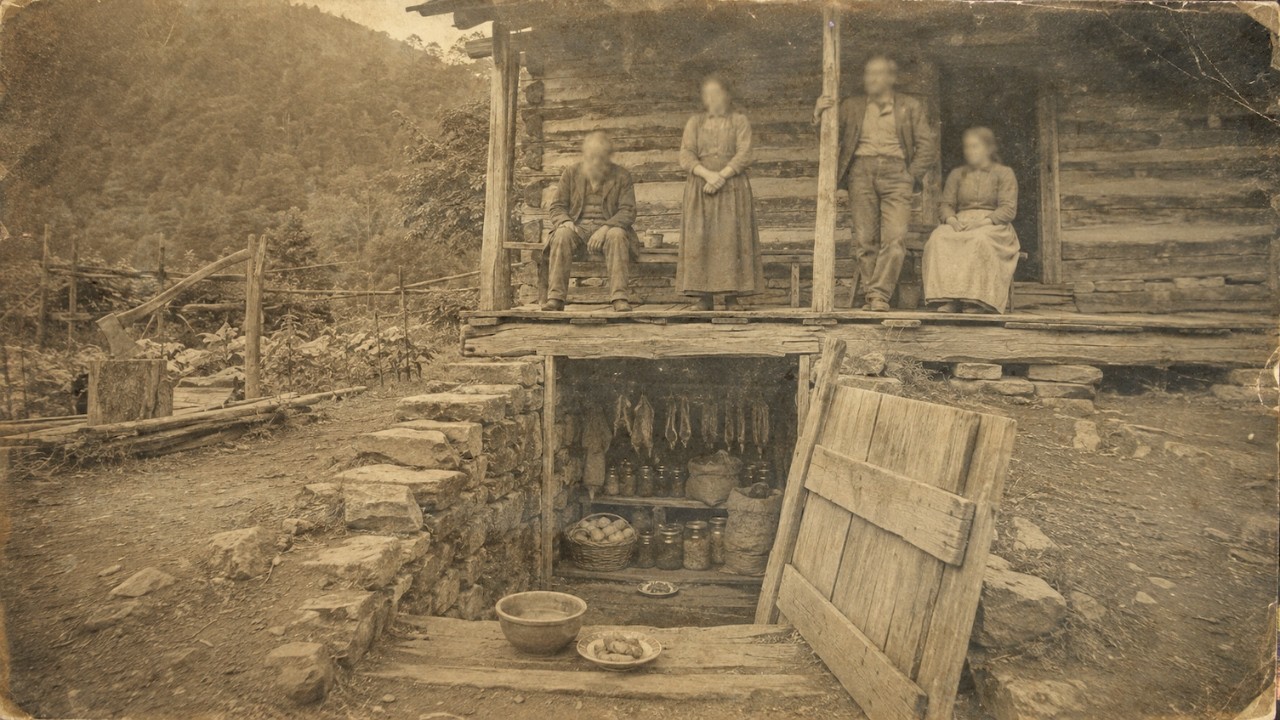
The main room of the Nettle house ran the whole width of the ground floor, about twenty-eight feet long by sixteen feet deep, with a stone chimney and hearth on the north wall. The trap door to the cellar was set into the floor about four feet in from the north wall on the west side of the hearth, a plain plank door with an iron ring set flush into it. He noticed the ring before he noticed the door, because the ring caught the firelight. The four children of Josiah and Prudence Nettle were there: Abselum, sixteen, tall and thin and already stooped; Rebecca, twelve, with her mother’s way of watching a stranger from under her lashes; Micah, nine, small for his age and freckled, with a habit of holding his tongue between his teeth when he was thinking; and a baby named Ruth, two years old, awake and looking at him without making a sound.
Josiah Nettle came in from the addition a minute later. He was forty-three, he shook Wesley’s hand, said he was much obliged for the school master coming this far up the creek in this weather, and told him to put his things in the upper room after they ate. They sat at the table. Six places, seven people.
And on the plank floor, four feet inside the door, on top of the iron ring set into the trap door, there was a bowl. A small clay bowl, unglazed, about the size of a man’s fist, dark from long use. There was food in it—a spoonful of the stew that was on the table, a piece of bread the size of a walnut—and there was a wooden cup beside it with a swallow of buttermilk. The bowl and the cup were on the trap door, not near it—on it, set carefully in the middle of the ring.
Nobody was eating. Josiah Nettle bowed his head. Prudence bowed hers. The three older children bowed theirs.
Even the baby went very still. Wesley bowed his head too, because he had been raised in a house where you did. And Josiah Nettle said, “Grace,” and his grace was one line long, and it was not the grace of any church. He said, “For what is set below and for what remains above, we are grateful for the portion.
” Then he raised his head and looked at Abselum. Abselum got up from the bench, walked around the end of the table, crossed the four feet of plank floor to the trap door, stopped just short of it without stepping on it, bent at the waist, took the bowl in one hand and the cup in the other, stood back up, and walked slowly—not backwards but sideways, the way a person walks who does not want to turn his back on a thing. He set them on a shelf along the north wall where six other empty bowls already stood. Abselum set the seventh bowl down at the end of the row and the cup beside it.
He came back and sat down. Josiah Nettle said, “We may eat now,” and the family ate. Wesley ate the stew, which was good—carrots, a piece of shoulder pork, dumplings, cornbread with cracklings. He said, “Ma’am, this is fine,” and Prudence Nettle inclined her head about half an inch and did not answer.
When the meal was almost done, Prudence got up, went to the shelf, picked up the bowl and cup Abselum had put there, carried them back to the trap door, set them down again in the middle of the iron ring in exactly the position they had been in, stepped back, and said quietly, out loud, and not to any person in the room: “Kept. ” Then she went back to the table and finished her buttermilk. Nobody looked at Wesley. Nobody explained.
When the meal was over and Wesley was shown to the upper room, he asked Josiah Nettle about the bowl on the door. Josiah stopped three rungs down the ladder and looked at Wesley for four full seconds, his face unchanged. Then he said: “It is a rule of the house. We keep it.
You do not have to keep it, but you do not disturb it. Do not set your foot on the door. Do not move the bowl. Do not eat any food from the bowl.
Do not at any time ask any child in this house about the bowl, and do not answer the child if the child asks you. If you have a question about the bowl, you bring it to me. ” Then he pulled the ladder hole hatch closed behind him, and Wesley was alone in the dark of an upper room. He lay in the bed with his clothes on because the cold was not something a tick mattress and two blankets would fix.
At somewhere around eleven o’clock, when the whole house had been silent for at least an hour, he heard the trap door open. He heard the iron ring lift and the plank door swing up. In the pause that followed there was no footstep, no voice, no movement of any kind. Then he heard the plank door lower back down, carefully, the way you would lower a lid on a sleeping child, and the iron ring settle.
After that, the house was quiet again for the rest of the night. He never heard the bowl move—not that first night, not any night that whole winter. He heard the door open and he heard the door close, and in between there was nothing. Whatever came up out of that cellar to take the bowl did not need to be heard, and whatever went back down did not eat the way a person eats.
In the morning, the bowl was on the shelf, empty, wiped clean. The cup was beside it, empty, wiped clean. Prudence Nettle was at the hearth, and she said without turning around, “Good morning, Mr. Coyle.
There is water in the basin, and there is coffee in a minute. You slept. ” Wesley said he had. Prudence said, “That is good.
It takes some a night or two. ” Something in the way she said it made him understand that she had said the same sentence to some number of strangers before him, and that she had counted the nights it took each of them. He started school with the three older children, and found them better educated than he had expected. Somebody had been teaching them.
Abselum said: “Our mother. ” At about half past nine, Prudence came out of the addition with the small clay bowl, containing a spoonful of grits, a small piece of bacon, and a swallow of coffee. She set the bowl in the middle of the ring, set the cup beside it, stepped back, said “Kept,” and went back to the addition. Wesley understood that this was not a supper custom.
This was a rule of every meal. Every meal served in this house was served first to the door. Three meals a day, 365 days a year. He began, in the margin of the McGuffey reader in his lap, to work out how many meals that was—14,940 meals fed to a door since the fourteenth of April, 1874—and then he covered the number with his hand and taught the rest of the morning.
Across the first week he noticed other things. The family did not raise their voices, not in anger, not in laughter, not in any circumstance. He never heard a note of music made by any Nettle in eleven weeks. Nobody ever stood east of the trap door.
The baby, Ruth, was always placed well away from the door, on the south side of the room, facing south, before each meal, and she sat where she was set without fussing until the meal was over. And there were exactly seven bowls on the shelf at any given time. When Prudence set a fresh bowl at the end of the row, the bowl at the head of the row was gone, and he could not catch the moment it happened, no matter how carefully he watched. On the twelfth of December the freighter came.
Emory Snead was sixty-six that winter, a small man with a face that had been out in weather for six decades, driving a wagon pulled by two mules named Ash and Bell. For thirty-one years he had hauled mail and small freight up and down Kutchin Creek every two weeks, and he had on every one of those trips refused to spend the night on the bench. He would not sleep there, not one night in thirty-one years. He asked Wesley how long his contract was, and when Wesley told him, he took his hat off, looked at the ground, then looked Wesley in the face.
“I am going to tell you three things,” he said, “and I am going to tell them one time, and then I am not going to speak of it again. ”
“First, you eat what they put in front of you, and you do not under any circumstance ever at any meal take a bite of food or a swallow of drink from that bowl on the door. Not if you are starving. If you do, it will know your mouth.
Second, when you walk past that trap door, you count your steps out loud, from the ladder to the door of the house and back, out loud in a plain voice, and you do not stop counting until you are past the door by three steps. Not two. Three. If you lose count, you go back and start over.
Third, whatever wakes you at night in that upper room, in a voice you know, in the voice of your own mother if you have one, you do not answer it. You put your fist in your mouth if you have to. That door in the floor is not the only door in that house. ” Then he put his hat back on, handed Wesley his mail, took the letter Wesley had written to his brother, climbed up onto the box, and went down the creek and out of sight.
Wesley counted his steps out loud that night when he crossed the room to go to the outhouse, and not one Nettle in that house looked up, not one said a word, not one so much as glanced at him. It was as though he was doing a thing they had all seen done before and had already decided not to remark upon. They already knew about the counting. In the second week he noticed a cold spot, a column of cold air about four feet across and six feet tall standing on the plank floor about a step and a half west of the trap door, present whether the hearth was blazing or banked, present even on the one warm afternoon in mid-December when everybody opened the shutters.
He mentioned it once at breakfast. Prudence, without looking up, said: “Yes. ” That was the whole conversation. He tried a small experiment with the bowls on the shelf.
One morning before the fire was lit he came down with a candle, picked up the second bowl in the row, and found scratched into the bottom of it a small mark, two lines crossed. He put it back. That day at breakfast, Prudence set a fresh bowl at the end of the row. The bowl he had marked, which had by then moved to the head of the row, was gone by the noon meal.
He watched the shelf all afternoon and never saw a Nettle come near it. He wrote to his brother that he had begun to suspect the bowls were not being moved at all, that they were being unmade, that some property of the shelf or of the house took the bowl at the head of the row, and that the family understood this and did not have to move it. Then he crossed the whole paragraph out before he sent the letter—but Ashbell could read it anyway through the ink, and he kept it. That is why we know what Wesley almost wrote and then chose not to send.
There was also the matter of Micah’s pinch. At every meal Micah would take a small pinch of what was on his plate before he ate any of it and set it aside on the rim. When the meal was over, he would take it off with his fingers and, on his way to the wash bench, without stopping and without any ceremony, drop it on top of the bowl on the door. He did this without being told, three times a day.
Rebecca told Wesley, quietly: “He does it for the extra. The extra of him. Please do not ask him about it. He does not know why he does it.
If you ask him, he will start to think about it, and then he will stop doing it, and then something bad will happen. ” Wesley did not ask, and Micah kept doing it. On the morning of the twenty-fourth of December, Prudence set the bowl on the door not in the middle of the ring but about two inches south of it. She said “Kept” but did not correct the position.
About ten in the morning, Wesley heard from below the plank floor a small, dry, single sound—the sound of a fingernail being tapped against the underside of a plank, once, very lightly, just below the trap door. The three Nettle children at the table sat up very straight, all three at once, looking at the door and not moving. After about a minute, Abselum, very quietly, said: “Mother. ” Prudence came out of the addition, looked at the position of the bowl, said “Oh,” in a small, dismayed voice, stepped forward, and nudged the bowl with her foot gently so that it slid two inches north into the middle of the ring.
She stepped back and said “Kept. ” The children exhaled, all three of them. Wesley understood that the bowl was not a memorial and not a superstition. The bowl was a mark that had to be in a specific place, and if it was not, the thing below noticed, and the thing below tapped.
And what he thought next was the thought that would run underneath every other thought for the rest of the winter: What does it tap for? Prudence Nettle went into the cellar once a day at around one in the afternoon, always alone, always for about four minutes—the length of a short prayer. Nobody else ever went down. She went down 365 times a year and had done so since 1874, when her father-in-law bought the ground.
In the fourth week, Wesley asked her casually whether the cellar was warm. She said without turning from the wash bench: “It is not warm. It is a cellar. It is cold.
” He said he only wondered if the potatoes kept. Prudence said: “We do not keep potatoes in that cellar. We keep potatoes in the springhouse. ” He had by then accounted in his head for every keeping place on the property, and he understood that the cellar under the plank floor was a room with no purpose except to be a room.
On the third of January, when Prudence went out to the springhouse with a lantern and Josiah and Abselum were at the barn, Wesley stood in the empty main room, counted his steps to the trap door, bent down, and lifted it. He went down the six wooden steps into a stone room with a clay floor and dry-laid sandstone walls. At about eye level on the east wall was a darker stone set into them. He crossed to it.
It was a piece of some dark green rock, worked smooth on the face toward the room, set flush with the sandstone as if the walls had grown around it, with nothing carved on it. He did not mean to put his hand on it, but his hand went up before he thought, and he put his palm flat on it. It was warm—the temperature of a stove that had been lit an hour ago—while the sandstone on either side was cold as a well. He took his hand off as fast as he would have taken it off a hot iron, and he never touched it again.
About two feet to the north of the dark stone, at about the same height, he found between two courses of the sandstone wall a thumb-sized piece of dry moss packed into the seam. Nothing else in the cellar had any moss anywhere. He pulled the moss away, fitted his fingers into the seam, and pulled a rectangular piece of sandstone out of the wall as easily as a book off a shelf. Behind it was a niche, and in the niche a bundle wrapped in oil cloth and tied with string.
He took it out. He put the stone and the moss back. He heard Prudence Nettle’s lantern in the yard. He crossed the room in four fast steps, went up the ladder, and pushed the bundle under his tick.
He was seated at the plank table with his McGuffey reader open when she came in with snow on her hair. He did not open the bundle until that night, after the family had gone to bed, after the trap door opened at eleven and closed a moment later, after an hour of silence. Under the shield of his coat over the head of the tick, he untied the string. The book inside was handsewn, about sixty leaves, three-quarters of them written on, in one hand—a woman’s hand, slanted, tight, careful, ink and pencil and one long entry in what he judged to be the juice of a pokeberry.
The first date was the fourth of October, 1867. The last was the second of March, 1874. On the inside of the front cover was one line: “This is the account of Cordelia Adair of the bench above Kutchin Creek in Calicoat County, for the use of any woman who comes to this bench after me, whom God preserve. ” He read the whole ledger that night without stopping.
Then he closed it and sat with his back against the wall of the loft and watched the candle burn down. At about four in the morning he opened it again and read the last four entries a second time. Then he wrapped it and put it back under his tick. This is what was in the ledger.
Cordelia Adair was born in 1832 and married a man named Amos Adair in 1851. Amos had been born on Kutchin Creek on that same bench in 1827; his father before him in 1803; his grandfather had bought the ground in 1791 from a man who had bought it in 1778 from a man known only as old Whitner, who had come into that country before the Revolution. The house had been built in 1858 over a cellar that was already in the ground when the house was built—older than any of them, and none of their business, only theirs to keep. On her first night in that house, Cordelia watched Amos’s mother put a bowl of food on the trap door and say “Kept,” and when Cordelia asked what the bowl was for, Amos’s father told her that the bowl was the rent, that the rent had been paid on this ground since before there was a house on it, that so long as it was paid the ground was theirs and nothing would happen to any of them, and that if she wanted to be his son’s wife she would learn to pay it and never ask about it.
Cordelia paid it for sixteen years, quietly, three times a day, without asking. Then in the fall of 1867 an old woman named Marthy Bledsoe came up the lane and told her the full account. The bench above Kutchin Creek had a hole in it—not a hole you could see, but a hole in the ground of the world. Some ground is thick and some ground is thin, and on some ground the two sides touch, and the bench above Kutchin was ground where the two sides touched, and had been for longer than anybody had been in that country to notice.
Something lived on the other side of the touching place. Marthy called it, when she had to call it something, the keep, because the whole of the human relation with it was one word said out loud three times a day when a portion was set on the door above the touching place, and the word was kept. The cellar was not a cellar. It was a room built by people at some time so long ago that no name for them had survived, built over the touching place to close it off and make of it a chamber, and the dark stone set into the east wall was the touching place itself.
The bowl of food set three times a day was the price of keeping the room a lid and not a door. If the rent was paid, the thing did not open the room. It took what was set for it. It was fed.
It did not seek. If the rent was not paid, the thing got hungry—and it did not get hungry for food. Food is not what it eats. Food is what it is offered so that it does not have to open the room to look for what it does eat.
What it eats, Marthy Bledsoe said, is a person called by name who has stood on that bench. It eats them slowly, the way a fire eats a log. It listens for a name spoken on the bench. It learns the voice that speaks the name.
And when it is hungry, it uses the voice it has learned and calls the name back from below the door, and if the person who owns the name answers in any word, that person is taken—not physically, nothing is dragged, but from that moment the person is not the same person, and over the following days is drained from the inside of what a person is made of until the shape remains and the person is gone. The rent had to be food that a person would eat, from the meal being served at the moment it was served, before any human had eaten from it. It could not be old food, could not be tainted or spoiled or sour. The thing understood the difference between a portion and a leaving, and a leaving was an insult, and the thing did not tolerate an insult.
And Marthy told her one specific rule, and Wesley Coyle underlined it in pencil that January night, and the pencil mark is still visible on the page in the Berea archive: “If the rent is missed once in one meal and only once, and the next meal is paid double, the thing will accept it, and the account is straight. If the rent is missed twice in a row, the thing will not accept a payment of any size, and it will begin to seek. Once is forgetfulness, twice is a decision. ” Cordelia underlined it herself twice in ink and wrote in the margin: “The number is two.
”
Cordelia wrote that if this was true, she had paid the rent for sixteen years without knowing why, and if she had known why, she would have paid it just the same. Amos died in 1872 from a fall off a horse. Ruth grew. In an entry dated the fourth of February, 1874, Cordelia wrote that a man named Silas Nettle had come up the lane with his son Josiah, who was twenty-nine, and that she had taken Silas out onto the porch and told him the rule and the story exactly as Marthy Bledsoe had told her, and that Silas Nettle had listened without interrupting and at the end of it had said: “We can pay a rent.
” Cordelia sold him the property on the fourteenth of April, 1874, and left the ledger in the niche in the east wall for whoever came after her to find, if they were the kind of person who would find it. She never came back to the bench. Wesley read the whole of that on the night of the third of January, and in the gray dawn light he thought the thought that changed everything that came after. He thought: What will happen if I leave in March?
He decided, sitting at the plank table the next morning, that he would go and find Ida Bledsoe, Marthy’s niece, who lived four miles down the creek at the mouth of Snakeroot Fork. He decided he would not tell the Nettles he had read the ledger. And he decided he was going to finish out the winter, because a man who left on the eighth of January was a man who was quite possibly leaving because he was afraid, and there was a shame for him in leaving three children to a winter he could not himself get through. He was wrong about what the decision would cost him.
It cost him, in the end, forty-eight years of setting a bowl on his own cellar step every night, and one morning in February of walking down a mountain in the snow with one boot in his hand, and the loss of some part of himself that never came back. Ida Bledsoe was seventy-seven that winter, and she had for most of her adult life been the woman other women walked to when a birth was going wrong or a fever was in a house or a person had died and needed laying out. Her cabin had a line of white salt laid out across the puncheon floor in front of the fire, about four feet long, parallel to the hearth, six inches back from it—laid out that morning, and swept away and re-laid many thousands of times over the sixty years she had lived there. Wesley told her everything he had seen, from the first meal to the ledger to the tap on the underside of the plank, without skipping, for about forty minutes.
When he was done, he said: “Is any of that true? ”
Ida Bledsoe drank a swallow from her cup and looked at the fire. Then she said: “All of it is true. My aunt Marthy did not lie.
My aunt Marthy did not know how to lie. What those women knew is right. ” And she told him two things Marthy had not told Cordelia. The first was that the seven bowls on the shelf were not being used up—they were being kept.
The thing took the portion, not the bowl. The bowls were older than any house in that county, made of the clay from that bench, made by a person who was not in any grave in any churchyard. The reason Prudence could not catch a bowl leaving the shelf was that a bowl did not leave. It moved, from one place to another, without going between.
The thing had in some part learned to move a small piece of stoneware. It had been practicing. The second was that if Wesley left the house before the last week of March, the thing would not follow him—but if he was in the house on a day when the rent was missed twice and the thing came up looking, and it fixed on the school master because he was the one it did not know as well as the others, then leaving would not stop it. It would follow the name.
It had already learned his. It learned it in the first week, when Prudence said “Mr. Coyle” out loud in a room above it. There was no untying a name to that thing.
Once it had your name, it had your name until you died—and after that, it had your name still. The only way to make it stop being interested was to give it enough of what it would accept in the currency it preferred, and after that it would leave you alone. When Wesley asked what was enough, she said: “That is not a question I am going to answer today. That is the question you will only understand the answer to on a night when you have to answer it yourself.
”
She told him to tell Prudence Nettle he had been to see her, and to tell her she said to keep the pinch, and to watch her face when he told her, because she would know what it meant and she would not tell him. He carried the message back that evening. Prudence stopped washing, stood at the wash bench with her hands in the water, and did not turn around. She said quietly: “Thank you, Mr.
Coyle. ” He heard her draw one long breath. He understood that whatever Micah was doing with the pinch was the second layer of the rule, and that Prudence had been counting on it for a piece of the family’s protection, and that she was, in her own way, relieved. Eleven days later, Micah Nettle fell sick.
A fever came up in him at supper on the eighteenth of January, and by morning it was clear it was more than a cold—his eyes were bright, and he did not know where he was. At the morning meal, Prudence put a bowl on the trap door, said “Kept,” went to the shelf, took a piece of bread the size of a walnut and a shred of pork off her own plate, and without touching the bowl on the door set them on a small tin plate on the top step of the ladder to the loft. She had not done that before. She did it again at noon.
Wesley put the whole of it together. Micah had, since he was old enough to eat solid food, been adding a small increment to what was set for the room below—an increment that had not been requested, that was Micah’s alone, roughly one nine-year-old boy’s worth of small extra portions of every meal since he was two. And now Micah was sick and could not carry his pinch, so Prudence in his place was carrying it for him, to the ladder where Micah slept, because if the thing had been counting Micah’s pinch and expected it, then the pinch had to be paid, and it had to be paid in a location Micah would have been in. Micah’s fever ran three days and broke on the third.
On the sixth day he was down at the table, thin in the face, and he took his pinch from the edge of his plate, and on the way to the wash bench he dropped it into the bowl on the door. The tin plate was gone off the ladder. Nobody said a word. In the last ten days of January, Wesley began to hear something at night.
A low tapping, not from below, but from the walls, from the plank floor of the loft, from the peg where his coat hung. Different places, different nights, always in the deep of the night, always in a rhythm—”the rhythm of a person tapping their finger on a table when they are waiting for you to say something. ” Over the course of ten days it moved closer. The first night it was in the wall behind his tick.
The second night in the pegs on the wall. The fourth night in the plank floor about a foot from his head. The seventh night in the beam directly above where he lay. By the tenth night it was coming from the straw of the mattress under him.
On the night of the twentieth of January, in the pause between two taps, he heard a small voice no louder than a breath say, from below him: “West boy. West boy. ” That was his sister Constance’s name for him. Nobody else had ever called him that.
Constance had died of typhoid in 1882 in a rented back room in Portsmouth, Ohio, alone, on the ninth day of an illness she had not written to tell him about, and he had never spoken of her again in the presence of another person until 1935. He did not answer. There is a disagreement in the sources about when the first voice came and what it said, and both accounts are from the same man, forty-seven years apart. It may be that both are true at once—that the thing was capable of learning several voices at once and of using them at different moments to different targets, and that a person who hears a voice like that will smooth the memory of it afterward into a single story, fixing on the voice that hurt most.
Wesley heard from below the trap door in February more than once, in more than one voice, things no thing in that cellar should have been able to say. Both sources agree on three of them. The first was his mother’s voice, dead nine years, saying his name—one word, “Wesley”—from below the plank floor in the cold spot on the morning of the twenty-eighth of January, when he crossed the room to fetch chalk. He did not answer.
He kept counting his steps. But when he got back to the table, his hand was shaking so much he could not hold the chalk. Rebecca Nettle, watching from under her lashes, said quietly, without looking up: “It will do that. Use somebody a person here would come to if it called.
That is why we do not any of us use our own names in the house. It is learning names. Once it has a name, it can throw the voice for it. ” Wesley asked why it had not learned hers.
Rebecca looked up at him, full in the face, for the first time in eight weeks, and said: “It has learned mine, and Abselum’s, and Micah’s, and the little one’s. It has all four of us. It got mine when I was two. My mother has spent nine years afraid every day that it would learn Ruth’s.
And it has, because Ruth is two now, and Ruth said her own name at the table three weeks ago, and my mother went white. If you have got a name here, Mr. Coyle, you keep away from the door. ” Wesley said he did not use his name here.
Rebecca said: “My mother said it once in the first week when Emory came up. ‘This is Mr. Coyle, our new school master. ‘ Mister and Coyle.
That is enough. It heard it. It has been working on it. ”
The second voice was his sister’s, early in the morning of the second of February, from the peg on the wall where his coat had hung, in the whistle-through-the-teeth voice Constance had made when she worked.
“West boy. West boy. Do you remember? ” Then: “West boy, do you remember the taps?
” That was the wrong word. Constance had never called them taps—she had never called them anything, because a person does not have a word for a thing they do without knowing they do it. Taps was not her word. It was the word of something that had watched her, that had seen the taps often enough to make a noun of them, but that had not been inside her head, and had therefore, when it went to use her voice, chosen the word a person watching her would have used.
The voice tried three more times, each time with a slightly different sentence, each time making a small wrong choice. Constance would not have said “Come and open the door. ” Constance would not have said “It is cold in here. ” Constance would not have said “I have been looking for you.
” Those were the sentences of a thing that had learned a voice and did not yet know how to use it. Wesley lay back down with his hand still over his mouth, and he wept without a sound for about half an hour. On the morning of the fifth of February, Rebecca came down the ladder while Wesley was alone at the table. She set a small tin box in front of him—the box he had seen her closing in December.
She said: “I want you to have this. I want you to take it when you go. Open it when you are on the other side of Rockhouse. Not before.
Do not tell my mother I gave it to you. Do not ever in your whole life tell any person that a Nettle child said anything to you that would betray what my mother has kept. But you take this and you open it past Rockhouse. ” Wesley said he did not leave until the last week of March.
Rebecca said: “No, you leave in the middle of February. My mother knows. My father knows. I know.
You do not know yet either. But you will know by next week. And when you go, you go fast. ” He put the tin box in his satchel and did not open it for eleven days.
He opened it on the eighteenth of February in Emory Snead’s wagon, six miles past Rockhouse Ridge. Inside was a small folded piece of paper. On it, in Rebecca’s careful hand, were four names: Abselum, Rebecca, Micah, Ruth. Under the names were four words: “Please forget these two.
” That was all—four names and four words, and no note and no explanation. Wesley folded the paper back up, put it back in the tin box, and put the tin box in his coat pocket. He did not forget the names. He remembered all four of them for the rest of his life.
On his deathbed in 1935, when his daughter Verly asked him to say them out loud one time, he said all four of them in the order Rebecca had written them. And in the two months between that day and his death, he never heard them said back to him in any voice at all. The third voice came on the evening of the seventh of February, at supper, in the presence of every human being in the Nettle house, and both sources agree on it down to the syllable. The meal had begun.
Prudence had put the bowl on the door and said “Kept. ” Abselum was passing the bread. And from the direction of the trap door, in the middle of the plank floor, in a voice that was Josiah Nettle’s voice exactly, from about a foot below the plank, in the same low, even, unhurried tone Josiah used at that table every night, a voice said: “Prudy. Come here.
Prudy. ”
That was what Josiah called his wife in private, and nobody outside that house had heard the word said in that voice in the last seven years because the only other person who had ever heard him say it was Silas Nettle, and Silas had been dead since December of 1886. Prudy was a word that lived in one place in one man’s mouth. Every human being at that table stopped moving.
Prudence went white. Her hands set the pitcher down on the plank without sound. She did not draw breath. She did not blink.
Josiah put down his spoon. Abselum’s hand on the bread did not move. Micah’s spoon stayed halfway to his mouth for eleven full seconds. And the baby Ruth opened her mouth as if to speak.
Prudence, without taking her eyes off the trap door, put her open hand across the mouth of the baby and held it there. The voice did not repeat itself. The silence lasted ten seconds—no one drew breath—and the baby, understanding at two years old that this was one of those moments, did not fight her mother’s hand. Then Josiah picked up his spoon and ate.
He said in his ordinary voice, so quietly it was almost only his lips: “Eat. ” Everybody ate. Nobody spoke. After the meal, Prudence carried the bowl off the door, looked at it for half a minute, and said quietly, so quietly that only Wesley, clearing a plate two feet away, could hear her: “It is not enough.
” Then she went into the addition, and Wesley heard through the plank door the sound of a woman crying without any noise, and it went on for perhaps three minutes and stopped. She came out with a plate holding a piece of side meat cut fresh off a slab, a spoonful of beans, and a whole piece of bread the size of a fist, and she carried it to the door and set it on top of the tin plate, and she said “Kept. ” She stood over it for a full minute and said quietly: “This is the last of it. Do you hear me?
This is what we have. ” Then she went back into the addition and did not come out again that night. Josiah put his forehead down on the plank and left it there for a long time. Wesley understood three things, sitting there.
He understood that the thing had called Prudy in Josiah’s voice, which meant it had learned Josiah’s voice and her private name by hearing Josiah say it at some time in that house without any of them knowing—that the thing had been present in places in the house that were not the cellar at times when the family thought they were alone. He understood that the double portion was a payment against a balance Prudence had suddenly understood to be short—that the accumulated portions were not matching what the thing had come to expect. And he understood that the reason the account was going wrong was Micah: in the six days of his fever, Prudence had carried his pinch to the top step of the ladder, but the pinch on the ladder had not been in the bowl, and the account had been short by six days of pinches. And eighteen pinches were not a piece of side meat.
The currency was not weight or nourishment—it was the pattern of it. You could not pay eighteen missed pinches with one slab of meat any more than you could pay eighteen missed Sundays with one long church service. And Prudence knew this too, and had put the meat on the door anyway, because it was the only thing she had left to try. The storm that came in that night finished the road to Hallum for the winter.
It snowed for two full days and a night, and by the tenth of February the road was not going to be usable until the middle of March. Emory Snead did not come on the twelfth. The four days between the eighth and the eleventh of February were the longest four days of Wesley’s life. Prudence put a proper double portion on the door at every meal—twelve double portions over four days, each one said kept, each one coming off empty every morning.
But the cold spot was moving. On the ninth of February it was two steps west of the door. On the tenth, three. By the eleventh it was four steps west, near the wash bench, so far from the door that there was no cold at all in the place it had stood on the ninth of January.
Wesley told Prudence. She said: “Oh, God. ” Then she turned around and said: “Mr. Coyle, get your things out of the loft and put them by the door.
Do it before the noon meal. Do not tell anybody I told you to. When the road opens, or when a chance comes, you go. ” He took his satchel and his oilcloth and his coat down from the loft and set them under the peg by the door, and the three children saw them and did not remark on them.
That afternoon Wesley heard, from below the plank, a small, clear sound: scraping—the sound of something dragging itself slowly along the underside of the plank floor, from somewhere near the north wall toward the west. Abselum, without looking up from his slate, said quietly: “It is looking for a soft board. If the floor has a soft plank in it, one that a person could pry, that is where it will come up. It cannot go through the door because the door is fed.
It has to try the boards. That is why my mother has had my father go over the floor every summer with a hammer and a piece of tin. He has replaced eleven boards in nine years. We do not think there is one now, but it is looking.
It has never looked before. That means the double portion is not enough. It has decided to try to come up its own way. ” Wesley asked what his parents were going to try.
Abselum said: “My father is going to open the trap door tonight after supper. He is going to go down into the cellar with the double portion in a proper bowl. He is going to put it on the clay floor at the foot of the dark stone and speak to it the way you would speak to a person, and explain about Micah and the six days of pinches, and ask for the account to be considered settled. My grandfather said on his deathbed: ‘Do not ever open the door on your own errand.
The door is for the bowl. It does not talk. It listens for a name and it eats. ‘ My father has been thinking about it for four days.
He is going to do it tonight anyway because he does not see another choice. My father will not come back up if he goes down. My mother knows this. He knows this.
They are going to do it anyway because if he does not go down tonight, something comes up tomorrow and takes the little one or my mother or one of us. ”
That night, after supper, Prudence filled a proper bowl with what was left of the soup, cut a full piece of bread the size of two fists, filled a cup with buttermilk, set them on a wooden tray, and set the tray beside the trap door. She said quietly: “Josiah. ” Josiah Nettle got up from the table.
He kissed his wife on the forehead. He told the children, “Up,” and the three older children went up the ladder with Rebecca carrying the baby, and Prudence followed them, and Wesley heard the bedroom door close and the wooden bar set into its brackets. He and Josiah were alone in the main room. Josiah told him to go up with the family, to sit on the far side of the door, to put his hand across the little one’s mouth if Prudence’s hand tired, and to not answer any voice that came up through the floor.
Wesley told him his plan instead: that he, Wesley, would stay in the main room, be the nearest voice, draw it toward the front door, and run. Josiah Nettle looked at him for a long minute and said: “That is not what happens. It does not follow. Once it comes up, it comes up in this room.
It does not go outside. Whatever gets taken gets taken in this house. If it comes up and I am not what it settles for, it will look for the next name it knows, and the next name is my wife’s. Your name is a fresh name.
You do not stand in for the both of us. Go up. ” Wesley asked one thing: to stand at the top of the ladder, so that if it came up through a plank he could pull the ladder up after him. Josiah agreed, on a condition: “Do not come back down for any voice you hear.
Not my wife’s, not one of the children’s. If any voice you know comes up through that plank, you keep the ladder pulled up. Do you promise me? ” Wesley said: “I promise you.
” Josiah walked over to the trap door, bent down, put his hand on the iron ring, looked back once, and said: “Thank you, Mr. Coyle. ” Then he lifted the trap door. Wesley climbed up into the loft and pulled the ladder up after him, and sat at the edge of the ladder hole looking down.
He watched the yellow candle light go down the six steps and move across the cellar. He heard the tray set down on the clay floor. Then he heard Josiah Nettle’s voice from below, ordinary and quiet, addressing a person he was not sure could hear him. Josiah said: “I have brought a proper portion.
It is a double. The bowl was set every meal for four days, and none of them were missed. I want to speak to you about my son, Micah. My son Micah has been giving you a pinch of every meal since he could sit at a table.
He has given you thousands of pinches, and he gave you none in the six days he was sick in January and could not carry them. His mother put them at the top of the ladder for the six days he was in the loft. If those six days of pinches were not enough and the account is short, I have brought a double portion tonight to make it up. If a double is not enough, I will bring a double tomorrow and every day after that until you accept it.
But I want the account settled. I want it settled tonight. Please. I am asking you.
” There was no answer of any kind. Then there was a sound Wesley described exactly in three separate places: a small, dry noise, like a person taking a shallow breath in through the teeth, from the east wall of the cellar at about the height of a man’s face. Josiah said: “I will take that as a yes. Thank you.
” Wesley heard the tray lifted, the boots cross the cellar, the six steps up. Josiah came up out of the trap door pale, but alive, his eyes his own eyes, holding the wooden tray—empty. The bowl was empty. The bread was gone.
The cup had no buttermilk in it. He set the tray down, lowered the trap door gently into its frame, stepped back a step and a half to the west, and stood in the cold spot, his shoulders shaking. Then he said quietly upward: “It is settled, Mr. Coyle.
Please put the ladder back. ”
Wesley put the ladder down. Josiah went to the bedroom door and knocked three light taps, and the bar was lifted, and Prudence took his face in her two hands and looked at him, and said: “We are done for tonight. ” The whole family came down and stood in the main room and looked at the trap door, and Josiah said “Kept” out loud, and Prudence said “Kept,” and the three older children together said “Kept,” and even the baby opened her eyes and looked at the door.
Prudence made tea, and they drank it in silence, and at about one in the morning the family went to bed. Wesley went up to the loft and lay in his tick in his clothes and waited for the tapping. The tapping did not come. At about three in the morning, from the straw of the tick underneath him, in a whisper no louder than a breath, in the voice of Constance Coyle in her whistle-through-the-teeth, a plain sentence: “West boy, it knows we lied about the pinches.
Come down. ” Wesley put his hand over his own mouth, and he did not answer. He waited until the sky in the east window was gray. Then he took his satchel and his oilcloth from where he had left them, came down the ladder in his boots, unbarred the front door, and stepped out onto the porch.
It was the sixteenth of February, 1888. There was fresh snow on the ground about six inches deep. He walked down the lane to Kutchin Creek and along the creek road, and he did not look back at the bench, and he counted his steps out loud into the empty woods, from one to one hundred and back down, over and over, the only sound in the world that morning. About the second mile, his left boot heel came off—it had been coming loose for a week, and he had meant to have Josiah look at it.
He stood in the road with the heel in his hand and thought for a minute about going back for a nail, then put the heel in his coat pocket and went on, walking the last two miles with his left foot going down half an inch lower than his right at every step. He came up on Ida Bledsoe’s porch a little after eight in the morning. The old hound stood up, and Ida opened her door before he reached the top step. She said: “Come in.
The room is warm. ” She put him in the chair by the fire, took his coat off him, unwrapped his foot, made him drink a cup of hot water with honey and dried apple, and waited. After about ten minutes, Wesley said: “They are all still alive. As of three o’clock this morning.
” He told her what had happened—that Josiah had gone down at eleven and come back up and said it was settled, and then at three, his sister’s voice had said the thing knew they had lied about the pinches. Ida said: “That was the right thing to do. ” He said: “I left them there. I promised the boy I would be the loudest voice in the house.
” Ida said: “That was the right thing to do also. What was needed of you was not to draw it out. What was needed of you was to be gone from the count of the house before the next meal, because the next meal is the one the account is going to fail at. Prudence Nettle is going to have to serve a bowl at breakfast and say kept, and the thing is going to know from the way she says it that she has been lying with the pinches.
And if you are in that room, whatever comes will come for you first, because you are the loose thread. She sent you off the bench so you would not be the loose thread. That is what the mother of a family does. ” Wesley put his face in his hands and cried for about a quarter of an hour, and Ida Bledsoe did not speak while he cried and did not touch him.
When he was done, she told him he would stay there for eight days, until Emory Snead could get through, and he would ride down with him to Hallum and take the eastbound train. And she told him: “You will not ever in any conversation for the rest of your life say the name of that family out loud, because their name is now attached to your name in the mind of what lives under that floor, and every time you say it, you make the attachment a little stronger. And when you get home, wherever you make a home, every night before you sit down to your supper, you will put a small bowl of food on the top step of whatever cellar you have, or on a window sill facing east if you have no cellar, and you will step back and say out loud one word, and the word is kept. Every day for the rest of your life.
Do not miss a day. Do not think you are eighty years old and can stop now. You do not stop. ” And she told him: “If a voice in a dead person’s voice ever calls your name from the other side of a door or from below a floor, you do not answer.
You hold the mouth of any child beside you closed, because it has your name now, and once it has your name it does not lose it, and it will call for the rest of your life, and it will call the names of your wife and your children when you have them, and if you answer even one time, you take the person you answered for with you. ” Then she cooked him a piece of bacon and grits, and he ate every bit of it, and he lay down on the rope-strung bed and slept for nineteen hours, and in those nineteen hours he did not hear one voice out of a wall or a mattress or the floor. For the next seven days, in the middle of a February that had shut down the road to everybody but the freighter, Ida Bledsoe told Wesley everything she knew that Marthy had not told Cordelia, and everything she had figured out on her own in sixty years at that mouth, and Wesley wrote down every word in a small notebook she gave him. Emory Snead came up on the twenty-first of February, and Wesley rode down with him in a shirt of Ida’s father’s that Ida had gone into a chest for and given him, with one boot on and one boot in his hand.
He took the eastbound train the following morning and was in Greenup by the twenty-eighth. His brother Ashbell met him at the station and did not ask any of the questions he had been carrying. Wesley slept in his brother’s spare room for eleven days before he could speak in a whole sentence. What happened at the Nettle place between the sixteenth of February and the eleventh of September, 1888, is what the inquest file in Hallum says it is.
On the eleventh of September, the sheriff of Calicoat County, at the request of Ida Bledsoe and Emory Snead, both of whom had not seen a Nettle come off that bench in six months, went up Kutchin Creek with three men, of whom Delford Fugate was one, and found the door of the Nettle house standing open, the main room clean, the plank table set for six with a small clay bowl on the trap door and in it a portion of food that had been set that morning. They found no living human being in the house. They found no bodies. The sheriff called the family’s names on the porch for approximately eleven minutes, and nothing answered him.
He lifted the small clay bowl, and it was warm to his hand. On the plank floor beside the door, in chalk, in a hand he did not recognize, one word in block letters: KEPT. On the springhouse door, at eye level, in the same chalk, the same word, and Delford Fugate did not open that door, and he never went back onto that bench, and he never in the whole rest of his life spoke of what he had done there—but it was on that trip that he went into the cellar and took the oilcloth bundle out of the niche in the east wall, and he kept the ledger of Cordelia Adair in the bottom of a trunk for forty-three years, and his son gave it to a folklorist in 1931. The county laid claim to the property on grounds of abandonment, recorded the deed, erected no marker, and made no attempt to sell or lease it ever to any person.
And no county official ever went up there again. By 1912 the road to the bench was gone. By 1930 the house had fallen in. Ida Bledsoe died on the fourth of November, 1901, at ninety years old, in her cabin at the mouth of Snakeroot Fork, found by a boy who had come up to bring her bread.
On the puncheon floor beside her bed was a line of white salt about four feet long, freshly laid that morning. Nobody in the years afterward moved into that cabin or took anything out of it. The roof fell in in 1911, and by 1920 it was foundation stones. Wesley Coyle went back to teaching in the fall of 1888 and taught eleven more winters.
He married a woman named Dileia Meek of Ashland, Kentucky in 1899, at forty-three, and they had three daughters. He worked as a bookkeeper in a coal office in South Portsmouth for the last nineteen years of his life. He set a small clay bowl on the top step of his cellar every evening for the last forty-eight years of his life, and he said the word kept out loud after he set it. He did it on nights when he was well and nights when he was sick, the night before he got married, the night after each of his daughters was born, the night his brother Ashbell died.
He did it on the night in 1923 when he heard from the direction of his own cellar stairs his mother’s voice call his given name once, and he did not answer, and he sat in his kitchen with his hand over his mouth for two hours until the voice went away. It came back in 1932, when he was seventy-six, and he answered no again. After that it did not come to his door in that voice or any other voice in his life. He died on the second of April, 1935, in his kitchen at seventy-nine, of a stroke at four in the afternoon, in his wife’s arms.
His last words were the four names Rebecca Nettle had put in a tin box for him in 1888, said in order in a plain voice, and then the four words written under them: “Please forget these two. ” Then he closed his eyes. His wife Dileia sat with him for an hour. Then she got up, went into the pantry, and took down a small unglazed clay bowl that she had put a portion of food into that afternoon at three, because Wesley had not been well enough to do it himself.
She carried it to the top step of the cellar, and she set it down, and she said, “Kept. ” Then she came back up and called the doctor.






