The lock clicked into place, and Thomas Brennan stood frozen on the porch of the Ashford estate, his heart hammering against his ribs. He had come up the mountain on a chilly October morning in 1924 to collect an old debt, money still owed for a sale of tools that had never been settled in full. But as he turned to leave, he heard it, a muffled sound from inside the house, a cry, or perhaps a lament, restrained and desperate. He glanced back at Jonathan Ashford, hoping for an explanation, but the patriarch only squinted and slowly shut the door.
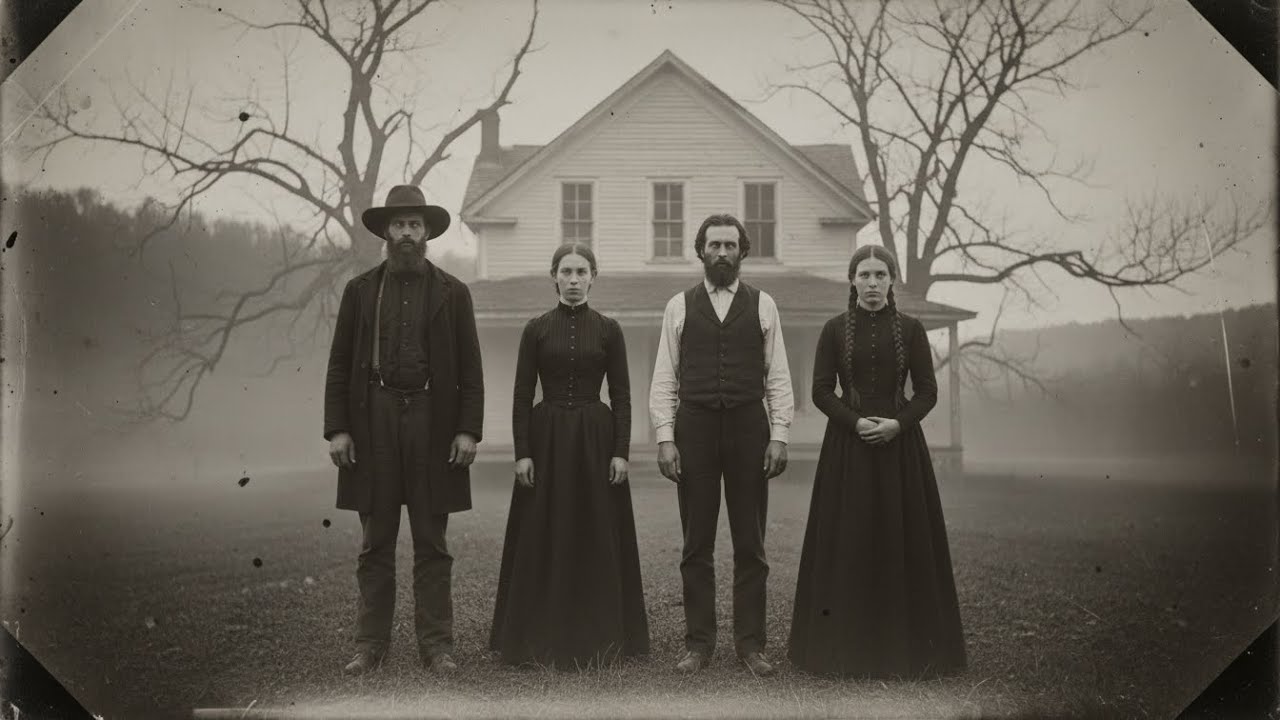
The sound of the lock engaging echoed through the dense air like a last warning. Thomas was a young merchant from eastern North Carolina, new to the area and unaware of the rumors that clung to the Ashford name like moss to stone. He climbed down the mountain far more slowly than he had ascended, that cry echoing in his mind. For days to come, it would plague him, creeping into his daytime thoughts and his nighttime dreams.
He knew he shouldn’t have heard it. He knew he had stumbled upon the fragment of a secret that the family fiercely guarded. And he could not let it go. The mountain communities of western North Carolina in 1924 were essentially cut off from the outside world, connected only by perilous, narrow paths winding between densely forested peaks.
Families living in these isolated areas adhered to ancestral traditions, practicing customs that went all the way back to the first European settlers who had entered those hostile territories. On the higher slopes of Haywood County, where the rocky soil made farming difficult, the Ashford family occupied a vast estate. They were renowned for being reticent, avoiding unnecessary interaction with neighboring communities. The family had been born and had passed away in those mountains, fostering a seclusion that was almost legendary.
People in the neighboring villages whispered about the Ashfords, always with that look of someone who knows too much. Jonathan Ashford, the patriarch, was a powerful man who seldom came down from the mountains. When he did, it was always out of dire need, exchanging animal hides for necessities at the store in Westville. Local traders said he had eyes that seemed to see right through people, a piercing gaze that made even the bravest turn away.
His wife Margaret was a quiet, pale woman who was never seen to smile. The Ashfords claimed a main house made of dark logs and a number of smaller buildings strewn across their property, some so obscured by vegetation that only those who knew the secret routes could find them. From a distance, one could see smoke rising from their chimneys, but the exact number of residents up there was unknown. Thomas could not remain silent about what he had heard.
Over the next few days, he visited the nearby tavern in Westville, where men congregated to exchange rumors and stories after work. His discomfort was evident. His hands trembled slightly as he held his glass, and his eyes constantly strayed to the window, as though he expected something to emerge from the shadows. One evening, an elderly man named Samuel Hartley approached him.
Samuel had spent decades getting to know the mountains and their families, and he was well respected in the area. Observing the young merchant’s agitation, he decided to intervene. Speaking softly enough for only Thomas to hear, Samuel told him what he knew. The family had come to those mountains a century ago, escaping from something no one was certain of.
They established their own remote world in the highest and most hostile places, where no one else wanted to live. Over the years, the Ashfords created traditions and customs entirely different from society at large. They upheld their own laws, rulings, and systems of justice, independent of the county government. Occasionally, whether out of necessity or curiosity, people had attempted to get in touch with the family.
Some came back upset, talking about odd things they had heard or seen. Others just decided not to bring up the subject ever again, as though they had made a silent commitment to forget what they had observed. The people in the area had an unspoken rule: the Ashfords stayed in their mountains in exchange for one not interfering in their affairs. When Thomas heard this, a shiver went through his body.
That muffled lament now had a more unsettling context. He asked Samuel if anyone had ever attempted to look into it further. The elderly man shook his head slowly, describing the size of the mountains and the limits of the law’s reach. Besides, there was no official reason for anyone to go up there, because the Ashfords had never directly caused trouble for the village.
There was more. Samuel told him about an itinerant pastor who, in 1911, had decided to share the gospel with the remote mountain families. He was a resolute individual who believed he could bring spiritual redemption to people living in remote areas. He brought his Bible and his beliefs to the Ashford property, expecting a favorable reception.
Three days later, he came back a totally different person. His hair had turned white. He refused to talk about what he had seen or felt up there, and his eyes were vacant. He left the area a few months later and was never seen again.
Thomas became aware that he had discovered something far more significant than a straightforward business debt. The Ashfords weren’t merely quiet or strange. They were guardians of secrets that defied shared comprehension. And the more he considered the sound he had heard, the more certain he grew that someone inside that house needed help.
Thomas started asking questions around the area, determined to find the truth. He talked to farmers, merchants, and even the local blacksmith who occasionally provided the Ashfords with tools. Every conversation added a piece to the puzzle, revealing a pattern of behavior that had persisted for generations. Strangers were never permitted to stay long on the Ashford land.
They never brought other family members to the village, carrying out their transactions swiftly and alone. Something particularly interesting came from the blacksmith. He claimed that Jonathan Ashford had occasionally ordered heavy, sturdy chains and locks, inappropriate for a modest rural property. When asked about their purpose, Jonathan would give evasive answers, stating only that he needed to keep his possessions safe from wild animals.
The blacksmith had his doubts. Those chains were designed to hold something far more powerful than any local animal. A theory began to form in Thomas’s mind. It was unsettling, but it appeared to be the only one that made sense.
What if someone was being held captive on that property? What if the wail he had heard came from a person detained against their will? It was a terrifying thought, but unavoidable. He had to find the truth, even if it meant facing one of the most feared families in the mountains.
He knew he couldn’t just return and demand explanations. A direct approach could endanger his own life. He needed a strategy, a way to observe the property covertly and gather evidence before involving the authorities. Thomas deliberately picked a night without a full moon.
The darkness would be his greatest ally. He brought only the necessities: a hunting knife, more for psychological protection than for actual use, a notebook to document any discoveries, and a small flashlight he would use with great care. The climb at night was far more terrifying than during the day. The darkness seemed to amplify every sound in the forest.
His heart pounded at every movement among the trees. The wind blowing through the pines created an unsettling melody, as though the trees were whispering warnings. He moved slowly and carefully, and it took him nearly five hours to reach the edge of the property. Some of the main house’s windows were lit.
Occasionally, shadows moved behind the heavy curtains. Someone was awake, even at that late hour, as evidenced by smoke rising from one of the chimneys. Thomas decided not to go straight to the main house. Instead, he circled the edge of the property, hiding among the trees, taking in the smaller structures that comprised this odd family complex.
There was a sizable barn, presumably for tools and supplies. There was a building that appeared to be a workshop, with a broken window revealing an extinguished forge. And then there was a small, remote cabin, partially built into a rocky hillside and nearly obscured by vegetation. He was immediately drawn to that cabin.
It had a heavy wooden door with metal bars for reinforcement, and no windows. Unlike the other buildings, this was no typical structure. It was something made expressly to hold something, or someone. Thomas pressed his ear against the cabin’s wooden wall.
At first, all he could hear were the sounds of the forest and the wind. But after several minutes of complete quiet, he heard it. Breathing from inside that structure, heavy and erratic. There was a living, breathing person inside.
His theory had been horrifyingly validated. He attempted to look through gaps in the wooden planks, but the interior was completely dark. He considered knocking, trying to communicate with whoever was inside, but the risk was too high. There was no way of knowing what the Ashfords would do if they found him there.
He decided to back off, record his observations, and consider his next move. As he was leaving the cabin, he heard two individuals approaching, speaking in low tones. Thomas froze, his entire body tense. He threw himself behind a cluster of thick bushes, burying himself in the leaves, trying to slow his rapid breathing.
Through the branches, he could make out the silhouettes of two men, one of them Jonathan Ashford, and a younger man who was most likely a member of the household. They stopped very close to his hiding place. Jonathan made reference to maintaining customs and preserving the family legacy at all costs. The other man’s voice sounded doubtful, perhaps weary, as he asked a question.
They had taken an oath, Jonathan responded firmly. No external law mattered more than the blood of the family. Every word sounded absolute, an unquestionable assertion. Then Jonathan said something that chilled Thomas to the bone.
He said they had to make sure everything was secure for the night in the cabin. The two men headed straight for the structure where Thomas had been only minutes earlier. Jonathan removed a large key from his pocket and pushed open the heavy door. For a brief moment, the interior was illuminated by a dim flashlight beam, but from his hiding place, Thomas could not see what was inside.
He heard muffled voices, a few words he couldn’t understand, and then the door was carefully closed and locked again. The two men stood there for a few more minutes. Jonathan instructed the younger man on a night watch matter, mentioning shifts, designated check-in times, and the importance of keeping their guard up at all times. They appeared to be protecting something very precious, hazardous, or both.
After what felt like an eternity, they finally departed toward the main house. Thomas waited at least thirty minutes before he dared to move. When he finally got up, his muscles protested from the awkward position. He knew he had pushed his luck past all reasonable bounds.
He needed to leave immediately. But now he had confirmation. Someone was being detained in that cabin. Someone the Ashfords were fiercely protective of.
The journey down the mountain was sheer terror. Every shadow seemed to harbor danger, every sound made him think he was being followed. He essentially ran the remaining portions of the trail, only slowing at dawn when he saw the village’s first lights. His branches scratched his face, the bushes tore his clothes, but he had accomplished what he had set out to do.
Over the next few days, Thomas was constantly agitated, pondering what he should do next. He knew that merely reporting a locked cabin and strange noises to the authorities would not suffice. He needed something more tangible. But every day that passed meant that the person in that cabin continued to suffer.
During one of those restless nights, Thomas had an unexpected guest. There was a knock on the door of his rented room above the grocery store, three gentle but insistent knocks. He opened it to discover a woman he had never seen before. She had dark hair in a plain bun, eyes that betrayed deep fatigue, and a youthful appearance, possibly in her early twenties.
She was dressed simply but neatly, and she exuded an alertness that made her seem like an animal always on the run. She requested permission to enter, looking anxiously around the deserted corridor. Despite his surprise and caution, Thomas let her in. She identified herself as Eleanor as soon as he shut the door.
Her next words confirmed all of Thomas’s worst suspicions. She had fled the Ashford estate just two nights prior, after living in those mountains for years. She spoke softly, stopping frequently to listen for any noise that might suggest she was being followed. Eleanor had not been born in the mountains.
She had arrived in 1919, taking a position as the family’s governess, a job in return for room and board that seemed like a fair offer at the time. But she soon saw there was a serious problem there. The Ashfords weren’t merely quiet people. They followed laws that defied all civilized reasoning.
Everyone on the property was completely under the family’s control, including when they were allowed to eat, sleep, work, and even speak. There were penalties. Eleanor mentioned periods of seclusion in the cabin Thomas had found, as punishment for any deviation. She had been imprisoned there for days after attempting to challenge one of Jonathan’s directives.
What Eleanor found most unsettling was the philosophy guiding the family. Jonathan Ashford believed they were the defenders of a long-standing custom that had to be protected from the corruption of the modern world. He viewed isolation as a sacred obligation, not a choice, and all residents of the property were required to abide by this strict code, whether they had come voluntarily or by accident. The immediate family was not the only people living on the property.
Over the years, some had been brought there as distant relatives. Some, like her, had come by accident and were never able to get away. Jonathan maintained a consistent surveillance system, making sure nobody could flee with ease. Everyone knew that attempting to escape and failing would have dire repercussions.
The surrounding mountains were dangerous, and the trails were unclear. Eleanor explained that she had heard about a merchant who had been spotted prowling the property at night and asking too many questions, through conversations among the Ashfords. She reasoned that this individual might be their only opportunity to receive assistance. But she also brought a serious warning.
Jonathan knew that someone had been on the property that night, even though he wasn’t certain who it was. He was more paranoid than ever, and surveillance had increased. Even worse, he intended to relocate some of the individuals he maintained on the property to even more isolated mountain areas where they would be impossible to find. There was not much time left.
Thomas realized he could not wait any longer. He now had a witness who could support his account. He and Eleanor went to the county seat the following day to speak with the sheriff. It was a long and stressful trip.
Eleanor constantly looked back, certain the Ashfords were pursuing them. A man named William Garrett served as sheriff of Haywood County, known for his fairness and practicality. He listened with increasing interest as Thomas and Eleanor told their story. At first, doubt flickered in his eyes, the instinctive mistrust of a man used to hearing rumors and exaggerations.
But as Eleanor gave detailed information about the land, the buildings, and the occupants, his face changed. Garrett tested the account’s consistency by posing a number of questions. He was interested in names, dates, and precise locations. Eleanor answered all of them with an accuracy that could only come from someone who had actually lived through it.
The sheriff leaned back in his chair and considered the situation. He admitted he had heard rumors about the Ashfords over the years, but he had never had sufficient hard proof to support a formal investigation. Now, with Eleanor’s testimony, things were different. Garrett explained that planning an expedition to that property would not be easy.
The terrain was challenging, the location remote, and he would have to assemble enough men to handle a potentially hostile family. He also needed to proceed legally, to ensure any evidence gathered could be used properly. He said he would take action, but he needed a few days to get everything ready. Thomas felt a mix of anxiety and relief.
At last, the authorities were involved, but every day of waiting meant more suffering for those still stranded in the mountains. Eleanor accepted Thomas’s offer of his room so she could remain hidden while preparations were made. That night, as Thomas sat in a chair by the window watching Eleanor sleep, he thought about how quickly things had gotten out of hand. A few weeks ago, he had been merely a merchant attempting to collect an unpaid debt.
Now he was at the center of an investigation that might uncover secrets the Appalachian Mountains had been hiding for generations. He stared out into the darkness, imagining the people still stranded on that property, unaware that help was finally on its way. Three days of nearly intolerable stress went by. Eleanor hardly ever left her room.
Thomas brought her water and food, trying to keep her mind off the fear that was always visible in her eyes. During these conversations, he learned more about the way of life on that property. Eleanor described a strict hierarchy with Jonathan at the top, making all of the crucial decisions. His word was unchangeable law, and questioning his orders was treason, not just against him, but against the entire lineage of the family.
He constantly talked about how their traditions were pure, how the outside world had lost the genuine values his ancestors had brought from far-off places. The family engaged in strange customs, and everyone was required to attend nightly ceremonies. Eleanor was kept in a separate room during the most crucial parts, but she heard chanting in a language she didn’t understand. The next morning, grim looks would be on everyone’s faces, as though they were reaffirming a long-standing agreement they would uphold for generations to come.
What scared Eleanor most was the Ashfords’ unwavering belief that they were acting morally. They acted not with needless brutality, but with a deliberate coldness, as though they were simply carrying out assigned tasks. Jonathan sincerely believed he was keeping something holy and safeguarding his family. It was impossible to reason with him.
Sheriff Garrett quietly planned his expedition. He enlisted four dependable men, all with mountain experience. According to the official narrative, they were investigating reports of suspicious activity in the area, but they didn’t specifically mention the Ashfords until they had hard proof. Garrett knew he had to move forward cautiously to ensure everything was done legally and to protect his group.
Garrett arrived at the grocery store on the morning of the fourth day. It was time to go. Eleanor would stay in the village, safe, where her presence couldn’t complicate matters. Despite her reluctance, she forced Thomas to swear he would do everything within his power to help the people who remained.
Six men set out at first light, riding horses for the first few kilometers, then walking when the trail grew too steep. The climb was quiet, each man absorbed in his own thoughts. Thomas acted as guide, remembering the route he had followed twice before, though everything looked different in daylight. As they neared the property, Garrett ordered everyone to slow down and reduce noise as much as possible.
He wanted to observe and gain an understanding of the situation before making an official announcement. The main house and surrounding buildings became visible through the trees. It appeared to be a typical Ashford morning, activity, people going about their daily lives. Garrett chose a straightforward approach.
He had the legal right to be there, and there was no use in trying to surprise them. They emerged from the forest and headed for the main house, Garrett in the lead, his sheriff’s badge prominently displayed. Nearly instantly, people halted their activities and turned to face the group, their expressions ranging from shock to fear. Before they even reached the door, Jonathan Ashford appeared.
In the bright daylight, he was perhaps even more formidable than Thomas remembered. His gaze swept over the group, stopping momentarily on Thomas with a familiar expression before settling on the sheriff. There was no fear in his posture, only a kind of weary resignation, as though he had known this moment would eventually come. Garrett formally introduced himself and stated he was there to investigate serious claims regarding the property’s living conditions.
Jonathan listened in silence, his face an impenetrable mask. When the sheriff finished, he asked if Garrett had a warrant. Garrett admitted he didn’t, but argued he had enough testimony to justify his presence, and that he could return with a warrant if necessary. Jonathan considered this for a long moment before finally shrugging and gesturing that they could go inside.
The house was dark and claustrophobic inside, with heavy furniture and thick curtains blocking most of the natural light. There was a musty smell, and something else that Thomas couldn’t identify, something that made his stomach churn. Garrett began asking questions, requesting to see every area of the property and to speak with everyone living there. Jonathan cooperated with a disturbing calm, as though he had nothing to hide.
But when Garrett mentioned the secluded cabin, something shifted. Jonathan tensed, his jaw visibly clenching. He said that structure was only used for storage, with nothing of interest there. Garrett insisted, and after a long, uncomfortable pause, Jonathan agreed to show him the place.
There was an urgency in his movements now, as if he were trying to think of something quickly. As they walked toward the cabin, Thomas noticed other family members watching from a distance, their expressions difficult to decipher. The group reached the heavy door, and Jonathan pulled the key from his pocket with slow, deliberate movements. His hands trembled slightly as he unlocked the door, the first sign of real emotion he had shown since their arrival.
Garrett pushed open the door, revealing the dark interior. It took a few seconds for his eyes to adjust, but when they did, what he saw inside changed everything. It wasn’t a storage place. It was a makeshift cell, with chains attached to the walls and a thin mattress on the floor.
There were clear signs that someone had spent significant time there, marks on the walls, personal belongings scattered about. In the farthest corner, huddled as if trying to disappear into the shadows, was a human figure. She was a frail, thin woman, with disheveled hair covering part of her face. She didn’t look up when the door opened, as if she had given up hope of any change in her situation.
Her clothes were simple and worn, and there was a disturbing stillness about her, the resignation of someone who had lost all hope long ago. Garrett slowly entered the cabin, speaking in a low, reassuring voice. He identified himself as sheriff and explained that she was safe now, that no one would hurt her. The woman finally looked up.
Her eyes were filled with deep confusion, as if she had forgotten that a world existed beyond that wooden structure. She didn’t speak, only stared at Garrett with a blank expression that broke the hearts of everyone present. Thomas felt a wave of anger rise in his chest as he looked at Jonathan Ashford. The patriarch remained silent, his face pale, but still retaining that strange dignity, as if even in the face of this clear evidence, he believed he had done what was necessary.
Garrett signaled to one of his men to help the woman out of the cabin, guiding her with extreme care into the daylight. It was then that Jonathan finally spoke. His voice was tired but firm. He explained that the woman was his younger sister, Rebecca.
He said she had become mentally ill years ago, in 1920, and had begun exhibiting behaviors that endangered herself and the family. Jonathan claimed that keeping her in that cabin was a form of protection, not cruelty. She needed to be contained for her own sake, and the family lacked the funds to place her in a far-off institution. They took care of their own in the mountains in their own way.
Garrett’s disbelief grew as he heard the explanation. He pointed out that regardless of the situation, there were proper ways to handle health concerns, and that it was never acceptable to keep someone in such cruel conditions. Jonathan merely shook his head, claiming the sheriff didn’t comprehend, that the rules of the outside world didn’t apply there. The tension in the situation rose.
The other Ashford family members had gathered at a distance, observing with solemn looks. Garrett announced that Jonathan and possibly other family members would be held accountable, and that Rebecca would be brought to the village for proper care. Jonathan took a step forward, his stance changing from defensive to menacing. He claimed the sheriff was abusing his power, that he would not allow them to take a member of his family.
The other Ashfords began to advance slowly. Garrett’s men reached for their weapons out of instinct, but the sheriff held up a hand to encourage composure. It was Rebecca who relieved the tension. She started talking, her voice surprisingly clear despite its lack of use.
She expressed her desire to go outside, to see the unobstructed sky, to feel the wind on her face without any walls surrounding her. Her words silenced everyone. Even Jonathan appeared affected, a change in his expression barely perceptible. Garrett took advantage of the moment to gently restate his position.
Rebecca had the freedom to decide her own fate. No one would suffer needless harm. She had every right to leave if she so desired, but she was also free to stay with the family. Jonathan remained silent for a considerable time, engaged in an internal conflict between his beliefs and the reality forced upon him.
At last, he stepped back and nodded. Rebecca was free to leave. But he insisted that Garrett tour the rest of the property and speak with all the residents, so the sheriff would understand that his family wasn’t made up of monsters, but rather individuals attempting to uphold a way of life they felt was right. Garrett agreed, realizing that understanding the whole situation was crucial.
Hours of heated discussions and unsettling disclosures followed. Garrett and his men were shown around the property, encountering a variety of people living in conditions ranging from austere to problematic. Some distant relatives had moved there voluntarily over the years; others had been brought there against their will. Some employees stayed because they had nowhere else to go.
Others, like Rebecca, were kept for reasons the family deemed acceptable, but that clearly crossed the boundaries of ethics and law. A pattern emerged. Under the guise of family custom, the Ashfords operated under a system of total control. Jonathan sincerely believed he was acting in everyone’s best interests, maintaining law and order, protecting the weak.
But this protection came at the expense of personal autonomy, freedom, and the fundamental dignity every person is entitled to. Thomas was both fascinated and horrified as he observed everything. He had assumed he would find simple wrongdoers holding people captive, but the truth was more nuanced and more unsettling. The Ashfords were not monsters in the conventional sense.
They were individuals who had established their own remote society with distinct laws and a warped, nearly unrecognizable definition of family. As the sun began to set over the mountains, Garrett assembled his group to determine their course of action. Rebecca and anyone else who wanted to leave would accompany them down. There would be legal repercussions for Jonathan and the major family members, but Garrett understood the particulars of this case would make prosecution extremely difficult.
Eleanor had been right about everything. Now, because of her courage in fleeing and asking for help, and because Thomas had persisted in not ignoring what he saw, the people imprisoned on that property had a chance at freedom. As they prepared to descend the mountain with Rebecca and a few others who had chosen to leave, Thomas couldn’t shake the feeling that he was only touching the surface of something far deeper. The Ashford estate was just one of the many mysteries of the Appalachian Mountains.
How many other families followed customs the outside world would never understand, living in similar seclusion? How many others were stranded in forgotten places, waiting for someone to come looking for them? When they arrived in the village, word of their return spread quickly. People gathered in the streets, curious and whispering.
Eleanor stood waiting in front of the grocery store. As she saw Rebecca, her face shifted from relief to something like sympathetic sadness. She approached slowly, speaking quiet words only Rebecca could hear. An instant connection formed between the two survivors.
Garrett arranged temporary lodging for Rebecca and the others who had descended from the mountain, ensuring they had food, clean clothes, and secure places to sleep. He briefly detained Jonathan, primarily for his own protection, because rumors were starting to agitate the local population. Garrett knew he had a long way to go before he could properly resolve the legal situation. Over the next few days, Westville became a hub of interest and conjecture.
Every discussion about the Ashfords produced new theories about what had actually transpired on that remote property. Some expressed empathy, claiming the family was merely trying to uphold its customs in a world changing too quickly. Others, outraged by the conditions Rebecca and others had endured, called for severe justice. Thomas was frequently approached by people wanting to hear his account.
He tried to respond truthfully, but realized that no single story seemed to convey the full scope of what he had seen. Eleanor and Rebecca spent much time together, finding solace in the company of someone who genuinely understood them. As days passed, Rebecca began to speak more, sharing fragments of memories from her life before the cabin. She talked about a time when she had hope for the future, when she was free to walk in the mountains and help with household chores.
But she had been transformed. Jonathan had seen her restlessness as illness, her need to question the rules as dangerous rebellion. Jonathan’s account of what happened was different. He maintained that Rebecca had become violent, threatening to flee and get lost in the mountains, endangering the family’s safety.
He saw the cabin as an essential remedy, a means of ensuring her safety until she calmed down. He didn’t seem to care that this had gone on for years, that she had never had a chance to get well or receive the help she needed. Garrett interviewed all parties involved, attempting to get a complete picture. He learned the Ashfords’ story was even more complex than he had thought.
They had brought a worldview already considered extreme when they arrived in the mountains, fleeing persecution elsewhere. Generations of seclusion only strengthened these ideas, creating a microcosm in which accepted social norms were irrelevant. Garrett was most struck by Jonathan’s total conviction. His actions showed no signs of malice, only a resolute belief that he was fulfilling his duty as head of the family.
He spoke of responsibility, the need for sacrifice, the importance of preserving the lineage and its traditions. Even though his values appeared irrational and cruel to others, he seemed to live in a parallel reality where they made perfect sense. Rebecca found adjustment to life away from the mountains difficult at first. Thomas began spending time with her, taking her on short strolls around the village, showing her simple sights, the grocery store, the church, the little park where people gathered.
She was curious about everything, absorbing information with a hunger that made clear how many years she had missed. One afternoon, while they were walking by the village river, Rebecca stopped to watch the water flow. She told Thomas she had loved that river when she was younger, before everything changed. She remembered swimming there during hot summers, helping wash clothes on the banks, dreaming of one day following the river wherever it led, exploring what lay beyond the mountains.
The weight of missed chances and stolen years was evident in her voice. Thomas came to see that Rebecca was more than just a helpless victim of Jonathan’s oppression. She was a complicated individual who had been gradually broken down, each day in the cabin taking away more of her essence until nearly nothing remained. The healing process would take a long time and might never be complete.
Some wounds were too deep. Some losses could not be recovered. But there was also hope. The potential to reconstruct something, even if it differed from what might have been.
Other Ashford family members who had stayed on the property began to come down to the village, either to see Jonathan or simply to learn what had happened. Their presence increased tensions, as many villagers perceived the entire family as complicit in Jonathan’s behavior. But conversations with these participants revealed a more complex reality. Many had lived under the same control system, obeying commands out of fear, or because they had no other option, or because they genuinely believed what Jonathan preached.
Jonathan’s wife, Margaret Ashford, was among the last to come down. She was a tragic figure, a woman who had lived for decades beside a man whose beliefs profoundly shaped her life. When she spoke during Garrett’s interview, her voice was hesitant and low, as though she had forgotten how to voice her own thoughts. She acknowledged that she had known about Rebecca, had witnessed her sister-in-law’s decline over time, but had never questioned Jonathan’s justification.
Perhaps more unsettling than Jonathan’s act of conviction was her quiet complicity, demonstrating how systems of control maintain themselves through everyone’s complacency. The legal matter remained complex. Garrett consulted authorities in larger cities, seeking precedent for such an uncommon case. The answers were consistently ambiguous and inadequate.
Technically, Jonathan had kept someone against her will in appalling conditions, but he was a family member claiming to act in her best interest. Particularly in family situations and in isolated areas where law enforcement had historically been lax, the laws of the time provided few protections. Thomas began to consider the nature of justice and retribution. He wanted to see Jonathan punished for what he had done to Rebecca and perhaps others, but he also acknowledged that Jonathan was a product of circumstances and beliefs beyond his uniqueness.
Would punishing one man resolve the larger issue? Were there other mountain families running similar systems? What could he do to prevent this from happening again? During a late-night conversation on the porch of the grocery store, Eleanor offered another perspective.
True justice, she argued, would not come from imprisoning Jonathan or destroying the Ashford family. It would come from ensuring Rebecca and others like her had the chance to start over, to discover meaning and purpose after trauma. It would come from raising awareness of how isolation and unquestioned customs can become prisons, even when constructed with what some might regard as noble intentions. Months passed, and a new normal began to take hold.
Rebecca found employment at a local laundromat, a simple job that gave her a sense of purpose and social connection. Her nightmares persisted, and she still had days when she was overwhelmed by sadness, but she also experienced genuine joy and small victories that helped her rebuild. Jonathan was eventually released with strict guidelines. He returned to the mountains, but he no longer controlled the family.
Many members chose to either stay in the village or relocate, attempting to build lives free from the influence of customs that had taken root. Even among those who remained with Jonathan, the dynamics had irrevocably changed. Winter descended upon the North Carolina mountains with its usual intensity, covering the peaks with snow and turning the trails into perilous roads. After years of confinement, this was Rebecca’s first cold season in freedom, and every snowflake that touched her face felt like a small miracle.
She had begun to smile from time to time, a tentative, shy, but sincere smile. Thomas felt that all the risk and work had been worthwhile as he quietly observed these changes. Eleanor emerged as a key figure in the community. She organized informal gatherings where survivors of family control systems could talk about their experiences without fear of judgment, creating a safe space.
Her quiet strength encouraged others to face their own histories and look for better paths forward. Thomas found that the experience had altered him. What had started as a straightforward business issue became something that changed his purpose. In addition to his work as a merchant, he began visiting other isolated mountain communities, quietly observing family dynamics and looking for signs of trouble.
When he encountered a family living under somewhat milder but similar circumstances to the Ashfords, he shared his observations with Sheriff Garrett, who conducted an investigation with the same diligence he had shown in the Ashford case. Not all situations were as severe, but they all revealed the ways remote families created their own laws and hierarchies of power. Garrett had developed an almost philosophical attitude toward his work. He recognized the law’s severe limitations in family matters, particularly in areas where custom outweighed outside law.
But he also believed there was room for slow change, for conversations that planted seeds of doubt in seemingly unassailable systems. Some families he visited began to open up to the outside world, allowing younger members to visit the village more freely. Spring brought renewal not just to nature, but to those affected by the previous year’s events. Rebecca had made great strides.
She formed genuine friendships and took up hobbies she had lost during her confinement. She discovered a talent for gardening, spending hours tending a small plot of land behind the house where she lived. The process of creating life was profoundly therapeutic, and the plants flourished under her patient care. One afternoon, Rebecca invited Thomas to go hiking with her, not to the Ashford estate, but simply to walk the paths she had known as a young woman.
She wanted to return to the mountains. Thomas paused, fearing this would trigger painful memories. Eleanor, however, supported the idea, saying Rebecca needed to reclaim those places, to transform frightening ground into peaceful places. They ascended slowly, Rebecca pausing often to take in details she remembered.
She pointed out particular trees, small streams, and rock formations from her childhood. She talked about how the mountains were her home, not her prison, how she used to run along those trails fearlessly. Thomas understood that this trip was necessary for her healing, a way of repairing her relationship with a place tainted by years of hardship. When they reached a natural lookout point overlooking the valleys below, Rebecca stood silently for several minutes.
Then she began talking about forgiveness. Not the simple kind that ignores wrongdoing, but the sophisticated kind that acknowledges pain while attempting to release resentment. She admitted she was still angry with Jonathan, and probably always would be, but she also recognized that holding onto that anger would only extend her imprisonment. Thomas listened without interrupting, realizing Rebecca was speaking something important, something perhaps he himself should consider.
Everyone involved had been altered by the experience in ways still being discovered. There was no easy fix, no happily ever after where everyone was content. The only task remaining was learning to live with what had happened, and attempting to build something better from the ruins. As they made their way back down to the village, they encountered one of the younger Ashford family members walking in the other direction.
Thomas recognized the young man from the initial investigation. He had been present during the questioning. The young man paused, uncertainty flickering across his face. Then, without a word, he nodded, and they continued on their separate paths.
Thomas watched him disappear into the trees. What would become of the Ashfords, he wondered. What would become of that isolated world they had built so carefully, removed from outside influence and judgment? Some of them had stayed in the village, learning to live among people who had once been nothing but rumors to them.
Some had remained with Jonathan on the mountain, clinging to their old ways. The young man walking up the trail seemed to belong to both worlds, caught between the life he had known and whatever lay ahead. In the end, Thomas realized, it wasn’t just Rebecca who had been released from that cabin. The Ashford family itself had been freed from the weight of its own isolation, even if they didn’t know it yet.
Through all of it, the story of what had happened on that mountain had quietly spread, passed from neighbor to neighbor, from village to village, until it reached places that had never heard of the Ashfords. Some dismissed it as exaggeration. Others heard in it a warning about the invisible boundaries families create, the lines we draw between protection and imprisonment, between tradition and cruelty. The Appalachian Mountains kept their secrets.
But one of them had finally been told.
