On April 30, 1945, inside the Führerbunker buried beneath the rubble of Berlin, Eva Braun took her own life at the side of the man she had loved for sixteen years. The woman who had once been a seventeen-year-old shop assistant in a photography studio, who had twice attempted to kill herself when the war became too much to bear, finally succeeded with cyanide and a gunshot. Hardly anyone in Germany had known that she and Hitler were married. She had been the Führer’s only known lover, and she would be dead before the world ever learned her name.
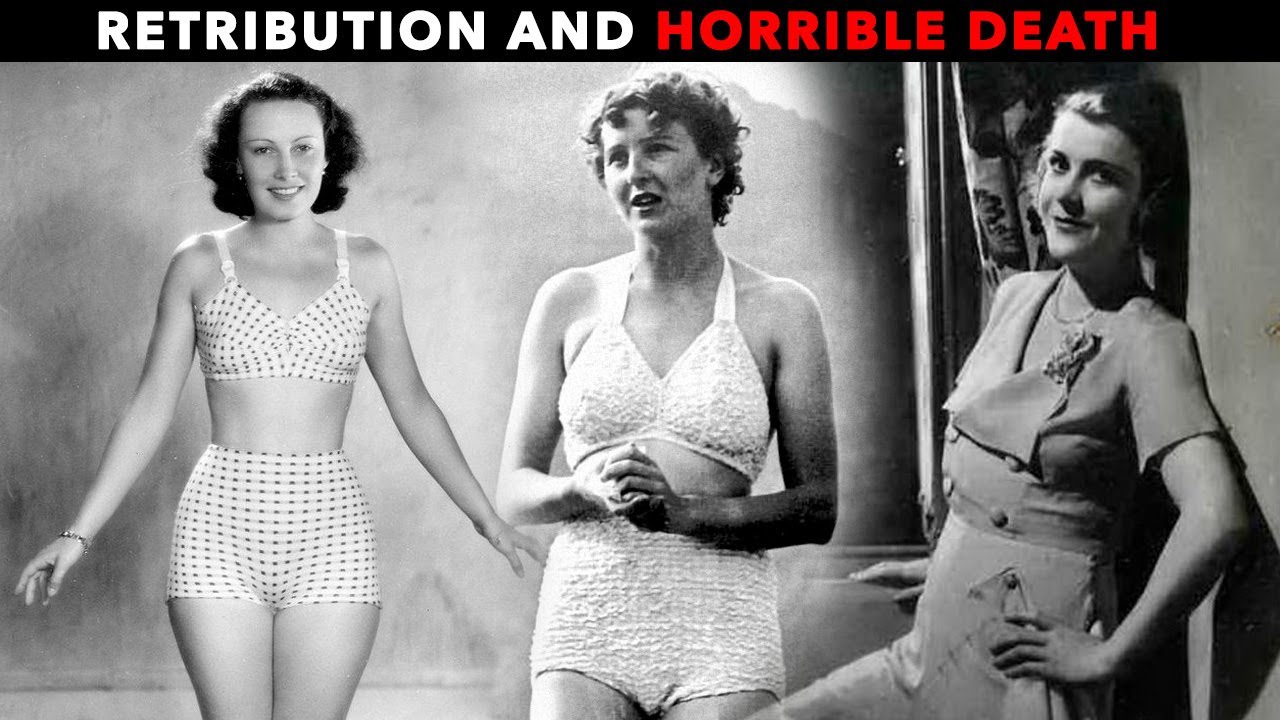
She first encountered him in 1929, when she was seventeen and he was forty. The bond between the middle-aged politician and the young girl formed instantly. At every chance, Hitler showed her kind gestures of attention, visiting the photography studio where she was employed. One day he proposed: “Allow me to invite you to the opera.”
“
Eva answered, “You see, there are always men surrounding me, so I understand how to value the happiness of being in a lady’s company.”
Even with his clear fondness for the girl, Hitler demanded that she be investigated for Aryan ancestry. Only once confirmation arrived that Eva Braun was indeed of pure Aryan blood did the future Führer relax and let the relationship continue. The affair stayed almost completely concealed from the German public.
As conditions at the front deteriorated, Eva made two attempts to end her life, but neither succeeded. On the last day of April 1945, however, she carried out her final and successful attempt, dying at the side of the man who had first wooed her in that Munich studio. Eva Braun was not the only woman linked to Hitler, though the others are far less familiar. There was Renate Müller, a talented actress who was, strangely enough, Hitler’s mistress, and about whom very little is known.
It is unclear where the Führer met her, but by 1935 there was at least one instance of what could be described as adultery between the two lovers. Hitler, a thoroughgoing psychopath, frequently took pleasure not in the act itself but in something far stranger. According to the memoirs of a certain Zesler, to whom Müller confided everything shortly before her death, the routine was rather unusual. The two undressed and were about to get into bed when Hitler flung himself onto the floor and demanded that she trample him.
The scene was unbearable for her, yet in the end she yielded to his wishes and began stomping on him with her feet. This aroused him greatly. He begged for more and more, while repeating the whole time that he did not deserve this, that he was not even worthy of sharing a room with her. The harder she stamped on him, the more excited he grew.
Incidentally, the Führer was quite often satisfied in the same manner by his official wife, Eva Braun. Apparently he believed that true leadership could be fully grasped only by being personally trampled. Renate Müller took her own life in 1936, leaping from a window on Hitler’s orders. Other women at the summit of the Third Reich led very different lives.
Emma Göring, a well-known theater and film actress in pre-war Germany, wed Hermann Göring in 1935. Since Hitler’s wife was never presented to the world, Emma Göring swiftly earned the title of First Lady of the Reich. The couple had a daughter, Edda, and Adolf Hitler himself served as her godfather. Following Germany’s surrender and during the denazification trials, Emma Göring was sentenced in 1948 to one year in prison and stripped of a third of all her property.
In addition, she was barred from performing in theater and cinema for five years. In 1967, Göring’s wife released a book of her memoirs. She passed away after a long illness in 1973. Magda Goebbels, Hitler’s favorite, possessed a truly Aryan appearance and became the face of the Ministry of Education and Propaganda.
Hitler himself insisted on this. She made her mark on the work of the ministry headed by her husband, visited hospitals, and took part in every public event, comforting widows and mothers who had lost their sons. Interestingly, Magda had already been married before she wed Goebbels. That husband was twenty years her senior, and his children from his first marriage were practically the same age as nineteen-year-old Magda.
What is more, the husband had adopted the three sons of a deceased friend, and Magda was also expected to care for them. In the end, the girl managed to obtain a divorce, taking with her the son born from that marriage. When she married Goebbels, Magda gave birth to six children. After Hitler killed himself, Magda wrote her final letter to her son from the first marriage, Harold Quandt: “The world that comes after the Führer is not worth living in, and so I am living and taking the children with me.
It is a pity to leave them to live in the life that will follow. Merciful God will understand why I decided to take on my own salvation.”
On May 1, 1945, all of the Goebbels couple’s children died from an injection of morphine and poison. Exactly who did it—the doctor or the parents themselves—was never established.
After the children’s deaths, Magda Goebbels killed herself together with her husband. Gerda Bormann, the wife of Martin Bormann, was unlike the other wives at the top of the Third Reich. She was, almost from the start, a committed Nazi. Her father likewise endorsed the ideas of the National Socialist Party.
The beautiful Gerda astonished everyone by selecting Bormann as her husband. Her parents had hoped their daughter would marry a prominent figure in the NSDAP, but not the unremarkable Bormann, who at that point had achieved no particular distinction and even had a criminal record for causing bodily harm. According to the recollections of contemporaries, Gerda and Martin genuinely loved each other. It was Gerda who in 1944 urged German women to abandon monogamy.
Gerda herself had experience with this. For instance, she paid no attention to Bormann’s flirting with other women in her presence. What is more, when Bormann began a fairly serious relationship with actress Manja Behrens, he always sought Gerda’s advice and even shared his experiences. His loyal wife helped however she could.
After Germany’s surrender, Martin Bormann fled. Gerda was admitted to a military hospital with a diagnosis of carcinoma. She died a few weeks later from mercury poisoning, which had been used in a course of chemotherapy. Lída Baarová, a Czech actress, was invited to work in Germany and managed to win the sympathy of Hitler himself.
Not surprisingly, she became a frequent guest at receptions, and the girl’s acting career advanced very rapidly. Once, in an apartment next door to the Goebbels couple, Lída very quickly drew the attention of the Minister of Propaganda. Goebbels lost his head so completely that he was even prepared to divorce his wife. The Minister of Propaganda submitted his resignation so that he could divorce officially and leave with his beloved.
Hitler, however, refused the resignation and flatly barred Baarová from any further contact with Goebbels. Her career then fell apart. Following the war, in Czechoslovakia, she was found guilty of collaborating with the Nazis. Yet while still behind bars, Baarová embarked on a fresh romance, married, and eventually made her way back to acting.
Reaching for the stars was no longer an option, and the memoirs she published, in which she discussed her ties to Goebbels, brought her no renown. Anneliese von Ribbentrop, by contrast, found her husband on her own. At a time when Ribbentrop had five children and wore nothing more than a lieutenant’s shoulder straps, Anneliese managed to arrange a meeting with Hitler. Thanks to this, the Führer soon took notice of Ribbentrop and appointed him Minister of Foreign Affairs.
Anneliese faced no conviction after the war. She lived quietly and in comfort, bringing out her memoirs after her husband did. She also went to court over property with her relatives, yet her life was thoroughly full and prosperous. Inga Ley, wife of Labor Front leader Robert Ley, had three children with her husband.
Even amid the war, the couple delighted in amusement and a leisurely way of life. Leading figures from science, art, and literature of the Third Reich were frequent guests at the Ley home. After her final childbirth, Inga became dependent on morphine, justifying it by the pain she endured. Despite treatment for the addiction, the pull of the drug never left her.
In the end, unable to endure another round of treatment after morphine was withdrawn, Inga shot herself in 1942. Ilse Hess was known not only as the wife of Hitler’s Deputy Rudolf Hess but also as Hitler’s personal secretary. It was Ilse who typed out the famous Mein Kampf. Wholly committed to Nazi ideology, Ilse Hess took part in every event, served as her husband’s secretary, and was, in today’s terms, a media figure.
After Nazi Germany fell, she spent roughly a year in prison. She later ran a boarding school, and she published letters and correspondence with her husband, which hold considerable value for researchers. Right up to her death, Ilse Hess stayed loyal to the ideology of Nazism. The wives and mistresses of the Third Reich’s leaders lived lives as different as could be.
Some vanished alongside their criminal husbands. Some tried to conceal the fact of their ties to murderers. And some, like Inga Ley in her morphine fog or Renate Müller in her brief, tragic fame, were themselves swallowed up by the regime they had married into.
In the end, only a handful, such as Anneliese von Ribbentrop and Ilse Hess, reached old age, bearing with them the memory of what they had seen and, in some cases, the ideology they would not give up.
