In this photograph she is twenty-nine, dressed in the uniform of the Women’s Auxiliary Air Force. Something about her face doesn’t quite add up. She has the look of a person who would show you kindness on your worst day, not someone three months from becoming the only Allied spy still at work in occupied Paris. The Nazis put her to death at Dachau on the morning of September 13th, 1944.
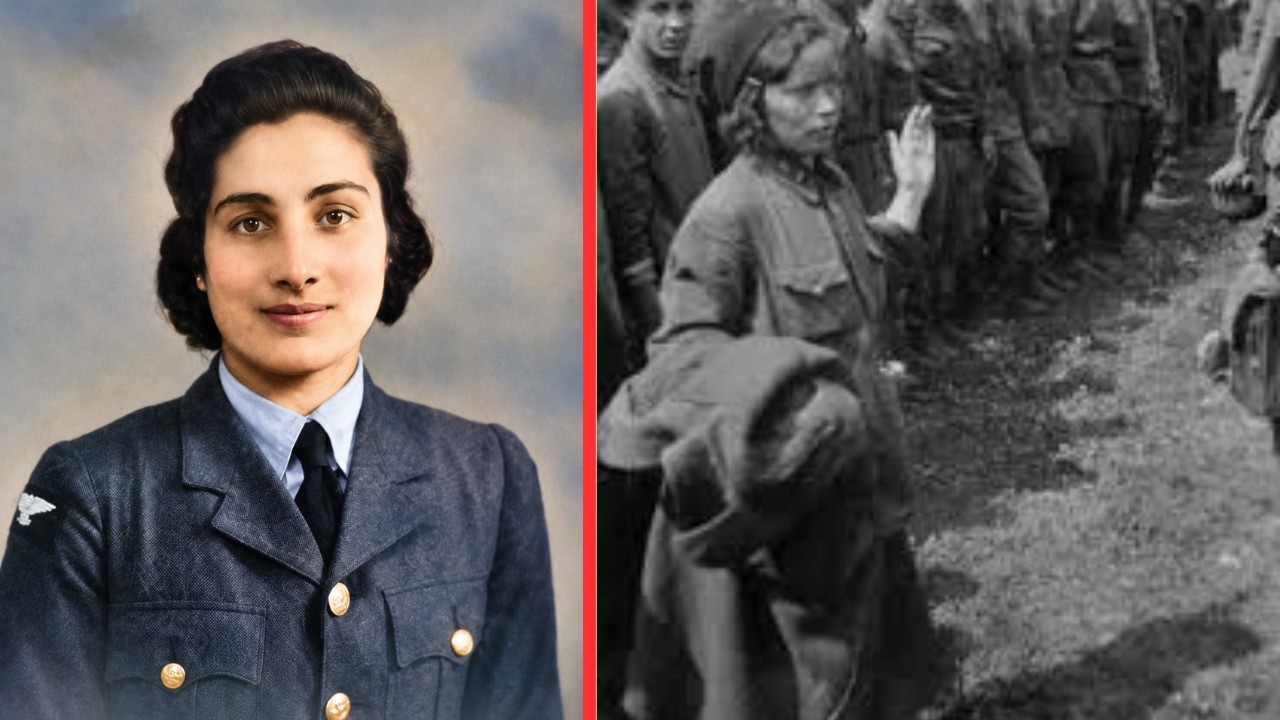
She was thirty. During the eleven months that separated her capture from her death, through interrogation and imprisonment and chains, she never handed them a single name. Not one safe house. Not one radio frequency.
Noor Inayat Khan was born on New Year’s Day, 1914, in Moscow, which says something about the family she came from, since that family seldom stayed in one place for long. Her father, Hazrat Inayat Khan, traced his line back to Tipu Sultan, the eighteenth-century ruler of Mysore, one of the most renowned and unyielding figures in Indian history, a man who fought the British Empire to a standstill and died in battle rather than surrender. He was himself a musician and Sufi teacher who passed years traveling through Europe and America spreading what he saw as a universal spiritual message. Her mother, Ora Ray Baker, came from New Mexico, an American who had embraced the Sufi path and taken the name Amina Begum when she married him.
By 1920 the family had put down roots in Suresnes, just beyond Paris, in a house that supporters of the movement had given them. Noor studied child psychology at the Sorbonne and music at the Paris Conservatory under Nadia Boulanger, which is no small distinction. Boulanger taught Aaron Copland, Philip Glass, and Quincy Jones. Noor took up harp and piano, wrote poetry, and published a collection of children’s stories, a retelling of the ancient Buddhist Jataka tales, the year before the war began.
Her father died in 1927, when she was thirteen. From then on she was, in effect, the grown-up of the household, caring for her devastated mother and three younger siblings, holding everything together without fuss, which was how she always operated. The last thing anyone, Noor included, imagined was that any of this would lead to war. When Germany invaded France in the summer of 1940, the family fled south to Bordeaux and crossed to England by sea, reaching Cornwall on June 22nd, the very day France signed its armistice with Hitler.
Noor had grown up in a home where non-violence was not a political stance but the bedrock of everything. Yet she saw what the Nazis were doing to the country she had been raised in and concluded that standing aside was its own form of moral failure. That November she joined the Women’s Auxiliary Air Force, trained as a wireless operator, and by late 1942 the Special Operations Executive had spotted her. She spoke fluent French, knew Paris inside out, and was quick and precise on a wireless set.
They brought her into the French section. Her training reports were hardly flattering. One examiner described her as unfit for intelligence work, too sensitive, too honest, too apt to break under pressure. Another hinted that she was not, in their phrasing, overburdened with brains.
The SOE sent her regardless, partly because by mid-1943 trained French-speaking wireless operators were hardly lining up for the job. On the night of June 16th, 1943, she was flown into France aboard a Lysander and set down in the darkness. She was the first female wireless operator the SOE had ever dispatched into occupied France. By the time she arrived, the SOE’s main Paris network, code-named Prosper, was already being quietly dismantled by the Gestapo.
In the weeks after Noor landed, arrests tore through the resistance. Colleagues she had barely met were gone. The network she had come to support more or less dissolved around her. London ordered her home.
She refused. She was now the only SOE wireless operator still working in Paris. The only functioning radio link between the French resistance and British intelligence. If she walked away, that connection would go dark for good.
So she remained, shifting from flat to flat with her wireless set in a suitcase, broadcasting from different spots while Gestapo direction-finding crews combed the streets below, trying to triangulate her signal. The Germans had her description and knew her code name, Madeleine. For months they could not locate her. Then someone sold her out.
In October 1943 she was betrayed, almost certainly by a Frenchwoman paid 100,000 francs to hand her location to the Gestapo. On or around the 13th of October, Noor was arrested and taken to Gestapo headquarters at 84 Avenue Foch. She fought them physically as they seized her, and under interrogation she gave them nothing. Not a name, not an address, not a single person in the network.
She did make one serious error, though. It was not cowardice. It was inexperience. She had kept painstaking copies of all her coded transmissions, which she was forbidden to do, and the Gestapo discovered them.
That meant they could now pose as her on the radio and draw new SOE agents directly into arrest. It was a disastrous lapse that cost people their lives. But it was the sort of mistake a conscientious person makes when nobody has spelled out clearly enough what the rules actually demand. She had been keeping records the way you would at any ordinary job.
Directly, they got nothing from her, not then and not in the ten months that followed. She attempted escape twice. The first time, she slipped out of a window and was picked up within hours. The second, in November 1943, was something else altogether.
She devised it with two fellow prisoners at Avenue Foch, British Captain John Starr and French Major Leo Faye. They stripped the bars from their cell windows, tied blankets into ropes, climbed onto the roof of Gestapo headquarters in the dead of night during an air raid, and lowered themselves onto the adjoining rooftops. Reaching that point from one of the most heavily guarded buildings in occupied Paris was remarkable in itself. They were caught before they could get clear of the area.
Afterward the head of the Paris Gestapo, Hans Kieffer, demanded she sign a document promising never to attempt escape again. She refused. Kieffer sent word to Berlin describing her as a dangerous and desperate case. On November 27th, 1943, she was moved to Fort Schirm prison in southern Germany, classified as a Nacht und Nebel prisoner: night and fog.
The designation meant she was to disappear without a trace. No contact with the outside world. No communication with anyone. Her own organization had no idea where she was.
At Fort Schirm she was held in solitary confinement, her hands and feet bound in chains. This went on for close to ten months. Just what sustained her through that stretch is not entirely clear to us. Those who later reconstructed her story uncovered accounts hinting that she meditated and clung to her father’s teachings, that she located within herself something her captors could not reach.
What is certain is that they extracted nothing from her. No information, no cooperation, no signature on any document. In the end they had labeled her highly dangerous, which, considering everything they had inflicted on her to reach that verdict, is almost grimly amusing. On September 11th, 1944, Noor was transferred from Fort Zinna to Karlsruhe prison, where she met three other SOE women for the first time: Yolande Beekman, Madeleine Damerment, and Eliane Plewman.
Each of them brought her own account of what Noor had endured. On September 12th, the four were taken to Dachau. A Dutch prisoner held at the camp lived through the war and later testified about what he saw in those final hours. During the night of the 12th and into the early hours of the 13th, the women were beaten by SS guards.
Noor was singled out for the harshest treatment. She had been marked as the most defiant, the one who had refused every demand they made of her. The beatings continued all through the night. At dawn on September 13th, 1944, the four women were marched into a yard within the camp and forced to kneel while their death sentences were read aloud.
Noor was shot in the back of the head. Her final word, according to that Dutch prisoner, was “Liberté. ” Their bodies were taken straight to the crematorium. Britain remained unaware of the full truth of what had occurred for years.
There was real uncertainty about which camp she had even been sent to, and only in 1947 did investigators assemble the true account. France honored her with the Croix de Guerre with gold star in 1946, and Britain followed with the George Cross, its highest civilian award, in 1949. A memorial bust now stands in Gordon Square Gardens in London, not far from where her family once lived, unveiled in 2012. She was the first South Asian woman to receive a public memorial in Britain.
The assessors who dismissed her as too sensitive, too honest, too naive for this kind of work had her character exactly right. They simply had no idea what that character could withstand. In the end, the Gestapo, with all their methods and eleven months to apply them, never reached the bottom of her.
