The man sits alone inside a glass cabin at midnight. Outside the window there is nothing but black water and the dark shape of the river sliding beneath him. It is September, the end of harvest season, and the cornfields of Illinois have been emptying their loads into barges for six straight weeks. The barges have been coming to him one after another, and he has been performing this same strange, specific task since four in the afternoon.
He will keep performing it until four in the morning. He picks up the radio and speaks to the captain of a towboat half a mile upstream. The captain is pushing a raft of barges the size of an apartment building and needs to get through before morning to make a delivery deadline downstream. The man in the glass cabin does some calculations.
He has three other boats ahead of him in line. He calls them in the order they arrived. The river runs on the schedule he keeps in his head. Then he reaches for a lever and opens a valve, and something remarkable happens.
Slowly, the water in the concrete chamber below him begins to drop. I spent weeks going through the records of the Army Corps of Engineers, navigation logs, and congressional testimony about a piece of American infrastructure that sits out in the open on one of the most famous rivers in the world, and almost nobody ever thinks about it. It is not hidden. It is enormous.
You can drive up to most of these sites, stand on the observation platform, and watch the entire system work. And yet it is somehow invisible, because it is the kind of thing a country only notices on the day it stops working. That is the fact that still circles in my head. Nearly sixty percent of all the grain the United States sells to the rest of the world passes through a system of twenty-nine locks and dams on the upper Mississippi River.
Sixty percent. China buys American soybeans. Egypt buys American wheat. Japan buys American corn.
The cargo that pays for all of that moves, most of it, through a concrete chamber in a river in the middle of the country. It is operated around the clock by a handful of people in glass cabins. People whose names you will never read in a history book, people whose jobs you have probably never imagined even once. This is the story of that system.
How it was built, what it actually does, what it cost the river to build, and the problem nobody in Washington wants to talk about: the whole thing is falling apart now, and the country has not yet agreed on what to do about it. But first, I have to show you what the river was like before the locks were built, because they were not built to improve a situation that was already working. They were built to fix a river that was deeply and genuinely broken for commercial navigation. And how broken it was is what surprises people.
The upper Mississippi, running from Minneapolis-St. Paul down to just above St. Louis, is not one river. Before anyone put a dam across it, it was a tangled mess of channels, sandbars, islands, and paths that rearranged themselves with every spring flood that moved the bottom.
The main channel might be eight feet deep in one place, then drop to just eighteen inches fifty yards later. A steamboat needing six feet of water could steam along easily, then suddenly hit a sandbar that had not been there the week before. The pilots who knew this river in the nineteenth century earned every cent they were paid. Samuel Clemens, who worked as a Mississippi pilot before he became Mark Twain, wrote about what the river demanded of a man.
You had to memorize the depth of every crossing, every obstruction, every hidden rock ledge, and the moment you thought you had mastered it, the river changed something and you had to learn it all over again. Memorizing a river that refused to stay memorized. That was the nature of the job. The commercial problem was simpler and worse.
Railroads ran in any weather, all year round, on a fixed schedule. A boat on the upper Mississippi could not. When the water level fell in late summer, the channel got too shallow to float a loaded barge. When the ice came in November, the river shut down completely.
The navigation season on the upper river lasted six months at best, and even during those months, any loaded boat was liable to stop at any moment at the first sandbar, costing its owners dearly. By the 1920s, the railroads had settled this contest in their favor for fifty years. The equation was not complicated. If you wanted to move goods reliably, you put them on a rail line, not in a river that changed its mind with every season.
The upper Mississippi was a scenic river, a place for fishing, a flooded backyard for the towns along its banks. It was not a commercial highway in any serious sense. Then the Great Depression changed the calculations entirely. The Rivers and Harbors Act of 1930, passed as the country was beginning to grasp the scale of the economic collapse, authorized a project that still seems audacious when you read the original document.
The Army Corps of Engineers was ordered to create a navigation channel nine feet deep and four hundred feet wide along the entire upper river. Not to improve the existing channel, not to dredge the worst shallow spots, but to create a nine-foot-deep channel everywhere from Minneapolis to the mouth of the Missouri River. A channel that had never existed, that had never been there, and that the river itself had no interest in providing. The way they would do it was by building dams.
Twenty-nine of them. And to build those dams, thousands of workers would be employed in the river valley during the Great Depression, which was also part of the point. The idea of the lock and dam is not complicated, and I want you to consider the mechanics for a moment, because once you see what it does, the system of twenty-nine dams becomes understandable in a way it never was before. Put a low dam across the river, and the water level rises behind it.
The river backs up in what engineers call a pool. That pool is deeper than the river ever was, and more stable. The current slows, the sandbars settle or get flooded over, and the required depth is available all year round, no matter what droughts or seasons do to the river’s natural level. The dam creates the navigation channel by creating that pool.
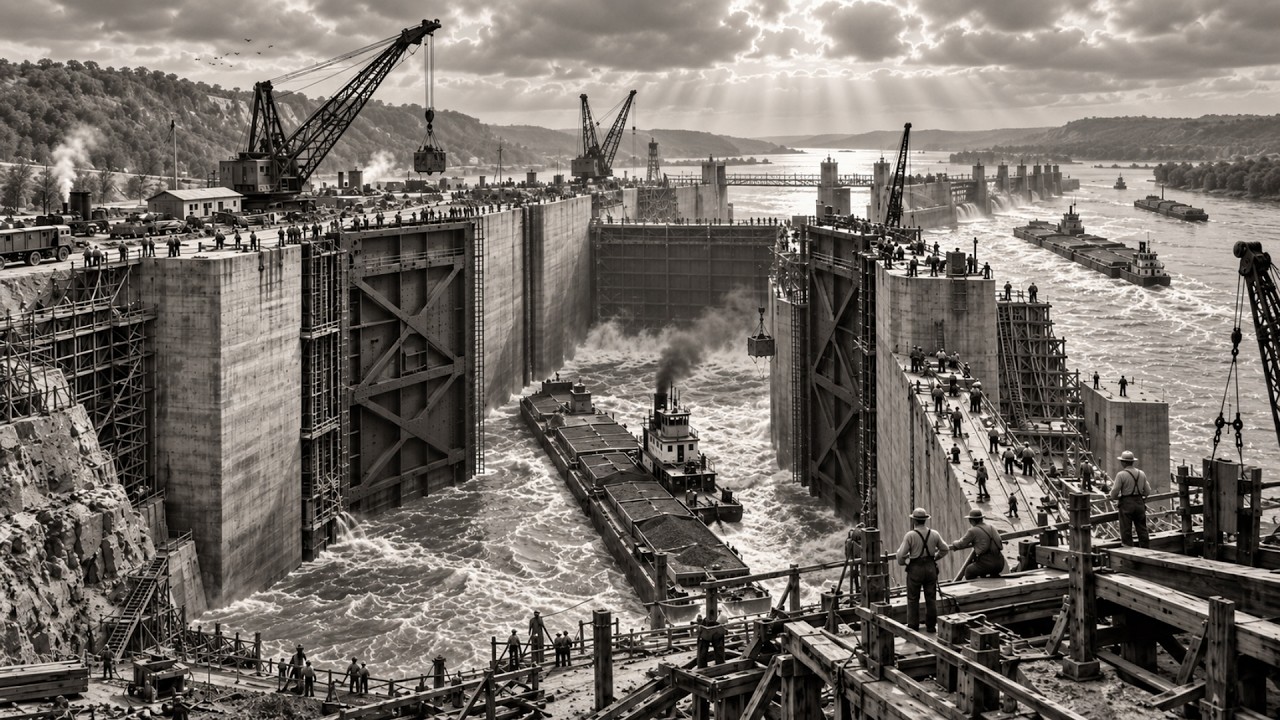
The problem is that you have just put a concrete wall across the river, and boats need to get past that wall in both directions. So next to the dam, you build a lock. The lock is a concrete chamber closed at each end by huge steel gates. When the chamber is at the level of the upper pool, it is full.
When it is at the level of the lower pool, it is empty. To move a boat upstream, you open the lower gates, bring the boat in, close the lower gates, then open valves in the chamber walls that let the upper pool fill the chamber. The water level rises, the boat rises with it, the upper gates open, and the boat comes out into the waterway above and continues on its way against the current. Going downstream, the process runs in reverse.
The whole operation relies on gravity, no pumps needed. The water up high is higher than the water down low, and all you have to do is let it flow. A single vessel takes between fifteen and forty-five minutes to pass through a lock, depending on the size of the chamber, the size of the vessel, and how the lockmaster sets the rate of water flow. The Corps of Engineers built these twenty-nine chambers between 1930 and 1940.
The standard lock in most of them is six hundred feet long and one hundred and ten feet wide. In the 1930s, that was more than enough. The commercial vessels of that era passed through with room to spare. But the river did not stop evolving.
After the Second World War, the barge industry came up with an idea that changed the economics of river shipping entirely. You no longer had to move barges one at a time. You could tie them together into one enormous rectangular raft and push the whole thing with a single powerful diesel towboat. And you could make that raft as big as the river would allow.
The standard river barge today is one hundred and ninety-five feet long and thirty-five feet wide, and it carries fifteen hundred tons of grain. That is one barge. A modern tow, pushed by a single boat heading downstream, can be made up of three barges across and five barges long. Fifteen barges.
Twenty-two thousand five hundred tons. If you took that grain off the water and put it on trucks, those trucks would form a line forty-one miles long. That is the load of a single towboat, with a single captain and a crew of about twelve people. Now here is the problem.
A fifteen-barge tow is about a thousand feet from bow to stern. The lock chamber is six hundred feet long. So the tow has to be split. The boat separates the front half and passes it through the lock, then goes back downstream, takes the back half and passes it through, then comes up over the lock to reassemble the whole tow in the river before continuing.
At a single lock, moving a standard tow from one side to the other takes two to four hours. At the busiest locks during the autumn harvest, the towboats line up in the river waiting for long stretches. Think about what that means for the arithmetic of moving grain to the Gulf of Mexico. A barge leaving Minneapolis in September passes through fifteen locks before it reaches the open river below St.
Louis. Every lock costs it more time. When traffic builds up, the tow that looked so efficient on paper starts to show its friction, its bottlenecks inside the system. The barge industry absorbs this, because even with the delays, river shipping remains cheaper per ton per mile than almost anything else, and that cheapness is what gets your corn to the Egyptian bread market instead of someone else’s corn.
But the delay is real, and it has a cost, and during harvest season that cost becomes visible. Lock 27, sitting just north of St. Louis at the end of the upper system, handles about ninety million tons of cargo in a typical year. That makes it one of the busiest commercial locks in the world.
On a fall afternoon, the line above Lock 27 looks like a river parking lot. Towboat after towboat sits in the channel, engines idling, crews rotating shifts, waiting their turn. Inside the lock control room, a small core team runs the operation around the clock, the way an air traffic controller runs an airport. With one difference.
An air traffic controller who makes a mistake has seconds to correct it. A lockmaster who misjudges the current or the timing of the gates can cause sixty thousand tons of steel and grain to slam into the walls of the concrete chamber. That is a very expensive afternoon for everyone involved. Harvest peak is the moment when the system shows all its flaws.
Between September and November, the Midwest harvests its corn and soybeans. The world market is buying. Barge rates are favorable. Everyone who has grain to move tries to move it at the same time.
The silos along the river fill up. The grain is loaded onto barges. The barges assemble into tows. The tows head south.
And they all reach the twenty-nine locks at roughly the same moment. At the worst locks during harvest season, waiting times exceed twenty-four hours. The captain sends his location and destination over the radio, then sits in the river waiting to be called. His delivery contract has a deadline downstream, and that deadline does not care about the line at Lock 25.
The lockmaster runs the queue from memory and radio, fitting the recreational boats into the gaps between commercial traffic, changing priorities, all during a twelve-hour shift in a building constructed in the administration of Franklin Roosevelt. Because that is the other thing. These locks are old. Not old in the charming historic-landmark sense.
Old in the sense of worn out and past their intended lifespan. The Corps of Engineers built these structures between 1930 and 1940, and they were designed to last fifty years. The math says that means about 1980. Most of these locks have now been operating for four decades beyond what the engineers who drew the original plans expected them to need replacement.
The concrete is cracking. The gate machinery is aging. The miter gates, the huge steel doors that close the chambers at each end, have to be removed and replaced on a regular maintenance schedule, and that schedule is falling behind because the money to fund it stays in dispute in Washington. Here is the number I want you to keep in mind.
One lock failure on the upper river, one gate coming off its track, one mechanical system stopping that cannot be quickly repaired, shuts the lock for weeks. One lock shutting down means every towboat trying to cross that point in either direction simply cannot. The grain headed for the Gulf sits stuck in the river. The towboats stop working.
The elevators upstream stop receiving because there is nowhere to store what they already have. The grain that was supposed to be loaded onto a ship in New Orleans in two weeks will not make it on time. In 2018, a lock failure on the Ohio River closed traffic on that system. The economic estimate of what the grain industry lost to that stoppage ran into the hundreds of millions of dollars.
That was the Ohio River, with its separate infrastructure. A failure at the wrong lock at the wrong time during an upper Mississippi harvest would be worse. The Corps of Engineers has been explaining this to Congress for years. The argument is not vague.
The system is old. Old things break. And when this system breaks, it takes sixty percent of the nation’s grain export capacity with it until it is fixed. The cost of fixing it before it breaks is far lower than the cost of fixing it after it breaks, plus the cost of everything the failure disrupts.
Congress has had a long, indecisive relationship with that logic. I said I wanted to be honest, and I want to be honest here too. Because the lock and dam system was not built without a cost, and the river paid the largest share of it. When the Corps of Engineers put a dam across the upper Mississippi, the water level behind it rose.
The backwaters, side channels, and shallow wetlands that had always been part of the river’s ecosystem, the warm-water habitats where fish spawned and ducks stopped on their migration south, those places got deeper and colder and slower, and they changed. Some of them drowned entirely. The slack water behind the dams began to collect sediment in ways the free-flowing river never had, and over decades, the sediment slowly filled in what was left of the habitat. The native fish populations the river had always carried, catfish and paddlefish, and the mussel beds that stretched for miles along the bottom, declined.
The species that adapted to the changed conditions thrived, and the Asian carp, the most prominent of them, had no predator big enough to control it. The people of the river towns, the farm families, the fishermen who had lived with the old river, they watched their world change in ways they were never consulted about. Streets that had never flooded before now sat at the edge of ponds that rose every spring. Fishermen whose families had worked the same waters for generations found the water too deep and too slow to hold what it once held.
The dam builders, the barge industry, the grain exporters, and the people who eat cheap food, they all benefited. The river paid the price. And so did the people who lived beside it. Both of those things are true at the same time, and I will not try to simplify one to make the other more acceptable.
What I will say is this. The lockmaster in the glass booth working the midnight shift in September, passing the harvest through his chamber tow after tow, is doing something that affects the price of bread on the other side of the world. When he opens that valve and the water starts to drop, a chain of consequences reaches out from that small act to a dock in Shanghai or a bakery in Cairo. He will end his shift at four in the morning, then drive home to sleep.
The next person will come to take over the radio and the lever, and the convoys will keep coming, and the corn will keep moving toward the Gulf, and most of the people this system feeds will never know it exists. The lock and dam system on the upper Mississippi does not appear in paintings of the great river. It is not in the songs. When people imagine the Mississippi, they imagine paddle wheels and steamboats and the wide brown current reflecting the light.
They do not imagine a concrete chamber and a steel gate and a man in a government booth writing arrival times in a notebook at two in the morning. But the river people carry in their minds, that river was made by the twenty-nine dams. The channel the barges travel is the channel the Corps of Engineers created by pooling the water behind a series of low concrete walls. The romance of the working river is supported by infrastructure so practical and plain that nobody ever put it in a song.
Twenty-nine steps down from Minneapolis to St. Louis. Each one a concrete chamber. Each one a gate weighing more than a house, swinging open on hinges the size of a man.
And at each one, a person waits in a booth to let the harvest through. The man in the glass booth writes a note in the log. The chamber empties. The lower gates open.
A towboat pulling fifteen loaded grain barges heads out onto the dark river below the dam, then reassembles its tow in the open water and turns south. It will pass through eleven more locks before it leaves the upper system. At each one, there will be someone waiting. The corn will eventually reach the Gulf.
It happens almost every time. So far.
