The shots came at sunrise, and smoke was already curling into the February sky when Mary Rowlandson looked out from her garrison house in Lancaster, Massachusetts. It was the tenth of February, 1675. A large force of Narragansett, Wampanoag, and allied Indians had fallen on the town, thirty-five miles west of Boston, and they were burning it house by house. Her husband, the Reverend Joseph Rowlandson, was away in Boston, and she stood inside the house with her children, her elder sister, and a crowd of neighbors who had fled to the garrison for safety.
Outside, the raiders were killing the men, women, and children of the settlement. This was King Philip’s War, one of the first great Indian wars in America, and it had begun, like so many of its kind, with a broken treaty. Philip—Metacom, as he was known among his own people—had become chief of the Wampanoag after the death of his father, Massasoit, in 1662. Massasoit had made an agreement with the colonists and kept it.
His son instead built an alliance of tribes and turned it against the settlers of Massachusetts. Mary Rowlandson would survive the attack, but she would not leave Lancaster as a free woman. She would be carried into the wilderness as a captive and held for months, and out of that captivity she would write one of the first bestsellers in American history, published in 1682 under the title The Sovereignty and Goodness of God, together with the Faithfulness of His Promises Displayed, a Narrative of the Captivity and Restoration of Mrs. Mary Rowlandson.
In it she set down what she saw, including the fate of a woman she met in the forest, Anne Josselin, pregnant and nursing a small child, whose story would end far worse than her own. The first the occupants of the garrison knew of the attack was the sound of guns. Looking out, they saw several houses already burning, flames and smoke rising into the air. Five people had been caught in one of them.
The Indians beat the father, the mother, and an infant on the head; two others they took and led away alive. Two more came out of their garrison for some reason and were set upon, one killed with a blow to the head, the other fleeing. Another man ran and was shot down; he begged for his life and promised them money, as Mary was later told, but they paid no heed, beat him on the head, stripped him, and ripped open his belly. One more saw Indians around his barn and took the risk of coming out; he was killed almost at once.
Three others belonging to the same garrison were also killed. By climbing onto the roof of the barn, the Indians gained the advantage of firing down over the defenses. And so the killers went on burning and destroying everything before them. Eventually they came to the house where Mary and the others were sheltered.
It stood on the edge of a hill. Some of the Indians positioned themselves behind the hill, others inside the barn, others behind anything that would shield them. From every side they poured fire into the house, so that the bullets flew like hail, and soon one man inside was hit, then another, then a third. For about two hours, as Mary estimated in that stunned time, they surrounded the house before they could set it on fire, which they finally did with flax and hemp carried from the barn.
The house had little in the way of defense—only two small flankers at opposite corners, and one of those unfinished. A man ran out and put the fire out once, but they soon relit it, and this time it caught. Now came the terrible hour Mary had heard described in other wars but never seen with her own eyes. Some inside fought for their lives, others floundered in their blood, the house burned over their heads, and the bloodthirsty heathen stood ready to kill them if they came out.
Mothers and children cried for help for themselves and for one another. She decided to leave. Taking her children, and her sister taking hers, she made for the door. The moment they appeared in it, the Indians fired so thickly that the bullets rattled against the house walls like a handful of stones flung against them, and they were forced back inside.
The garrison had six strong dogs, which in any other time would have flown at any Indian who came near the door; now not one of them stirred. Mary saw the hand of God in it, making them acknowledge that their help came only from him. But there was no choice but to go out. The fire roared behind them, closing in, and the Indians waited before them with guns, spears, and hatchets.
The moment they emerged, her son-in-law fell dead. He had been wounded earlier, in the neck or near it, while defending the house. The Indians shouted and triumphed in scorn and fell upon him at once to strip him. The bullets came thick, and one struck Mary in the side.
It seemed to her that it passed through her bowels and through the hand of her dear child, the six-year-old she held in her arms. A son of her elder sister, named William, had his leg broken, and when the Indians saw it they beat him on the head. In the house behind her, Mary’s elder sister watched these horrors through the doorway, saw the heathen dragging mothers one way and children another, some wallowing in their blood, and heard her eldest son tell her that William was dead and Mary wounded. She said, “Lord, let me die with them.
” A bullet struck her, and she fell dead on the doorstep. Mary hoped she had reaped the fruit of her good works, for she had been faithful in serving God in her place. In her youth she had suffered many spiritual troubles, until God settled this scripture in her heart: “My grace is sufficient for thee,” from the second letter to the Corinthians. More than twenty years later Mary had heard her sister tell how sweet and comfortable that text had been to her soul.
The Indians now had hold of Mary and the others, dragging her one way and the children another. “Come, go along with us,” they said. She told them they would kill her. They answered that if she went with them, they would not hurt her.
She looked back at the house—the terrible sights she had been forced to see there. Of the thirty-seven people who had been in that house, not one escaped either sudden death or bitter captivity. Twelve were killed, some by shot, some by stab, some by hatchet. She saw one man who had been struck on the head with an axe and stripped naked, still crawling here and there.
It was a solemn sight to see so many Christians lying in their blood, scattered about like a flock of sheep torn by wolves, stripped by a pack of hellhounds who roared and sang and shouted and insulted as if they were tearing out the hearts of the survivors. God in his great power kept a number of them from death—twenty-four were taken alive and led away as captives. Before this, Mary had often said that if the Indians came, she would rather be killed by them than taken alive. Now her mind changed.
Their shining weapons terrified her soul, and she chose to go along with those wild beasts, as she called them, rather than end her life at that moment. And so began what she would later write down in careful detail: their many removals back and forth through the wilderness. That first night they marched about a mile, up onto a hill within sight of the town, where the Indians meant to camp. There was an empty house nearby, abandoned earlier by the English out of fear of the Indians.
Mary asked if she might lodge there. They answered, “What, will you love Englishmen still? ” It was the most doleful night her eyes had ever seen. The roaring, singing, dancing, and yelling of those cruel creatures made the place a lively picture of hell.
The destruction was miserable to behold—horses, cattle, sheep, swine, calves, lambs, piglets, and fowl, all plundered from the town. Some were roasting, some lying and burning, some boiling, to feed their merciless enemies, who were in great joy while the captives were in despair. To add to the gloom of the day and the darkness of the nights, her thoughts ran on her losses and her sad condition. Everything was gone.
Her husband was gone, or at least separated from her, away in the Bay. The Indians told her they would kill him when he came home. Her children were gone, her relatives and friends gone, her house and all her comforts gone, inside and out. Nothing was left but her life, and she did not know whether that would go next.
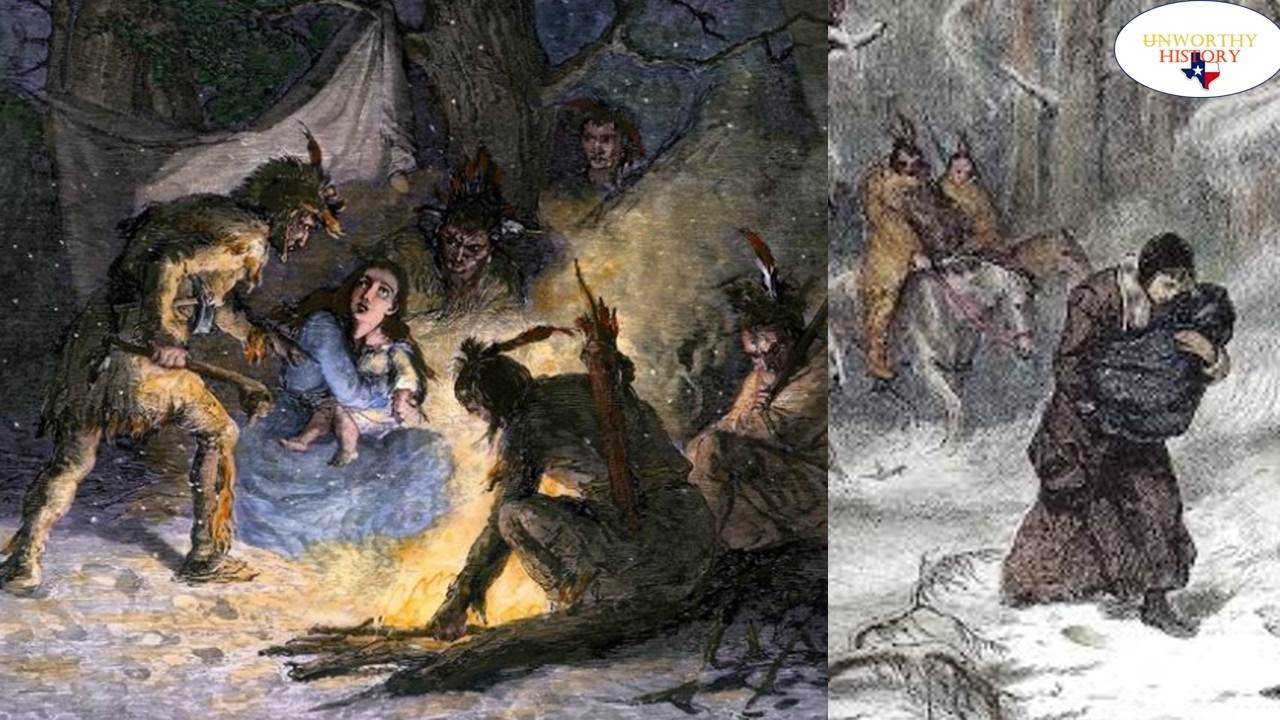
The only thing left was her little wounded child. Her wound had stiffened so that she could hardly sit or stand; the child was sick with fever and crying for water. And there she sat, all that cold winter night on the snowy ground with her dying daughter in her arms, expecting every hour to be the child’s last. In the morning they set out again.
One of the Indians took the wounded child on a horse; she groaned all the way, “I shall die, I shall die. ” Mary walked behind on foot, in grief beyond description. At last the Indian took the child down and gave her to Mary, who carried her until her strength gave out and she fell with her. They set Mary on a horse with the wounded child in her lap.
There was no saddle, and as they went down a steep hill, both of them fell over the horse’s head. The Indians laughed and rejoiced at the sight, like creatures without humanity. Snow began to fall, and when night came they stopped; Mary sat in the snow by a small fire with a few boughs behind her, her sick child in her lap, asking continually for water. For nine days the child would live in this misery, without food or drink except a little cold water, and Mary would sit with her on her knees until her own flesh was wasted with pain.
On the afternoon of the third day, about an hour before sunset, they reached an Indian town called Wenimesset, north of Quabaug. The next day was the Sabbath, and Mary, sitting among the heathen, remembered how she had neglected God’s holy time, how many Sabbaths she had misspent, and how she had walked in ways evil in his sight, and it weighed on her soul until she could easily see the justice of God in cutting off her life and casting her out of his presence forever. Yet God still showed her mercy. In this place came a man named Robert Pepper, of Roxbury, who had been taken captive in Captain Beers’s fight and had lived with the Indians a long time.
He had gone with them to the outskirts of Albany to see King Philip, as he told her, and had recently returned to these parts. Hearing she was in the village, he asked leave to come and see her. He told her he had himself been wounded in the leg in Captain Beers’s fights and could not walk for a while unless helped by them; he used oak leaves on his wounds, and by God’s blessing could walk again. Mary took oak leaves and laid them on her side, and by God’s blessing she too was healed.
But before the healing came, one torment followed another. She sat alone with the poor wounded child in her lap, groaning day and night, and the Indians took turns coming to her with the same message: “Your master will knock your child on the head. ” First one, then a second, then a third. That was the consolation she received from them.
When the child was near death, they ordered Mary to carry her to another hut, she supposed because they did not want to be bothered with such sights. She went there with a heavy heart and sat with the image of death in her lap. Two hours after nightfall, on the eighteenth of February, 1675, the child died, a gentle lamb. She had been six years and five months old, and nine days had passed since her wounding.
Mary, who had once not been able to bear being in a room with a corpse, now slept beside her dead child, side by side, for the nights that followed. She thought afterward of God’s wonderful dealings with her, that he preserved her mind and senses in that time, so that she did not resort to evil and violent means to end her miserable life. In the morning, when they learned the child was dead, they sent for Mary to return to her master’s hut. Her master, she explains in her writing, was Quonopin, a leader married to the sister of King Philip’s wife.
He had not been the one who captured her; she had been sold to him by another Indian, a Narragansett who had taken her when she came out of the garrison. She went to carry her dead child with her, but they ordered her to leave it. There was no room for resistance. She had to go on without it.
When she reached her master’s hut, she took the first opportunity to learn what had become of the child. They told her it was on the hill, and showed her the place, where the earth was newly dug. There they had buried it. She left her child there in the wilderness and committed it, and herself, to him who is above all.
After the child was taken from her, Mary went to see her daughter Mary, who was in the same Indian village, in a hut not far off, though they had little freedom or opportunity to see each other. The girl was ten years old, taken from before the door at the first by a praying Indian, then sold for a gun. Whenever Mary appeared before her, the child began to cry, which angered the Indians, and they would not allow Mary near her. They ordered her away, and it was a hard word that tore her heart.
One child was dead, another in the wilderness she knew not where, and a third they would not let her come near. She could not rest. Walking about in the morning, lamenting her condition, she prayed earnestly to the Lord to look on her low estate and show her some sign for good, some hope of relief. And the Lord answered her quickly.
Her son came to her, asking how she did. She had not seen him since the destruction of the town. He told her he had been with a small company of Indians about six miles off, and with tears in his eyes asked whether his sister Sarah was dead, and told her he had seen his sister Mary. He begged her not to worry about him.
He had been brought to see her by his master’s wife, during the absence of his master, who had gone with a band of Indians to attack and burn Medfield. The next day the raiders returned, all of them. They began their noise about a mile off, and by their whooping and yelling signaled the number they had destroyed—twenty-three persons. Those who had stayed behind gathered at the sound, and each time the returning men called out their count, those within answered with a shout that shook the earth.
When they reached the chief’s tent, there was shameful triumph over the English scalps they had brought with them, as was their custom. In the midst of these trials, Mary remembered the mercy of God in sending her a Bible. One of the Indians who came back from Medfield had brought plunder, and asked her whether she wanted a Bible he had in his basket. She was glad of it, and asked whether the Indians would let her read it.
He said yes. So she took the Bible, and in that gloomy time it came into her mind to read first the twenty-eighth chapter of Deuteronomy, which she did. As she read, her dark heart wondered whether mercy was clean gone from her, whether the blessings were removed and curses come in their place, and whether she had lost her opportunity. But the Lord helped her to read on, until she came to the thirtieth chapter, the first seven verses, where mercy was promised again if they repented and returned to him.
Even if they were scattered from one end of the earth to the other, the Lord would gather them and turn all those curses on their enemies. She resolved never to forget that book and the comfort it gave her. The Indians now began to talk of leaving the place, each to his own destination. Nine other English captives were there with Mary, all children except one woman.
She had the chance to go and bid them farewell, since they were destined to go one way and she another. She asked them whether they prayed to God for deliverance. They told her they did what they could. That woman, Mrs.
Josselin, told Mary she would never see her again and that she was seriously thinking of escaping. Mary begged her not to run away on any account. They were thirty miles from any English town, she was in the last days of her pregnancy, she carried a young child in her arms, there were rough rivers to cross, and they were weak from poor food. Mary had her Bible with her, and asked whether Mrs.
Josselin would like to read. They opened it, and their eyes fell on the twenty-seventh Psalm, especially one verse: “Wait on the Lord: be of good courage, and he shall strengthen thine heart: wait, I say, on the Lord. ”
Now Mary had to part from that small company. She left her daughter Mary there, and would not see her again until they met at Dorchester after the girl’s return from captivity.
She left four of her relatives and young neighbors, some of whom she would never see again. And she left that poor woman, Mrs. Josselin. As some of her companions later told her, Anne Josselin’s fate was a miserable one.
Heavy with grief over her condition, and her time of delivery near, she often begged the Indians to let her go home. They would not. At last, tired of her pleading, they gathered a great crowd around her, stripped her, and set her down in the midst of them. When they had sung and danced about her in their diabolical way, they knocked her on the head and killed the child in her arms with her.
Then they made a fire and threw them both into it. The other children with them were told that if they tried to go home, they would be served the same way. The children said she did not shed one tear, but prayed all the time. Mary never learned what became of her other children that day.
She traveled on with her own master, about half a day or a little more, to a desolate place in the wilderness where there had never been huts or inhabitants. They arrived at noon, cold and wet and snowy and hungry and tired, with nothing to rest on but the cold ground and the Indians’ poor fare. Painful thoughts ran through her mind about her poor children, scattered here and there among the wild beasts of the forest. Her head was light and dizzy, from hunger or the harsh lodging or her cares together.
Her knees were feeble and her body sore from sitting bent night and day, and she could not express to anyone the affliction that weighed on her soul. She opened her Bible again, and the Lord directed her to a precious verse: “Thus saith the Lord, refrain thy voice from weeping, and thine eyes from tears: for thy work shall be rewarded, saith the Lord, and they shall come again from the land of the enemy. ” It was sweet balm to her soul when she was almost ready to faint. Many times she sat down and wept over that verse.
They stayed in this place about four days. Anne Josselin’s husband was Abraham Josselin, born in 1649 in Hingham, Massachusetts; he had married Anne on the twenty-ninth of November, 1672, and had been killed in the attack on Lancaster on the tenth of February. Their two-year-old daughter, Beatrice, was the child killed with her mother and burned in the fire. Mary Rowlandson carried wounds in her side and lived with the memory of the child she had buried on a hill in the wilderness, and of the woman who prayed without tears while the Indians danced around her.
She was held captive for eleven weeks and five days before she was ransomed and restored to her husband on May 3, 1676. Her book, published in 1682, would be read across the English colonies, one of the first works of American literature to reach a wide audience.
