The voice that had once promised to be curiouser and curiouser was now calling out names on an elementary school attendance sheet. Decades after she had fallen down a rabbit hole and flown to Neverland, Katherine Beaumont was doing something far quieter: teaching children in a Los Angeles classroom. The girl who had given voice to two of Disney’s most beloved heroines had chosen a life that had nothing to do with Hollywood. Born in London in 1938, Katherine grew up surrounded by the arts.
Her father was a professional singer, her mother had theater experience, and the two encouraged their daughter to perform from a very young age. By the time she was six, she had already appeared in her first film. Her real break came in 1944, when she was cast in the British film It Happened One Sunday. It was not a massive international success, but it drew enough attention to reach MGM, which was eager to expand its roster of international talent.
The studio signed her to a contract, and soon the family made the transatlantic move to Los Angeles. It was during this period that Walt Disney was deep in development on Alice in Wonderland, a passion project he had been trying to bring to the screen for over a decade. He was looking for a young actress who could capture the innocence, curiosity, and slightly stubborn charm of Lewis Carroll’s Alice. He wanted someone British, someone who felt authentic rather than theatrical.
When he saw a screen test of Katherine Beaumont, he reportedly knew immediately that she was his Alice. Her voice was clear, expressive, and intelligent, but it also carried a grounded realism. She did not sound like a stagey child actor. She sounded like a real girl.
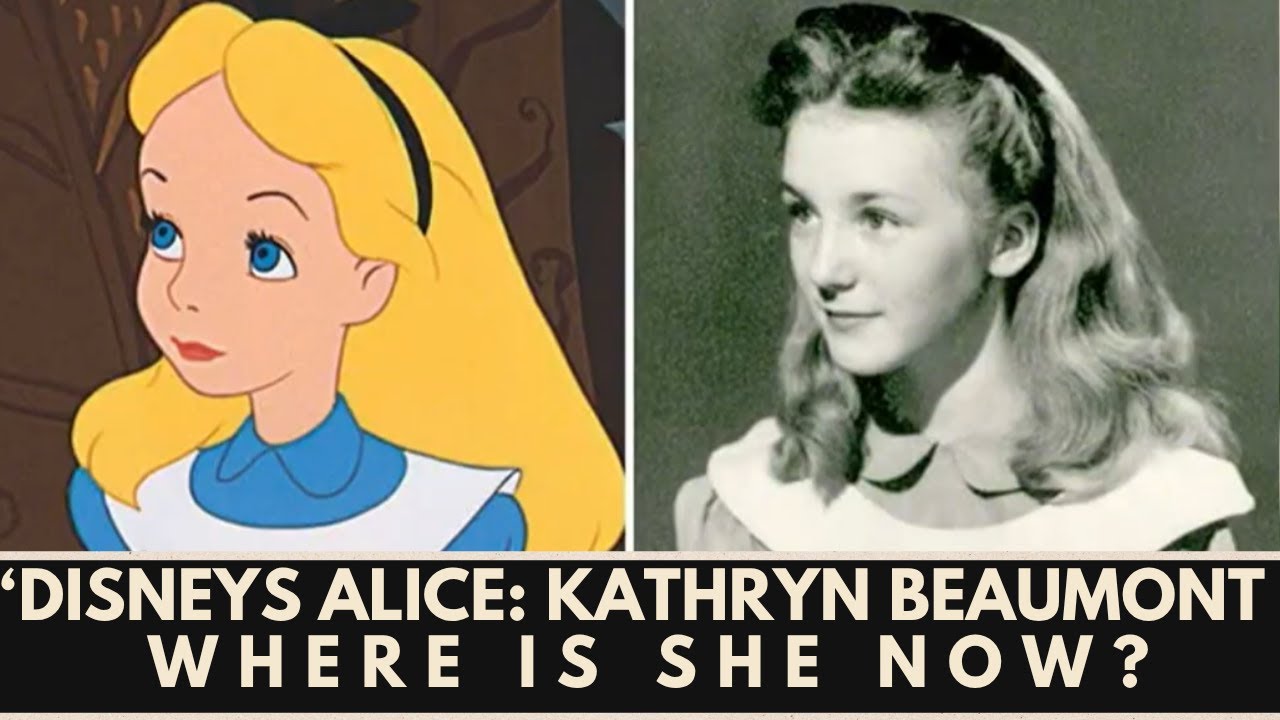
Her role, however, went far beyond voice acting. Disney’s animators frequently used live-action reference footage to guide their hand-drawn characters, and Katherine was asked to act out nearly every scene from Alice in Wonderland on a soundstage. Wearing a blue dress and interacting with props, she performed the entire story while cameras filmed her movements. The animators studied her gestures and body language to bring Alice to life frame by frame.
She was only ten years old when she began the work, and already she was shaping one of the most iconic characters in animation history. She spent months on that soundstage, sometimes hanging from wires to simulate falling, sometimes pretending to shrink or grow with oversized props. Her facial expressions were mirrored in the character, and her delivery was subtle and emotionally grounded. She captured Alice’s curiosity, her irritation, her wonder, and even her fear with remarkable naturalism.
Her performance was so well received that Disney cast her again two years later, this time as another curious and kind-hearted girl: Wendy Darling in Peter Pan, released in 1953. Just as she had done with Alice, she voiced the character and acted out her scenes for the animators, pioneering what would later be understood as performance capture. In just two roles, Katherine Beaumont became the voice of a generation of childhood dreams, first down the rabbit hole and then off to Neverland. By the early 1950s, she had achieved what most child actors could only imagine.
She had starred in two major Disney animated features, both of which would become timeless classics. She had worked directly with Walt Disney himself and had become one of the studio’s favorite young performers. And then she disappeared from Hollywood almost entirely. There was no scandal and no dramatic fallout.
Katherine was still a teenager in the mid-1950s, and her parents had always emphasized education and stability. She herself had interests beyond acting. She decided to finish school and eventually enrolled at the University of Southern California, where she studied education. Disney had given her a platform that few others had at her age, but she made a conscious decision to leave the industry behind.
It was a quiet, personal choice to live a more ordinary life. And that is exactly what she did. After graduating, she became a schoolteacher in Los Angeles, dedicating herself to education for more than three decades. Generations of children passed through her classroom with no idea that their kind, well-spoken teacher had once sailed through Neverland and wandered through Wonderland.
Having spent her early years in animated fantasy worlds, she chose to live a grounded and meaningful life in the real one. For many years, she kept her Hollywood past mostly to herself. But the world had not forgotten her. In the 1990s and early 2000s, as Disney began celebrating its classic animated films through special editions, documentaries, and theme park expansions, interest in the voices behind those characters returned.
When Disney came calling, Katherine answered. In 1998, she was officially honored as a Disney Legend, an honor rarely granted to someone who had voiced only two characters. But those two roles, Alice and Wendy, had become part of Disney’s cultural foundation. Disney invited her back to voice both characters for various theme park attractions and projects, including updates to the Alice in Wonderland ride at Disneyland and Wendy’s voice in Peter Pan’s Flight.
Even decades later, she was the only one who could bring those characters to life with such authenticity. In 2002, she reprised the role of an older Wendy in Return to Neverland, a rare return to animation after nearly fifty years. Her voice had aged gracefully, still full of warmth and elegance. She also appeared in Disney retrospectives and anniversary specials, offering behind-the-scenes insight into what it was like to work with Walt Disney and the pioneering animators of that era.
Her work continued to shape how Disney princesses and heroines were portrayed: intelligent, curious, strong, and sincere. Unlike many performances of that era, hers felt timeless. She was not just reading lines. She was living in those characters.
Katherine Beaumont’s story was not one of scandal or spectacle. It was something rarer, a story of grace. She gave voice and soul to two of Disney’s most iconic characters and then, at the height of her potential, chose a different path. She did not chase the spotlight, and she did not cling to fame.
Instead, she gave decades of her life to education, guiding real children through their own journeys, not in fantasy but in everyday life. Her voice remains woven into the fabric of childhood for millions, whether it is Alice tumbling down the rabbit hole or Wendy soaring across the London sky. She proved that a person does not have to stay in the spotlight to leave a legacy.
Sometimes a single voice is enough.
