The backward-facing third-row seat of the American station wagon, known as the wayback, was the greatest place a child could be in the 1960s and 1970s. A seven-year-old sat with knees pressed against the tailgate, watching the road unroll behind like a gray ribbon. Cars behind got smaller. Parents in the front seat seemed impossibly far away.
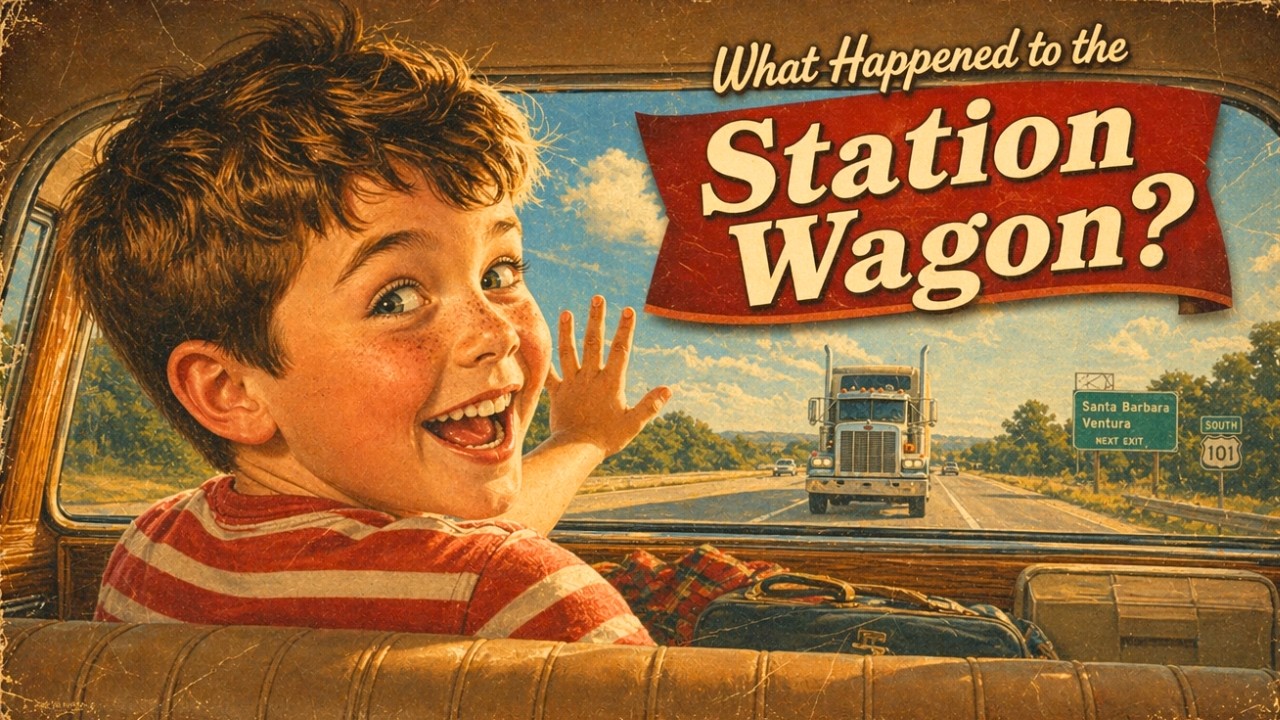
You could not see where you were going, only where you had been, and that was the entire point. Truckers were right there, six feet from your face, separated by nothing but a tailgate window. You made faces at them, stuck out your tongue, waved. When a driver saw you and pulled his air horn, the sound was so loud you jumped, your brother jumped, and both of you laughed until your stomachs hurt.
A mother’s voice would come from the front: stop bothering the truck drivers. You did not stop. The parents could not see you, could not reach you. The third row was nearly a football field from the front seat, and by the time a father’s voice traveled that distance it had lost all authority.
The road trip itself ran on a ritual. A cooler sat between the mother’s feet in the front passenger seat, holding sandwiches wrapped in wax paper, hard-boiled eggs, a thermos of coffee, and sodas for the children that were not to be opened until the car crossed the state line. The mother navigated with a paper map spread across her lap, guided by landmarks, highway signs, and intuition. Sometimes she got it wrong.
The father insisted she had said left; she insisted she had said right. Nobody spoke for eleven miles. There were no screens, no tablets, no GPS. Children read the backs of cereal boxes until every word was memorized, played I Spy until everything had been spied, counted out-of-state license plates on a gas station receipt.
A brother got punched every time a Volkswagen Beetle appeared, and he punched back. A mother’s arm flew over the seat like a tollgate coming down. That was the end of the fighting for roughly four minutes. Fathers drove twelve hours straight, stopping for gas twice and for lunch at a rest-area picnic table.
The mother laid sandwiches on a checkered cloth. The father stretched his back. The dog ran circles on the grass. The children ate standing up because they had been sitting for six hours.
Then everyone climbed back in, and the wayback resumed its watch over the receding highway. That station wagon was the Ford Country Squire, the car that defined the American family for more than three decades. Its fake wood paneling, vinyl glued to steel, peeled at the corners after three summers in the sun. It was never real wood, but it looked like a piece of furniture rolling down the street, and that was the point.
The wood said this is a family doing fine, taking vacations, with children in the back. A Country Squire parked in a driveway in 1968, wood panels catching the afternoon sun while a sprinkler ran on the lawn, was the most American image that had ever existed. The car itself was nineteen feet long, weighed nearly five thousand pounds, and got about eight miles to the gallon. Nobody cared, because gasoline cost thirty cents and the highway went to California.
It held three rows of seats, nine people: three adults in the front bench, three in the middle, and three children in the wayback facing backward. In 1966, Ford introduced the magic doorgate, a rear gate that swung open to the side like a door or folded down flat like a pickup tailgate. Ford sold more than a hundred thousand Country Squires every year through the sixties and seventies and called themselves the wagon master without exaggeration. The tailgate was not just for loading groceries.
It was a way of life. Folded flat, it became a bench at the Little League game, a grandstand for the Fourth of July fireworks, a bed at the drive-in on a Saturday night. At the drive-in, fathers backed the wagon into a spot, dropped the tailgate, and the children lay on sleeping bags in the cargo area with a speaker hanging on the window. Mosquitoes came in through the gap between tailgate and roof, and the kids fell asleep before the second feature.
The tailgate shook with every firework boom. A little sister covered her ears and the dog hid under the middle seat. The tailgate was a front porch, a picnic table, a grandstand, a bed, whatever flat surface a family needed. There were no car seats, no booster seats, no seatbelt laws for rear passengers in most states until the 1980s.
Children sat on laps, rolled around the cargo floor, stood on the transmission hump to see over the dashboard, and by age seven were doing somersaults between the wheel wells while the father took an exit ramp at forty miles an hour. The entire child restraint system of the United States in 1971 was a mother’s arm flying across the front seat when the father hit the brakes. It was the seatbelt, the airbag, and the whole of it. Children survived, which was more than their mothers’ nerves could say.
The sounds defined the experience. The V8 at idle on a cold morning rumbled through the floorboards. The turn signal clicked like a metronome. The AM radio stayed on one station for seven hundred miles because nobody wanted to reach over and change it.
The tires hummed and changed pitch when the car crossed a bridge. The tailgate closing sounded like a bank vault sealing shut. The wing window cracked open two inches because the air conditioning was broken and the backseat smelled like dog. And through it all came the father’s voice at every stop, the single command: everybody in the car.
And everybody got in, the doors closed, the V8 caught, and the trip continued. The rise of the station wagon was demographic. Between 1940 and 1960, the number of American families with three children doubled and the number with four quadrupled. Sedans could not hold them.
Station wagons went from three percent of all cars sold in America in 1950 to seventeen percent by 1960. Nearly one in five cars on the road was a station wagon. Every manufacturer made one: Ford, Chevrolet, Buick, Oldsmobile, Pontiac, Mercury, Chrysler. They were everywhere, in every driveway, every church parking lot, every campground from Maine to California.
The station wagon was not a type of car. It was the car, the only one that mattered if you had children and a dog and a vacation. Then Clark Griswold got in one. In 1983, National Lampoon’s Vacation showed Chevy Chase driving his family from Chicago to California in a station wagon so ugly it became one of the most famous movie cars in history: the Wagon Queen Family Truckster, a modified 1979 Ford Country Squire painted metallic pea green with fake wood everywhere, eight headlights, and a hood-mounted gas cap.
The movie was hilarious and devastating, because it did something no oil crisis or emission standard could do. It made the station wagon a joke. Clark Griswold was a dork and his car was a dork’s car. Every baby boomer who grew up in the wayback of a Country Squire laughed, then went out and bought a minivan.
The Dodge Caravan arrived in 1984, one year after Vacation. The boomers who had spent their childhoods in the wayback did not want to look like their parents. The minivan took the families. The SUV took everyone else, offering the space of a station wagon with the image of adventure.
You were not a suburban parent in an SUV; you were an explorer. The station wagon could not compete with that image. The Country Squire was discontinued in 1990 after forty years. The Chevrolet Caprice Estate was gone by 1991.
The last full-size American station wagons, the Buick Roadmaster and the Chevrolet Caprice, were discontinued in 1996. The body style that had carried every American family for forty years was gone. But the station wagon never truly died. The SUV is a station wagon.
The crossover is a station wagon. The minivan is a station wagon. Every family vehicle sold in America today does exactly what the Country Squire did in 1968, carrying a family and their belongings. The only differences are the name, the height, and the fact that nobody sits in a backward-facing third row watching the world roll away.
The Country Squire never pretended to be anything other than a family car. It was honest. The SUV insists it is an adventure vehicle that will never leave the pavement. That is the real reason the station wagon died: not because it stopped working, but because America stopped wanting to be honest about what it needed.
The best part of every trip was the end. It was dark. The highway narrowed from four lanes to two to a country road. The children were asleep in their various rows, the dog on the cargo floor.
The only sounds were the tires and the AM radio turned low. A child lay on the bench seat with a jacket for a pillow, trying to stay awake to see the house, but the vibration of the car rocked him into sleep. The last sight was red taillights blurring into streaks. The next sensation was being carried.
A father’s arms were underneath, a face pressed against his shoulder, cold night air, the front door opening, the smell of home. He carried the child up the stairs, put him in bed, pulled the blanket over him. Nobody remembers the drive or the arrival, only being carried, because a father did not wake up a child who fell asleep three states ago. The last ride came in the mid-1980s.
The father pulled the station wagon into the driveway for the final time with two hundred thousand miles on it, the fake wood peeling, the tailgate squeaking, the V8 burning a quart of oil every thousand miles. He traded it in for something smaller. The wagon went to the dealer lot, then to auction, then to a junkyard, and then it was gone. The child, now twenty-two, did not think about it and did not miss it.
But decades later, at a car show, there sits a Country Squire with perfect wood paneling and polished chrome. Standing there, you can smell the vinyl seats, the cooler, the exhaust, the wax paper from the sandwiches. You are seven years old again, sitting in the wayback, watching the world roll away behind you, laughing so hard your stomach hurts, and nobody has told you to stop yet.
