The command arrived quietly, whispered right at his ear, and it was no suggestion. Deputy Sheriff Ted Hinton had just helped gun down Bonnie Parker and Clyde Barrow, had watched the Ford V8 convulse beneath a hail of more than a hundred bullets, had seen blood spread and spatter over the front seat. Now, amid the confusion on that Louisiana roadside, his superior drew him aside and said the bodies would have to be repositioned. The scene had to be improved for the photographers.
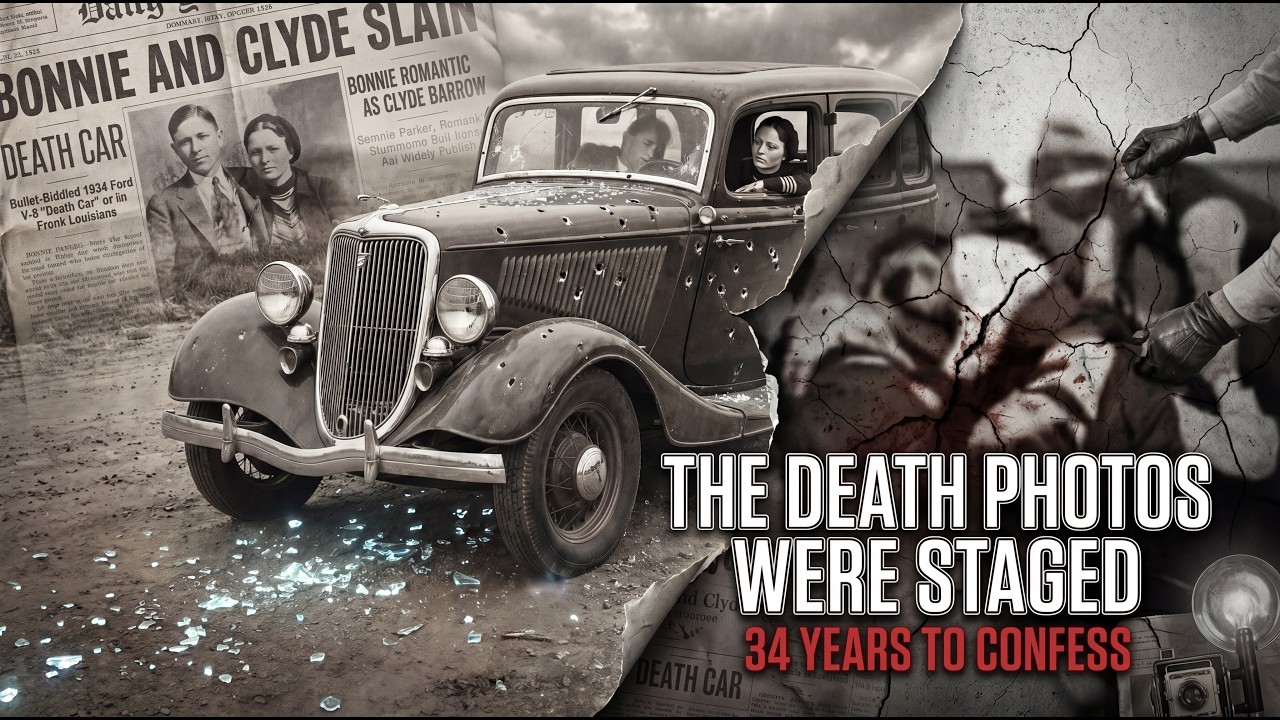
Hinton obeyed. He walked over to the car, grasped Bonnie Parker, and shifted her body so she leaned against Clyde Barrow in a way that would give the cameras something the actual scene had never shown. For the next thirty-four years, he kept silent. The most celebrated crime scene photographs in American history may be wholly fabricated.
For nine decades, those images have occupied a settled place in the national memory: Bonnie Parker slumped against Clyde Barrow inside their bullet-riddled Ford, caught in what appears to be their final moment together. The pictures seem to reveal precisely how the two outlaws met their end—her head near his shoulder, his tilted back against the seat, two young criminals held in a curious, nearly tender stillness. Generations gazed at those photographs and trusted they were witnessing history as it unfolded. The evidence now indicates the photographs were staged, deliberately arranged by the very lawmen who had killed them, to convey a story the harsh reality could not sustain.
The question that ought to unsettle anyone studying those images is why a deputy sheriff waited over three decades to confess that he had shifted a dead woman’s body. Other contradictions also persist and will not be explained away. Glass fragments strewn over the corpses fail to correspond with the bullet paths recorded in the official reports. A small-town Louisiana mortician went to his grave swearing he had been ordered to lie about what he saw that day in May 1934.
The death car photographs were never merely historical records. They were evidence—and that evidence indicates one of the most deliberately engineered deceptions in American crime history. The official account was simple, and for decades it went essentially unquestioned. On May 23, 1934, in Bienville Parish, Louisiana, six lawmen lay in wait for Bonnie and Clyde after a manhunt lasting months.
Roughly 130 rounds were discharged in about sixteen seconds. Both outlaws perished instantly inside the stolen Ford V8 sedan. The photographs taken hours afterward showed precisely how they were discovered: Bonnie crumpled against Clyde’s right shoulder, Clyde’s head tipped back against the seat, their bullet-riddled bodies arranged as though death had come almost softly. The images became the definitive conclusion to the Bonnie and Clyde story—proof that crime did not pay, evidence of swift frontier justice carried out by professional lawmen.
Within hours, the photographs appeared in newspapers across the country, locking in the narrative of two young criminals meeting their inescapable fate. But photographs can deceive, particularly when those controlling the scene have reasons to construct a particular narrative. The ambush team consisted of six men with everything on the line if the operation failed. Frank Hamer headed the group—the legendary former Texas Ranger whose reputation for flawless law enforcement hung in the balance.
Ted Hinton was the young deputy sheriff from Dallas County, and he had known Bonnie Parker before she became an outlaw. The remaining four officers came from several law enforcement agencies whose credibility rested on bringing the Bonnie and Clyde crime spree to a clean and professional end. Around them gathered a growing crowd of people with their own agendas: local Louisiana law enforcement struggling to control the chaos as thousands of souvenir seekers swarmed the ambush site; C. F.
“Boots” Bailey, the Arcadia mortician assigned to handle the bodies, who would later insist he had been given very precise instructions on how to prepare the corpses; and newspaper photographers hurrying to capture what they knew would be the scoop of the decade. The stakes reached far past two dead outlaws. This concerned Frank Hamer’s reputation as a lawman who never failed to get his target. It concerned the credibility of multiple law enforcement agencies that Bonnie and Clyde had humiliated for more than two years.
It concerned a Depression-era nation desperate for closure to a crime spree that had turned cop killers into folk heroes. Everyone involved needed this to appear flawless. The official timeline fixed the ambush at 9:15 in the morning on a rural Louisiana highway near Gibsland. The posse waited in roadside brush after receiving a tip about Bonnie and Clyde’s whereabouts.
Clyde was at the wheel of their stolen Ford. Bonnie was said to be eating a sandwich in the passenger seat. The ambush opened with no warning. According to all six officers, the outlaws never had an opportunity to surrender, though whether surrender was ever truly an option remains debated.
The car coasted to a halt after taking over a hundred rounds. Both occupants were plainly dead. Silence. Then pandemonium, as locals came out from nearby farms and businesses, followed by law enforcement securing the scene.
Within hours, photographers arrived from Shreveport and other regional newspapers. They recorded everything methodically: the bullet holes in the car, the weapons inside, the blood. But above all, they captured Bonnie and Clyde in death, placed almost intimately in the front seat. Those photographs became evidence, history, and legend all at once.
They demonstrated the efficiency of American law enforcement and the finality of criminal justice. The case was closed not only legally but in the public mind. Justice served. Two cop killers permanently stopped.
Frank Hamer became a national hero. The other officers received commendations. The photographs fulfilled their intended purpose flawlessly. For thirty-four years, the story stood without contradiction from any of the six ambush participants.
Then, in 1968, Deputy Ted Hinton published a memoir titled *Ambush*. Buried within its pages was a startling confession that transformed everything about those famous photographs. Hinton wrote, in his own words: “I rearranged them for a better picture.” He had moved Bonnie’s body.
He had placed her against Clyde for the photographers. The admission immediately raised questions that Hinton did not fully answer in his memoir. Why confess it thirty-four years later? Why had none of his fellow officers ever mentioned the detail in their own accounts?
What exactly did “rearranging for a better picture” entail? And most disturbing of all: what had the scene looked like before Hinton intervened? The answers started to surface in the 1980s, when crime scene analysts began examining the death car with more advanced techniques. Glass fragments were scattered across the bodies in patterns that did not match the bullet trajectories documented in the official reports.
If Bonnie and Clyde had been shot through the car windows, as claimed, physics indicated the glass should have fallen differently. The fragments seemed to be resting on top of blood that should have flowed after the shooting ended. That suggested the bodies had been moved after the initial blood loss but before the glass had settled. Someone had disturbed the scene.
In 1979, the elderly undertaker Boots Bailey finally spoke out after decades of silence concerning his part in handling the bodies. Bailey maintained that he had been given explicit directions on how to ready Bonnie and Clyde for transport and viewing. He asserted that law enforcement instructed him to arrange the bodies in certain ways, though he never spelled out precisely what those directions entailed. Why would law enforcement concern itself with post-mortem arrangements if they were merely moving corpses to the morgue?
Bailey’s account pointed to coordination between the ambush squad and local authorities to govern how the bodies would be shown to the public. The true stakes grew clearer once the media pressure surrounding the case was factored in. Frank Hamer’s whole career rested on this ambush appearing clean, professional, and entirely justified. Any hint of evidence tampering or scene staging could ruin numerous reputations and careers.
The American public of 1934 wanted heroes and villains, not questions about police procedures. The timing problems only multiplied under scrutiny. How had photographers managed to capture such flawless, well-composed shots so swiftly at a chaotic crime scene? Why did some contemporary witness accounts place the bodies in different positions than the famous photographs showed?
And why were certain early photographs taken at the scene never made public? More significantly, why had five of the six ambush participants kept absolute silence about any scene manipulation for decades? Ted Hinton had been the youngest member of the team, the one who knew Bonnie personally from his Dallas County work. Something was gnawing at him, and that something finally drove him to break his silence in 1968.
The 1990s brought forensic blood spatter analysis to the examination of the death car. Modern techniques exposed what investigators in 1934 either could not detect or chose to overlook. The blood patterns told a strikingly different story than the official photographs implied. Bonnie’s blood showed that she had first been positioned forward over the dashboard, not gracefully leaning against Clyde’s shoulder.
The spatter patterns indicated she had died face down, likely with severe facial trauma that would have left her unrecognizable. Clyde’s position seemed more consistent with the photographs, but even his final pose showed signs of post-mortem adjustment. Enhanced analysis of several photographs taken that day exposed the truth about the scene staging. Early crime scene photos, taken before media photographers arrived, showed the bodies in markedly different positions.
Later photos—the ones that became historically famous—showed the repositioned bodies that produced the iconic image of Bonnie and Clyde dying together. Someone had unquestionably staged the scene. The question was no longer whether it had happened, but who had ordered it and why. Ted Hinton’s private papers, found by researchers decades later, held the full confession that his published memoir had only hinted at.
The complete truth was more disturbing than anyone had imagined. Hinton had been explicitly ordered to reposition Bonnie’s body because the actual death scene was too gruesome and undignified for public consumption. Bonnie had been shot multiple times in the face and was slumped forward in what Hinton described as an unglamorous position that did not fit the story they needed to tell. The brutal reality of 130 bullet wounds and destroyed faces would not serve law enforcement’s narrative needs.
They needed photographs that showed a clean end to the Bonnie and Clyde saga. The cover-up was not about hiding police misconduct or an unjustified shooting. It was about controlling public perception and historical narrative. Law enforcement wanted photographs that depicted two outlaws who had died together almost romantically, rather than the savage reality of what happens to human bodies when hit with that volume of gunfire.
Frank Hamer and the other senior officers made a calculated decision: the American public needed a palatable version of violent justice. Ted Hinton, as a junior member of the team, was assigned to create that version. What is known now, based on ninety years of investigation, is that the most famous crime scene photographs in American history were indeed carefully staged—not to conceal a wrongful shooting or cover up criminal behavior by law enforcement, but to construct a more acceptable version of brutal justice for mass media consumption. Ted Hinton carried the psychological weight of that deception for thirty-four years before finally admitting his role in creating false historical evidence.
The staged photographs became the accepted truth that three generations of Americans believed without question. The real scene was apparently too graphic, too honest about what violence actually looks like, for the mythology being constructed around Bonnie and Clyde’s death. The repositioned bodies created a narrative of romantic outlaws meeting their fate together, rather than two people destroyed by overwhelming firepower. Several questions remain disputed among investigators and historians.
Did all six lawmen participate in the staging, or was it primarily Hinton’s responsibility? Were there other crime scene manipulations beyond the repositioning of the bodies? How many other historical photographs from that era were similarly arranged for public consumption rather than documenting actual events? The truth, ninety years later, does not change what Bonnie and Clyde did during their crime spree, or the likelihood that they would have continued killing law enforcement officers.
But it reveals how authorities were already manipulating crime scene evidence for media consumption in 1934, establishing practices that would become standard procedure for decades to come. It also demonstrates how easily false narratives become accepted history when they serve everyone’s interests. Law enforcement got their heroic story. The media got compelling photographs.
The public got closure. Only the historical record suffered.
