The tent flap swung open, and a chill settled over the room before anyone uttered a sound. A young aide hurried across the headquarters floor, his face ashen, a telegram shaking in his grip. The red border on the paper signaled only one thing: urgent operational intelligence. Montgomery took the message, read it once, then again, as though a second look might reshape the words into something easier to accept.
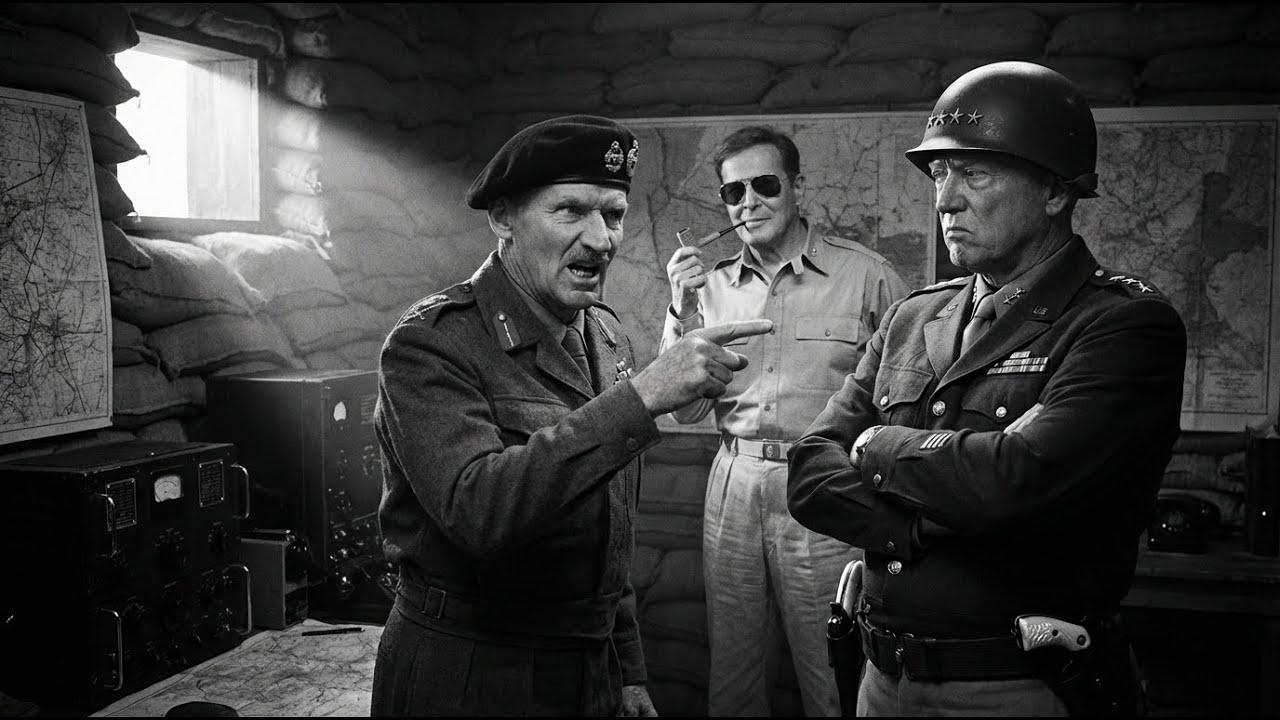
The Third US Army crossed the Rhine last night. Oppenheim sector, light resistance. Patton. A heavy silence descended on the command post.
The other officers stood motionless, picking up on the change in the air without yet grasping its source. Montgomery’s face stayed composed, but those who knew him caught the faint clench of his jaw, the almost invisible narrowing of his eyes. No coordination. No ceremony.
No permission. No advance notice. While Montgomery had been refining every element of Operation Plunder—his enormous artillery barrage, his synchronized airborne and amphibious assaults, his carefully orchestrated press coverage designed to display Allied might under British command—George S. Patton had simply crossed the Rhine in small assault boats under the cover of darkness.
No clamor. No elaborate preparations. Just troops, boats, and the night. By daybreak, American forces controlled the eastern bank.
Engineers were already assembling pontoon bridges. Tanks were getting ready to cross. The Third Army was moving forward while Montgomery’s painstakingly arranged moment of glory remained in its last stages of preparation. The triumph Montgomery had so carefully constructed, the victory meant to secure Britain’s standing after years of sacrifice and resolve, had been turned into a historical footnote by an American general who would not wait his turn, would not honor the chain of planning and authorization, would not accept that some moments require patience and coordination.
“Get me Eisenhower,” Montgomery said quietly. His voice was measured, but the hard edge in it told every officer present that this was no ordinary request. Within hours, he would draft a letter demanding something unprecedented in Allied command relations: the removal of George S. Patton from his post.
It would be formal, thorough, and unmistakable. Montgomery would contend that Patton’s actions amounted to disobedience of orders, sabotaged operational coordination, and threatened the very basis of Allied unity. Far off in the Pacific theater, Douglas MacArthur—another general who perhaps understood controversy and ego better than any living man—would offer a response that would stun Allied command and change the course of the crisis in ways no one anticipated. But this confrontation had not begun with a single night of unauthorized river crossing.
It was the product of nearly two years of rivalry, resentment, and deeply divergent visions of how to win a war. A struggle that endangered Allied unity from the shores of Sicily to the hedgerows of Normandy, from the disastrous bridges of Market Garden to the desperate winter fighting in the Battle of the Bulge. And now, on the eve of final victory over Nazi Germany, it threatened to split the alliance completely. Bernard Law Montgomery and George Smith Patton Jr.
were not simply two commanders with different styles. They represented two opposing philosophies of war itself, formed by different experiences, different national military cultures, and fundamentally different convictions about how battles are fought and won. Montgomery had survived the trenches of the First World War, where he saw firsthand what happens when generals send men forward without adequate preparation. He watched the flower of Britain’s youth slaughtered in futile attacks against fortified positions.
He saw how improvisation and bold initiative brought death and disaster, while careful planning and overwhelming force brought survival and eventual victory. Those experiences, burned into his consciousness during the most formative years of his military career, shaped everything that followed. He rose through the methodical British military culture, a system that prized precise preparation over inspiration, and believed wars are won by systematic planning, not brilliant improvisation. His approach was almost scientific, almost mathematical.
Calculate the force required. Amass overwhelming superiority. Plan for every contingency. Execute with discipline and coordination.
Victory through certainty. Victory through ensuring the battle is decided before it begins. Every variable must be controlled. Every possibility must be planned.
Nothing should be left to chance or the inspiration of the moment. Montgomery believed wars were too important to be left to the chaos of combat. They must be decided in planning rooms before the first shot is fired. George S.
Patton believed the exact opposite, with equal conviction. Speed is salvation. Momentum is everything. Hesitation kills more soldiers than enemy fire.
Wars are won by commanders willing to seize fleeting opportunities before the enemy can react, leaders who understand that war is fundamentally about will and speed rather than careful calculation. Strike hard before the enemy expects it. Move fast before they can respond. Force the enemy to fight your battle on your terms, not theirs.
Keep them off balance, reacting to your movements rather than executing their own plans. Victory through momentum. Victory through denying the enemy time to prepare, coordinate, or build the fortifications that make frontal assault so costly. Patton’s philosophy came from different experiences.
He had studied cavalry warfare where speed and shock were everything. He had absorbed military history, particularly Napoleon’s campaigns, where rapid movement and bold maneuver decided battles against superior numbers. He believed in the spirit of the offensive, in the moral weight of aggressive action, and in leadership that inspires rather than merely manages. Their collision was inevitable from the moment they were assigned to work together.
But coalition warfare made it catastrophic, magnifying personal and professional disagreements into matters of national prestige and alliance politics. Britain fought for survival and pride after years of standing alone against Nazi Germany. Every victory mattered not just militarily but symbolically. British commanders viewed caution as wisdom earned through bitter experience.
Having survived where others had fallen, they understood the true cost of reckless action. America fought with industrial confidence and restless energy. American generals saw the war as a problem to be solved through the application of overwhelming resources and aggressive action. They viewed British caution as cowardice disguised as prudence, a refusal to take the risks necessary for victory.
And standing between them was Dwight David Eisenhower, a diplomat in military uniform who fought his greatest battles not against the Germans but between the Allies. His genius lay not in battlefield tactics but in political maneuvering. He managed egos that would have destroyed lesser men. He balanced national pride, soothed wounded feelings, and kept the Montgomery-Patton rivalry from shattering the alliance.
But even Eisenhower, with all his diplomatic skill, could not reconcile their fundamental beliefs about war. He could manage the symptoms, but he could not cure the disease. Montgomery saw Patton as reckless at his core, a “cowboy” whose theatrical behavior and aggressive tactics endangered soldiers’ lives for personal glory. Patton saw Montgomery as paralyzed by caution, a “bureaucrat” whose endless planning squandered precious opportunities and needlessly prolonged the war.
Each man believed the Allied cause could not succeed without him. Each man believed the other posed a threat to the war effort. In July 1943, they faced their first real test side by side on the island of Sicily, where winning the military fight turned out to be far simpler than holding the partnership together. Operation Husky, the Allied invasion of Sicily, had been conceived from the outset as a stage on which Montgomery could display his talents.
When Allied planners met in the spring of 1943 to discuss invasion strategy, Montgomery’s word carried the day. He pressed hard for the approach he favored, drawing on the standing he had won at El Alamein, where he had secured Britain’s first major land victory over German forces. The resulting plan massed the British Eighth Army on Sicily’s eastern coast, poised to push north straight toward Messina, the island’s strategic prize. Whoever held Messina held the narrow strait that separates Sicily from the Italian mainland.
It was the key to everything. Patton’s Seventh Army was tasked with guarding Montgomery’s left flank, in essence a supporting part in what was designed to be a British-led triumph that would restore Britain’s military standing after years of setbacks. Patton would not accept that part. Once his troops were ashore, he began plotting something else, something that would prove his methods right and establish American independence from British command.
While Montgomery pushed steadily up the eastern coast against stubborn German resistance, exactly as planned though slower than hoped, Patton improvised with brilliance. He swung his army westward, tearing across Sicily’s mountainous interior in a lightning campaign that took Palermo on July 22. The Americans advanced so fast that German forces scarcely had time to dig in before being outflanked and bypassed. Then Patton wheeled his entire army east toward Messina, turning what was meant to be a flank-protection assignment into a race for glory.
What came next owed less to military necessity than to personal competition. Both armies drove toward the same objective along parallel roads. The commanders knew full well they were racing each other as much as fighting the enemy. Patton got there first, on August 17, 1943.
Photographers captured American troops celebrating in the streets of Messina. Headlines across America sang Patton’s boldness and speed. Radio broadcasts hailed American initiative and offensive leadership. Montgomery arrived hours later to find the glory already claimed, the photographs already taken, the headlines already printed, and the carefully scripted British victory eclipsed by American improvisation.
In public, Allied leaders celebrated a successful campaign that secured Sicily in a mere thirty-eight days. In private, Montgomery burned. His standing as Britain’s foremost field commander had been challenged and cut down. The story he had built was coming apart.
Patton, for his part, grew bolder still. He had proved his methods worked. Speed had beaten systematic caution. Bold action had succeeded where careful planning crept along.
The lesson appeared obvious. The Allies had won a decisive victory in Sicily, but partnership had given way to rivalry. Cooperation had been soured by contempt. What started as professional competition was hardening into something more dangerous, a personal vendetta that would trail both men to the shores of Normandy and beyond, menacing Allied unity at every critical turn.
When planning for Operation Overlord got underway, Eisenhower named Montgomery to command all Allied ground forces in the invasion’s opening phase. Montgomery’s plan was strategically sound. Seize Caen quickly to anchor the eastern flank, compel German armored reserves to fight there, and set the conditions for the American breakout in the west. Caen was meant to fall on D-Day, June 6, 1944.
Instead it took six savage weeks. British and Canadian forces ground their way through some of the fiercest fighting of the European war, taking heavy casualties against entrenched German SS Panzer divisions. Every village turned into a battlefield. Every field was sown with enemy positions.
In London and Washington, doubts multiplied. Why was the advance so slow? Why were the casualties so high? Why had Montgomery failed to deliver the breakout he had promised?
Montgomery answered by recasting failure as strategy, insisting the drawn-out battle had always been intended, deliberately crafted to pull German strength away from the American sectors. Whether that was true or a justification invented after the fact is still debated, but it shielded his reputation while planting doubts among American commanders. All the while Patton sat in England, still sidelined after the notorious incidents in Sicily where he had slapped two soldiers suffering from combat fatigue. From his forced exile, he watched the Normandy campaign stall, watched Montgomery’s promised breakthrough fail to arrive, watched the whole invasion appear to sink into the mud.
Then, on August 1, he was back in action, leading the newly activated Third Army. What followed was astonishing by any military measure. Patton’s forces tore across France in one of the fastest advances in military history, liberating ground at speeds that defied conventional doctrine and German expectations. His tanks covered in three weeks what Montgomery’s armies had struggled six weeks to achieve.
One city after another fell to American forces moving faster than German commanders could react. The breakout from Normandy became an American triumph. Newspapers turned their attention from the grinding British battles to the spectacular American breakthroughs. Public attention shifted from Montgomery to Patton.
The narrative Montgomery had so carefully controlled was slipping through his fingers. What had been a professional rivalry in Sicily became a war over reputation in France. Montgomery no longer merely disagreed with Patton’s methods. He needed to prove them wrong.
He needed to show that careful planning delivered better results than reckless speed. Strategy turned personal. Ego turned into military doctrine. And as the Allied armies raced toward the German border, Montgomery demanded not just priority but total control.
That gamble would cost thousands of lives, precious momentum, and whatever small measure of trust still remained between the Allies.
