The cage had no bars. That was what made it unbearable. Two boys rested on cushions embroidered with silver thread in rooms where the air carried cardamom and crushed rose petals. Trays appeared without a word.
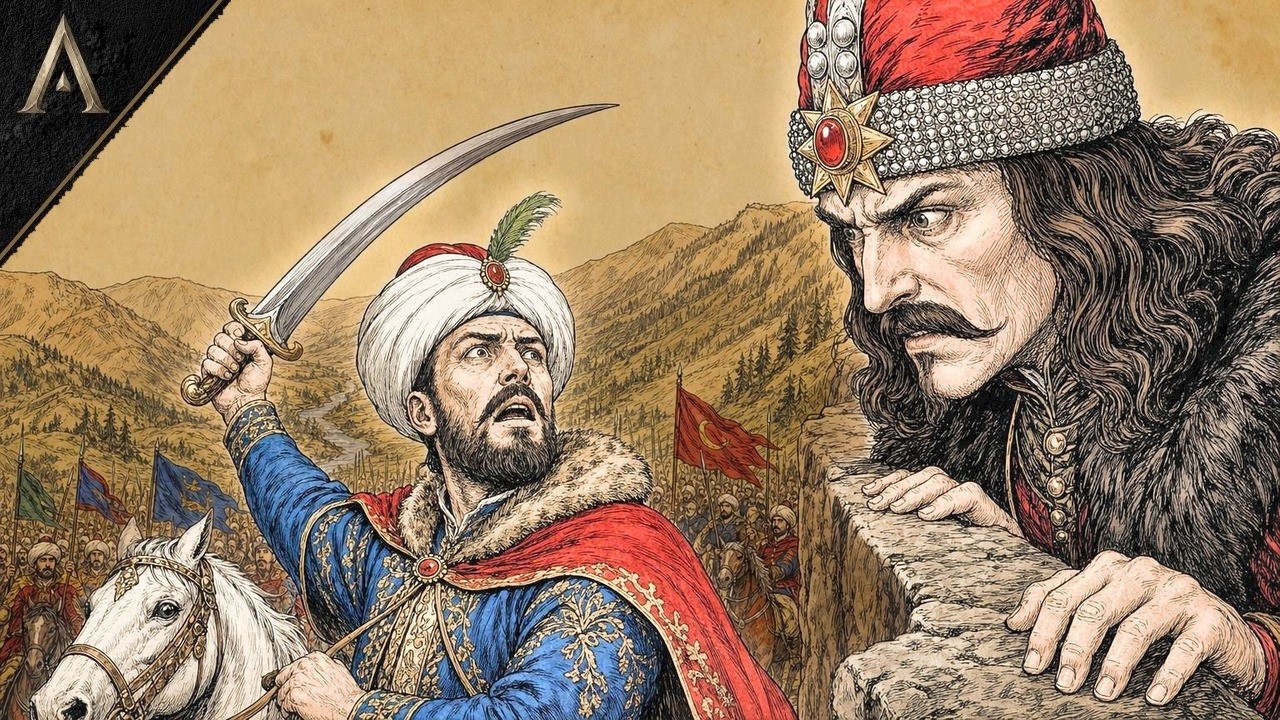
Honeyed pistachios, lamb shredded by saffron and slow fire. Tutors arrived at dawn with scrolls on geometry, the stars, the verses of the Quran. From the courtyard walls, it seemed like a gift. Within those walls at the Ottoman court of Edirne, it was a bargain.
Two children seized from their homeland, delivered by their own father to keep his throne secure. Their names were Vlad and Radu. One was about eleven. The other had just turned six.
And every sweet thing set before them carried the same silent warning: if their father broke his word, they would die before sundown. Vlad mastered the language quickly, then turned it on his captors the way a hunter studies the animal he means to kill. He observed how the empire moved its soldiers, how it punished its disobedient, how it broke proud men into kneeling shapes. He stored every detail behind eyes that, according to those who met him, never stopped counting.
Radu went the other way—younger, softer, beautiful in the way that turns the heads of powerful men. He did not resist the Ottoman world. He stepped inside it. He walked its corridors with a smile, charmed its princes, and slid into the bed of a young heir named Mehmed.
The boy who would one day take Constantinople. One forge, two blades. One pointed outward, burning with hate. The other turned inward, polished, patient, smiling.
This is not the story of Dracula the vampire. That legend buried the real one. Forget the mountain castle. Forget the cape, the coffin, the fangs.
The truth is a civil war that began in a child’s bedroom and ended with a severed head packed in a jar of honey. Vlad the Impaler, the man who made Mehmed the Conqueror turn his army around and retreat, was not brought down by an empire. He was brought down by his little brother. Radu the Handsome, the boy who traded his country for silk sheets, is the name history almost erased.
He is also the one who won. AD 1442. Two boys kneel on a marble floor inside the throne room of Sultan Murad II, and neither of them is shaking. The hall is enormous.
The ceiling is painted in geometric patterns of gold and indigo that repeat themselves into a kind of mathematical infinity. Lamps of beaten brass hang on chains from beams of cedar imported from Lebanon. The floor under the boys’ knees is veined marble cut from quarries near Marmara, polished so cleanly it reflects the lamps as though the room were doubled. Janissaries line the walls in their tall white headgear, motionless, the brass plates on their belts catching the lamplight.
The air smells of alderwood smoke from a censer near the throne, and of the lanolin grease the guards rub into their leather. The older boy, Vlad, is around eleven. The younger one, Radu, is six or seven, small enough that the silk kaftan on his shoulders bunches at the wrists and pulls around his knees. Behind them stands their father, Vlad Dracul, prince of Wallachia, a sworn knight of the Order of the Dragon, the chivalric brotherhood founded by Emperor Sigismund of Luxembourg in AD 1408 to push back the Ottoman tide.
The dragon device sits on his cloak: a serpent curled into a ring, swallowing its own tail, the cross of St. George burned across its back. He is a man who has taken an oath before God and Christendom to bleed for the cross. He is also a man who has just placed his two living sons at the feet of the Sultan as a guarantee—proof of his obedience written in the bodies of his children.
He will mount his horse and ride home to Wallachia. They will not. No chronicler recorded what he said to them before he turned around. Not the Byzantine Ducas, not the Ottoman Ashik Pashazade, not the German chronicles compiled later at St.
Gall. No farewell, no written apology, no surviving letter pulled from any archive. He walked out, and the cedar doors of the Ottoman court swung shut behind him like the lid of a coffin. To understand how a Christian prince ends up handing his children to a Muslim sultan, you have to back up only a few months, to a trap so elegantly built that one of the cleverest rulers in Eastern Europe walked into it without seeing the wire.
Vlad Dracul had spent years balancing the impossible geometry of fifteenth-century Wallachia: a small principality wedged between the Kingdom of Hungary to the north and the rising Ottoman Empire to the south, roughly 75,000 kilometers of forest, river valley, and Danube plain. Too weak to fight either neighbor. Too valuable, sitting on the trade roads between Brașov and the Black Sea ports, to be ignored. Wallachian princes survived by playing both giants against each other, taking protection from whichever side offered better terms, then betraying both when the wind shifted.
Dracul was a master of this game. In AD 1437, he had marched with Murad against Transylvania. In AD 1441, he had welcomed John Hunyadi into Târgoviște and helped plan a campaign against the same Sultan. By AD 1442, the bill came due.
Murad summoned him to Gallipoli, the fortress port at the mouth of the Dardanelles, the same crossing the Ottomans had used to step into Europe almost a century earlier. Dracul rode in expecting negotiation, maybe even an alliance. He was wrong. According to the Ottoman court historians, Murad had him seized the moment he passed the gates, bound and held under guard, while the terms of release were laid out in three lines: go home, swear loyalty, pay an annual tribute of 10,000 gold ducats, and leave your sons behind.
The boys would be treated as guests—educated, fed, clothed in fine cloth—but they would remain inside Ottoman walls for as long as the Sultan wished. The day Wallachia rebelled, the day Dracul broke his word, those two boys would be the first ones to bleed. The Ottomans had been perfecting this mechanism for generations. The Byzantine emperors had used it before them.
The Persians before that. Hostage-taking in plain language, but the empire dressed it in softer clothes: an educational arrangement, a cultural privilege, a chance to study at the most refined court in the known world. The framing was not entirely a lie. What was done to these children was not flogging or starvation.
It was something more chilling and more lasting. They constructed a world around the boys so whole, so lovely, and so hard to abandon that, bit by bit, it started to replace the one from which they had been taken. In the 1440s, Edirne was the pulse of an empire stretching from the Balkans far into Anatolia. The city stood where three rivers met—the Tundzha, the Maritsa, and the Arda—and the bridges over those rivers were crowded with merchants from Ragusa, Kaffa, Bursa, and Cairo.
The Friday call to prayer poured down from the minaret of the Eski Camii, the old mosque completed just twenty-eight years before the boys arrived, and the sound drifted across tile roofs still steaming from the morning rain. Caravans from the east unloaded saffron from Khorasan, silk from Tabriz, indigo cakes pressed in Bengal. The palace where the brothers lived was no prison in any ordinary sense. It was a tangle of courtyards and gardens, libraries and training grounds run by scholars and soldiers and courtiers drawn from every land the Sultan had conquered.
There were orchards of pomegranate trees brought from Persia, water clocks that struck the hours with brass figures of horsemen. The food alone would have astonished two boys raised on Wallachian bread and boiled meat: spice mixtures with no counterpart north of the Danube, flaky pastries drenched in syrup, lamb cooked with dried plums and pomegranate seeds, rice turned yellow with saffron from the Anatolian highlands. The buildings themselves spoke a language of power they had never encountered—arched colonnades, tile work in lapis and turquoise, geometric and endless, fired in the kilns of Iznik, indoor fountains that ran day and night because the empire could afford to let water run for no purpose but beauty. If Wallachia was woodsmoke and frost and muddy forest tracks, Edirne was the reverse of every memory their bodies held.
The Ottoman scheme for training elite hostages was not improvised. It was a system honed since the reign of Murad I in the previous century, organized through the institution that would in time be known as the Enderun, the inner palace school. Tutors came for Turkish, then Arabic, then Persian. The boys studied the Quran—not as a conversion tool in those first years, but as the foundational text of the civilization they now inhabited, the way a student in a Roman court would have been drilled on Virgil.
They learned mathematics through the works of al-Khwarizmi, astronomy from copies of Ulugh Beg’s star tables, the geometry of fortifications, the logistics of moving armies over long distances, the mechanics of siege engines, including the bronze bombards that would, within a decade, break the walls of Constantinople. They trained their bodies—horseback, bow, sword, wrestling—beside other hostage sons taken from the conquered nobility of Serbia, Bulgaria, Greece, and the Anatolian frontier: the sons of Branković, the sons of the Lazarević line, boys from Albanian clans whose fathers were already negotiating with a young captain named George Kastrioti, the one who would later become Skanderbeg. It was one of the most efficient machines history has ever built for turning the children of defeated peoples into instruments of the empire that defeated them. Both brothers were sharp.
The sources, sparse as they are, agree on that. They absorbed the language quickly. They advanced through the curriculum without faltering. But the way each of them stood inside this new world was not the same.
And the difference appeared early. Vlad watched. He moved through the Ottoman court the way a wolf moves through unfamiliar woods: silent, patient, charting every exit. He was not studying a subject.
He was studying an enemy. He observed how power ran through the empire’s veins, how obedience was wrung from the conquered, which methods broke a man, and which methods only made him angrier. He noticed which faces went still when a certain vizier entered a room. The chronicler Laonikos Chalkokondyles, writing decades later, describes the young Vlad as openly hostile to his Ottoman handlers, talking back, refusing instruction, fighting other students, punished for it more than once.
The details did not survive in any precise form, but their outline did: a boy who would not show gratitude for the gift of his own captivity, and who took the beatings rather than smile. He was not broken. He was taking notes. There is one thing in particular that Vlad witnessed during these years that would never leave him: the Ottoman practice of impalement.
This matters because popular memory attributes impalement to Vlad as though it were some Wallachian peasant custom he invented in a candlelit tower. It was not. Impalement as a method of execution and mass intimidation was an Ottoman instrument, used throughout the empire’s expansion to keep conquered populations fixed in place. The stakes went up outside city gates after rebellions in Anatolia.
They went up along the Danube frontier after each Wallachian uprising. The boys at Edirne would have seen the bodies the way a child raised near a slaughterhouse grows familiar with the smell without ever being formally introduced to it. The stake was part of the furniture of Ottoman power. Vlad put it away the way he put away everything else: as a study in how fear scales.
Radu, within the same walls, became a different creature entirely. He did not resist. Some of that was age. A six-year-old is softer clay than an eleven-year-old, and the Ottoman court began shaping him before whatever he might have become in Wallachia had time to harden.
But the chronicles point to something beyond age. Radu possessed a quality his brother did not: people wanted to be near him. The sources are unusually consistent about his physical beauty, which is why the epithet cel Frumos, the Handsome, stuck the way it did. And it was not only the face.
It was the way he entered a room, the way he listened, a warmth that pulled powerful men toward him without anyone deciding to be pulled. He used it, whether knowingly or by instinct hardly matters. In court politics, the line between genuine charm and weaponized charm is mostly a fiction. What the records show is that Radu rose.
He was welcomed into circles most hostage princes never breathed in. And the most important of those circles belonged to the heir apparent—a prince several years older, fiercely intelligent, hungry, strange. Mehmed, son of Murad, who at the age of twelve had briefly held the Ottoman throne when his father attempted to retire to a Sufi lodge in Manisa. Mehmed, who already spoke six languages by the time Radu met him.
Mehmed, who would within a decade make himself the most feared man on three continents. The future Conqueror. The exact nature of the bond between Radu and Mehmed has been argued over for centuries, though the argument is less about evidence than about how much modern readers want to flinch from it. Ducas writes that Mehmed, drunk one night, attempted to force himself on Radu, who at first defended himself with a dagger, and that the relationship deepened from there into something neither violent nor distant.
Other Byzantine and Ottoman chronicles are more guarded in their wording, yet they concur that Radu held a position near Mehmed that exceeded anything court ceremony could account for. The bodily details are beside the point. What matters is the political outcome: Radu, a Wallachian hostage, grew essential to the man who would shortly lead the largest army in the Eastern world. Not a captive to be handled—a person whom the most dangerous man alive insisted on keeping near.
A position like that rewrites a life. While these two versions of the same boy were being shaped inside Edirne, the country they had been stolen from was consuming itself in the way Wallachia so often did. The news came in pieces. Catastrophic news always does.
Fragments first, then the whole shape of it, which always proves worse than the fragments implied. The year was AD 1447. Their father, Vlad Dracul, was dead. Not in battle, not at Turkish hands.
He had been run to ground by a faction of Wallachian boyars—the noble class whose loyalty and betrayal drove every princely dynasty in the region—acting in concert with John Hunyadi, the voivode of Transylvania, the very man Dracul had once welcomed into Târgoviște six years before. Dracul had played one side too many. Worse, he had failed to stand with Hunyadi at the catastrophe of Varna in AD 1444, where King Władysław III of Poland was killed and the last crusader army of the century was broken. Hunyadi never forgave him.
The sides had closed at last. Dracul was ambushed at Bălteni in the marshlands north of Bucharest, dragged from his horse and killed among the reeds. The news of their elder brother Mircea was fouler still. Mircea had been ruling alongside their father, bearing the family’s claim to the throne.
The same boyars seized him alive in Târgoviște. They blinded him first—a standard medieval method of political erasure: hot iron driven into the sockets, burning out the eyes to make a man legally unfit to rule under the customs of the age, the very technique Byzantine emperors had used on rivals for six centuries. Then, while he still breathed, they buried him. Whether he was conscious when the earth closed over his mouth is a question the sources leave unanswered.
The answer hardly matters. Hold that thought a moment. Picture it arriving in Edirne. A messenger crossing the Bosphorus by ferry, riding the post road through Thrace, dismounting in a courtyard where two boys are being drilled in Arabic conjugation.
Two boys already torn from their country, already living as costly prisoners beneath a foreign sky, told that their father is rotting in a swamp and their elder brother was blinded and buried alive by his own countrymen. Not slain by enemies. Slain by Wallachians. By the very noble class they were meant to rule.
One day, the same news struck each brother from a different angle. And those two angles explain nearly everything that follows. For Vlad, it locked into place the lesson he had been assembling for years inside the Ottoman court. Trust was bait.
Loyalty was a costume men put on before they stabbed you. The boyars who had butchered his family were the same class he would have to rule one day, and his father’s death proved that ruling through their cooperation was a fantasy that ended with a prince face down in a marsh. The only stable bond between a ruler and his subjects was fear—not love, not respect, not negotiation—fear kept at such a temperature that a man would choose death over disloyalty. Vlad did not become this from damage.
He became this from arithmetic. For Radu, the same news ran through a mirror. Wallachia was a slaughterhouse of greedy nobles and dying dynasties. A cold, poor, wretched place where every prince eventually met the same end.
And here he was, inside the strongest empire on earth, beside the man who would soon command its armies, eating from silver plates, sleeping without a blade beneath his cushion. His brother could go back and burn for that mess if he wished. Radu was not going home. The Ottoman court was no longer his cage.
It was where he belonged. He had chosen. The final split came when the Ottomans decided Vlad had grown into something useful. He had the bloodline.
He had the name. He had a claim to the Wallachian throne that could be played whenever the current prince grew inconvenient. That current prince was Vladislav II, installed by Hunyadi himself, which made the Ottomans uneasy. They needed a counterweight.
Vlad was it. He was also, after years of Ottoman schooling, deeply familiar with how the empire fought, which meant Constantinople believed it could predict him. They would put him on the throne. He would pay tribute.
The leash would be managed from the south. Vlad accepted—not out of gratitude, not because Murad had won him over. He accepted because the men who killed his father lived in Wallachia, and the road home now ran through the Sultan’s blessing. Years of captivity had taught him patience.
They had also given him a route back to the people he intended to bury. Radu did not go with him. No record shows him asking. No source describes him grieving the separation.
He stayed in Edirne, and then in Constantinople after May 29th, AD 1453, when Mehmed’s bombards finally cracked the Theodosian walls and the queen of cities fell after a thousand years of standing. Radu was inside Mehmed’s inner circle on the day the Sultan rode through the breach at the Gate of St. Romanos. Radu cel Frumos stayed exactly where he had placed himself: at the right hand of the Ottoman world.
Comfortable. Powerful. Loyal. Two brothers.
The same father. The same stolen years. The same cold marble under their knees in a foreign throne room. One went home to burn down the people who had destroyed his family.
The other decided those people had been right. Vlad rode back into Wallachia for the first time in AD 1448, taking advantage of Hunyadi’s absence at the second battle of Kosovo, where the Hungarian army was being smashed by Murad on the same field where the Serbian nobility had died fifty-nine years earlier. Vlad held the throne for about two months before Hunyadi returned and threw him off again. He scattered into exile—Moldavia first, to the court of his cousin Bogdan II, where he met a boy his own age named Stephen, the future Stephen the Great, the prince who would one day defeat the Ottomans at Vaslui.
The two of them swore to help each other onto their thrones. Then Bogdan was assassinated in AD 1451, and Vlad ran again—this time straight into the lion’s mouth, to Transylvania, to the court of John Hunyadi himself, the man who had killed his father. He convinced Hunyadi that he was a better Ottoman counterweight than Vladislav II. Hunyadi believed him.
History rarely produces a stranger alliance. The permanent return came in AD 1456. Hunyadi died of plague that summer outside Belgrade, days after winning the siege that saved Hungary from Mehmed. The political balance cracked.
Vlad made his move. Near Târgoviște he met Vladislav II in single combat and killed him. The chronicles say little, but they do not disagree on this point. Then he took the Wallachian throne and began the reign that history would not forget.
His first act was not a treaty, a tax reform, a fortress, or a letter to Constantinople. He gave a banquet. He invited the boyars who had murdered his family and laid his brother in the ground. The invitations bore his princely seal.
He announced it as an Easter celebration. He asked them to dress in their richest garments. He asked them to bring their wives and their sons. What took place in that hall on Easter Sunday, AD 1457, is still spoken of in whispers six centuries on.
Easter Sunday, AD 1457. Târgoviște. The bells of the princely court peal over the muddy streets of the Wallachian capital, and the boyars emerge from the spring mist in their finest cloth. They come from the great houses—the Craiovești of the south, whose lands ran along the lower Olt; the Albești from the foothills near Curtea de Argeș; the Florescu; the Bărcănești; the Mihăilă.
Names that appear in donation charters across the reigns of nine different princes: princes they had served, betrayed, replaced, and outlasted. Their cloaks are lined with marten and sable, their silver belts forged in Sibiu workshops, their boots stitched in Brașov. The women follow a step behind in long gowns of Florentine wool dyed crimson with kermes and indigo carried along Ottoman trade routes, silver pectoral crosses at their throats. The sons and daughters trail after them, scrubbed for the occasion, fetched from the monasteries at Cozia and Tismana and the country estates along the Argeș for what has been proclaimed a feast of reconciliation.
Vlad had sent the invitations under his princely seal: the dragon coiled around its own tail, emblem of the Order of the Dragon, the very device his father had worn the day he was dragged from his horse at Bălteni and killed among the reeds. The invitations went out to every major boyar house. To the old patriarchs who had sat in the council chamber the morning his father was condemned by silence. To the middle generation who had inherited their fathers’ rings and their fathers’ debts.
To the young heirs whose only crime was the surname on their baptismal records. They came because refusal was treason. They came because Wallachian boyars had been managing princes for a hundred years and believed they could manage this one too. They came because the prince was twenty-six, installed by force of arms in August AD 1456 after killing Vladislav II in single combat near Târgoviște.
They had managed his father. They had managed Vladislav II. They had managed Alexandru Aldea before him. They had managed Dan II before that.
The machine had served for four generations. Until it stopped. The hall in the princely court was lit by tallow candles in iron stands wrought by smiths of the Slătioara guild. The trestle tables were laid with linen from Sibiu and garnished with sprigs of basil, the Easter herb blessed at the Metropolitan Church that morning.
The kitchens had been at work since before dawn: roast boar from the Vlasia forest; carp from the Ialomița baked whole in clay; bread from the ovens beneath the chapel of St. Nicholas; sheep’s milk cheese rolled in sea salt; wine from the Dealu slopes, dark and resinous, poured from glazed pitchers into pewter cups. The air smelled of beeswax and roasting fat and damp wool drying by the hearth. Behind a wooden screen, a fiddler from the Romani settlement beyond the walls played a slow doina, the tune Wallachian shepherds used to call their sheep down from the high pastures.
Vlad sat at the head of the table. He wore a kaftan of dark red velvet in the Hungarian cut he had taken up during his exile at the court of John Hunyadi—a deliberate visual statement, since most of the boyars present had Ottoman tastes from years of accommodating the Porte. His mustache was long. His eyes, as the diplomatic report Modrussa would later write for Pope Pius II, were green and unusually wide, the lashes thick and dark, the gaze of a man who did not blink at the expected intervals.
The chroniclers who later pieced the scene together—Saxon clerics writing from refuges in Brașov and Sibiu, monks at the monastery of Snagov copying down what survivors whispered, the anonymous author of the Slavic narrative known as the Scazanie o Dracula Voievod—agree on the prince’s face that afternoon: still. Watching. The stillness men mistake for calm when it is in fact calculation. He let them eat.
He let them drink. He waited until the wine had loosened tongues and the second course was on the table. Then he rose. He said nothing about loyalty.
He said nothing about reform. He put a single question to them: how many reigns had each of them lived through? The boyars answered. They counted aloud.
Some said seven. Some said ten. The eldest of them, a man whose beard had turned white during the reign of Mircea the Elder at the turn of the century, named thirty princes from memory—every Wallachian ruler since the days of Radu I, the whole bloody carousel of the Basarab and Dănești houses, every poisoning and exile and forced abdication and decapitation. He gave the number with the quiet pride of a man who had outlived it all.
Vlad heard out every answer. He did not interrupt. He wrote nothing down. He had written it down in his head long ago, in a room in Edirne when he was twelve years old.
Then his guards moved. They came through the side doors—mercenaries Vlad had brought down from Transylvania during his exile years, men with no ties to any Wallachian house, paid in silver struck at the Sibiu workshops and bound to him by oaths sworn at the chapel of St. John in Făgăraș. The old patriarchs were taken first: the gray-bearded ones, the ones who had been in the room when his father was sold.
They were hauled through the side doors into the inner courtyard, where the stakes had been driven into the earth the night before. Impalement, in the hands of men trained to it, was an unhurried craft. The stake was rounded at the tip, never sharpened. A sharp point pierced organs and killed too quickly.
The wood was greased with mutton fat. The Ottoman manuals from which the technique was borrowed set out the proper angle of insertion, the rate of progress, the way to follow the body’s natural channels so that the stake displaced rather than cut. A man impaled correctly stayed alive on the wood for a day, sometimes two. The screams from the courtyard rolled back through the high windows into the hall.
The fiddler had fallen silent. Beneath the table, the dogs had ceased their gnawing. The younger captives—those men and women still fit for labor—were for the moment denied the stake. Hemp rope bound their wrists, they were parted from the corpses of their mothers and fathers and grandparents, and by that same afternoon they were driven out of Târgoviște still wearing the garments they had donned for dinner.
Five hundred souls, according to the tally in the Scazanie. Other accounts offer differing numbers. The German chronicler Michael Beheim, composing his verse narrative, Story of a Bloodthirsty Madman Called Dracula of Wallachia, circa AD 1463 from conversations with a Cistercian monk, Brother Jacob, who had fled Wallachian lands, enumerates the men and the women of the procession as separate groups and reaches a comparable order of magnitude. The column headed north.
Poenari was the goal—perched on the precipice above the Argeș Gorge, some fifty kilometers into the Carpathian foothills, reached by a road that wound upward past the villages of Aninoasa and Corbeni before fording the river at the timber bridge beneath the cliff. Easter in the southern Carpathians bears no resemblance to the spring a Venetian or a Florentine would have known. Snow persists in the high passes above two thousand meters. The Argeș flows dark and swollen with meltwater.
Down through the gorges, off the Făgăraș peaks, the wind descends in a sluggish current of chilled air that presses against the flesh like cold water. The boyars trod that road in slippers stitched for marble halls. The women’s gowns, five or six kilos when dry, doubled in weight once wet within the first hour of rain. The chronicles describe the procession as a sluggish caterpillar of unraveling finery creeping up the river road, flanked by mounted guards with lances, strewing behind it scraps of cloth and bodies in the ditches.
No one lifted those who collapsed. The guards dispatched them on the spot. The survivors arrived at Poenari to discover a ruin—a decaying fortification dating to the early thirteenth century, first erected by the Basarab dynasty and left abandoned for decades, half tumbled down upon its limestone ledge above the gorge. Vlad’s engineers, brought up from the construction yards of Curtea de Argeș, had already staked out where the new walls were to rise.
Tools were placed in the boyars’ hands: iron mauls, wooden levers, leather buckets. They cut stone from the cliff face. They mixed mortar with lime hauled up from the valley kilns. The women bore bricks in baskets strapped to their backs, climbing paths a goat would have taken with caution.
They labored in the garments they had worn to the feast until those garments shredded away from their bodies in strips, and afterward they labored in the burlap rags the guards tossed down from a heap. Beheim’s narrative names a boyar woman, Anca, widow of one of the patriarchs impaled in the courtyard, who is said to have toiled at Poenari for forty days before her hands could no longer grip a hammer shaft. The detail endures because Brother Jacob had known her family. Those who outlasted the construction became the new servants of the finished fortress.
Those who did not were folded into the foundations or hurled from the cliff into the river two hundred meters below. Once Poenari stood complete—and it was complete within a year, a remarkable pace for the labor involved—it became Vlad’s true seat. Not the princely court at Târgoviște, where ambassadors were received and the chancellery kept its ledgers. Poenari was where he slept when he wished to sleep without dreaming.
A fortress reachable only by one ridge approach, with the river curving two hundred meters below on three sides. Walls raised from limestone hauled up by the hands of the very people who had murdered his father. The architecture itself carried the message. That message needed no translation into any tongue spoken in Eastern Europe.
What Vlad erected across Wallachia between AD 1456 and AD 1462 was no government in any form the Italian or Hungarian chancelleries would have known. It was one instrument tuned to one note. And that note was fear. He impaled criminals.
He impaled as well the merchants who gave short weight on grain at the markets of Târgoviște. Wives who took lovers—the Scazanie records an instance in which Vlad personally examined the corpse of an executed adulteress and commanded that she be displayed in the market until the body disintegrated. Servants who robbed their masters. Beggars he judged fit for work.
One account relates that Vlad summoned every beggar of Târgoviște to a feast at a disused barn outside the city, had the doors barred once they were inside, and set the building alight with them trapped within. The Saxon pamphlets that started circulating throughout the Holy Roman Empire in the AD 1460s list case upon case in a tone that shifts between horror and accounting. The legal reasoning was calculated. When the penalty for petty theft matches the penalty for treason, the populace cannot reckon the odds.
There is no lesser offense. There is no tolerable risk. There is only the stake. The same stake for all of it.
Foreign traders journeying Wallachian roads during those six years described a land in which crime had disappeared. Not because the people had turned virtuous, but because the roadsides were lined with those who had not. The celebrated tale of the golden cup turns up in virtually every chronicle of the era. Vlad placed a drinking cup of solid gold at a public fountain in Târgoviște, there for any traveler to use.
Throughout the whole of his reign the cup stayed at that fountain. No hand touched it. Then came the Saxon campaigns, which carried Vlad’s name beyond Wallachia and into the imagination of Europe. The Transylvanian Saxon cities—Brașov, Sibiu, Bistrița—had been quietly harboring rival claimants to the Wallachian throne.
Pretenders maintained on retainer in Saxon townhouses, spares in case the reigning prince required replacing. The Saxons had played this game since the reign of Mircea the Elder. They had also been undercutting Wallachian merchants in cross-border trade, refusing to honor the price agreements signed under Vlad’s father. The spark came when Brașov gave shelter to a claimant named Dan, a member of the rival Dănești line.
Vlad demanded his extradition. Brașov refused. The mayor of Brașov at the time, a German named Christian, returned a letter of courteous refusal composed in Latin. Vlad replied in April AD 1459.
He crossed the Carpathians by way of the Bran Pass, put the suburbs of Brașov to the torch—including the village of Bartolomeu beyond the city walls—and burned the chapel of St. Jacob, where Saxon pilgrims had assembled for an Easter procession. The pilgrims’ bodies were gathered up for what was to follow. He raided again in AD 1460.
And beyond the walls of Brașov, at the foot of the limestone face of the Tâmpa Hill that towers over the Saxon city, he staged the tableau that would feed European nightmares for the following three centuries. He dined in the open air. A long oak table was carried out and arranged on the bare ground at the base of the Tâmpa. Around it, in concentric rings, he had stakes driven into the earth.
The tally given in the German pamphlets runs anywhere from a few hundred to more than twenty thousand, though most present-day historians settle on roughly three to four thousand corpses for the Brașov incident alone. The stakes stood taller along the outer ring and grew shorter as they stepped inward toward the table, so the entire arrangement read as a wheel of the dead radiating outward, with Vlad’s own place setting at the hub—a geometry that could be made out from the watchtowers of the Saxon city, from the bell tower of the Black Church, still rising in the AD 1450s. The townsfolk climbed the walls to stare. Then they climbed back down and never looked again.
He ate. He drank. He soaked his bread in the boar gravy. The smell—and this is the detail that endures in every version, because it is the detail every witness could not stop fixating on—was the smell of late-spring decay in vast quantities, out in the open air.
A damp, oppressive stench that clung to the back of the throat. One of his own boyars at the table, a man whose name the chronicles leave unrecorded, pressed a sleeve over his nose. Vlad saw it. He asked the man what troubled him.
The boyar replied that the stench was turning his stomach. Vlad had him impaled on a stake taller than any of the others. He explained, in the account set down by the Saxon priest Conrad Justinger, that the man would now be lifted high enough that the smell could no longer bother him. That story traveled.
It traveled because the printing press had only just been invented. Gutenberg had turned out his first Bibles in Mainz in AD 1455. By AD 1463, the workshop of Markus Ayrer in Nuremberg, the press of Bartholomäus Ghotan in Lübeck, and printers in Augsburg, Strasbourg, and Bamberg were producing pamphlets—short and cheap, eight or twelve pages, decorated with rough woodcuts. The Dracula pamphlets rank among the earliest instances of what media historians regard as the first mass news cycle in European history.
Titles such as Die Geschichte Dracole Waide went through fourteen separate printings across the German lands by AD 1500. The woodcuts depicted the prince at his table, the stakes encircling him, the bodies drawn in the rigid vertical strokes that early woodcut work permitted. The pamphlets circulated. They arrived at the court of King Matthias Corvinus in Buda, where they were put to use justifying Vlad’s later imprisonment.
They arrived before Pope Pius II in Rome, who wove material from them into his Commentaries, the only autobiography a sitting pope has ever written. They arrived in the Republic of Venice, where the Senate had them read aloud while debating Balkan policy. They arrived at the French court of Louis XI. They arrived, in time, at the Russian principality of Moscow, where the Slavic narrative Scazanie o Dracula Voievod was composed around AD 1486 by a diplomat in the service of Ivan III, possibly Fyodor Kuritsyn, who had passed through Wallachia on an embassy.
Vlad Dracula entered the European mind as a category that had not existed before: not a war criminal in the old sense, not a tyrant in the classical Roman mold of Suetonius’s Twelve Caesars, but something more modern and more unsettling—a ruler who wielded atrocity as an instrument of policy, applied with bureaucratic consistency both at home and abroad. A man who had read his Tacitus on Tiberius’s purges and his Plutarch on Sulla’s proscriptions, and concluded that the bloodier passages were instruction manuals. From Vlad’s own standpoint, the reputation was an asset. A prince no one could predict was a prince no one would conspire to replace.
Every boyar who heard about Brașov understood that Brașov was also about them. Every Hungarian diplomat negotiating with Wallachia understood the grain of the man across the table. He was building a name the way a smith builds a blade: slowly, deliberately, tempered for a single purpose. The clash with the Ottomans was always coming.
Wallachia owed tribute to the Sublime Porte: ten thousand gold ducats a year, plus five hundred boys for the Janissary Corps, under terms negotiated decades earlier in his father’s time. Vlad had ceased paying in AD 1459. He had also ceased sending the boys. By AD 1461, the unpaid tribute had compounded into a debt the Sultan could not overlook without losing face throughout the Balkans, where every other tributary state was watching to see what would happen.
Mehmed II dispatched envoys to Târgoviște in the autumn of AD 1461. The Greek diplomat Thomas Katabolinos, a converted Byzantine serving in the Ottoman foreign service under the name Yunus Bey, headed the delegation. With him rode Hamza Pasha, the Bey of Nicopolis, an old soldier under orders to seize Vlad and haul him south in chains should the prince refuse to come willingly. The demands were set out at the audience: pay the arrears, send the boys, journey in person to the Porte to renew the oath of vassalage.
Both sides understood that the final item was a courteous way of inviting Vlad to walk into his own execution at the Topkapı. The envoys, following Islamic protocol, kept their turbans on in the prince’s presence. Under their own customs this was no insult. It was religious observance.
Vlad chose to take it as one. He asked them why they would not uncover their heads before a prince. They explained, through Katabolinos’s translator, that their faith did not allow it. Vlad said he would help them honor their faith more permanently.
He had them seized. He had iron nails fetched from the smithy in the lower court. The nails were driven through the fabric of the turbans into the skulls beneath. Slowly enough that the men were still alive for the first several blows.
Hamza Pasha received special treatment. He was taken alive to a separate spot and impaled on a stake higher than those of his men, as his rank demanded. Their bodies were sent back south with messengers. The diplomatic message could not have been clearer.
Mehmed received it inside the Topkapı, the new imperial complex he had been raising since AD 1459 on the promontory above the Bosphorus where the old Byzantine acropolis once stood. He was thirty years old. He had taken Constantinople nine years before. He had crushed the Serbian despotate in AD 1459 and absorbed the Empire of Trebizond on the Black Sea coast in AD 1461.
The Genoese had paid him tribute. The Venetians bargained with him from a position of fear. He was not a man who accepted humiliation at the hands of a vassal prince whose entire country could fit inside one of his sanjaks. In the winter of AD 1461 into AD 1462, Vlad moved first.
He crossed the frozen Danube at several points between Zimnicea and Chilia. He struck the Ottoman river settlements with mounted columns dressed in Ottoman uniforms and speaking Turkish. The language he had been forced to learn as a hostage in Edirne now turned against the very men who had taught it to him. He burned villages from Nicopolis to Ruse.
He destroyed granaries, fortresses, mosques, ferry stations. He moved by night in small parties, using local guides paid in advance. He was back in Wallachia before the Danube thawed. Then he sent the letter.
The letter bears the date February 11th, AD 1462. It was dispatched from Giurgiu and directed to King Matthias Corvinus of Hungary. The original Latin text still exists in the Hungarian state archives in Budapest. In it, Vlad lists the dead region by region, settlement by settlement, victim by victim.
His tally comes to 23,884 Turks and Bulgarian Muslims slain, “without counting those whom we burned in their homes or whose heads were not presented to our officers, because the cutting of heads was difficult in the dark.” He frames the count as a service rendered to Christendom and requests crusader reinforcements from Matthias so the work can be completed. The figure may have been rounded. It may have been exact.
None of that matters. The letter was written for two audiences. The first was Hungary, where Matthias was being pressed to commit to a Balkan war. The second was Constantinople, where Mehmed was meant to grasp the shape of what had been inflicted on his frontier.
Mehmed gathered an army. Contemporary sources disagree on the numbers. Laonikos Chalkokondyles, writing in Greek, gives the force as 150,000. Ottoman court records compiled later in the Tarih-i Ebü’l-Feth of Tursun Bey indicate 90,000 to 100,000.
Modern historians place it at roughly 60,000 to 90,000. Whichever count one accepts, it was the largest force Mehmed had personally led since the siege of Constantinople in AD 1453. Janissaries from the barracks at Edirne. Sipahi cavalry from the Anatolian provinces.
Akıncı raiders from the Rumelian frontier. Bombards drawn by ox teams along the post road through Plovdiv. Camels from the Anatolian baggage train, brought into Europe for the first time on this campaign. A Danube flotilla of twenty-five galleys and 150 smaller vessels.
Mahmud Pasha, the Sultan’s most seasoned commander and a man at Mehmed’s side since the conquest of Constantinople, acted as second in command. The man who briefed Mehmed on the Wallachian terrain was Radu. He was twenty-seven years old. He had stood beside the Sultan throughout the planning.
He sat in the war councils within the Topkapı construction camp, alongside Mahmud Pasha and the chief of staff, Mehmed Niyancı. He marked the maps in ink. He named the river crossings: Vidin, Nicopolis, Turnu Severin. He pointed out the boyar families most likely to defect.
He spoke the language of every village along the line of march. He understood his brother’s cast of mind—the patience, the patterns of thought, the tactical preferences—because he had once shared a stone floor with him in Edirne, listened to the same tutors, and drawn the opposite conclusion from every lesson. Radu had not seen his brother in fourteen years. He was about to march back into Wallachia at the head of the largest invasion force the country had ever confronted, carrying in his own head the most precise intelligence the Ottoman command possessed about the man waiting across the river.
Mehmed’s army crossed the Danube on the night of June 4th, AD 1462, near the fortress of Nicopolis. The crossing took three days. The Janissary regiments waited on the shore under cover of the bombards firing across the river, and Mehmed himself crossed on the fourth day at the head of his household troops, mounted on a white Arabian. The lead columns spread out into the Wallachian plain at dawn on June 7th and began the march north toward Târgoviște along the road that followed the old river.
They anticipated a battle. They anticipated a siege. They anticipated a beaten prince fleeing into the Carpathians toward Hungary. What they encountered instead was a country that had disappeared.
Villages stood empty with doors swinging open. Wells were poisoned with the carcasses of dogs. Fields were burned to black stubble. Granaries were emptied and set alight.
The wells along the line of march had been not merely fouled but deliberately caved in—in some cases the stone linings were pulled down so the water table could not be reached. The wind passed through abandoned doorways carrying nothing but the smell of smoke and the stench of dead animals left in the road. The Ottoman scouts pushed farther. They found nothing.
No livestock. No grain. No human voices. Three days into the march, the first cases of dysentery began to appear in the camp, from the few wells the men had drunk from before they understood what had been done.
And somewhere ahead—in the woods, in the river bottoms, in the marshes east of the road, in places the Janissary outriders could not yet see—Vlad was waiting. Not with an army drawn up for battle. With something else. Something no one in the Ottoman command—not Mehmed, not Mahmud Pasha, not Radu, not the war planners who had spent six months mapping every road and ford—had believed a prince of his size and resources could build.
Vlad did not wait for them at the river. His cavalry struck the bridgehead on the night of June 4th, AD 1462, hitting the Janissary lead elements as they came off the pontoons at Nicopolis. He drove horses into the shallows where the footing was poor and the Ottoman ranks had not yet locked into combat formation. Arrows in the torchlight, sabers in the wet sand, men screaming in two languages above the noise of the current.
The river ran fast at that point. The Danube widens before the Iron Gates, and the water carries broken branches and silt, and bodies pulled in by the current were found later as far downstream as Silistra. He made no attempt to stop the crossing. He knew he could not.
He was writing the opening sentence of a different argument: every step into this country will be paid for. What the Ottoman army marched into over the next ten days was a country its own ruler had taken apart with the precision of a butcher dressing a carcass. Vlad had spent six months stripping the land between the Danube and Târgoviște down to the bone. Wells were salted with brine hauled in ox carts from the Transylvanian salt mines at Ocna Sibiului and Ocna.
Dead horses were dropped into wells too deep to clean. Lime was poured into cisterns. Foxglove leaves were crushed into the flour stores of villages along the road. Dysentery does not appear at the well.
It appears two days later, when the column has already passed three more sources. By June 12th, the Ottoman field surgeons were reporting cases in the hundreds. By June 14th, the cases numbered in the thousands. The Greek physician serving in Mahmud Pasha’s household, a man named Iakovos who had trained at the medical school of Padua, recorded the symptoms in a letter sent back to a colleague in Adrianople: bloody stools, fever, the characteristic gray pallor of profound dehydration, the men collapsing in the marching ranks and refusing to rise.
He cleared out the granaries. He set fire to the standing rye in the fields before it could be harvested. He drove the livestock north into the high pastures above Câmpulung, along the Rucăr–Bran corridor, into mountain summer grazing grounds where Ottoman foraging parties would not reach them. The chronicle of the Tismana monastery records that the prince’s men took the bells from village churches along with the livestock, melted them down in mountain forges to deny the bronze to Ottoman smiths who might repair siege equipment with it.
The Saxon merchant Hans Aldenberger, captured later that summer and ransomed for forty Hungarian florins, described the Ottoman camp at the latitude of Bucharest as reeking of vomit and feces, because the soldiers had been drinking from the marshes for days. The summer of AD 1462 ran unusually hot across the Balkans. Climate records preserved in tree-ring data from the Carpathians confirm what the chronicles describe: a season of drought and elevated temperatures. The Wallachian plain reached forty degrees Celsius in the open at midday.
There was no shade where Vlad had burned the villages. There was no fodder where he had reaped the fields. The Janissaries marched in their wool coats under a sun that did not move behind clouds. The Anatolian camels brought across the Bosphorus for the first time on this campaign as pack animals began to die from a combination of heat and the wrong fodder.
The veterinary records from Mehmed’s army quartermaster list 1,400 camels lost in the first three weeks of the campaign—a number that on its own would have broken a smaller commander’s logistics. Vlad used the forest. Fifteenth-century Wallachia was not the open agricultural plain it would become four centuries later. Much of the central country was old-growth oak and beech woodland: the Vlasia forest stretching from north of Bucharest to the Argeș; the Teleorman covering the western plain; the Codrii Cosminului running into Moldavia—unbroken canopy across thousands of square kilometers.
Cavalry could not maneuver inside it. The paths were known to local hunters, to the men of the prince’s household, to the Roma trackers Vlad had retained on retainer at three silver pieces per month. A small force that knew the paths could appear at a column’s flank, kill thirty men, and dissolve into the trees before the Ottoman commander could even identify the direction of the attack. He hit supply convoys on the road between Giurgiu and Bucharest.
He ambushed rearguard units separated by a river crossing or a defile. He killed sentries every night by twos and threes with crossbows fired from the dark. The crossbow bolts found in the camp the following mornings were of Wallachian manufacture, fletched with goose feather, tipped with the square-section steel heads forged in the workshops of Sibiu. By the second week of the campaign, Janissary regiments were posting double watches and still losing men to silent killers who left no trace beyond an empty post and a body cooling on the ground.
The campaign of psychological dismantlement reached its sharpest edge on the night of June 16th to 17th, AD 1462: the night attack of Târgoviște. Vlad did not plan a conventional assault. The Ottoman force was too large for that, and he knew the arithmetic of his own troops with the precision of a man who had counted them himself. What he planned was an execution.
One specific target. Mehmed II. He led a force the Slavic Scazanie puts at 10,000, though Ottoman sources reduce the number, and modern military historians settle around 7,000 to 8,000. The men wore captured Ottoman kaftans.
They carried Ottoman bows and Ottoman sabers stripped from the dead at Nicopolis. They spoke Turkish—the language Vlad had been forced to learn at Edirne, now spoken by a unit of Wallachian assassins moving through the outer rings of an Ottoman camp at midnight. The camp was a temporary city of 40,000 tents pitched across a Wallachian plain north of the Neajlov River. Tursun Bey’s history describes it: separate quarters for the Anatolian sipahi and the Rumelian sipahi; the artillery park with its bombards on wheeled carriages; the bazaar of camp followers and Armenian merchants selling dried apricots and Cretan wine; the iç oğlanı, the inner palace pages—boys of twelve and fourteen taken from Christian families in Bulgaria and Serbia under the devşirme—bivouacked closer to the Sultan’s tent complex; the Janissary battalions in concentric rings around the imperial pavilion.
The pavilion itself was lit at night by oil lamps hanging from cedar poles, the silk walls glowing from within like a paper lantern, visible from a kilometer away. Mehmed slept inside it on a low couch under a wool blanket dyed Tyrian purple, with a guard of forty solak archers standing within arm’s reach and the chief of his bedchamber, the silahdar Hasan Ağa, sleeping at the foot of the couch. Vlad came in from the south. He divided his force into two columns.
The first, under his direct command, was supposed to strike the Sultan’s tent directly. The second, under a boyar named Galeș, was meant to attack from the west and create the confusion that would let the first column reach Mehmed before the guard could mass around him. Galeș did not arrive. The Scazanie and the verse account of Beheim disagree on whether his force lost the road in the dark, whether he hesitated and turned back, or whether he had been bribed.
What they agree on is that the western assault never came. Vlad attacked anyway. His men cut their way into the camp at the third hour past midnight, using the Turkish passwords he had drilled into them. They burned tents.
They killed pages and grooms and Armenian merchants who came out of their stalls to see what was happening. They reached the section of the camp where they believed Mehmed slept. They were wrong. The Slavic chronicle says they entered the tents of two viziers, Mahmud Pasha and Isa Bey, killing the household staff and burning the silk walls before the deception was understood.
The pages of Tursun Bey describe Mehmed waking inside his actual pavilion, half a kilometer eastward, to the sound of his own camp screaming. Hasan Ağa pulled the Sultan’s mail shirt over his head before he was fully awake. Mahmud Pasha—the same Mahmud who had stood beside Mehmed at the breach of Constantinople nine years earlier, a Serbian-born Christian taken in the devşirme as a boy and raised inside the palace school—rallied the inner Janissary regiments and pushed back against the Wallachian raid. Isa Bey, commanding the Anatolian column, moved his cavalry to cut off the line of retreat.
Vlad disengaged before the noose closed. He rode back into the dark with most of his force intact. Three thousand Ottomans dead by the lower estimates, fifteen thousand by the higher ones. The man who mattered was alive.
On the morning of June 17th, the Sultan was alive and more dangerous than he had been the day before, though in a different way. A man of power who has just been attacked in his sleep does not easily return to rest. Mehmed issued the command to march on Târgoviște. What he anticipated along the road to the Wallachian capital is not recorded in terms that permit certainty.
Any commander in his position would have expected a fortified city, a garrison behind walls, perhaps an envoy under a white flag. Vlad had prepared something else entirely. Târgoviște was deserted. Days earlier, the population had been evacuated and driven by the prince’s household troops into the forests and river valleys north of the city, leaving behind a city whose buildings still stood, whose gates still hung on their hinges, whose churches still carried the scent of incense from the last mass celebrated within them.
The silver vessels of the Metropolitan Cathedral had been buried in the courtyard. The princely treasury at the Curtea Domnească had been emptied during that same week. The city’s physical structure remained intact. The city itself was a corpse.
And around it, in concentric arcs stretching two kilometers outward from the walls into the approach roads along which the Ottoman army was advancing, stood a forest—not of trees. Ottoman chroniclers present at the scene count between 20,000 and 30,000 stakes. Tursun Bey, writing with the Sultan’s staff, records 20,000. Chalkokondyles, writing later in Greek from interviews with Ottoman participants, gives the higher number.
Modern historians settle on roughly 23,000 to 25,000. On each stake, a body. The stakes had been driven into the earth in a deliberate spatial arrangement. The field was not random.
The taller stakes—some reaching five meters—stood at the outer rim. The shorter ones stepped inward toward the city walls, so that the whole formation read as a radiating geometry visible from the high ground of the surrounding hills. The bodies formed a catalog of the campaign: Ottoman soldiers captured during the river ambushes; Bulgarian villagers seized during the winter raid across the Danube; Wallachian criminals from the prince’s standing supply of condemned men. Hamza Pasha’s body was identified among them, mounted higher than the rest by rank, his beylerbey’s robes still recognizable on the desiccated frame.
The Greek translator Katabolinos was found beside him on a slightly lower stake. The state of decomposition varied across the field. Some corpses were fresh enough to still bleed when the crows landed on them. Some were skeletal, rib cages picked clean, skulls catching the late afternoon sun.
That variation gave the field a particular character. It implied duration. It implied a mind that had been preparing this exact tableau for months. The crows were the loudest detail in every account.
Tens of thousands of crows, ravens, and Egyptian vultures drawn up from the lower Danube on the heat thermals. The air above the field was thick with them, the noise audible from three kilometers away. The ground beneath the stakes was white with droppings. The smell reached the Ottoman vanguard first.
A field of twenty thousand bodies in July heat produces an olfactory mass that travels downwind for many kilometers. The advanced scouts smelled the city before they saw it. When they crested the last rise of the road from the south and the field came into view, the column halted—not by command. It was the kind of halt that happens when the human nervous system receives information it cannot translate into motion quickly enough.
A Janissary officer named Hüseyin Çelebi, whose pension records survive in the Ottoman archives, reportedly dismounted and was sick on the road. He was not punished for it. The chronicler noted only that he was not the first. Mehmed rode forward to see it himself.
He came up the road on a chestnut Karabakh stallion, with Mahmud Pasha at his right and Radu at his left. He had taken Constantinople. He had stood inside the Hagia Sophia after the fall and quoted the Persian verse of Saadi on the transience of empire: “The spider weaves the curtains in the palace of the Caesars; the owl calls the watches in the towers of Afrasiab.” He had watched Trebizond fall the previous year, and the imperial family of the Grand Komnenoi led away in chains.
He looked at the forest of the impaled and was visibly disturbed. Every primary source—Ottoman, Byzantine, and Saxon—records this. Chalkokondyles preserves the line attributed to him: that a man capable of such things could not be driven from his land by force, and that the throne of such a man could not easily be taken from him. The register is not admiration.
It is the recognition that comes when a predator meets something outside its own category and chooses to walk away. Radu was silent. He had not seen his brother in fourteen years. He was looking at the work of a mind he had once shared a stone floor with.
He said nothing that the chroniclers recorded. Mehmed ordered the retreat. Not a withdrawal to consolidate. Not a tactical realignment.
A retreat—back toward the Danube, back across the river, back into the lands where the dead were buried instead of displayed. The man who had broken a millennium of Theodosian walls walked his army out of Wallachia and did not look behind him. The march south took eleven days. The army lost another two thousand men to dysentery and ambush along the way.
By the time the last regiments recrossed at Nicopolis on June 29th, Mehmed had already left for Adrianople by fast horse, escorted by sixty solaks, leaving the army’s command to Mahmud Pasha. By any conventional military standard, this was Vlad’s greatest hour. He had no realistic prospect of beating the Ottoman army in the open. He had no allied relief column on the march.
He had no diplomatic instrument that could neutralize the Sultan’s mobilization. What he had was an architect’s understanding of where the limits of a human nervous system live, and the willingness to construct an object on the field designed to reach those limits in the specific person he needed to stop. It worked. Then Mehmed handed the problem to Radu.
This is the turn most retellings miss. The popular version of this story stops at the retreat and files the rest as Vlad’s twilight. The actual sequence is where the lesson sits. It is not a story about military genius.
It is a story about what happens to a regime built on fear when someone arrives carrying a different offer. Radu crossed back into Wallachia in late summer of AD 1462 with a smaller Ottoman force: four thousand Janissaries detached for the purpose, and a sack of imperial gold drawn from the Edirne mint. He did not present himself as a conqueror. He presented himself as a prince by blood: son of Vlad Dracul, brother of the current ruler, raised at the Ottoman court, but Wallachian by birth and by Orthodox baptism.
He spoke Romanian fluently, with no trace of a foreign accent. He brought no stake with him. Under his own seal—a falcon, the emblem of his side of the family—he sent letters to the great boyar houses, to the abbots of the chief monasteries at Cozia, Tismana, and Snagov, and to the town councils of Brăila, Urziceni, and Râmnicu. The message was simple.
Vlad’s rule was over. The Ottomans had not been beaten, only turned aside. Radu would govern as a vassal of the Porte, which meant ten thousand ducats in tribute each year and formal acknowledgment of Ottoman overlordship. It also meant the feasting would stop once the meal was done.
To the boyar families that had come through the first Easter purge of AD 1457 and the six years of arbitrary terror that followed, this offer carried a particular weight. Tribute to the Sultan was a known expense. It was a figure set down in a treaty, predictable down to the ducat. Vlad was not a figure.
Vlad was a mood that could shift between breakfast and supper and have a family’s daughters hauling stones up the cliff to Poenari before the week was out. They chose Radu. The Craiovești came over first—the strongest house in the south, with lands along the lower Olt and the Danube, three fortified manors, and some fifteen hundred armed retainers. Their defection set the pattern.
The Florescu followed. The Bărcănești. The boyars of the Buzău region under Neagoe of Glodeanu. The chronicle of the Cozia monastery records that by October AD 1462, most of the southern half of Wallachia was swearing allegiance to Radu, with the boyar Mihail of Florești handing over the keys of the Cetatea de Floci fortress in person at a ceremony attended by the Metropolitan bishop.
A regime of fear has one structural weakness. The machinery of terror holds together on the calculation that defection is more dangerous than loyalty. The instant a credible alternative appears, the math flips. Suddenly staying is more dangerous than leaving, because each defector weakens the prince’s ability to strike back.
And each weakening speeds the next defection. The coalition does not wear away. It breaks apart. Vlad fell back through the country he had built.
He retreated to Poenari in late autumn AD 1462, into the stone walls his enemies had hauled up the cliff face fourteen years earlier. He held it for a short time. The Ottoman force under Radu’s command did not attack it head-on—the position was truly hard to take, reachable only by a single switchback path that a small force could hold against many times its number—but it severed the supply routes from the valley villages and waited. The story of Vlad’s wife belongs to this stretch of the chronology.
Romanian folk memory keeps it with a precision that suggests it holds at least a kernel of fact. She threw herself from the upper walls of Poenari rather than be taken by the Ottomans. The folk ballad gathered by Vasile Alecsandri in the nineteenth century from oral tradition in the Argeș valley names her Elena and puts her last words in a single line: “Mai bine prada peștilor decât roaba turcilor” — better the food of fish than the slave of Turks. The river below the castle still bears the name the local villages gave it after that fall: Râul Doamnei, the Lady’s River.
Whether she jumped, whether the chaos of the siege pushed her, whether she existed in the form the legend describes—the castle fell, or became untenable, and Vlad escaped through the underground passage that local tradition says ran from the cellars down through the limestone to the riverbed below. He fled north. He climbed the passes through the Făgăraș Mountains in early winter snow, crossed the high pass at Balea above two thousand meters in conditions that killed two of his retainers, and came out into Transylvania at the village of Cârțișoara. He rode for the court of King Matthias Corvinus at Buda.
Matthias was the son of John Hunyadi—the same Hunyadi who had killed Vlad’s father at Bălteni, and whom Vlad had later allied with regardless. Vlad had written Matthias the letter of 23,884 dead in February. He had expected a crusading partnership. What he got was a pair of chains.
Matthias arrested him on November 26th, AD 1462, at the Transylvanian fortress of Kunigstein—today’s Piatra Craiului. The workings of the betrayal have been debated for five centuries. Matthias had received forty thousand gold ducats from Pope Pius II set aside for a crusade against the Ottomans, with another sixty thousand expected from the Venetian Senate. He had spent the money.
He had not raised the crusade. He needed a reason. Vlad supplied one. The Hungarian chancellery produced a set of letters supposedly from Vlad to Mehmed, offering to change sides and lead Ottoman forces into Transylvania.
The letters are almost certainly forgeries. The Romanian historian Nicolae Iorga spotted inconsistencies in the chancery hand in the early twentieth century, and modern paleographic analysis has confirmed his judgment. They did their job. Vlad was framed for treason against Christendom by a king who had pocketed the crusade money.
The papal nuncio Nicolò Modrussa, sent to investigate, wrote a report describing Vlad in person—the green eyes, the long mustache, the unblinking gaze—and concluded that he could form no firm judgment on the treason charge. Pius II received the report and set it down in his Commentaries with the dryness of a man who suspected the truth and chose not to dig further. Vlad was imprisoned at Visegrád, the royal fortress on a bend of the Danube north of Buda. The Solomon Tower on the lower terrace of the complex was his cell for most of the twelve years that followed.
The length of it deserves a moment’s pause. The man who had impaled twenty thousand bodies around his capital, who had ridden through the Sultan’s camp at midnight trying to reach his throat, who had killed enough Ottoman subjects in one winter to itemize the corpses in formal diplomatic correspondence, spent twelve years in a Hungarian castle. The chronicles describe him at Visegrád catching mice in his cell, shaping miniature stakes from splinters pulled from the bed frame and impaling them in rows along the windowsill. Birds caught at the window, insects pinned to the wooden frame.
The Florentine humanist Antonio Bonfini, working at Matthias’s court decades later, recorded the detail in the careful tone of a man writing down something he had heard from people who had actually seen it, whether literal or constructed retrospectively. The image fits. Radu ruled in his brother’s absence. His reign spread across portions of thirteen years between AD 1462 and AD 1475, with multiple displacements by Stephen the Great of Moldavia—the same Stephen who had sworn brotherhood with Vlad at Bogdan II’s court in AD 1450, and who now turned against Radu out of fear of Ottoman expansion northward.
Stephen beat Radu at the Battle of Soci in AD 1471, and again during the Bârlad campaign in AD 1473. Radu was expelled and put back on the throne more than once, each time on Ottoman support. He did not rule with his brother’s iron certainty. He ruled through negotiation, through marriage alliances—his daughter Maria Voichița would eventually marry Stephen the Great himself—and through the practiced adaptability of a man who had spent his whole adult life within the Ottoman court.
He planted no forests of the impaled. He kept the tribute paid on time. He died in January AD 1475, likely of syphilis contracted years earlier at the Ottoman court, in a bed under a roof, with his wife Maria Despina and his daughter beside him. He was buried at the Tânganu monastery near Bucharest.
For a fifteenth-century Wallachian prince, such an ending came close to miraculous. Vlad was freed from Visegrád in stages starting in AD 1474. Matthias’s diplomatic situation had changed. Ottoman expansion into Hungarian lands called for a seasoned anti-Ottoman commander, and Vlad was the most seasoned one to be had.
He converted to Catholicism, formally reconciling from Orthodoxy, in the chapel at Buda. He married Ilona Szilágyi, a Hungarian noblewoman and a cousin of King Matthias himself. He fought in Hungarian campaigns through AD 1475 and AD 1476, including the expedition into Bosnia under the Hungarian general Pál Kinizsi, where he reportedly impaled Ottoman prisoners after the engagement at Srebernica—the only language he had ever learned to speak fluently. In late AD 1476, he returned to Wallachia for the third and final time.
The throne stood empty. Radu had been dead nearly two years. His successor, Basarab Țepeluș, had turned both the Ottomans and Stephen the Great against him. Stephen backed Vlad’s return, since Stephen needed a Wallachian prince hostile to the Porte, and Vlad was the only candidate available who matched that description.
Vlad entered Bucharest on November 26th, AD 1476, in a procession led by Stephen Báthory of Transylvania at the head of a Hungarian relief force. The third reign lasted under two months. The boyars who had survived the first reign by defecting fourteen years earlier had no wish to submit to a second. The Ottomans had no wish to accept Vlad’s restoration.
Stephen the Great pulled his forces back to Moldavia within weeks, because Stephen could not afford a drawn-out Wallachian campaign while his own northern frontier needed garrisoning. Sometime in late December AD 1476 or early January AD 1477, Vlad was killed in a forest south of Bucharest, near the village of Snagov. The circumstances were not preserved in detail. The cleanest reconstruction comes from a letter Stephen Báthory sent to the bishop of Brașov in February AD 1477.
Vlad was caught in a small skirmish with an Ottoman raiding column near Snagov Lake. His escort, made up partly of boyars whose families had been damaged by his first reign, broke and fled. Some accounts say they turned on him themselves. He was struck down as he tried to climb a ridge to survey the terrain.
The Hungarian retainer who survived to carry the news to Báthory reported that he died fighting with his back against a beech tree, surrounded by men in Ottoman uniform, killed by a sword stroke to the neck. His head was cut from his body. It was preserved in a jar of honey—a standard medieval method for carrying flesh long distances without decay, recorded in Byzantine and Persian practice for centuries before this—and taken south. It was delivered to Mehmed II at the Topkapı in Constantinople sometime in February or March AD 1477.
The Sultan reportedly had it shown on a stake outside the imperial gate of the palace for the public to see. The man who had impaled twenty thousand was finished by the technique he had perfected, inside the city of the brother who had chosen the other side. The final destination of that head—inside the capital of the empire that had taken both brothers as children, displayed in the city Radu had spent his life serving, preserved in sweetness for the court that had raised the man who broke his brother’s regime—carries a precision too narrative to feel invented. It probably was not invented.
The Ottoman court kept records. The display was witnessed by the Genoese consul in Galata, who mentioned it in dispatches to the Bank of St. George. Radu chose correctly, in the only sense the word holds inside fifteenth-century Balkan politics.
He read the options available to him. He picked the one that ended in a bed at Tânganu rather than a forest at Snagov. He understood his brother’s structural flaw: that a kingdom built on fear holds no loyalty inside it, only the temporary compliance of people waiting for a credible alternative. And he became that alternative, with the precision of a man who had been studying the architecture of human motivation since he was six years old at Edirne.
Vlad was wrong about almost everything that matters to a ruler’s long-term survival. He was wrong about the durability of fear as a binding agent. He was wrong about the loyalty of boyars terrorized into kneeling. He was wrong about Matthias Corvinus.
He was wrong about the limits of what a Sultan would tolerate before reaching for a different instrument. He died alone in a forest, after three reigns and perhaps seven years in total on the Wallachian throne, spread across two decades of exile, imprisonment, and intermittent power. And yet Vlad is the one history remembers. He is the one whose name grew large enough to absorb a fictional vampire four centuries later.
Bram Stoker, writing at the Royal Hotel in Whitby in August AD 1890, copying notes from William Wilkinson’s 1820 study of Wallachia and Moldavia, reached into a vague Romanian historical memory and pulled out a name that already carried its own gravitational field. He did not know Vlad’s biography in detail. He did not need to. The name was enough.
Radu cel Frumos—the brother who actually won, who dismantled the regime of terror from inside using gold and patience and a reasonable face—is a footnote in his brother’s biography. Sometimes not even that. This is what history does with people whose method of survival requires them to be palatable. The terrible ones leave marks on the landscape: woodcuts, chronicles, folk songs, a name that crosses centuries.
The reasonable ones leave administrative records and die quietly. The reasonable ones are harder to remember, because understanding them is more uncomfortable than contemplating the monster. The choice Radu made—to align with the power that had taken something from him, to trade principle for survival and call it wisdom—is not a choice that requires a fifteenth-century court to feel recognizable. The brothers lie in different kinds of silence.
People have gone looking for Vlad’s grave again and again, at the Snagov monastery on the island in the lake where local tradition said he was buried. When Dinu Rosetti and George Florescu dug there in AD 1933, they uncovered a headless skeleton exactly where the legend put it—no skull, since the skull was in Constantinople—wrapped in scraps of a purple cloak bearing a worn emblem that might have been a dragon. The bones went to the Bucharest Archaeological Museum and were lost when the city was bombed in AD 1944. Digs at Snagov in the AD 1970s turned up nothing where the grave was supposed to be.
The man who staked his whole reign on the certainty of stakes has no certain resting place in the ground. Radu’s grave at Tânganu is known. The stones keep their silence. The version popular culture settled on—a vampire count in a Carpathian castle, undone by garlic and crucifixes—has the virtue of being easy.
It is the story it pushed aside that deserves to be kept. Two boys their own father handed over to an emperor. Brought up in the same rooms. Instructed by the same tutors.
Handed the same tidings from a country in flames in the spring of AD 1447. Reaching opposite conclusions, then spending the rest of their lives proving each other wrong. One set everything ablaze and turned into a legend. The other smiled in the right rooms and inherited a country.
The tragedy isn’t that Vlad was monstrous. It’s that he was understandable. Every choice he made after Edirne obeyed a logic his childhood had planted in him. That same childhood shaped Radu.
The same fire. The same marble. The same tutors. The same word of a father in a marsh and a brother beneath the earth at Târgoviște.
Two boys, two conclusions. One stake. One smile.
Radu was the one who proved it last.
