By January 1971, a welder at the Erie Marine shipyard on the southern shore of Lake Erie was building the bottom of a ship. Not the whole ship—just the bottom. He welded the keel parts, the side stringers, and the inner plating of a hull that, when finished, would be longer than three football fields laid end to end and wider than a four-lane highway. The section he worked on was one of dozens of prefabricated units laid out across the yard in sequence, each one a piece of a hull that could not be assembled in one continuous run, because no shipyard in Pennsylvania had a building basin long enough to hold all of it at once.
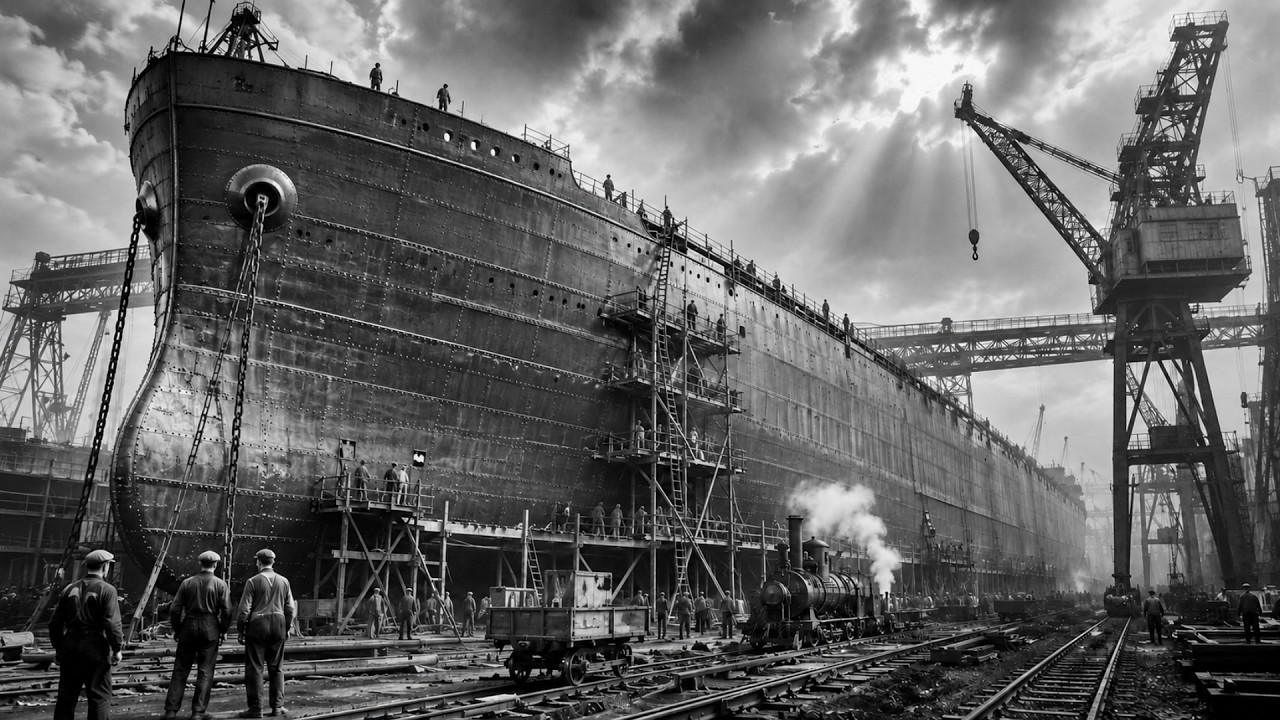
The temperature in Erie in January was reliably below twenty degrees Fahrenheit. The wind coming off Lake Erie swept across a broad expanse of open water from the southwest and hit the exposed yard with the full force of a Great Lakes winter. The man welding steel in those conditions wore every layer of clothing he could manage, but he worked with bare hands when he had to change the welding electrode, because touching steel with bare hands in January in Erie was the difference between a perfect weld and a weak one. He was building a ship that would never leave the Great Lakes.
Not because it could not sail in open water, but because it was too large to fit through any of the locks connecting the Great Lakes to the outside ocean. The ship he was building would spend its entire working life on a body of water it could not leave, carrying more iron ore in a single trip than any vessel in history, serving an industry that needed the ore and could not afford to wait for it. His name does not appear in the operating records of the ship he helped build. The ship’s name does.
She was called the Stewart J. Cort. She was 1,000 feet long. To understand why American steel companies in the 1970s spent money to build ships too large to pass through their own canals, you have to understand what the Great Lakes iron ore trade was, what it demanded, and what it cost the system to fail to move fast enough.
Lake Superior sits at the top of the Great Lakes chain, 350 miles long and 160 miles wide, the largest freshwater lake on Earth by surface area and the coldest of the five. At its western end, near Duluth, Minnesota, and across the bay in Superior, Wisconsin, ore docks received iron ore from the mines of Minnesota and shipped it east across the lake to the Soo Locks at Sault Ste. Marie, then south through Lakes Huron and Erie to the steel mills of Cleveland, Detroit, Gary, and Pittsburgh. The iron ore moving through this system was the raw material of American steel production.
Without it, the furnaces went cold. Without the furnaces, steel production stopped. Without steel, the cars, buildings, bridges, and machines produced by the American industrial economy in the twentieth century were not built. The Great Lakes iron ore trade was not a regional shipping concern.
It was the circulatory system of American heavy industry, and it had been running continuously, except in winter, since the first commercial shipment of iron ore left Marquette, Michigan, in 1846. The constraint on the system had been the same from the start. The lakes are connected, but the connections are narrow. Between Lake Superior and the lower lakes lies a rock ledge called the St.
Marys Rapids, a drop of twenty-one feet where Superior’s waters fall toward the level of Lake Huron. Ships cannot navigate a twenty-one-foot waterfall. To pass, they must use a lock, a chamber that fills and empties with water to raise or lower vessels from one level to another. The first lock at Sault Ste.
Marie was built in 1855. It was 350 feet long and 70 feet wide, and it could handle the ships of that era, which were small, wooden, and carried hundreds of tons rather than thousands. The ore trade grew. The ships grew.
The locks were rebuilt and enlarged, then rebuilt and enlarged again. Each generation of lock builders tried to stay ahead of the ships the industry demanded, and each generation lagged a little behind. By the middle of the twentieth century, there were four working locks at the Soo, the name universally given to the Sault Ste. Marie facility.
The MacArthur Lock, completed in 1943, was 800 feet long and 80 feet wide. The Davis and Sabin Locks were longer, at 1,350 feet, but they were still only 80 feet wide. The new Poe Lock, the largest of them all, was completed in 1968, 1,200 feet long and 110 feet wide. The Poe Lock was not built to accommodate the ships that already existed.
It was built to accommodate ships that had not yet been built. The Army Corps of Engineers engineers who designed it in the early 1960s understood what the steel industry would need. The economics of bulk shipping move in one direction. Bigger ships cost less per ton to operate than smaller ships.
A ship twice the size does not require twice the crew, does not burn twice the fuel, does not take twice the time to load or unload. It carries more at relatively lower cost. The pressure on the ore trade was the same pressure that drives every bulk shipping market. The customer wants lower freight rates.
Lower rates require bigger ships. Bigger ships require bigger infrastructure. And the infrastructure must be built before the ships, because no shipowner orders a 1,000-foot vessel without knowing there is a lock that can pass it. The Poe Lock was the answer given before the question was fully asked.
When it opened in 1968, there was no ship on the Great Lakes large enough to require it. The largest vessels in service were in the 700-foot range. The Poe Lock, at 1,200 feet, had spare capacity. That spare capacity was an invitation.
The steel industry read that invitation clearly. In the late 1960s, the American steel industry was under pressure it had never faced before. Foreign steel producers, rebuilt after the destruction of World War II, were making steel at costs that American mills, running old equipment and paying high labor wages, struggled to match. The response of American steel companies was to invest in scale.
If you could not lower the cost of labor, you reduced the number of workers per ton of output. If you could not lower the cost of raw materials, you reduced the cost of transporting them. If ore freight rates could be cut by thirty percent through the use of larger ships, then investing in larger ships was not optional. It was the margin between staying in business and going out of it.
Bethlehem Steel, one of the two largest American steel companies in the early 1970s, commissioned the design of a ship that would fill the Poe Lock within acceptable limits and carry more iron ore in a single trip than anything that had ever floated on fresh water. They brought in naval architects and structural engineers to answer the questions that a 1,000-foot hull on Lake Superior required. The answers were not simple. A ship 1,000 feet long and 105 feet wide was not merely a larger version of a 600-foot, 65-foot-wide vessel.
It was a different engineering problem entirely. The forces acting on a long hull in heavy seas are not like the forces on a shorter hull, scaled up. A short ship in a big wave rises and falls with the wave. A long ship in a sea where the wavelength is shorter than the ship does not rise and fall with the wave.
It spans it. The bow settles in the trough of one wave. The stern settles in the trough of another. The middle section stretches over the crest between them, unsupported by water, carrying the weight of the fully loaded hull across an unsupported distance.
This bending stress, called hogging, imposes loads on a hull that do not exist in calm water and increase with the height of the sea and the length of the ship. Lake Superior in November generates waves that can exceed twenty-five feet. A 1,000-foot ship loaded with 60,000 tons of iron ore trying to cross Lake Superior in a November storm would experience bending stresses that no Great Lakes ship had ever been designed to withstand. The naval architects who designed the Stewart J.
Cort spent a long time studying this problem. The solution was not elegant. It was heavy. The hulls of the 1,000-foot ships were heavier relative to their cargo capacity than the smaller ships they replaced, because the steel had to be thick enough to take the bending loads the lakes could impose.
Thick steel is expensive. Expensive steel raises the cost of construction. The Stewart J. Cort cost about $35 million to build in 1972 dollars.
The economics of building her were strong enough that Bethlehem Steel paid that cost anyway. The self-unloading system used by the 1,000-foot ships was not new. Great Lakes ore carriers had been developing self-unloading technology since the early twentieth century, driven by economic logic. Shore-based unloading equipment was expensive, labor-intensive, and added to a ship’s time in port.
A ship that could unload its own cargo left the dock faster. A ship that left the dock faster made more trips each season. More trips in a season meant more tons moved annually, and more revenue on the same capital investment. The self-unloading system on the Stewart J.
Cort worked on the principle of gravity and conveyors. The cargo hold was divided into a series of V-shaped hoppers with gates at the bottom. When the gates opened, the ore fell by gravity onto a system of conveyor belts running longitudinally through tunnel spaces in the ship’s double bottom. These belts carried the ore toward the stern, where it discharged onto a conveyor boom extended out over the dock.
The boom swung on a horizontal axis to direct the discharge to the precise location on the dock where the storage pile was being built. A fully loaded Stewart J. Cort, carrying 58,000 long tons of iron ore, could unload her entire cargo in about six hours using this system. By comparison, the first iron ore docks in the 1880s, using gravity chutes and shore-based handling equipment, took a full day to unload a small ship if conditions were favorable.
The increase in productivity between 1884 and 1972 was not measured in percentages. It was measured in multiples. The Erie Marine division of Litton Industries was the shipyard that built the Stewart J. Cort, and the choice of Erie, Pennsylvania, for a ship that would spend her entire career on Lake Superior was not accidental.
Erie sits on the southern shore of Lake Erie, which connects through the Detroit River and Lake St. Clair to Lake Huron. From there it runs north to Lake Superior through the Soo Locks. A completed ship built in Erie could cross the lower lakes under her own power, pass through the Soo Locks, and enter Lake Superior in a single delivery voyage.
That location was the logical choice. What Erie Marine also had was a building basin large enough and a workforce sufficient. The workforce in Erie in 1971 was not different in kind from the men who had built the ore docks, steel mills, and railroads that fed the Great Lakes industrial system for a century before. They were men who worked with steel for wages that were considered adequate by the standards of industrial labor in 1971, and inadequate by the standards of the difficulty of the work itself.
Shipbuilding work is hot, noisy, and confined. Welding inside a partially enclosed section of a steel hull means welding in a space where the fumes have nowhere to go. The metal surfaces around you conduct heat in both directions, depending on the season. Working on plates in the high parts of the hull means working without a roof in whatever weather conditions prevail.
The welder who worked on the bottom sections of the Stewart J. Cort in January 1971 was not working in conditions recorded in the ship’s available documents. He was working in the conditions imposed by a Pennsylvania winter in the city of Erie, and by the nature of massive shipbuilding in that era. He finished his section.
The next crew moved to the section after it. The ship began to grow. Assembling a 1,000-foot ship in a yard that could not accommodate a ship that long in one piece required a modular construction approach, which was not standard practice in American shipbuilding in the early 1970s. The hull of the Stewart J.
Cort was built in sections. The sections were assembled and outfitted as much as possible on the building berths, then moved in sequence for final joining. The construction sequence required coordination between multiple fabrication operations running simultaneously, because the schedule did not allow sequential construction of a ship this size within the time allotted by the contract. The launch date was fixed and firm.
The first shipping season the ship was contracted for was also fixed. The link between the fixed delivery date and the modular construction schedule was the same link that governed every massive American infrastructure project of the industrial age. Money had been committed, revenue was expected on a certain date, and the work had to be done by that date, regardless of weather or delays in plate shipments from the mill. The keel of the Stewart J.
Cort was laid in 1971. She was launched in May 1972. Launching a 1,000-foot ship required a berth with sufficient water depth to accommodate the hull without striking the bottom, and the approach channel and turning basin in Erie had to be checked for fit before the launch proceeded. She was launched.
She floated. The engineers had calculated the ship’s draft correctly. The delivery voyage from Erie, Pennsylvania, to Lake Superior in the summer of 1972 required transiting four bodies of water and one set of locks. From Erie, she headed west across Lake Erie to the Detroit River, through the narrow waters of the St.
Clair River to Lake Huron. From Lake Huron north to the St. Marys River and the Soo Locks. She was 1,000 feet long and 105 feet wide.
The Poe Lock was 1,200 feet long and 110 feet wide. The clearance on each side when the Stewart J. Cort entered the lock chamber was approximately two and a half feet. Two and a half feet between the hull of the largest freshwater ship ever built and the concrete walls of the lock.
The lockmaster, the ship’s captain, and the Soo Locks pilot who took command during the transit all knew the numbers precisely. The Stewart J. Cort entered the Poe Lock, descended twenty-one feet to the level of Lake Superior, and came out of the lock. The hull never touched the walls.
She was the first 1,000-foot ship to transit the Soo Locks. What also became clear on that transit was the other side of the equation. The Davis, MacArthur, and Sabin Locks, the other three working locks at the Soo, which handled the bulk of traffic and which smaller ships used without restriction, were not available to the Stewart J. Cort.
The MacArthur Lock was 800 feet long and 80 feet wide. The Davis and Sabin Locks were 1,350 feet long, but only 80 feet wide. The Stewart J. Cort was 105 feet wide.
She could not transit an 80-foot-wide lock. Of the four working locks at Sault Ste. Marie, only one could accommodate her. Only one.
If the Poe Lock went out of service for any reason, the Stewart J. Cort could not transit the Soo. She could not move iron ore. She could sit in Lake Superior, Lake Huron, or Lake Erie with a full cargo of ore in her holds and no place to unload it, because the only lock in the entire system that allowed her passage had stopped working.
This was understood at the design stage. It was understood when the contracts were signed. The economics of the 1,000-foot ships were compelling enough that the steel companies built them anyway, accepting the risk that any single infrastructure failure could strand their largest vessels at the worst possible time. The fleet grew.
In 1973, the Presque Isle joined the ranks of the Great Lakes giants, a 1,000-foot integrated tug-barge unit operated by U. S. Steel, a configuration chosen partly to address the question of what a 1,000-foot ship could do in ice and narrow water when conventional propulsion was insufficient. In 1976, the James R.
Barker entered service at 1,004 feet. In 1977, the Belle River joined. In 1978, the Mesabi Miner joined. In 1979, the Edwin H.
Gott and the Indiana Harbor joined. The fleet of ships that could use only the Poe Lock was multiplying. The Poe Lock was not multiplying. There was one Poe Lock in 1972.
There was one Poe Lock in 1979. There remained one Poe Lock for the next four decades. Between the launch of the Stewart J. Cort and the end of the building program in that decade, Great Lakes shipyards built more large tonnage than had been launched in any comparable period since World War II.
The yards that built them were not the major maritime facilities of the East and Gulf coasts. They were the industrial shipyards of the inland freshwater region. Bay Shipbuilding in Sturgeon Bay, Wisconsin. American Ship Building in Lorain, Ohio.
Defoe Shipbuilding in Bay City, Michigan. These were facilities that had been building Great Lakes ships for decades. Their workers understood the special requirements of building freshwater bulk carriers, and their management understood the scheduling requirements of a seasonal ore trade that stopped in January and resumed in late March, and did not tolerate late deliveries. A ship not ready for the spring opening of the Soo Locks was a ship that would lose the first weeks of the season.
Losing the first weeks meant losing revenue. Losing revenue on a $35 million capital investment meant having a conversation with the bank that no shipyard manager wanted to have. The yards worked through winters made miserable by Lake Michigan and Lake Superior, in facilities some covered and some open, with a workforce paid by the hour and not compensated for the cold. The workers who built the 1,000-foot ships in the yards of Sturgeon Bay, Lorain, and Bay City are not part of the commissioning record.
The commissioning record names the naval architects, the structural engineers, and the corporate managers who signed the contracts and attended the launches in good weather with newspaper photographers present. The men who cut the plates, welded the joints, fitted the piping, tested the self-unloading conveyors, and painted the hulls of the largest freshwater ships ever built exist in the payroll records of shipyards that have since closed, and in union records that were never comprehensively archived, and no public ceremony documented their achievement as something important. They came to work. They built the ships.
The ships were launched and went to sea. The yards closed or shrank over the following decades as American shipbuilding ceased to be competitive with the economics of the late twentieth century. Bay Shipbuilding, which built many of the largest Great Lakes vessels in the 1970s building program, closed in 1989. The workers who had been there were elsewhere by then, working at whatever jobs were available in a Wisconsin port town after the city’s largest employer shut its doors.
The ships kept running. On November 10, 1975, three years after the Stewart J. Cort first transited the Poe Lock, a Great Lakes ore carrier left Superior, Wisconsin, loaded with 26,116 tons of taconite pellets bound for a steel mill in Detroit. She was 729 feet long, and she had been the largest ship on the Great Lakes when she entered service in 1958.
Her name was the Edmund Fitzgerald. She had crossed Lake Superior hundreds of times without incident in seventeen years of service. On the evening of November 10, during a storm that the National Weather Service had underestimated and the lake had worsened beyond forecasts, the Edmund Fitzgerald disappeared from the radar screen of the Arthur M. Anderson, the ship steaming with her across the lake.
No distress call was sent. No survivors were found. The Edmund Fitzgerald sank in 530 feet of water, seventeen miles northwest of Whitefish Point. All twenty-nine of her crew went down with her.
The wreck was found by the U. S. Navy in May 1976. The wreckage lay in two pieces, which told investigators something about how she sank, but the weather of Lake Superior, the depth of the water, and the absence of witnesses meant the exact sequence of events could not be recovered, and remains a subject of investigation and debate.
She was not a 1,000-foot ship. She was more than 200 feet too short to fit through the Poe Lock. The fleet of 1,000-foot ships assembled in the same years as her sinking was a different class of vessel by every measure, but the loss of the Fitzgerald reminded everyone who worked the lakes that Lake Superior in November is not a body of water that makes allowances for the size of the ship trying to cross it. A 729-foot ship loaded with 26,000 tons of iron ore had gone to the bottom in a storm.
The 1,000-foot ships, designed to carry 60,000 tons across the same lake in the same November gales, had to be built to face what was down there. The engineers who designed the structural hulls of the 1,000-foot ships did their calculations: the bending stresses, the wave bending moments, the fatigue life projections for a hull subjected to cyclical loads over a 30-year operating life. They did this with the tools available in the early 1970s. The 1,000-foot ships were built to withstand what the lakes could do to them.
The loss of the Fitzgerald confirmed the engineering judgment that building them heavier and stiffer than pure economic optimization required had been the right call. The ships built in the years before and after the loss of the Fitzgerald are still in service. The Edwin H. Gott, launched in 1979, still works Lake Superior today.
The James R. Barker is still in service. The Indiana Harbor is still in service. They are 45 to 50 years old, still running from the ore docks of Duluth to the lower lakes mills and back, still passing through the Poe Lock with a two-and-a-half-foot clearance on each side, still moving 60,000 tons of iron ore with a fuel efficiency per ton that no comparable vessel in the world shipping fleet can match.
The economics that drove their construction in the 1970s did not work out the way the steel companies that commissioned them expected. American steel production fell sharply in the early 1980s as foreign competition intensified and domestic demand shrank. The mills the 1,000-foot ships were built to supply at maximum capacity shut down and then closed. U.
S. Steel closed its South Chicago mills in 1992 after more than a century of production. Bethlehem Steel’s Lackawanna, New York, plant, one of the largest integrated steel facilities in the world, also ceased operations. The Great Lakes ore trade shrank from its record volumes.
The 1,000-foot ships, designed to operate at full capacity for a full season, found themselves running partial seasons at reduced loads because the demand that justified their construction had declined. But they did not stop running. They could not economically stop, because the capital that built them required repayment regardless of market conditions. They ran at reduced capacity, waiting for markets to recover, which they partially did over the following decades as the surviving American steel producers modernized their facilities and achieved efficiencies that the planners of the 1970s had not anticipated.
The Poe Lock was not expanded. It did not get a companion. For 50 years after the first voyage of the Stewart J. Cort, the entire Great Lakes fleet of 1,000-foot ships depended on a single lock chamber, 1,200 feet long and 110 feet wide, for every transit between Lake Superior and the lower lakes.
The lock worked without major failure through those decades. It required maintenance. It required periodic inspections. It required a scheduled shutdown of the chamber for several weeks each winter, when the Soo Locks facility closed for winter maintenance.
During those weeks, the 1,000-foot ships waited in the ports of Lake Superior or Lake Huron, tied to docks, waiting for the locks to reopen in late March. The crews that spent winter with the ships were not full operating crews. Most sailors on Great Lakes ore carriers were seasonal employees, laid off at the end of the navigation season and rehired in the spring. The winter shutdown is a feature of the Great Lakes ore trade with no counterpart in ocean shipping.
The locks close, the ships stop, and the men go home. In late March, the locks open and the season begins again, the men return to the ships, the ships return to work, the ore starts to move, the mills light up, and the cycle that has run since 1846 continues. The argument for a second large lock at Sault Ste. Marie had been clear since the early 1980s.
A fleet of ships that can transit only one lock is a fleet one mechanical failure away from stopping the iron ore supply chain that feeds American steel production. A failed hydraulic system on a single miter gate, a structural fault in a single lock wall, a ship grounding in the approach channel and closing the route. Any of these events, each one plausible over a 50-year operating period, would stop the movement of iron ore on Lake Superior. The steel industry, the Corps of Engineers, and the Great Lakes shipping interests had been making this argument for decades.
Studies were commissioned, estimates were prepared and re-prepared. The vulnerability was documented, analyzed, and presented to Congress, and declined. The logic was sound, but the funding did not materialize. The argument that a single point of failure in a vital national infrastructure system warrants a backup is an argument that has always been easier to make after the failure occurs, not before it.
The Poe Lock did not fail. And so the funding to prevent any future failure was postponed again and again in favor of other priorities, the way infrastructure investment is always deferred until the facility collapses and the deferral becomes a crisis. In 2020, the United States Congress passed the Infrastructure Investment and Jobs Act, and that legislation included funding for a second large lock at Sault Ste. Marie, to be built next to the existing Poe Lock.
The new lock will be 1,200 feet long and 110 feet wide, a replica of the existing Poe Lock. When it is completed, the 1,000-foot fleet will have two available chambers instead of one. The single point of failure for the 45- and 50-year-old ships will be addressed before those ships reach the end of their operating lives. The timing is not generous.
But it is sufficient. People who study the Great Lakes ore trade describe the 1,000-foot ships as a system that worked as designed within constraints that were accepted as permanent and then addressed later. That is an accurate description. It is also an incomplete description of what the system was and what it cost.
The workers who built the 1,000-foot ships in the shipyards of Sturgeon Bay, Lorain, and Erie are not part of the description of the system. The sailors who took those ships across Lake Superior in November do not become part of the description of the system until a ship sinks, because a sinking requires an investigation and an investigation requires names. The 29-man crew of the Edmund Fitzgerald has names. Ernest McSorley, who was the captain, and John Simmons, the first mate.
The other twenty-seven who went down in 530 feet of cold November water in 1975 and did not come back. Their names are engraved on a bell recovered from the wreck and placed in a maritime museum at Whitefish Point. Their names are in the investigations and reports and in a Gordon Lightfoot song that entered the cultural record of the Great Lakes and ensured they would not be forgotten the way the workers who built the docks, the ships, and the mills were forgotten. The dead of the Fitzgerald are remembered because the manner of their deaths demanded a public accounting.
The living workers who built the system that moved the ore, smelted the steel, and kept the industrial economy of the American Midwest running for a century exist in payroll records and union contracts, and no song was ever written about them. The wages of the shipyard workers who built the 1,000-foot ships were union wages, negotiated, documented, and adequate by the standards of heavy industrial labor in the 1970s, but inadequate in the sense that no wage adequately compensates a person for the hazards this work imposes. Shipbuilding is among the most dangerous industrial occupations by every measure. Falls from heights in confined spaces, crushing injuries during module assembly, welding burns in enclosed hull sections where the heat has no escape, hearing loss from the constant noise of cutting and grinding plates in spaces designed to amplify sound rather than absorb it.
Exposure to chemicals from the coatings, primers, and solvents used to finish the steel hull. These injuries are documented in the occupational safety records of the yards, and those records have never been compiled into any publicly available report accounting for the human cost of building these ships. The ships were commissioned. The workers were not celebrated.
The logic of construction economics in 1971 in Erie, Pennsylvania, was the same logic that governed construction in 1883 in Two Harbors, Minnesota, where the work crew drove piles into frozen ground to build the first wooden ore dock. The dock gets built. The ship gets built. The structure does the work it was built to do.
The men who built it move on to the next one. You can stand on the observation platform above the Soo Locks on a late June morning when the sky is clear over Lake Superior and the air is cold enough to see your breath, and you can wait for what comes around the bend of the St. Marys River from the Lake Superior side. You will hear it before you see it.
The low vibration of the diesel engine running at maneuver speed travels across the water and into the concrete of the lock walls before the hull appears. Then it appears. A 1,000-foot ore carrier coming down the river from Lake Superior toward the Poe Lock at a speed of about four miles per hour in the narrow channel of the St. Marys River.
At four miles per hour, a 1,000-foot ship takes two and a half minutes to pass a fixed point on shore. You watch the bow swing around the bend. The bow rides high above the water because the ship is running light, returning to the ore docks at Duluth for reloading after delivering her last cargo to the lower lakes. The hull above the waterline is red, and the hull below the waterline, which is visible because the ship is riding high, is darker.
The pilothouse is aft rather than forward, because on a self-unloading bulk carrier, the unloading boom at the stern requires clear sightlines from the bridge. The bow must be kept clear of obstructions for the conveyor system that runs the entire length of the ship beneath the cargo holds. The captain at the controls watches 650 feet of ship ahead of him and 350 feet behind him as he guides her into the approach channel. The approach to the lock is a straight channel.
The lockmaster has cleared the chamber and raised the upper lock gates. The ship slows to about two miles per hour approaching the lock entrance. A clearance of two and a half feet on each side does not permit error. A captain entering the Poe Lock slightly off the centerline has no room to correct.
The ship enters the lock at approach speed, moving forward and sideways at once as the river current pushes the hull. Lines are passed to dock workers who walk alongside the ship as it moves through the chamber, maintaining tension on the lines that hold the ship to the wall during the locking process. The upper gates close behind the stern. The water is drained from the chamber through discharge channels in the lock walls.
The ship descends twenty-one feet to the level of Lake Huron. Twenty-one feet. That is the entire difference in elevation between Lake Superior and all the Great Lakes below it. A 1,000-foot ship carrying 60,000 tons of iron ore is lowered twenty-one feet by gravity draining water from a concrete chamber built in 1968.
The lower gates open, the ship moves into the river channel on the Huron side, and accelerates toward the lower lakes. The transit took 45 minutes. The ship will reach the steel mill at its destination in three days. The ore in her holds was mined from the earth in Minnesota’s Iron Range, from open pits that rank among the largest excavations on Earth.
The taconite was crushed, concentrated, and formed into pellets at processing facilities near the mines, then loaded into ore cars pulled by locomotives to the ore docks at Duluth or Two Harbors, where the cars were pushed over the top of the dock and dumped their loads into the dock’s pockets. The ship moved alongside, the dock gates opened, the ore fell from the pockets into the ship’s holds, and the ship was loaded within hours, with what had taken weeks to mine, process, and transport to the dock. At the other end, the ore falls from the holds onto conveyor belts, the boom discharges it onto the mill dock, trucks and rail cars carry it to the furnace that turns it into iron, the iron is turned into steel, and the steel into the products the economy needs. The system moves between 30 and 40 million tons of iron ore across the Great Lakes every year.
Every ton of it passes through the Soo Locks. The bulk of it passes through the Poe Lock. The Poe Lock is 1,200 feet long and 110 feet wide, completed in 1968, and has been operating for 56 years. When the new lock beside it is completed, the 1,000-foot ships will have two chambers to choose from.
Until then, they have one. The captain in the pilothouse watches the lock walls and holds the centerline as the ship descends, the lower gates open, and the system continues. The welder who built the hull plates of the Stewart J. Cort in a cold January in 1971 in Erie, Pennsylvania, is not aboard the ship.
He is not in any record that has been provided. The ship is still on the lakes. The ore is still moving. The locks are still operating.
What he built still carries what it was designed to carry, through a lock built to accommodate it, to a mill built to consume it. None of it stops.
