The afternoon light filtered through the tall windows of Heritage Restorations, a small studio tucked between a coffee shop and a law office on Meeting Street in Charleston, South Carolina. Maya Bennett adjusted her magnifying lamp and reached for the next item in the day’s intake pile, a manila envelope marked fragile, family heirloom, and careful handwriting. She slid out a photograph and immediately her breath caught. The image was mounted on thick cardboard, edges worn soft by more than a century of handling.
Someone had protected it well. The sepia tones were still rich, the details surprisingly clear for 1903. Maya had restored hundreds of old photographs in her fifteen years as a professional conservator. But something about this one made her pause before even reading the attached note.
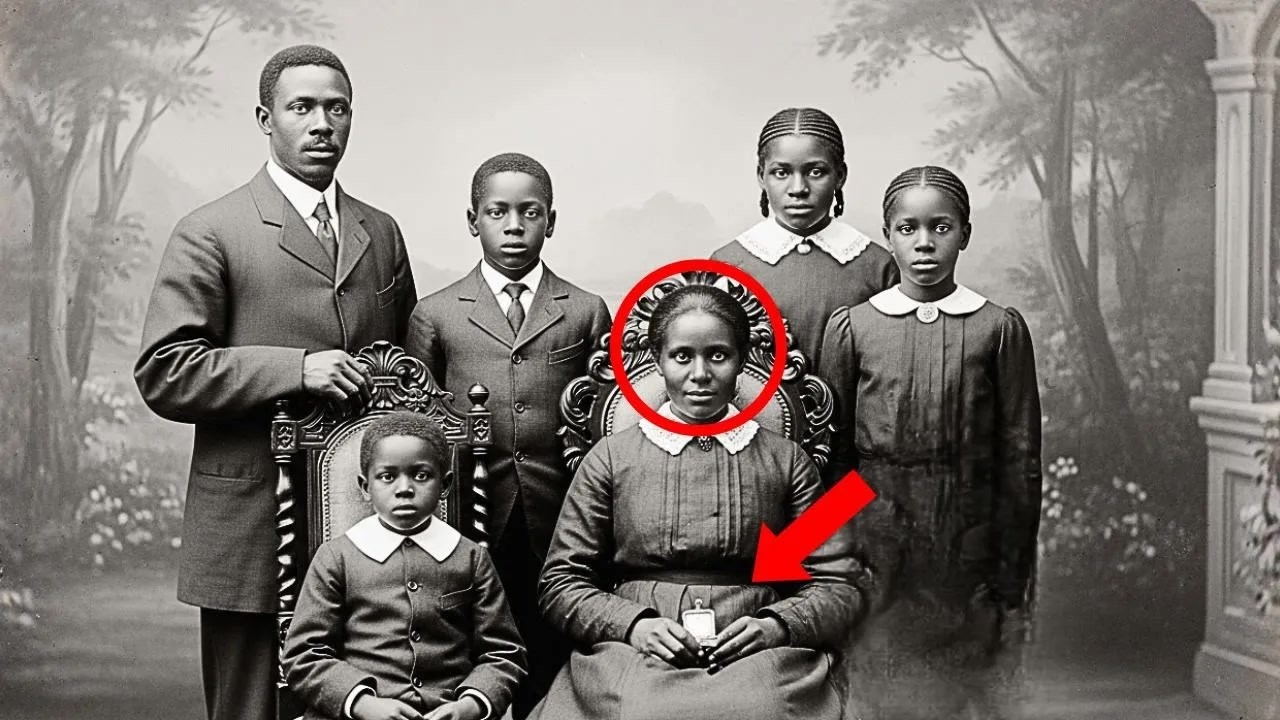
The photograph showed a black family posed in what was clearly a professional studio. She could make out the painted backdrop, a generic pastoral scene popular in that era, and the formal arrangement typical of the time. A father stood to the left, his hand resting on an ornate chair with carved wooden details. Four children, ranging from perhaps three to twelve years old, sat and stood in descending height order, dressed in their Sunday finest: starched white collars, polished leather shoes, hair meticulously combed and braided.
And in the center, seated in that ornate chair with her hands folded gracefully in her lap, was the mother. Maya leaned closer, her professional eye immediately catching what made this photograph unusual. While every other family member held the rigid, solemn expression required by early photography, faces frozen in careful stillness to avoid the blur of long exposure times, the woman in the center wore something entirely different: a smile. Not a broad grin, but a gentle, unmistakable curve of the lips.
Serene, deliberate, knowing, her eyes held a warmth that seemed to reach across 121 years of separation. Maya had seen thousands of photographs from this period. People didn’t smile. The photographic technology of 1903 demanded absolute stillness.
Exposures could take thirty seconds or more, and any movement resulted in blur. Beyond the technical constraints, Victorian social conventions demanded seriousness in formal portraits. These images were visual records of respectability, especially for black families in the Jim Crow South, who used photographs to assert their humanity in a society that denied it. But this woman smiled.
Maya set down her magnifying glass and reached for the note attached to the envelope. Dear Miss Bennett, this photograph has been in our family since 1903. My great-great-grandmother is the woman seated in the center. We’ve always treasured it, but it’s damaged.
We’d like it restored and digitized. There’s something special about this photo. Our grandmother used to say, “That picture holds more than it shows. Maybe you’ll see what she meant.
” Respectfully, Dorothy Harris. Maya turned back to the photograph. That smile seemed less like a mistake and more like a message: a deliberate choice made for reasons lost to time. She pulled her laptop closer and began the intake documentation, but her eyes kept returning to that inexplicable expression.
Something about it felt profound, as if this woman had been trying to communicate something important. By the time she finished her notes, Maya had made a decision. This photograph deserved more than standard restoration. She would scan it at the highest resolution, examine every detail, and perhaps discover what Dorothy’s grandmother had meant.
What Maya didn’t know yet was that this decision would lead her into a mystery that had waited more than a century to be solved. Maya arrived at her studio early the next morning, coffee in hand and the photograph already occupying her thoughts. She had dreamed about it, unusual for her. But the image had lodged itself in her mind like a splinter.
That smile, so out of place in its historical context, had become a question she couldn’t stop asking. She set up a professional scanner, a high-end Hasselblad model capable of capturing details invisible to the naked eye. Most restoration jobs only required standard resolution, but something told her this photograph demanded closer examination. The scanning process took nearly an hour.
Maya set the machine to its maximum capability, 12,000 dpi, far beyond what was necessary for normal work. As the scanning head moved slowly across the photograph surface, capturing every microscopic detail, she sipped her coffee and researched photography studios in Charleston, circa 1903. There had been several studios serving the black community then, operating despite segregation laws that made even the simple act of having a family portrait taken an assertion of dignity and humanity. These photographers were often pillars of their communities, documenting weddings, funerals, church gatherings, and rare family portraits like this one.
The scanner beeped, signaling completion. Maya transferred the massive file to her large monitor and opened it in her professional editing software. The image filled her screen in stunning detail. She zoomed in slowly, beginning with the family as a whole, then focusing on each person individually.
The father’s weathered hands gripping the chair back, calluses visible even in the photograph; the oldest daughter’s carefully braided hair, each plait perfect; the youngest child’s wide, serious eyes staring into the camera with an intensity that seemed to demand recognition. Then Maya zoomed in on the mother’s face. Her heart rate quickened. At this magnification, she could see individual eyelashes, the fine texture of the woman’s skin, the precise weave of the fabric in her dark Sunday dress, and the smile.
It was even more pronounced than she’d initially thought. More than that, it looked intentional, controlled, as if the woman had held that expression deliberately through the long exposure time, despite the physical difficulty of doing so. But something else caught Maya’s attention. She zoomed in further, focusing on the woman’s eyes.
There was extraordinary clarity there, a sharpness of gaze that seemed almost modern, and something in that gaze. Was it determination, love, a message encoded in the depths of her pupils? Maya pulled back and examined the woman’s hands, folded in her lap. The position seemed formal at first, but at this resolution, she noticed something unusual.
The woman’s left hand was positioned over her right, but not quite covering it. The fingers were arranged deliberately, and the woman’s right hand was holding something small, partially obscured by her left hand in the folds of her dress. Maya adjusted the contrast and brightness, playing with the digital levels, bringing out details that had been hidden in shadow for 121 years. There: the object was cylindrical, small, perhaps three inches long.
One end appeared to have some kind of decorative element, possibly metal, catching just the faintest hint of light from the studio’s gas lamps. What was it, and why had the woman positioned her hand so carefully to both reveal and conceal it at the same time? Maya sat back in her chair, her mind racing through possibilities. This wasn’t just an unusual smile anymore.
This was a photograph with layers, with intentional composition, with secrets deliberately hidden in plain sight for more than a century, waiting for technology advanced enough to reveal them. She needed to know more. Who was this woman? What was that object in her hands?
And why, in an era when photographic portraits were meant to project dignity and respectability, had she chosen to smile? Maya pulled up the client’s contact information. Dorothy Harris had left a phone number. It was only 8:30 in the morning, perhaps too early to call, but Maya suspected that whoever had preserved this photograph for four generations and entrusted it to her care would want to know immediately what she’d found.
She picked up her phone and dialed. Dorothy Harris answered on the second ring, her voice warm and slightly breathless. “Hello? ”
“Ms.
Harris. This is Maya Bennett from Heritage Restorations. I’m calling about the photograph you brought in yesterday. ”
“Oh, yes, of course.
Is everything all right with it? Nothing damaged in handling? ”
Maya glanced at her monitor, where the woman’s enigmatic smile still filled the screen, that mysterious object clutched in her hidden hand. “The photograph is in good condition, considering its age.
But I found some interesting details during the initial examination. Would you have time to come to the studio today? I’d like to show you what I’ve discovered and ask you some questions about your family history. ”
There was a pause on the line, and Maya could hear the sharp intake of breath.
“You found something? ”
“I did. Nothing concerning. Actually, it’s fascinating.
But I think it would be better to discuss in person, if you’re able. ”
“I can be there in an hour,” Dorothy said immediately, her voice tight with barely contained emotion. When Dorothy Harris walked into Heritage Restorations sixty minutes later, Maya understood immediately that this photograph meant everything to her. The woman was in her mid-seventies, dressed carefully in a lavender cardigan and pressed slacks, carrying a worn leather portfolio under her arm.
Her eyes went directly to the photograph on Maya’s desk, and her expression softened with something that looked like recognition mixed with longing. “Thank you for seeing me so quickly,” Dorothy said, shaking Maya’s hand with surprising strength. Maya led Dorothy to the large monitor where the high-resolution scan glowed. “Before I show you what I found, can you tell me anything about the people in the photograph, particularly the woman in the center?
”
Dorothy set down her portfolio and moved closer to the screen, her eyes immediately finding the image. “That’s my great-great-grandmother, Ruth Thompson. This photograph was taken in May of 1903 at the Anderson Photography Studio on King Street. The studio doesn’t exist anymore.
The building was torn down in the 1960s to make way for a department store. ”
“What can you tell me about her? ”
Dorothy’s expression softened with a mixture of pride and sadness. “Not as much as I’d like.
She died six weeks after this photograph was taken. Tuberculosis. She was only thirty-two years old. ” She gestured to the children in the image.
“She left four children. The oldest was twelve. The youngest was only three. My great-grandmother was the oldest girl, the one standing right here behind her mother’s chair.
”
Maya felt a chill run through her body. Six weeks. This woman had known she was dying when this photograph was taken. She had known these would be the last images her children would have of her.
“The family was poor,” Dorothy continued, her voice quiet. “My great-grandmother told me they’d saved for nearly a year to afford this one photograph. Back then, a professional portrait cost about three dollars. That was more than a week’s wages for a dock worker.
It was the only professional portrait they ever had taken together as a complete family. After Ruth died, her husband, that’s Samuel, standing here on the left, he never remarried. He kept this photograph on the mantelpiece until he died in 1941, thirty-eight years later. ”
“Did your great-grandmother ever mention why Ruth was smiling in the photo?
”
Dorothy’s eyes widened slightly. “You noticed that, too? Yes. She mentioned it many times.
She said her mother had insisted on smiling, even though the photographer, a man named Mr. Anderson, told her it would be very difficult to hold still enough. She was quite weak by then, could barely sit upright for long periods, but she refused to take the picture any other way. She told the photographer, ‘My children will look at this picture for the rest of their lives.
I want them to see me happy. ‘”
Maya felt her throat tighten with emotion. She pulled up the highest resolution scan on the monitor. “Ms.
Harris, I need to show you something. At maximum magnification, I found details that aren’t visible to the naked eye. ” She zoomed in on Ruth’s carefully positioned hands. “Your great-great-grandmother is holding something in her right hand, partially hidden.
Do you know what this might be? ”
Dorothy leaned forward, squinting at the screen. Maya adjusted the contrast further, making the small cylindrical object more visible against the dark fabric of Ruth’s dress. “Oh my god,” Dorothy whispered.
Her hand went to her mouth, her eyes filling with tears. “I know exactly what that is. ” She turned to her leather portfolio and opened it with trembling fingers. Inside were several documents, old letters tied with faded ribbon, a yellowed funeral program, a few other photographs, and, wrapped carefully in tissue paper, a small object.
Dorothy unwrapped it slowly, reverently, and held it up to the light streaming through the studio windows. It was a silver needle case about three inches long, engraved with delicate flowers. The metal had tarnished with age, turning dark in the recessed areas of the engraving, but it still caught the light beautifully. Tiny roses and vines wound around the cylinder, each petal rendered with remarkable detail and craftsmanship.
“This belonged to Ruth,” Dorothy said softly, her voice thick with emotion. “It was passed down through the women in our family. My great-grandmother gave it to my grandmother, who gave it to my mother, who gave it to me. My grandmother told me that Ruth never went anywhere without it, that it was her most precious possession.
” She looked back at the photograph on the screen, at Ruth’s hands carefully positioned to both show and hide the needle case. “I never realized she was holding it in the picture. In all these years of looking at this photograph, I never saw it. ”
Maya took the needle case carefully, examining the engravings with professional appreciation.
The metalwork was exquisite, the kind of detailed craftsmanship that suggested either significant expense or deep personal meaning. “It’s beautiful. Was Ruth a seamstress? ”
“Yes,” Dorothy said, her voice growing stronger.
“But not just any seamstress. According to my grandmother, Ruth was extraordinary. She could create anything with fabric and thread. Wealthy white families would secretly hire her to make their finest clothes, even though they’d never publicly acknowledge that a black woman had sewn them.
My grandmother said Ruth’s stitches were so perfect, so tiny and even, that her work was indistinguishable from the most expensive dressmakers in New York or Paris. ”
Dorothy reached back into her portfolio and pulled out a yellowed envelope, its edges soft with age. “But there’s something else. These are letters Ruth wrote to her sister Sarah in the weeks before she died.
My grandmother kept them all these years. I’ve read them dozens of times, but I never quite understood what Ruth was trying to say. They felt like instructions, or a puzzle. ”
She handed the first letter to Maya.
The handwriting was elegant despite obvious weakness in the hand that had written it. Some letters shaky, the pressure varying throughout. Dearest Sarah, I know my time grows short. The children must have something of me that will last beyond memory.
I’m working on it now, though my hands shake and my breath comes hard. Tell no one. When it is finished, they will understand. The photograph will show them the way.
Your loving sister, Ruth. Maya read the letter twice, her mind working through the implications. She looked from the elegant handwriting to the photograph on her screen to Dorothy’s anxious face. “What was she working on?
”
“We never knew,” Dorothy admitted, frustration evident in her voice. “My great-grandmother, Ruth’s daughter Clara, said her mother sewed constantly in those final weeks, even when she could barely sit upright without help. But Clara was never allowed in the room when Ruth was working. Her mother would lock the bedroom door, something she’d never done before.
Clara would hear the sewing machine running at odd hours, sometimes late into the night when everyone else was asleep. ”
“A sewing machine? ” Maya looked up sharply. “They had a sewing machine in 1903?
”
Dorothy nodded. “Samuel, Ruth’s husband, had bought her a treadle sewing machine in 1901. It was a Singer, one of the newer models. It cost fifteen dollars, which was an enormous sum for them, nearly a month’s wages.
But Ruth’s sewing brought in good money, so it was an investment that paid for itself. Clara said it was her mother’s most prized possession, the tool that let her create the beautiful work that kept the family fed. ”
Maya made notes on her laptop. Treadle sewing machines were becoming more common in households by the turn of the century, but they remained expensive for a poor family to own.
This one suggested either significant sacrifice or that Ruth’s sewing skills were valuable enough to justify the investment. Probably both. “After Ruth died,” Dorothy continued, her voice quieter now, “Clara said her father sold the sewing machine within a week. He couldn’t bear to look at it, couldn’t stand to hear the silence where her work had been.
Clara always regretted that. She thought maybe whatever her mother had been making was still in the machine somewhere, or stored nearby, and they’d lost it when Samuel sold everything. ”
“What about Ruth’s other possessions? ” Maya asked.
“Her clothes, fabric scraps, any unfinished work? ”
“Most of it was sold or given away immediately. The family was desperate. Samuel had four children to feed and substantial medical bills to pay.
Tuberculosis treatment was expensive. Even though it didn’t save her. They kept almost nothing except this photograph, the needle case, and… ” Dorothy reached into her portfolio again, “for this.
”
She pulled out a small fabric square roughly six inches across, carefully preserved between two pieces of acid-free paper. The fabric was deep indigo blue, and even after more than a century, the color remained remarkably rich and vibrant. Maya took it carefully, holding it up to the light. The fabric was fine quality, much finer than what a poor family would have had access to for their own use.
The weave was tight and even, the work of a master weaver. But what caught her attention immediately was the edge. It had been cut with remarkable precision, and there were several small holes along one side. “Where did this come from?
” Maya asked, examining the fabric square more closely. “It was in Ruth’s needle case when Clara inherited it,” Dorothy explained. “Just this one piece, folded very small. Clara never knew what it was part of, what larger garment or project it had belonged to.
But she kept it because her mother had kept it. She thought it must be important. ”
Maya moved to her work table and set up her professional microscope, the kind she used for examining damaged photograph emulsions and fine details in historical documents. She placed the fabric square carefully under the lens and adjusted the magnification.
The weave leaped into sharp focus, and Maya’s breath caught in her throat. There, woven into the fabric itself in thread that nearly matched the indigo color, were tiny stitches. They weren’t decorative. They were deliberate, purposeful, forming a pattern that was almost invisible to the naked eye.
“There’s text here,” Maya said, her voice tight with excitement. “Hand-stitched text sewn into the fabric itself. The stitches are so small, and the thread matches the fabric so closely that you’d never see it without magnification. ”
Dorothy rushed to her side, leaning over to look through the microscope.
“What does it say? ”
Maya adjusted the focus, following the nearly invisible thread line by line. The letters were cramped together, clearly made by someone working with limited time and failing strength. She began reading aloud, her voice barely above a whisper.
“For my children. Look where you see me smile. ”
The text ended abruptly mid-sentence. The thread simply stopped, as if Ruth’s strength had finally given out before she could finish the message she so desperately needed to leave.
Both women stared at the fabric in heavy silence, the weight of 121 years of mystery pressing down on them. “Look where you see me smile,” Dorothy repeated slowly, turning the words over in her mind. She turned to the monitor where Ruth’s photograph still filled the screen, that mysterious, deliberate smile frozen in time. “She’s telling us to look at the photograph,” Maya said, her mind already racing through possibilities.
“To look at something specific in the photograph. Not just look at it generally. She’s telling us to look at something specific connected to her smile, something she positioned deliberately, something she wanted her children to find, but kept hidden from everyone else. ”
Dorothy pulled out the other two letters from her portfolio.
“There are two more. Each one more urgent than the last. ”
The second letter was dated May 10th, 1903, just days before the photograph was taken. The handwriting was noticeably shakier.
Sarah, it is nearly complete. I have worked every night, praying my strength holds just a little longer. The children sleep unaware. Samuel thinks I rest, but I cannot rest.
Not until this is done. They will need it, sister. Promise me you will help them find it if I cannot tell them myself. Promise me.
The third letter was barely legible. The handwriting shaking violently across the page, some words crossed out and rewritten: evidence of a dying woman’s desperate struggle to communicate. Tomorrow we take the photograph. I have sewn the answer into their very clothes.
Look closely, dear sister. Look where I smile. The numbers will show the way. I love them so much.
Tell them I love them. Tell them. The letter ended there. The final words trailing off into nothing.
Maya read the last line again, her heart pounding. Look where I smile. The numbers will show the way. She turned to the monitor, studying Ruth’s face with new intensity.
The smile wasn’t just unusual. It was a deliberate signal, a marker pointing to something hidden in the photograph itself. “Ms. Harris,” Maya said slowly, her mind working through the puzzle, “do you still have any of the children’s clothing from this photograph?
Anything that was actually worn that day? ”
Dorothy shook her head sadly. “No, nothing survived. The family was too poor to keep clothes as keepsakes or memorabilia.
Everything was worn until it literally fell apart. Then the fabric was cut up and reused for quilts or cleaning rags or whatever else was needed. Nothing from that day exists anymore except this photograph. ”
Maya felt a flash of disappointment.
But then another thought struck her with the force of revelation. “Wait. Ruth wrote that she’d sewn the answer into their very clothes. What if the answer isn’t in the physical clothes themselves, but in how they appear in the photograph?
What if she sewed something into the clothes specifically so it would be captured in the image? ”
She turned back to the monitor and began systematically zooming in on each child, examining their clothing at maximum magnification. She started with Clara, the oldest daughter, studying every detail of her simple Sunday dress. The collar was white cotton, starched and carefully pressed.
And there, barely visible even at this extreme resolution, was something stitched into the fabric itself, so tiny that it would have been completely invisible to anyone in 1903 looking at the physical photograph without modern digital enhancement. It was a number, a single embroidered digit sewn with thread that nearly matched the white fabric: the number four. “There’s embroidery on Clara’s collar,” Maya breathed, hardly believing what she was seeing. “A number.
It’s the number four. ”
Dorothy leaned closer to the screen, her hands trembling. “What does it mean? ”
Maya’s fingers moved rapidly across her keyboard, zooming to the next child, a boy of about nine or ten, wearing a simple but neat shirt with a pressed collar.
She examined the collar at maximum magnification. Another number stitched in nearly invisible thread: seven. She moved to the third child, a girl of perhaps six, wearing a carefully mended dress. The number two was embroidered into her collar.
The youngest child, a small boy of about three in a sailor suit, had the number nine stitched into his collar. “4, 7, 2, 9,” Maya said aloud, writing the numbers down on her notepad. “She stitched numbers onto each of her children’s clothing. Numbers so small they’d be invisible to anyone looking at the photograph without extreme magnification and digital enhancement.
”
Dorothy stared at the numbers, her mind clearly racing. “What does it mean? An address, a date, some kind of code? ”
Maya sat back, thinking hard.
“Ruth was a seamstress. She thought in measurements, patterns, dimensions. These numbers must mean something specific to her work, to what she did. ” She paused, a new thought forming.
“What if they’re measurements themselves? In sewing, measurements are everything. ”
She pulled up a search on her laptop, looking for information about sewing measurements and garment construction in the early 1900s. In Ruth’s time, seamstresses worked primarily with inches.
Bust, waist, hip, length. These were the critical measurements for any custom garment. Dorothy’s eyes widened. “You think these are garment measurements?
”
“Look at the sequence,” Maya said, her excitement building. “47, 29. Those could be bust and waist measurements. Forty-seven-inch bust, twenty-nine-inch waist.
But what about the four and the two? ” She thought for a moment, then had another realization. “What if they’re not separate numbers? What if we’re meant to read them in pairs or combine them differently?
” She wrote out the possibilities. “Forty-seven could be 47. Twenty-nine could be 29. Or maybe it’s 4 inches, 7 inches, 2 inches, 9 inches.
Smaller measurements for details like seam allowances or hem depths. ”
Dorothy pulled out her phone and began searching. “The letter mentioned the Rutledge commission. Let me see if I can find any information about Katherine Rutledge, the bride.
”
They worked in focused silence for several minutes, Maya examining every other detail of the photograph while Dorothy searched through digitized newspaper archives from 1903 Charleston. “Here,” Dorothy said suddenly. “Society page from the Charleston News and Courier, August 1903. ‘The wedding of Miss Katherine Rutledge to Mr.
James Thornton took place Saturday evening at St. Michael’s Church. The bride wore an exquisite gown of ivory silk, though the seamstress who created it remains unknown. ‘” She looked up.
“They did get married. And someone did make her a wedding dress. They just didn’t know it was Ruth’s work. ”
Maya felt pieces clicking into place.
“So Ruth did complete the commission before she died. And these numbers, they’re connected to that wedding trousseau somehow. Maybe they’re the actual measurements she used, or measurements that would prove she made it. ” She looked at the photograph again, at Ruth’s mysterious smile, at the needle case held so carefully in her hands.
“Dr. Parks at the historical society mentioned that unfinished work was supposed to be destroyed. But what if Ruth hid the completed work and left these numbers as a way for her family to prove it existed and claim it later? ”
“But where would she hide something that valuable?
” Dorothy asked. Maya stared at the photograph. At Ruth sitting in that ornate studio chair, smiling that impossible smile. And suddenly she understood.
“She’s sitting in the hiding place,” Maya said quietly. “Or rather, she’s showing us the hiding place. Ruth wouldn’t have hidden something so valuable at home where it could be found and destroyed, or where the family might lose it if they had to move. She hid it somewhere public, but overlooked.
Somewhere it could stay safe for years. ” She zoomed in on the chair Ruth sat in, the ornate wooden chair with its carved details and heavy construction. “This chair was a studio prop, part of Anderson Photography Studio’s equipment. Ruth knew exactly where it would be because she’d been there before, because she knew the studio.
”
Dorothy’s eyes widened. “The studio closed in 1928. What happened to its contents? ”
Maya was already calling Dr.
Parks at the historical society. He answered on the third ring, and she explained what they needed. He promised to search the records and call back. Two hours later, her phone rang.
“Maya, I found it,” Dr. Parks said. “When Anderson Photography closed, the contents were sold at auction. Most of the equipment went to other photographers, but the furniture and props, including several chairs, were purchased by Mother Emanuel Church for use in their community center.
”
Maya felt her heart leap. Mother Emanuel Church, where Ruth had been a member of the Lady Sewing Circle. The church still stood, rebuilt after the tragic fire of 2015, but maintaining careful records of everything salvaged and restored. With permission from the church historian, Maya and Dorothy searched the storage basement three days later.
And there, among other historical pieces, they found it: an ornate wooden chair with carved details matching exactly the chair in Ruth’s photograph. Maya examined it carefully, running her hands over every surface. The seat lifted up. It was a storage compartment, common in furniture of that era.
Inside, wrapped in layers of muslin cloth that had protected it from moisture and decay for 121 years, was a large bundle. Dorothy’s hands shook as they carefully unwrapped it. Inside was a complete wedding trousseau: a wedding gown of ivory silk, three day dresses, an evening gown, and carefully folded undergarments, all in perfect condition. Each piece was embroidered with the initials CR in tiny, perfect stitches.
And tucked into the wedding gown’s bodice was a small piece of paper in Ruth’s handwriting. For my children. Measurements 47-29-42. Completed May 1903.
Ruth Thompson, seamstress. Dorothy wept as she held the wedding gown. Ruth’s final gift to her children, hidden for 121 years. The photograph had kept it secret all this time.
Ruth’s smile guarding the truth until someone finally understood. A mother’s love sewn into silk and frozen in time had finally come home.
