Deputy Augustus Vale had spent enough time in those woods to understand that a fire pit still warm meant somebody had stood beside it only moments ago. On the morning of November 12th, 1893, at the rim of a clearing known as Devil’s Kettle, he shouted once more into the quiet timber. Nothing came back. The coals were still glowing.
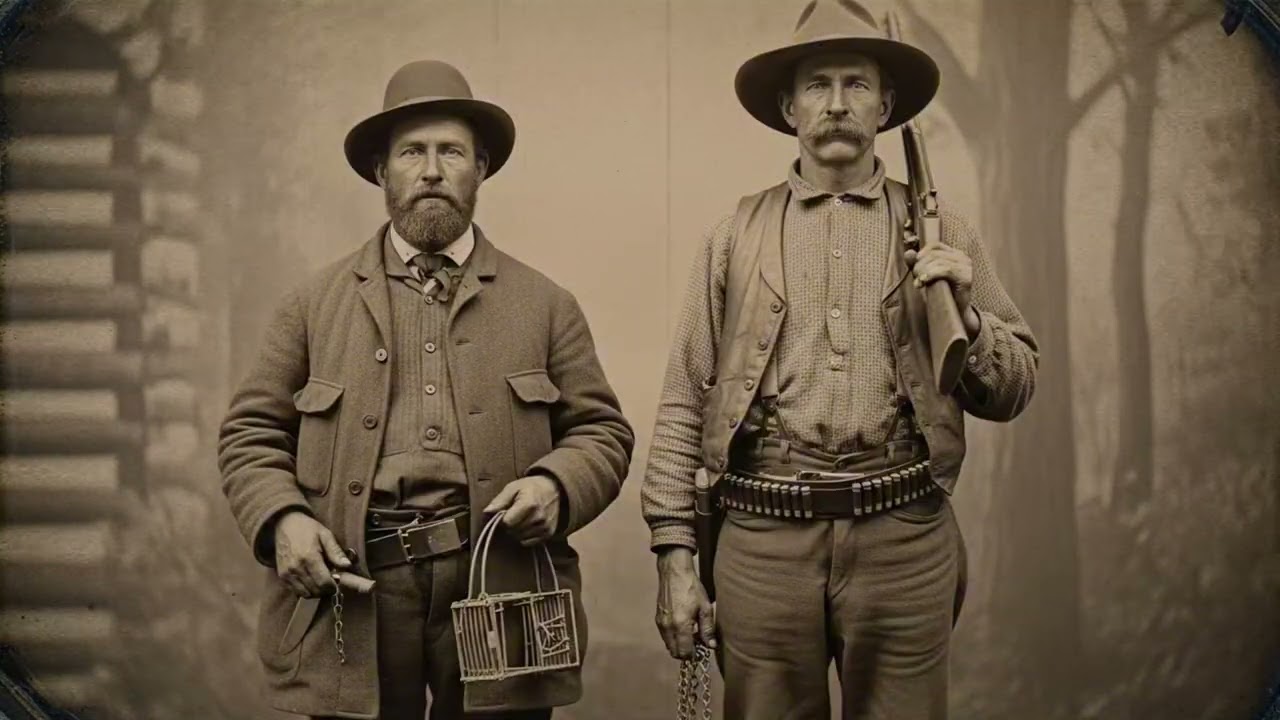
Whoever had kept this fire going had departed in a rush, yet every possession they owned remained behind. The camp was arranged with painstaking care. Two bedrolls lay atop platforms of interlaced branches, lifted clear of the frozen ground. Rifle cases leaned against the rear wall of a neatly constructed lean-to, each one holding a well-kept firearm.
Folded garments rested inside canvas sacks. Cooking gear had been scrubbed and set out beside the fire pit. And then there were the pelts—dozens of them, properly cleaned and stretched, the product of weeks of good trapping. Nothing suggested a struggle, a hurried exit, or an emergency.
The men who had lived here had simply turned their backs on everything they owned, including a leather-bound journal that would reveal far more to investigators than they ever wished to learn. The missing pair were Ezekiel Thornfield and Matias Crane, two seasoned trappers out of Cuba, Missouri. Thornfield, thirty-four, had roamed these Ozark woods since the age of eighteen, learning the craft from his father and earning a name as a careful planner who kept precise maps of his trap lines and noted weather patterns and animal habits. Crane, thirty-nine, had arrived from Pennsylvania in 1885, lured by tales of plentiful fur-bearing animals.
He was the experimenter, always hunting for new methods and untried country, at times with remarkable results, at times with outright failure. For three seasons the two had run trap lines side by side, rivals at first, until they realized their differing methods suited each other well. By the fall of 1893 they had settled into a routine of teaming up through the most productive months, splitting both the dangers and the earnings. Their families had looked for them home by October 25th.
When that day came and went with no word, Cordelia Thornfield and Beatrice Crane began to worry. Thornfield had never been more than two days late, and he always sent ahead word whenever weather held him up. Crane had been especially eager about this trip, telling his wife that he and Thornfield had located a stretch other trappers had mostly abandoned. They expected to come back with the richest haul of pelts either of them had ever brought in.
As days turned into weeks and other men working the same country came home on schedule, worry hardened into alarm. Vale put together a party of eight skilled hunters and trackers and set out from Cuba on November 10th. For two days they pushed through thick brush, steep gullies, and creek crossings made dangerous by heavy autumn snows. They came across old camps, signs of recent use, but nothing they could tie to the missing trappers.
Then, on the morning of the twelfth, they came upon a well-kept trail running deeper into the wild than any of them had gone before. Snapped branches and churned earth indicated that people had passed this way within the last few weeks. They followed it about three miles and arrived at Devil’s Kettle. Thornfield’s journal, discovered among the abandoned belongings, opened with the expedition’s departure on September 30th.
“Weather clear and cold, perfect for the season,” he wrote. “Matias suggests we push further east than either of us has been before. The old-timers in town spoke of beaver dams in the headwaters of Little Piney Creek that have never been properly worked. If we can locate these sites, this could be our most profitable season yet.
” On October 3rd they came upon what they had been seeking: three separate dam complexes within two miles of camp, with animals untouched by human activity. Crane had worked out an inventive method of setting traps, using the lay of the land to steer animals into efficient capture positions. By October 8th, Thornfield recorded that they were taking twice what he would ordinarily expect from country this rich, enough pelts to warrant an extra week beyond their planned schedule. The first sign of trouble surfaced on October 12th.
Crane had devoted most of the day before to inspecting what he described as strange rock formations roughly a mile north of camp. Thornfield went to look himself and found nothing out of the ordinary, but Crane maintained there were traces of earlier human presence—stone tools, remnants of old fire pits. Thornfield reminded him that Indian camps were common in these hills. Crane seemed certain that what he had come across was somehow different.
Three days later, Thornfield discovered his partner studying what Crane called carved symbols on a boulder beside the creek. Thornfield spent two hours examining the rock and saw nothing but natural weathering. When he proposed they get back to checking the trap lines, Crane grew defensive and charged him with a lack of intellectual curiosity. “This is not like him,” Thornfield wrote.
“Matias is normally as focused on practical matters as I am.”
By October 18th, Crane was passing whole days away from the trap lines, coming back with stones he swore were tools fashioned by people who had occupied these hills long before any known Indian tribes. To Thornfield the objects looked like nothing more than ordinary rocks, yet Crane talked of finding caves holding signs of human habitation—places he refused to show his partner, insisting Thornfield would not grasp their importance. On October 22nd, Crane’s stories grew wilder.
He described tools of impossible precision, cave paintings showing events no primitive people could have witnessed, proof that these ancient inhabitants held knowledge modern science could not account for. “I fear that the isolation is affecting his mind,” Thornfield wrote. October 25th was the day they had meant to start for home. Crane would not go.
He insisted they could not walk away from what he had found, that the world had to learn of the evidence he had turned up. When Thornfield reminded him of their duties to their families, Crane flew into a rage and accused him of being ready to trade scientific discovery for plain profit. Three days passed beyond their planned departure. Then Crane left camp early on the morning of October 28th, pack on his back, vowing to return with conclusive proof of his claims.
He was away two days. The weather was growing colder, and Thornfield worried that snow might trap them if they did not get out soon. Crane came back at dawn on October 29th, carrying a canvas bundle he guarded jealously. He looked worn out, as if he had not slept at all while he was gone.
He said he had found a cave system reaching far into the hills, with chambers showing signs of habitation by people whose development surpassed anything linked to the native tribes of the region. He talked of preserved artifacts, cave paintings recording astronomical events, proof of metalworking that should never have existed in this part of the world. When pressed for details, he would say only that certain knowledge was too dangerous to share without proper preparation. Thornfield tried to persuade his partner that they had to leave at once.
Reports from the south indicated that violent storms were on their way, and any further delay could leave them stuck there until spring arrived. Crane conceded that they needed to go, yet he was determined to make one last trip into the cave system to gather more evidence. On November 2nd, heavy snow started coming down. When Thornfield checked the route back toward Cuba, he discovered that ice was already making several creek crossings hazardous.
He wrote that if they failed to depart within the next two days, they would have no choice but to stay until the weather improved. Matias, he noted, appeared indifferent to their predicament, insisting that whatever he had uncovered was worth any danger.
It was November 4th when Crane at last opened the bundle he had been guarding so closely. The objects inside looked to be fashioned from metals Thornfield could not identify, shaped with a precision that pointed to tools far more advanced than any he had encountered.
Even more unsettling were the reproductions Crane had made of the cave paintings, pictures of events and beings Thornfield could not name, drawn with an artistry that seemed beyond what primitive people should have been capable of. On November 5th, Crane finally consented to take his partner into the cave system. What Thornfield witnessed there overturned his whole sense of the region’s past. The caves stretched on and on, their chambers holding unmistakable proof of long-term human occupation.
The artifacts Crane had gathered made up only a small portion of everything still lying in those underground rooms. The caves showed signs of advanced engineering, water systems that regulated drainage and airflow, and living quarters deliberately arranged for comfort and safety. The paintings showed animals and hunting scenes, but also astronomical occurrences, geographical features drawn with the accuracy of maps, and human figures doing things Thornfield could not decipher. Most troubling of all were paintings that seemed to depict the caves themselves, with careful renderings of chambers reaching far deeper into the earth than either man had managed to go.
Yet it was another discovery that persuaded Thornfield the situation had turned truly perilous. While exploring, the two men came upon signs that someone else was using the caves at that very moment. Fresh supplies of food. Fire pits recently in use.
Sleeping areas that showed regular use. Someone was dwelling in these caves, and that someone knew the trappers were in the region. The journal’s last entry, dated November 8th, set down the conclusion the two men had reached after lengthy discussion. According to Thornfield, they could not go back to civilization carrying knowledge of what they had found here.
He continued that they likewise could not disregard their duty to protect anyone who might later come into this area. The next day, they would take measures to keep the secrets of these caves safeguarded while also making sure the present inhabitants were not troubled by future expeditions. Certain knowledge, he wrote, was too dangerous for the outside world.
That was where the journal stopped.
Four days afterward, Vale’s search party came upon the deserted camp. A thorough sweep of the nearby area turned up several partly filled excavations, indicating the men had been digging in some fashion during the days before they vanished. Nothing was found to show what they might have been trying to bury or recover. The canvas bundle Crane had guarded so fiercely was itemized and taken to the Crawford County Courthouse, its contents recorded as fragments of worked metal, pieces of carved stone, and sheets of paper bearing copied images from cave paintings.
The official records hold no detailed analysis of what these things meant or where they came from. Vale, though, resolved to locate the cave system for himself. Working from a rough map discovered among the trappers’ belongings, he put together a small team of seasoned woodsmen and carried out a methodical exploration of the underground chambers. His private notes, found among his belongings after his death in 1923, give a detailed account of what they found.
The underground complex proved far larger than Thornfield’s journal had indicated, its chambers reaching deep into the hillside. The cave dwellers had cut rooms out of the natural rock and furnished them with carefully built furniture of stone and wood. Water systems carried underground streams through the whole complex, and ventilation shafts kept the air moving even in the deepest chambers. The artifacts showed a level of craftsmanship that did not fit the primitive technology usually associated with the region’s prehistoric inhabitants.
Metallurgy was plain to see in many objects, with alloys and working methods far more advanced than anything recorded among Native American cultures of the historical period. The cave paintings were even more striking than the journal had described, covering walls with detailed images of hunting and ceremonial scenes, astronomical observations, geographical surveys, and technical diagrams that seemed to lay out engineering principles. But the most unsettling find was proof that the caves really were inhabited in the present. Fresh food stores.
Fire pits kept in regular use. Sleeping areas showing signs of ongoing occupation. Storage areas holding preserved food, manufactured goods, and personal belongings that pointed to a well-established community. All through their exploration, team members reported a constant feeling of being watched.
Noises and movements in sections they had not yet explored pointed to people deliberately keeping out of sight. On several occasions, the investigators discovered that areas they had examined on earlier visits had been changed, objects shifted and passages blocked in ways that suggested organized attempts to hide the true size of the underground community. And then, in the deeper chambers, the exploration team came upon evidence of activities that Vale found deeply troubling. His notes describe areas that seemed to have been used for purposes far outside the bounds of acceptable human behavior, implements and arrangements whose exact nature he chose not to record.
Vale decided to classify this information and to recommend that the cave system be permanently sealed. The other members of the exploration team agreed unanimously. Keeping the underground community cut off from the outside world, they concluded, would better serve the public interest. The sealing was carried out with dynamite, bringing down the main entrances and effectively trapping the present inhabitants inside the underground complex while shutting off outside access to the chambers and everything in them.
Vale’s notes indicate the action was taken with reluctance, in full awareness that it doomed an unknown number of people to permanent imprisonment underground. Still, the conviction held that the alternative would pose unacceptable risks to the surrounding communities. The official investigation was closed in the summer of 1894. Thornfield and Crane were declared dead from unknown causes.
The case files make no mention of the cave exploration or the decision to seal the underground complex. Later inquiries were steered toward the standard conclusion that the men had fallen victim to a wilderness accident. The story, however, did not end there. In the years that followed, reports piled up of strange activity in the forests around Devil’s Kettle.
Hunters and loggers told of run-ins with people who seemed to live entirely off the land—men and women whose woodland skills surpassed those of even the most seasoned outdoorsmen, who could slip through the forest without a sound, and who appeared to know animal behavior and the turn of the seasons with uncanny intimacy. What unsettled them most were reports of methodical theft from hunting camps and logging outfits. Gear and provisions vanished from locked or secured spots, always removed by someone able to get close and take things without leaving a single detectable trace. No footprints were ever discovered.
Witnesses could never supply detailed descriptions. The stolen goods disappeared completely, with no hint of where they might have been carried. By the early 1900s, many veteran hunters and trappers had started steering clear of the Devil’s Kettle region altogether, in effect creating an unofficial wilderness preserve. The fullest account of contact with the mysterious forest dwellers comes from a hunting party that entered the area in October of 1902.
Led by a seasoned guide named Isaiah Montgomery, the group planned an ordinary deer hunt in country previously regarded as safe and productive. From their very first day afield, they noticed signs that they were not alone. Equipment carefully secured each night would turn up slightly shifted the next morning. Game they had tracked successfully during the day would vanish overnight, apparently taken by someone who could get close and carry off the animals without leaving tracks the experienced hunters could follow.
Time and again, party members described the feeling of being watched from the surrounding forest, yet thorough searches never turned up any sign of human presence. On their fourth night, they were roused by noises suggesting someone was moving about their camp. Several in the party saw shadowy figures at the edge of the firelight, watching them from the darkness. When they shouted out, the figures withdrew at once, gliding through the underbrush with a silence that seemed impossible for human beings.
The next morning, they found that the visit had not been a shared hallucination. A message had been carved into the bark of a tree near their fire pit, made up of symbols none of the party could decipher. More unsettling still, their food supplies had been methodically examined during the night. Containers had been opened, their contents apparently tested or sampled, then carefully resealed and put back exactly where they had been.
The precision suggested that whoever had done the examining possessed considerable skill and detailed knowledge of how such supplies were normally packed. The hunting party cut their expedition short and returned to Cuba at once. Their report to the state game commission recommended that the region around Devil’s Kettle be officially declared off-limits to recreational hunting, arguing that the area appeared to be occupied by individuals whose ties to the civilized world had been severed so completely that any contact between the two groups could only end in tragedy. The recommendation was never officially put into effect, but word spread quickly.
By 1905, few licensed hunters or trappers were willing to venture into the deeper sections of the forest. In 1908, the state of Missouri designated a large stretch of Crawford County wilderness as a protected natural area, citing the need to preserve unique geological features and safeguard sensitive wildlife habitats. Local residents understood that the real purpose was to ensure the general public would not accidentally encounter whatever or whoever was living in the deep woods around Devil’s Kettle. The last documented reference to the Thornfield-Crane case appears in a series of letters written between 1920 and 1925 by Father Michael Shannon, a Catholic priest who ministered to the scattered rural communities of Crawford County.
Shannon learned of the situation through conversations with parishioners who reported encounters with individuals living outside the boundaries of normal human society—people who seemed to possess supernatural abilities to survive wilderness conditions, who avoided all contact with organized communities, and who appeared to follow a form of social organization bearing no resemblance to anything recognized by mainstream society. Shannon made several attempts to establish contact, leaving food, clothing, and religious materials where he hoped they would be found. The supplies were consistently taken, suggesting that his intended recipients were indeed finding and using them. But he never managed face-to-face contact.
More troubling were the responses he began to receive. On several occasions, he returned to spots where he had left supplies to find religious symbols and biblical passages carved into nearby trees. The messages suggested that his intended audience was literate and familiar with Christian theology, but their content pointed to a theological perspective that diverged sharply from orthodox church teaching. The carved messages often invoked themes of judgment, purification, and the need for separation between the righteous and the corrupt.
In the summer of 1922, Shannon found what appeared to be a cemetery in a remote clearing deep within the protected forest area. The burial ground held roughly two dozen graves marked with simple wooden crosses, arranged in rows suggesting careful planning and upkeep over many years. Fresh wildflowers and neatly arranged stones indicated that someone was tending these graves with considerable devotion. The dates on the markers ran from the 1890s through the early 1920s, and several bore dates matching the period right after the disappearance of Thornfield and Crane, raising the possibility that the missing trappers’ final resting place had been found.
Shannon decided to hold religious services at the cemetery. His attempt was interrupted by clear signs that his activities were being observed and that his presence was unwelcome. He heard movements in the surrounding forest suggesting multiple people were present, along with sounds he took to be attempts at communication or warning. When he carried on with his planned service, he found his movements deliberately blocked by obstacles that appeared in his path and by equipment that mysteriously malfunctioned.
His final letter on the matter, written in December of 1925, describes his decision to give up his direct intervention efforts. The priest had concluded that the inhabitants of the deep woods had built a form of society that, though radically different from mainstream civilization, appeared to supply them with everything they needed for survival and even a kind of spiritual fulfillment. He had seen evidence of cooperation, planning, and mutual support suggesting that these people had successfully adapted to their environment and created sustainable ways of life that did not depend on contact with the outside world. His recommendation was that the forest dwellers be left alone, arguing that their survival over many decades showed they had found solutions to the challenges of their existence and that attempts to force them back into mainstream society would likely do more harm than good.
The diocesan archives hold no documentation of any formal reply to Shannon’s letters. They do, however, record that he kept the wilderness community in his regular prayers and carried on leaving the occasional offering at the border of the protected forest until his death in 1934. Decades of accumulated evidence sketch a portrait of a people who, confronted with circumstances that ordinary society could neither comprehend nor accept, made the remarkable choice to turn their backs on the civilized world altogether and build something new deep within the American wilderness. Whether Thornfield and Crane eventually joined the forest community they had discovered, lost their lives trying to guard its secrets, or met some altogether different end, the evidence points to both men having concluded that their duty to shield the forest dwellers from outside interference mattered more than their obligations to their families and their community.
It was a choice that cost them everything they had once held dear. The Missouri wilderness that swallowed two seasoned trappers in 1893 still keeps its secrets. And perhaps that is precisely how it ought to be.
