In 1976, an employee at the Joseph Schlitz Brewing Company lifted a bottle off the refrigeration line, tilted it toward the light, and spotted something that had no business being there. Small white flecks were floating through the beer. At the height of the trouble, drinkers all over America kept describing the same thing, again and again, in identical words: it looked like snot drifting in their beer. Schlitz had once been the largest brewery on Earth, the beer that made Milwaukee famous, the Friday-night drink of millions of working-class men.
Now taverns were shipping back whole crates, customers were dumping bottles down the drain, and the phones would not stop ringing. The company withdrew the product without a word, no press release, no public statement, no apology, and recalled 10 million bottles and cans, praying the story stayed contained. The recall ran $1.4 million, yet the genuine cost, the shattered faith of millions of loyal drinkers, could not be measured in money at all.
This story begins in Milwaukee in 1849. A German immigrant by the name of August Krug started a small brewery. His bookkeeper, a young man called Joseph Schlitz, handled the figures, kept the place running, and quietly absorbed everything he could about the trade. When Krug passed away, Schlitz married his widow and assumed control of the entire business.
A modest beginning, but large ambitions. Then, in 1871, the Great Chicago Fire reduced the city to ashes. Clean water was unavailable, people were in dire straits, and Schlitz loaded up wagons and sent beer south. Not as some marketing gimmick, but as a real lifeline.
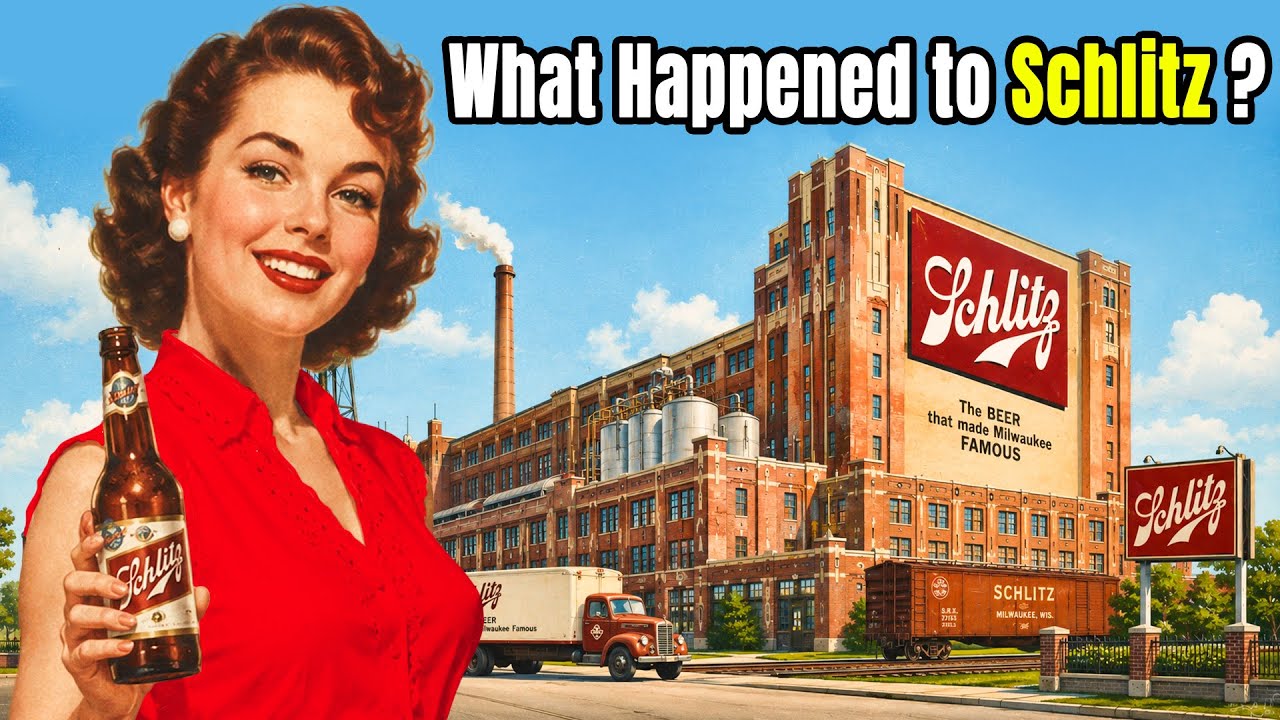
Chicago drank Schlitz while it rebuilt itself from the rubble. A story like that does more than earn headlines, it builds a reputation that carries across generations. By 1902, only fifty years after Krug’s little tavern brewery first opened its doors, Schlitz stood as the single biggest brewery on the entire planet. Through the 1950s, Schlitz was behind every bar in America.
Every televised sports game carried one. It sat in the cooler at the company picnic and in the fridge at the union hall after the night shift. The smell of a cold Schlitz in a frosted mug belonged to Friday night as surely as the ball game did. It was never a brand decision.
For millions of working-class American men, Schlitz was simply the beer. The one your father drank. The one that signaled the week was finally done. More than 4 million barrels a year.
The slogan, “The beer that made Milwaukee famous,” was not clever copywriting. It was a simple statement of fact. Here is the trouble with being number one. You wear a target, and everyone else stands to gain more than you do.
By 1957, Budweiser had narrowed the gap, then overtaken it. Anheuser-Busch claimed the top spot, partly because Schlitz got caught in a labor dispute and halted production for two and a half months over wages. Just like that, the title they had held for decades was gone. Schlitz settled into second place.
Still massive, still moving millions of barrels a year, but second. And the man who would soon inherit control of this company was already turning over how to change that. His name was Robert Uihlein Jr., fourth generation of the family that had owned Schlitz since 1875.
He was chairman, president, and the man who signed every check. Uihlein studied the numbers and reached a logical conclusion. If Schlitz could not out-sell Budweiser, it could out-earn it per barrel. Squeeze more profit from every single unit than any rival.
Leaner, quicker, more efficient. So he altered the recipe step by step. A substitution here, a shortcut there. Changes a customer might not catch right away.
He drove the fermentation process harder, shrinking aging and storage times that once took weeks down to days. He trimmed quality ingredients and replaced them with cheaper options throughout brewing. He introduced a silica gel stabilizer to keep the beer looking clear in the fridge, making up for a fermentation cycle that no longer had the time to do its job properly. Each change built on the one before.
On paper, every one of those decisions was sound. Quicker production, cheaper ingredients, fatter margins. The spreadsheet looked excellent. There was only one issue.
The beer tasted different. Not slightly, but noticeably, unmistakably different. Men who had drunk Schlitz every Friday for twenty years recognized on the first sip that something was wrong. They did not send letters to the company, they did not lodge complaints, they did not organize.
They simply reached for a Budweiser instead, and they never came back. By 1973, Schlitz reached its all-time production peak, over 12 million barrels. Not 12 million bottles, 12 million barrels. Enough to fill roughly 4 billion cans.
Lined up end to end, you would have an aluminum tower stretching to the moon and back, twice. From the outside, the company still resembled a giant. On the inside, complaints were already piling up. And then came the ingredient that sent everything over the edge.
Around that same period, the FDA hinted it might begin requiring breweries to print full ingredient panels on labels. Schlitz switched to a different stabilizer, called Chillguard, that could be filtered out before bottling, meaning it technically would not have to be listed. It looked like a tidy answer to a regulatory worry. Nobody at Schlitz anticipated what would happen when Chillguard met the foam stabilizer already in the beer.
When a customer took a bottle from the fridge, cold, the way it is meant to be enjoyed, proteins dropped out of solution. At its mildest, it appeared as tiny white flecks drifting through the beer. At its worst, drinkers described it the same way, again and again. It looked like snot floating in their beer.
Schlitz’s internal position was that the substance was harmless, that few beers would stay refrigerated long enough to set off the reaction. The customers were likely overreacting. Yet bars across America were returning full crates. Customers were pouring bottles down the sink.
The phones were ringing. Schlitz pulled the product quietly, recalled 10 million bottles and cans, and hoped the story would stay buried. Robert Uihlein died of cancer that same year, 1976, never witnessing the full fallout of what the company had turned into. Here is where most companies facing a crisis like this would go silent.
Repair the product, admit the truth, rebuild trust slowly and honestly. Schlitz did the reverse. With sales collapsing and distributors losing faith, the company hired Leo Burnett, one of the most respected ad agencies in the country, based in Chicago, and handed them a single directive: get something on the air fast that makes people love Schlitz again. In September 1977, Leo Burnett rolled out four TV spots.
The idea: tough, masculine Schlitz drinkers react when a voice off-screen suggests they switch to another beer. A boxer in a gym. A lumberjack beside his pet mountain lion. The voice raises the notion of changing brands.
The characters fire back with barely disguised menace. “I’m going to play Picasso and put you on canvas.” The tagline: “If you don’t have Schlitz, you don’t have gusto.” The spots were filmed first-person, the camera standing in for your eyes.
Those threats were aimed directly at you. It didn’t play like a lighthearted beer commercial. It played like getting boxed in inside a parking lot by somebody who desperately needed you to like them. The public, not Schlitz, instantly gave the campaign its nickname: “Drink Schlitz or I’ll kill you.
”
The spots aired for ten weeks. Then Schlitz yanked them. Leo Burnett was let go. A company spokesman would later confess it was a genuinely great tragedy, truly, truly awful.
The campaign didn’t sink Schlitz by itself, but it did something worse than damage sales. It gave the panic a face, and that face was cradling a mountain lion and menacing your living room. Between 1976 and 1981, Schlitz’s sales dropped 75 percent. Three quarters of the business erased in five years.
From the second-best-selling beer in America to a brand that some bartenders were quietly nudging customers away from. All the while, the whole beer industry was reshaping itself. Miller brought out Miller Lite. Bud Light came right after.
Light beer wasn’t a passing fad. It was a revolution that redrew the entire category. Schlitz took a short stab at it with Schlitz Light in 1976, with actor James Coburn fronting the ads. It went nowhere.
The company was too consumed with managing disaster to build anything new. By 1980, production had sunk below 6 million barrels. That’s more than half the business lost in seven years, down from a peak of 12 million barrels in 1973. In 1981, Schlitz closed its Milwaukee brewery.
The company that literally made Milwaukee famous, that stamped the city on every bar sign and beer truck across the country, shuttered its original operation in the very city that built it. That same year, questionable accounting practices set off a federal SEC investigation. A labor dispute. Creditors moving in.
Everything crashing down at once. In 1982, what had been America’s number two beer barely a decade earlier was sold to Stroh Brewery Company. Stroh kept it breathing, but couldn’t repair the underlying problem. The trust was gone.
You can swap out an owner, but you can’t swap out a memory. In 1999, Pabst Brewing Company purchased Schlitz from Stroh, along with a portfolio of other American heritage brands. It endured the way old things sometimes do. Not truly living so much as waiting.
Name still printed on a can, somewhere at the back of a cooler, a quarter cheaper than everything else on the shelf. In May 2026, just recently, Pabst placed Schlitz Premium on permanent hiatus. Rising costs, declining demand, the usual vocabulary companies reach for when they’d rather not say the word dead. A brewmaster in Verona, Wisconsin, named Kirby Nelson felt the brand deserved better than simply going quiet.
He brewed the last batch, 80 barrels, following the original 1948 recipe, the one from before all of this began. Packaged in 16-ounce four-packs, pickup only, you had to drive to Verona yourself to claim them. The beer that once stocked every bar in America ended that way. Eighty barrels, a trip to Wisconsin, and one man who believed something that old was owed a proper farewell.
If you’re in your fifties or sixties, you likely recall the last time you drank a Schlitz. You may not even recall deliberately switching away from it. It simply sort of happened. The beer tasted off one day.
You reached for something else, and that was it. That’s how betrayal works when it comes from something you never imagined you’d have to second-guess. It doesn’t announce itself. It just quietly stops being what it was.
Consumers will wait for something. They’ll pay more. There’s a tremendous reserve of goodwill sitting inside a brand that’s been part of people’s lives for decades. But there’s one thing they won’t do.
They won’t keep coming back once they sense the thing they trusted silently turned into something else. Once the taste shifts and the company stays silent. Once the product returns wrong and the answer is a menacing man on TV. Once the gap widens between what they remember and what’s actually in the glass.
And the truly painful part, none of it had to happen. The product was already good. The brand was already trusted. The loyalty was already there.
One hundred and thirty years of it, built one Friday night at a time by people who never wanted anything more than a cold beer that tasted like the last one. All they had to do was not wreck it.
