She was twenty-three years old, and the fever had burned for weeks. In a different time, she would have been given a simple remedy and recovered. In Vienna, on Christmas Eve 1692, the doctors could only watch as her strength slipped away. The baby boy she had given birth to in October was healthy, a son at last, the thing her entire life had been arranged to produce.
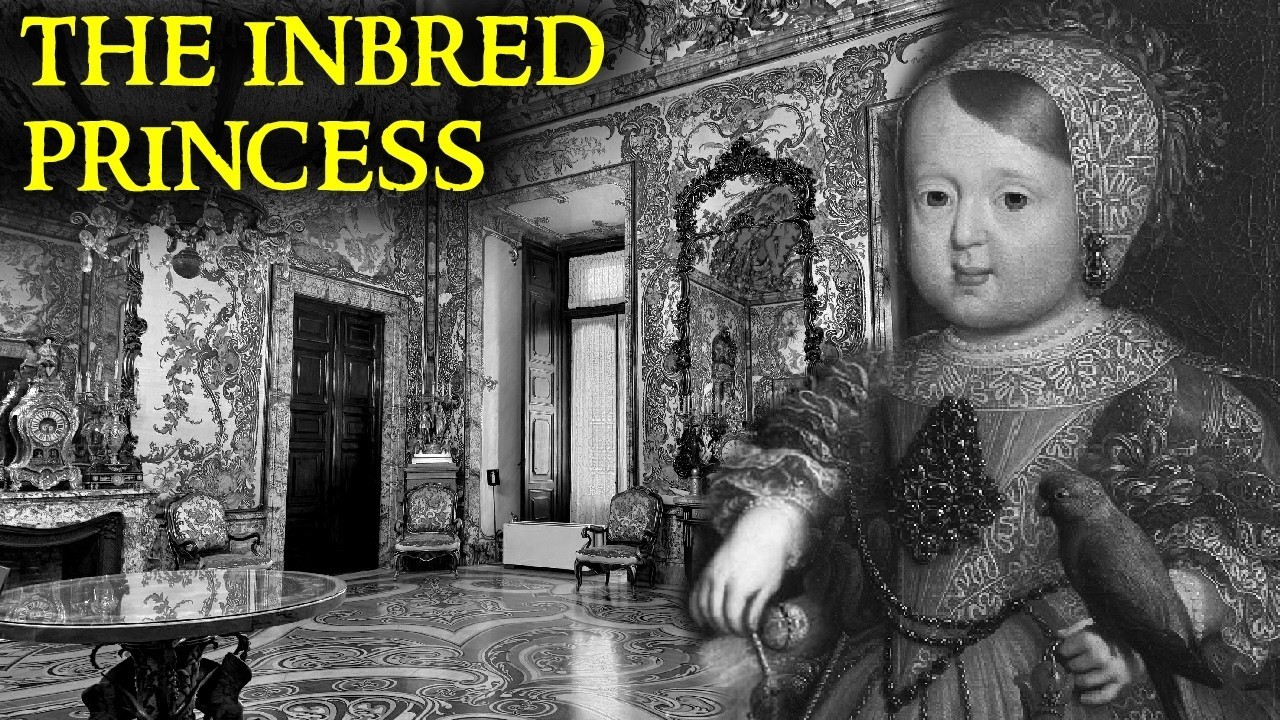
And now she was dying of an infection no one in that room understood. Her name was Maria Antonia of Austria, and a single measure of her bloodline sets her apart from nearly everyone in the history of Europe. The number attached to her is 31 percent. A child born to a brother and sister carries an inbreeding coefficient of about 25 percent.
Maria Antonia’s calculated score was higher than that. In all the centuries of the Habsburg dynasty, a family famous for marrying its own, she may have been the most inbred of them all. Vienna, January 18, 1669. She was born in the Hofburg Palace to parents who were not merely related but uncle and niece.
Her father, Leopold I, was Holy Roman Emperor, King of Hungary, Croatia, and Bohemia, one of the most powerful men in Europe. Her mother, Margaret Theresa of Spain, was the daughter of King Philip IV. Margaret Theresa’s own mother, Maria Anna, was Leopold’s sister. So Leopold was both Margaret Theresa’s husband and her maternal uncle.
It is said she called him “uncle” in private, a small detail that reveals how entirely normal this arrangement had become to them. The Habsburgs had built their empire not primarily with armies but with weddings. The proud family motto ran, *Let others make war; you, happy Austria, marry. * A marriage could deliver a kingdom without a single battle.
But the cost was hidden and compounding. Two branches of the family, one ruling Spain, one ruling Austria, kept marrying each other to keep power inside the bloodline. From the early 1500s, cousin married cousin, then uncle married niece, then it happened again in the next generation, and again. The family tree stopped branching outward and began folding back on itself like a rope tied into a knot.
Maria Antonia was born at the end of that rope. Every person carries two copies of each gene, one from each parent. When parents are unrelated, those copies are usually different; a harmful change in one copy is often covered by a healthy version in the other. But when parents share ancestors, the two copies are more likely to be identical.
A harmful mutation can appear twice, with nothing left to mask it. In 2009, a team of Spanish scientists led by Gonzalo Álvarez at the University of Santiago de Compostela built a Habsburg family tree sixteen generations deep, encompassing more than three thousand people. For Philip I, the first Habsburg king of Spain, the inbreeding coefficient was 0. 025, about two and a half percent, very low.
By the time they reached King Charles II of Spain, it had grown tenfold, to 0. 254, almost exactly the level expected of a child born to a brother and sister. In only a few generations, the family had descended from nearly no inbreeding to what would be considered sibling-level. Charles II was not part of that study, but separate genealogical calculations have given him a score in that range.
And Maria Antonia’s calculated score, about 31 percent, exceeds his. That number comes from family-tree reconstruction, not from her DNA, and it is only as reliable as the records behind it, but historians accept the broad picture it paints. She may have been the most inbred Habsburg who ever lived. The suffering began before she could speak.
Her parents had four children. The first, a boy named Ferdinand, died the year before she was born. She came next. In 1670, a son named John was born and died within hours.
In 1672, a girl named Maria Anna lived only about two weeks. Of the four, only Maria Antonia survived infancy. The same 2009 study demonstrated that among the Spanish Habsburgs, children of more closely related parents were significantly less likely to reach the age of ten. The family tree was not merely sad; it was dangerous to babies.
On March 12, 1673, her mother, Margaret Theresa, died at twenty-one. Maria Antonia was four years old, left alone in a vast palace full of servants, tutors, and a father who ruled half of Europe, with no mother, no brother, no sister. She was the last child standing. That made her something else as well: a piece on a chessboard.
She was not merely a princess; she was a possible queen of Spain. The king of Spain was her mother’s half-brother, Charles II, a boy who had inherited the throne just before his fourth birthday. Everyone could see he was gravely unwell. Born in 1661, he was small and weak, barely able to walk until he was a young child.
His jaw, the famous Habsburg jaw, projected so far that his teeth could not meet properly, and he struggled to chew. A 2019 study of Habsburg portraits found that the more inbred a person was, the more severe these facial features tended to be. He suffered digestive problems, swollen limbs, and constant illness, and he seemed to age far too quickly. The 2009 research team suggested that two rare recessive gene disorders, both needing two copies to manifest, could explain most of his ailments and his inability to father children.
That remains a hypothesis, not a proven fact. In his own time, people blamed something else entirely. They called him *El Hechizado*, the Hexed, the Bewitched. Priests performed rituals to free him from an imagined curse.
None of it helped. The scientists found what the curse-mongers could not: a family tree that had turned back on itself for generations. If Charles II produced no children, someone would have to follow him. Maria Antonia, as the daughter of his half-sister, held a strong claim.
For her father, Leopold, this was an opportunity beyond price. If his daughter became queen of Spain, or if she bore a son who did, the Austrian Habsburgs would rule both Austria and Spain and its empire across Europe, the Americas, and beyond. So from childhood she was watched, painted, written about, and planned for. Her father wanted her face known across Europe, and she sat for many portraits, which were sent especially to the Spanish court.
This was a form of advertising, a message to every court in Europe: here is the girl who should be your queen. It was necessary precisely because she was a girl; many people disliked the idea of a woman ruling a vast empire. If a boy in Vienna had held the same claim, the paintings would not have been needed. Then her father remarried, first to Claudia Felicitas, a cousin who was kind to Maria Antonia and who died of tuberculosis in 1676, then to Eleonore Magdalene of Neuburg, another distant cousin, with whom Leopold had ten children.
Almost every year, Maria Antonia gained a new half-brother or half-sister. In 1678, one of those babies was a boy named Joseph. At last Leopold had a son to inherit Austria. That changed Maria Antonia’s role.
She was no longer a possible heir to Austria; she was the key to Spain. Leopold devised a plan so audacious that even a family accustomed to uncle-niece weddings was shocked. He decided she should marry her own uncle, King Charles II of Spain. The announcement came in 1676, when Maria Antonia was seven years old and Charles about fourteen.
A seven-year-old girl promised to a teenage boy who was her uncle and already failing in health. The logic was simple: if they married and she bore a son, that son would be a Habsburg prince who could inherit Spain with both sides of the family joined. A proxy wedding was planned for December, a ceremony in which a stand-in represents the absent groom. At the last moment, it collapsed.
Charles and his advisers realized Spain needed an heir soon, and a seven-year-old girl could not provide one. In 1679, Charles married a French princess, Marie Louise of Orléans. Maria Antonia’s chance at the Spanish throne seemed gone. More plans followed.
She was considered for the young Duke of Savoy, Victor Amadeus II; that fell through as well. A princess whose future was used as a bargaining chip again and again, always at the whim of other people’s needs. In 1685, her father chose a husband for her: Maximilian II Emanuel, the elector of Bavaria. He was a distant relative, a second cousin.
Because the relationship was not close, the match actually slightly reduced the family’s inbreeding. On paper, it looked like a good thing. Maria Antonia was sixteen when she left Vienna, the only home she had ever known, and moved to Munich to live with a man she barely knew. He was nothing like her.
Maximilian was outgoing, devoted to court life, hunting, and parties. She was quiet and studious, disliked ceremony, and preferred books. One contemporary described him in harsh words, as having one of the most twisted minds and hearts one could imagine. He kept a mistress and did not hide it.
A young wife, far from her family in a foreign court, watched her husband parade another woman in public. This is the part of her story that has nothing to do with genes at all. It is about power, and about how little choice a princess had. Then came the pregnancies, and the heartbreak.
In 1689, she gave birth to a son who did not survive. In 1690, another son, also lost. Two babies, one after another. Historians cannot be certain of the exact causes; in that era, many infants died even in ordinary families.
But the study of the Habsburgs showed that children died at higher rates when their parents were more closely related, and Maria Antonia’s own coefficient was very high. It is possible her family tree played a role. It is equally possible that bad luck, illness, or the limits of contemporary medicine were to blame. What is certain is how it must have felt.
She had been told her entire life that her purpose was to give a son. Twice she tried; twice she was left with nothing. By 1691 she had had enough. She was pregnant again, miserable, humiliated, and exhausted.
She made a bold choice. She left her husband and went home to Vienna. For a seventeenth-century woman to leave a prince, defying everything she had been taught, required enormous courage. There were rumors she never intended to return to him.
In Vienna, on October 28, 1692, she gave birth. This time the baby lived: a healthy boy, named Joseph Ferdinand. Across Europe, those who had watched her for years suddenly saw something new. Here was a boy with Habsburg blood on his mother’s side and a Bavarian father, a child who could one day claim the throne of Spain.
The Spanish court was overjoyed. After everything, she had done it. But there was a cost. After the birth, Maria Antonia fell ill with what would now be called a postpartum infection, commonly known as childbed fever.
Today antibiotics would treat it in days. In 1692, nobody understood germs, nobody knew that dirty hands and dirty instruments carried infection. The body either fought it off or it did not. For weeks her fever burned and her strength faded.
On Christmas Eve, December 24, 1692, she died. She was twenty-three. Her death was not a curse and not a punishment. It was not even, in all likelihood, caused by her family tree.
Childbed fever killed women of every rank in that era, peasants and queens alike, and it was one of the leading causes of death for women who had just given birth. The tragedy of Maria Antonia is not that she was doomed from birth. She was a healthy young woman who, in a different time, would almost certainly have lived. She died of a problem medicine had not yet learned to solve.
Some of her pain, perhaps her two lost babies, may have come from her bloodline. Much of it came from other things: a father who used her as a tool, a husband who did not care for her, a world that gave her no choice, and finally an infection a single pill could cure today. That is sadder than a curse. A curse is something that happens to you.
This was something that people and their times did to her. Her death did not end the story. It began a much larger one. She left behind a baby boy, Joseph Ferdinand, and a Spain without an heir.
King Charles II was still alive, but sicker than ever. Through the 1690s, Europe expected him to die any year, yet he lingered until 1700. The great powers watched and waited to see who would take the Spanish Empire. There were three contenders.
The Austrian Habsburgs wanted it for one of their own. The French Bourbons, led by Louis XIV, also had a claim, because Louis’s wife had been Charles’s half-sister. And then there was the little boy, Joseph Ferdinand, Maria Antonia’s son. He was a great-grandson of Philip IV of Spain through his mother, and he was tied neither to Austria nor to France.
To many, he looked like a compromise: a way to give Spain a Habsburg heir without letting either giant swallow it. In 1698, England, France, and the Dutch Republic signed a treaty awarding the Spanish crown to Joseph Ferdinand, and Charles II named him heir in his will. A six-year-old boy in Brussels, with the hopes of a continent resting on his small shoulders. In February 1699, he fell ill with smallpox.
He died, still a child, only six years old. There were whispers of poison, because it all seemed so convenient for someone, but smallpox was one of the deadliest diseases of the age, and the most likely explanation is that he simply caught it. With his death, the balance broke. The peaceful solution was gone.
The Austrian Habsburgs turned to Leopold’s younger son, Charles. The French pushed their own candidate, a grandson of Louis XIV named Philip. On November 1, 1700, King Charles II finally died, just short of his thirty-ninth birthday. He left no children.
With him ended the Spanish line of the Habsburgs, which had ruled for nearly two hundred years. In his last will, Charles named Philip, the French prince, as his heir. That was the spark. Austria, backed by England and the Dutch, refused to accept it.
They would not allow France and Spain to become one giant power. In 1701, the War of the Spanish Succession began. It lasted thirteen years and drew in nearly every major power in Europe. Armies fought in Spain, Italy, Germany, the Netherlands, and across the seas.
Hundreds of thousands of people died. In the end, Philip won. He became King Philip V of Spain, and his family, the Bourbons, still occupy the Spanish throne today. But there was a condition: Spain and France could never be united under the same crown.
The rule was meant to preserve the balance of power in Europe. The Austrians received something in return: many of Spain’s European lands, including what is now Belgium, as well as Milan and Naples. Austria gained much, though not the throne it had dreamed of. A war with immense consequences had begun because a family tree had run out of branches.
Charles II could not have children. His sister’s daughter, Maria Antonia, died at twenty-three. Her son died at six. If any one of the three had lived, history might have taken a very different road.
Historians rightly distrust simple counterfactuals; many forces drove that war, France’s power, Spain’s vast empire, the ambitions of other states. A single person did not control everything. But it is true that Maria Antonia sat at the center of one of the largest questions of her time, and she never knew how large it would become. Was she cursed, or paying for something more sinister?
As far as the evidence shows, there is no trace of a curse. What appears instead is a family that, over centuries, made the same choice again and again, marrying within itself to keep power within its own walls. The result was a tree that doubled back until its last Spanish king could barely live a normal life. Scientists call it inbreeding depression: the children of closely related parents face a higher risk of illness and early death.
Among the Spanish Habsburgs, the study found a clear, measurable drop in the number of children who survived to age ten. The Habsburgs paid over and over with the lives of their own children. The price of keeping the crown close was losing the people meant to inherit it. But Maria Antonia is more than a number.
She was a girl who loved books more than parties, who was close to her stepmother, a mother who lost two babies and who in the end found the strength to leave a bad marriage and bring a healthy son into the world. She lived a life of duty in a world that gave her very little choice. Her final act, going home to give birth, showed that she chose when she could. For a woman in her position, that was an act of courage.
Her name is barely known today. Most people have never heard of Maria Antonia. But the story of the last Spanish Habsburgs is taught in schools and books, and she is the missing person inside it, the one whose life could have changed everything. If her mother had lived, if her brother had survived, if her babies had lived, if medicine had been a little better, if her husband had been kinder, her life, and perhaps the history of Europe, would have been different.
She lived only twenty-three years, but a continent waited on her, and she carried that weight from the age of four. And all she asked, as far as anyone can tell, was to be allowed to read, to think, and to live.
