The headland rises out of the North Atlantic on the southeastern corner of Newfoundland, a wall of rock that has carried the name of a mistake for centuries. Ships inbound from the open ocean aimed for Cape Race, and in the fog that this coast produces in enormous quantity, the two headlands looked identical. A captain would sight the wrong one, believe he had rounded the corner, and turn north too early. What he turned into was stone.
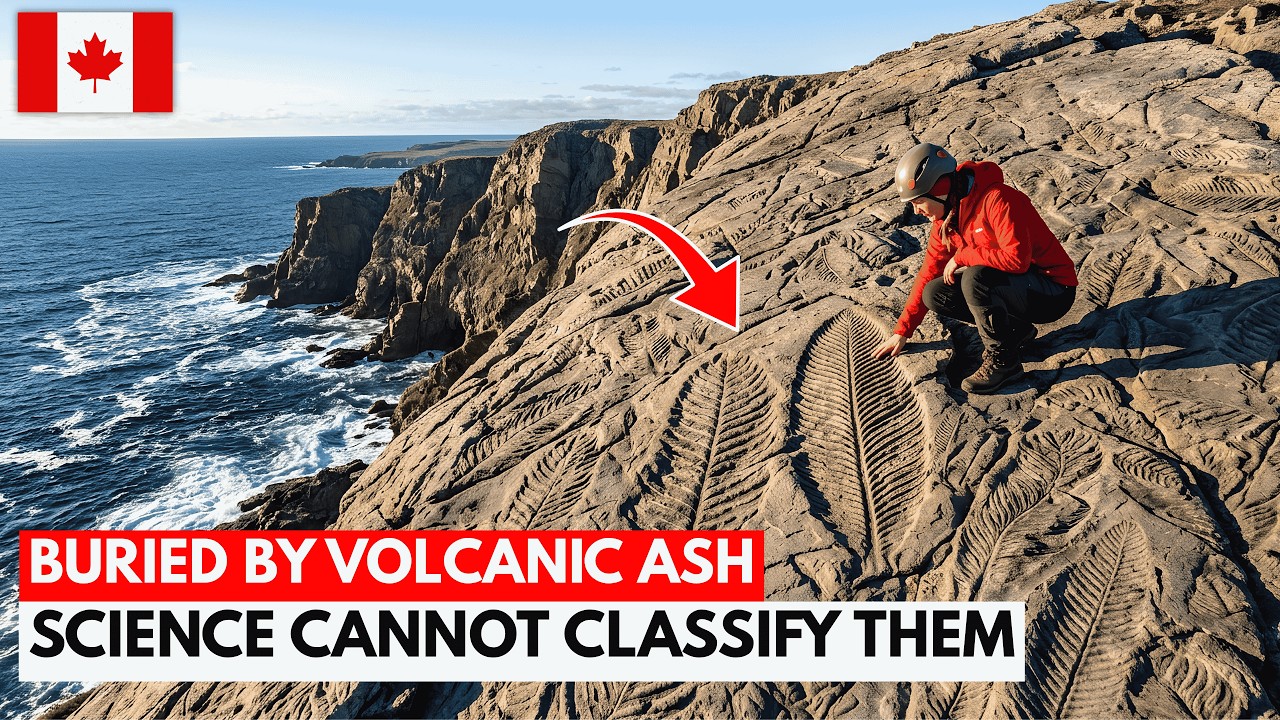
The water at the base of those cliffs is cold enough that a person in it has minutes rather than hours. So many vessels died on that error that the place came to bear the error as its name: Mistaken Point. For roughly four hundred years, that was the only thing the place was known for. Then, in 1967, a graduate student walked out onto the tilted rock at the base of the cliffs, looked down, and found something that pushed the origin of complex life on this planet back further than almost anyone was prepared to accept.
The surfaces at Mistaken Point are 565 million years old. Not the rock in general—the exact bedding planes, dated from volcanic ash sitting directly on top of the fossils to within about half a million years. Pressed into those surfaces, in some places more than 4,000 individuals on a single sheet of stone, is the oldest known assemblage of large, complex living things anywhere on Earth. They are not animals, not exactly.
Nobody has been able to say for certain what they are. To understand why a Canadian cliff matters this much, you have to understand what the fossil record looked like before it was found. For most of the history of this planet, life was small. The Earth is about four and a half billion years old.
Life appears somewhere around three and a half to four billion years ago, and then, for the overwhelming majority of the time that followed, it stayed microscopic. Single cells. Mats of bacteria. Films and slime and crusts.
Three billion years of that, with almost nothing you could see without a lens. Then, in the rocks of the Cambrian period, starting around 540 million years ago, the record explodes. Suddenly there are animals with shells, eyes, legs, guts, mouths, and hard parts. Trilobites, predators, whole functioning ecosystems arriving in the rock, apparently out of nowhere.
This bothered Charles Darwin enormously, and he said so in print. If life had evolved gradually, there had to be a long history of complex organisms below the Cambrian. He could not find one. Nobody could.
He admitted openly that the absence was a serious problem for his theory, and that he had no good explanation for it. So a doctrine settled in. Below the Cambrian, there was nothing complex. That was simply how the world worked.
Which is why the first person to find one of these fossils was ignored. In 1872, a Canadian paleontologist named Elkanah Billings described a strange disk-shaped impression in rock from St. John’s, Newfoundland, and gave it a name, Aspidella terranovica. He argued it was the remains of a living thing.
His colleagues did not accept it. The rock was clearly older than the Cambrian, and complex life older than the Cambrian was not possible. Therefore, the marks were not fossils. They were dismissed as gas bubbles, or compaction marks, or some other quirk of sediment.
Aspidella sat in the literature as a curiosity for about a century. It is now accepted as a genuine fossil. The first Precambrian complex organism ever described was found in Newfoundland, correctly identified in 1872, and rejected because the answer was not allowed. The doctrine finally broke in England in the 1950s, and it broke twice.
A schoolgirl called Tina Negus saw a fern-shaped impression on a quarry face in Charnwood Forest and told her geography teacher about it. She was told she was mistaken, because there were no fossils in rock that old. A year or so later, a schoolboy called Roger Mason saw the same fossil while out climbing, made a rubbing of it, and took it to a geologist at the University of Leicester named Trevor Ford. Ford went to look, agreed it was real, and published it in 1958.
The organism was named Charnia masoni. That single fossil ended the argument. Complex life did exist before the Cambrian. The question immediately became how much, and where else.
Which brings us back to a wet cliff in Newfoundland, nine years later. In 1967, a graduate student at Memorial University in St. John’s, a geologist from India named Shiva Balak Misra, was mapping the rocks along that coast. At Mistaken Point, he came across bedding surfaces covered in impressions.
Not one or two—hundreds of them, spread across the exposed rock like something had been laid out and pressed flat. He published the find in 1969. What he had walked onto was not a fossil site in the ordinary sense. It was a sea floor.
Here is the difference, and it is the reason this place became a world heritage site rather than a footnote. Most fossils are wreckage. A bone gets carried down a river, tumbled, buried somewhere it never lived, and found next to the remains of animals it never met. You get pieces of a world out of order, out of place.
Mistaken Point is not wreckage. These organisms lived on a deep sea floor, and they were buried where they stood by ash. The Avalon Peninsula in the Ediacaran period sat near a chain of volcanoes off the edge of an ancient continent. Eruptions dropped ash into the ocean, and the ash settled onto the seabed in sheets, smothering everything living there in a matter of hours.
Each ashfall sealed one community in place, in the exact positions the organisms had grown in, and then the next layer of sediment sealed the ash. Then it happened again. And again. The result is a stack of seafloors, nearly three kilometers of rock in total, with dozens of separate fossil surfaces inside it, each one a single moment.
Geologists call it an Ediacaran Pompeii, and the comparison is fair. You are not looking at a collection of specimens. You are looking at a neighborhood frozen mid-life, with the small ones next to the large ones, and the young next to the old, exactly where they were standing when the sky fell in. There is no other site on the planet that preserves this period in this way at this depth.
And the depth is the part that changes everything. The rocks show these communities were living in deep water, well below the reach of sunlight, hundreds of meters down at least, on a slope in permanent darkness. That single fact removes the obvious explanation. Whatever these things were, they were not plants, and they were not photosynthesizing, because there was no light to photosynthesize with.
They were large, they were complex, they were living in total darkness on a cold seabed, and they were doing it without any of the equipment we normally associate with being an animal. Because when you look at what they actually are, the equipment is missing. The dominant group at Mistaken Point are called rangeomorphs. A rangeomorph looks, at first glance, like a frond or a feather.
Look closer, and the structure is stranger than that. Each branch divides into smaller branches, which divide into smaller branches, which divide again, and the shape of the small parts repeats the shape of the whole thing. It is a fractal. The entire organism is one geometric rule executed at four or five scales.
Some of them stood nearly two meters tall. They have no mouth, no gut, no anus, no eyes, no head, no front, and no back. No shell, no skeleton, no limbs, no evidence of muscle, and at this site, no evidence of movement. Almost all of them were anchored to the seafloor by a holdfast, a disc that gripped the sediment, and they simply stood there in the dark.
So how does a two-meter organism with no mouth eat? The leading idea is that it did not eat in any sense we would recognize. It absorbed. The deep ocean of that period was rich in dissolved organic carbon, and a fractal body is a machine for producing surface area.
All that branching gives an enormous amount of skin for a very small amount of volume. If you take in food directly through the surface of your body, the fractal is not decoration. It is the entire feeding strategy. The shape is the stomach.
That is called osmotrophy, and it remains the best available explanation rather than a settled fact. Now for the question everyone asks, and the question that still has no agreed answer: what are they? They are not plants, not fungi, not algae, not bacteria. Some researchers class them as early animals, stem members of groups that later produced everything from sponges to us.
Others, following the German paleontologist Dolf Seilacher, argued they were something else entirely—a separate experiment in multicellular life that has no living descendants and does not belong on any branch of the tree we currently use. A kingdom that ran for tens of millions of years and then stopped. Both positions are still held by serious people. More than fifty years after Misra walked onto that surface, the basic biological identity of the most abundant organisms at the site is unresolved.
But one thing about their lives has been worked out, and the method used to do it is remarkable. In 2015, a research team led by Emily Mitchell at Cambridge took a problem that looked impossible and solved it with statistics. You cannot watch a 565-million-year-old organism reproduce. But because Mistaken Point preserves whole communities in place, you can map exactly where every individual of a species sat relative to every other one.
And the spatial pattern of a population carries a signature of how that population spread. They mapped a rangeomorph called Fractofusus and analyzed the clustering. The pattern that came out was not random, and it was not a single process. It was two.
Large individuals were distributed as though they had arrived from a distance, carried in the water as some kind of propagule. Around each of those, smaller individuals were clustered tightly in the pattern you get from something growing outward from a parent by runners along the ground, the way a strawberry plant colonizes a patch of soil. Two reproductive strategies in one organism. One to reach new ground, one to take over the ground you already hold.
That is the oldest known evidence of any reproductive strategy in a complex organism, recovered from nothing but the positions of impressions in a rock. And then they vanish. Around 541 million years ago, at the boundary with the Cambrian, the rangeomorphs and their relatives disappear from the fossil record almost entirely. What replaces them is the world we recognize.
Animals that move, dig, chase, and eat each other. There is no consensus on why. One line of argument is predation—that the first true animals with mouths simply ate a group of organisms that had spent tens of millions of years with no defenses at all, because nothing had ever needed defenses before. Another is engineering—that the arrival of burrowing animals destroyed the microbial mats covering the Ediacaran seafloor, and those mats were the surface the whole ecosystem was built on.
A third points to changes in ocean chemistry and oxygen. Possibly all three. What is agreed is that an entire way of being alive, one that had worked at scale for a very long time, ended, and nothing like it has appeared since. The rocks at Mistaken Point today are tilted.
What was once a flat seabed now sits on an angle, hammered by North Atlantic weather, and every storm takes a little more of it. The fossils are on the surface, exposed—which is why you can see them at all, and also why they are disappearing. Access is controlled. The site became a provincial ecological reserve, and in 2016 it was inscribed as a UNESCO World Heritage Site.
You cannot walk to the fossil surfaces alone. You go with a guide on foot, and when you reach the rock itself, you are asked to take off your boots, because hard soles grind the impressions away. People stand on a 565-million-year-old seafloor in their socks. That precaution is not theoretical.
There has been damage. In one reported case, someone was caught having made molds of the fossils on site, which is illegal, and left marks on the surface doing it. It is also worth being precise about the claim, because the claim gets stretched online. Mistaken Point is not the oldest evidence of life, which is billions of years older.
It is not even the only Ediacaran fossil site. There are important ones in Australia, Russia, and Namibia. There are also older claims for large organisms elsewhere that remain contested. What Mistaken Point holds is the oldest known assemblage of large, complex organisms that is precisely dated, densely populated, and preserved as whole living communities rather than scattered fragments.
That combination exists nowhere else. So this is what the place actually is. A headland named for a navigational error on a coast known mainly for drowning people holds a stack of seafloors from a time before animals. On those surfaces stand thousands of organisms that grew as fractals, fed through their skin in permanent darkness, reproduced by two separate methods, held the planet for tens of millions of years, and then went out completely, leaving no descendants that anyone can identify with any confidence.
They were pressed into that rock more than 300 million years before the first dinosaur. They were already ancient beyond comprehension when the first fish appeared. And for four centuries, sailors were breaking their ships apart directly above them without knowing they were there. The last part is the one that stays with people who visit.
You can put your hand flat on that surface. What you are touching is not a picture of an ancient seabed. It is the seabed.
The organisms were lying on it, and then the ash came down, and nothing has moved since.
