The snow around the base of the standing pine had been disturbed, scraped away from the roots in a pattern that made no sense, because there were no tracks leading to it and none leading away. Virgil Moss crouched and studied it, then stood and scanned the forest. Nothing moved. The silence pressed down on the deep cut like a weight, and for a moment he felt the cold settle into his bones in a way it never had before, not in fifteen years of working the timber.
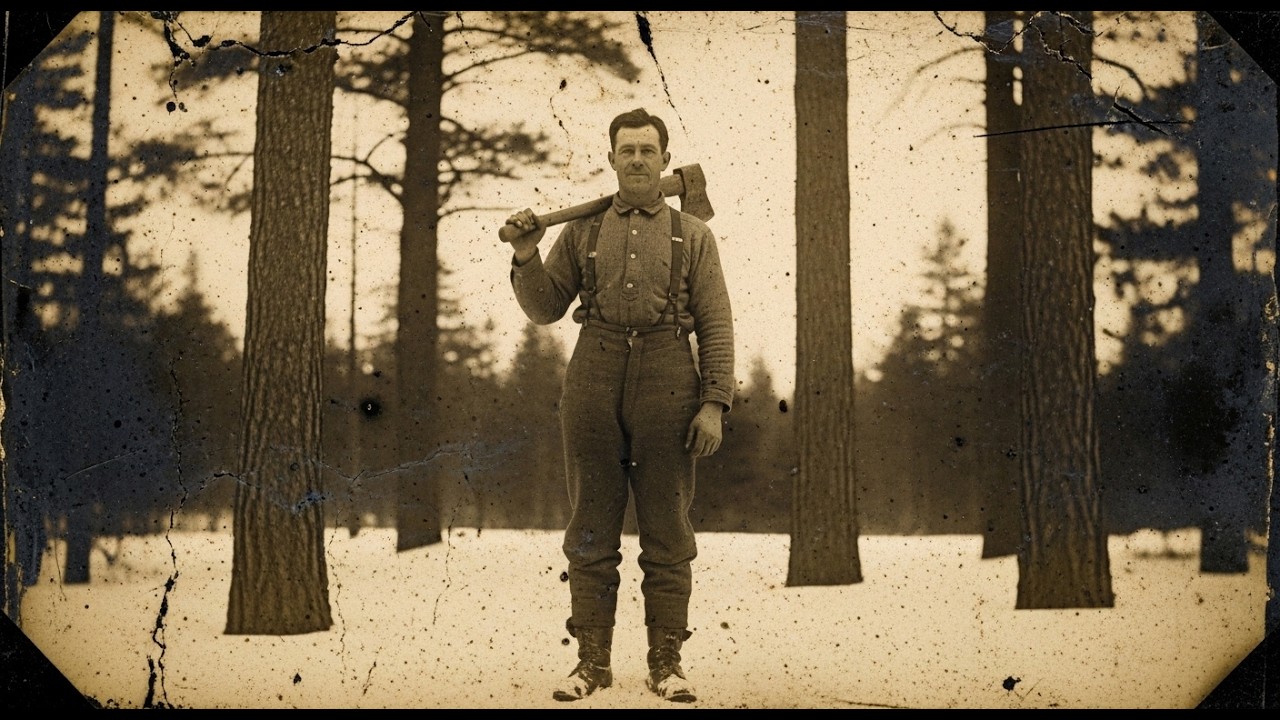
He was thirty-four years old, the best faller in the northern territories, and he had never once made a mistake in the woods. That is what made what happened so impossible to explain. The camp where Virgil worked that winter was called Taggart’s Mill, named after the man who ran it, Cyrus Taggart, who operated his logging enterprise like a military campaign, efficient, brutal, profitable. The camp sat about twelve miles northeast of a town called Kalkaska, deep in the white pine forest of northern Michigan, where the trees grew so tall and thick that noon looked like dusk.
Seventy men worked there that season, most of them Swedish and Norwegian immigrants, with a handful of French Canadians and a few American-born drifters like Virgil. They slept in a long bunkhouse built of rough-cut timber, on straw mattresses, and they ate beans and salt pork twice a day. The work was hard enough to break a man’s back and cold enough to freeze his breath in his lungs. Men died regularly in camps like Taggart’s, crushed by logs, frozen in the snow, drowned in the river during the spring drives.
It was just part of the job. But what happened that winter was not part of the job. It started in late January, the coldest part of the season, when the temperature dropped so low that the sap froze in the trees and the wood cracked like rifle shots in the night. Virgil was working a section about two miles west of the main camp, an area the men called the deep cut, because the trees there were older and taller than anywhere else in the region.
Some of those pines were over two hundred years old, their trunks so wide that two men holding hands could barely reach around them. Taggart had assigned Virgil to the deep cut because he was the only faller he trusted not to waste timber. Every tree was money, and a bad cut could ruin thousands of board feet. So Virgil went out there alone most days, with just a younger man named Otto Lindgren to help clear brush and haul chains.
Otto was twenty-three, blond, strong as a mule, and talked more than any three men combined, always filling the air with stories about his family back in Sweden, or some girl he’d met in town, or his plans to save enough money to buy a farm. Virgil tolerated it because Otto was a good worker, and because silence didn’t bother Virgil the way it bothered most people. The two of them had developed a rhythm over the weeks they’d worked together. Otto would talk, Virgil would grunt occasionally to show he was listening, and the work would get done.
On the twenty-fourth of January, 1887, they were working a section near the northern edge of the deep cut when Otto found something. It was mid-afternoon, and they had just dropped a big pine, a tree that had taken Virgil nearly an hour to notch and fall properly. The tree had come down clean, exactly where Virgil had intended, the trunk hitting the snow with a sound like thunder that echoed through the forest for miles. Otto was clearing branches from the trunk when he stopped, stepped back, and called Virgil over.
His voice had a strange quality to it. Not frightened, exactly. More like uncertain, like he had found something he didn’t have words for. Carved into the bark of the fallen pine, about chest height from the ground, was a symbol.
It was not a logger’s mark, which was common, just a simple slash or initial to claim a section. This was something else. It was a circle, maybe eight inches across, with lines radiating out from the center like the spokes of a wheel. Twelve lines, evenly spaced, and at the end of each line was a smaller circle.
The carving was deep, cut into the bark and the wood beneath, and it was old. The edges of the cuts were dark with sap and age, stained almost black by years of exposure to the elements. Virgil crouched down and ran his hand over it. The wood around the carving felt colder than the rest of the tree.
Not frozen, just cold. Like someone had pressed ice against it for hours, and the cold had sunk in and stayed there. Otto asked what he thought it was, and Virgil said he didn’t know. Otto said it looked like something the Indians might have done, but Virgil shook his head.
The local tribes, the Ottawa and the Ojibwe, didn’t make marks like that. Their symbols were different, animals mostly, figures that told stories. And besides, the carving was too high up, unless someone had carved it when the tree was younger and smaller. But that didn’t make sense either, because the tree had to be at least 150 years old, and the carving didn’t look that old.
It looked old, yes, but not ancient. Maybe twenty years, maybe thirty. Virgil told Otto to forget about it and get back to work. They limbed the tree, sectioned the trunk, marked it for the sledding crew to haul back to camp.
By the time they finished, the sun was setting and the temperature was dropping fast. They packed up their tools and started the walk back to Taggart’s Mill, a walk that took about forty minutes in good conditions, following a trail packed down by weeks of use. But that evening, the walk felt longer. The shadows between the trees were deeper than usual, and the light had that strange quality it gets in winter when the sun is low and everything looks blue and gray and unreal.
Virgil kept thinking about the symbol, the way it had been carved so deliberately, the way the wood around it had felt cold. He had seen strange things in the woods before, carvings, piles of stones, old grave markers from pioneers who had tried and failed to settle the land. The woods were full of history, most of it forgotten. But there was something about that symbol that stayed with him.
That night, Virgil couldn’t sleep. Not because of the carving exactly, but because of what it did to him. He lay in his bunk listening to the sounds of seventy men sleeping, snoring, coughing, the creak of old timber. Outside, the wind picked up and the trees made that low groaning sound they make when they sway in the cold.
Virgil finally dozed off sometime after midnight, and when he did, he dreamed. He dreamed he was standing in the deep cut, surrounded by trees, and every tree was marked with that same symbol. Hundreds of them, thousands, carved into every trunk as far as he could see. And in the dream, Virgil understood what the symbol meant.
But when he woke up just before dawn, the understanding was gone, leaving only a faint, uneasy feeling that he had known something important and lost it. The next day, Virgil went back to the deep cut. Otto asked if he wanted to work a different section, but Virgil said no. There were good trees where they had been working, and Taggart wanted them down before the thaw.
So they went back, and that’s when Virgil started noticing things. Small things at first. The snow around the base of certain trees was disturbed, like something had been digging or scraping at the roots. But there were no tracks, no animal prints, no boot marks, just disturbed snow and the silence.
Virgil had worked in the woods long enough to know that silence was never absolute. There were always sounds, wind in the branches, birds, the distinct crack of trees settling in the cold. But in the deep cut, starting that second day, the silence was different. It wasn’t the absence of sound.
It was the presence of something that made sound irrelevant, like the air itself was holding its breath. Otto felt it too. He stopped talking as much, started glancing over his shoulder. At one point he asked Virgil if he thought anyone else had been working their section, and Virgil said no.
The deep cut was assigned to them, and Taggart ran a tight operation. No one wandered into someone else’s claim. Otto nodded, but he didn’t look convinced. They worked through the morning without incident, dropping two more big pines and limbing them for transport.
It was just after noon when Otto found the second symbol. This one was carved into a tree that was still standing, about fifty yards north of where they had found the first one. Same circle, same twelve radiating lines, same smaller circles at the ends. But this carving was fresh.
The cuts were clean, the wood inside pale and raw, and sap was bleeding from the edges. Otto called Virgil over, and they both stood there looking at it. Virgil reached out and touched the sap. It was still tacky, warm even, like the carving had been made within the last few hours.
Otto asked who could have done it, and Virgil didn’t answer, because he didn’t have an answer. They were the only ones working this section, and they had been together all morning. No one else had been there. Virgil looked around, scanning the trees, the snow, the shadows.
Nothing. Just the forest, silent and waiting. He told Otto to stay close, and they went back to work. But the rest of the day had a tension to it that hadn’t been there before.
Every sound seemed louder, every shadow seemed darker. Virgil kept catching movement in his peripheral vision, but when he turned to look, there was nothing. Just trees, just snow. By the time they finished and started back to camp, the sun was already below the horizon and the woods were filling with that blue-gray twilight that makes everything look unreal.
They were about halfway back when Otto stopped walking. Virgil turned around and saw Otto staring off into the trees to their left. He said he’d seen someone, a figure standing between two pines about thirty yards off the trail, tall, wearing dark clothes, just standing there watching them. Virgil looked, but he didn’t see anything.
Otto insisted it had been a man. Virgil told him it was probably one of the sledding crew, but Otto shook his head. The sledding crew didn’t work this far out, and besides, the figure hadn’t moved, just stood there. Virgil suggested they keep walking, and Otto agreed, but he kept looking back over his shoulder the whole way to camp.
When they reached the bunkhouse, Otto went straight to his bunk and sat there staring at nothing. Virgil asked him if he was all right, and Otto said yes, but his hands were shaking. That night, Virgil asked around quietly. He wanted to know if anyone else had been working near the deep cut.
The answer was no. Taggart had assigned that section to Virgil and Otto exclusively, and no one else had any reason to be out there. He also asked if anyone had seen anything strange in the woods lately. Most of the men laughed it off.
Strange things happened in the timber all the time, sounds that didn’t make sense, shadows that moved wrong, trees that fell when there was no wind. It was just the woods. But one man, an older French-Canadian named Lucien Broussard, pulled Virgil aside later and told him something. Lucien had been logging in Michigan for twenty years, and he had worked a camp about thirty miles north of Taggart’s Mill back in 1879.
He said that camp had been shut down after three men disappeared in the space of a week. Just vanished. No bodies, no tracks, no explanation. The owner had tried to keep it quiet, but word got out, the men refused to work, the camp folded, and the area was abandoned.
Lucien said the men who disappeared had all been working the same section, a stand of old growth pine that the locals called the hollow. Virgil asked why it was called that, and Lucien said, “Because that’s how it felt, hollow, empty. Like something had been scooped out of the world and replaced with nothing. ” Virgil asked if Lucien knew where the hollow was, and Lucien said, “Yeah, about twelve miles north, right where the deep cut would be now.
”
Virgil didn’t sleep that night. He lay in his bunk and thought about the carvings, the figure Otto had seen, the story Lucien had told. He thought about the way the wood around the first symbol had felt cold, and the way the sap from the second symbol had been warm. He thought about the silence in the deep cut, and the way the shadows seemed to move when he wasn’t looking directly at them.
And he thought about the dream he’d had, the one where every tree in the forest was marked with that symbol, and the feeling of understanding something terrible and then forgetting it. By the time the wake-up bell rang at four in the morning, Virgil had made a decision. He was going back to the deep cut alone. He didn’t tell Otto.
He told him he was feeling off, maybe coming down with something, and that Otto should take the day to sharpen tools and mend gear. Otto looked relieved. He didn’t want to go back to the deep cut any more than Virgil wanted to bring him. Virgil packed his axe, a canteen, some hardtack, and a small notebook and pencil he’d bought in town the previous fall.
He left camp just after sunrise and walked the two miles to the deep cut under a sky the color of old iron. The air was still, and the cold was the kind that settled into your bones and stayed there. When he reached the section where they’d been working, he stopped and looked around. The trees they’d felled were still there, waiting for the sledding crew.
The stumps were fresh, pale wood against the snow. Everything looked normal except for the silence. It was back, heavier than before, pressing down on the forest like a weight. Virgil walked north, deeper into the deep cut, past the tree where Otto had found the second carving.
He wanted to see if there were more, and there were. Over the next hour, Virgil found eleven more symbols, all of them carved into trees that were still standing, all of them fresh, the wood raw and bleeding sap. They were spaced irregularly, some close together, some fifty or sixty yards apart, but they all followed a rough line heading northwest, deeper into the forest. Virgil marked each one in his notebook, drawing a crude map and noting the size and type of tree.
By the time he found the eleventh symbol, he was nearly three miles from where he and Otto had been working, in a part of the deep cut he’d never seen before. The trees here were older, bigger, their trunks dark with age and their branches heavy with snow. The light barely reached the ground. It was like standing at the bottom of a well.
Virgil stopped and listened. Nothing. Not even the sound of his own breathing seemed to carry. And then he saw it.
About a hundred yards ahead, through the trees, there was a clearing. Not a natural clearing. The trees around it were too uniform, too evenly spaced, like they’d been planted that way deliberately. Virgil walked toward it, his boots crunching in the snow.
And as he got closer, he realized the clearing wasn’t empty. There was something in the center of it. A structure. It was hard to describe because it didn’t look like anything Virgil had seen before.
It was made of wood, rough-cut logs stacked and interlocked in a way that seemed random but wasn’t. The structure was maybe twelve feet tall, circular, with no obvious door or entrance. The logs were old, dark, covered in a layer of frost that made them look almost black. And carved into every single log, repeated over and over, was the symbol.
The circle with the twelve radiating lines. Virgil approached slowly, his hand resting on the handle of his axe. He walked around the structure looking for an opening, but there wasn’t one. It was solid, a closed cylinder of wood standing in the middle of the clearing like a monument.
Virgil reached out and touched one of the logs. It was cold. Colder than the air. Colder than anything should be.
And when he pulled his hand back, his fingers were numb. He stepped back and looked up. The top of the structure was open, but it was too high for him to see inside. Virgil considered climbing it, but something stopped him.
A feeling. Not fear, exactly. More like the certainty that climbing the structure would be a mistake he wouldn’t come back from. So he didn’t.
Instead, he walked around the clearing, examining the trees. And that’s when he noticed something else. The trees around the clearing were marked, not with the symbol, but with cuts. Deep, deliberate cuts, like someone had taken an axe or a saw and carved into the trunks at chest height.
The cuts were old, the wood inside dark and dead, but they were unmistakable. Virgil counted them. Forty-seven trees. Forty-seven cuts.
He didn’t know what it meant, but he wrote it down in his notebook. 47. Virgil stayed in the clearing for maybe twenty minutes, trying to make sense of what he was seeing. He walked around the structure again, examined the carvings, touched the logs.
They were all the same temperature, unnaturally cold. He looked at the snow around the base of the structure and saw that it was undisturbed. No footprints, no drag marks, nothing to indicate that anyone had been there recently. But the carvings on the trees outside the clearing had been fresh, made within hours, maybe.
So someone had been there. Someone was still there. Virgil turned slowly, scanning the tree line. The shadows between the trunks were deep and uniform.
And for a moment, he thought he saw movement. A flicker, like something tall and dark shifting position. But when he focused on the spot, there was nothing. Just trees, and shadow, and silence.
Virgil decided it was time to leave. He marked the clearing in his notebook, drew a rough sketch of the structure, and started walking back the way he’d come. But as he walked, he had the distinct feeling that he was being followed. Not closely, not threateningly, just followed.
Like something was keeping pace with him, staying just out of sight, watching. He stopped several times and turned around, but he never saw anything. Just the forest. Just the silence.
By the time he reached the section where he and Otto had been working, the sun was starting to set and the temperature was dropping. Virgil picked up his pace. He didn’t want to be in the deep cut after dark. When he got back to camp, Otto was waiting for him.
He asked where Virgil had been, said he’d been worried. Virgil told him the truth, said he’d gone back to the deep cut to look for more carvings. Otto asked if he’d found any, and Virgil said yes, lots of them. He told Otto about the clearing, and the structure, and the cuts on the trees.
Otto listened without interrupting, and when Virgil finished, Otto was quiet for a long time. Then he said, “We should tell Taggart. ” Virgil shook his head. Tell him what?
That they’d found some old carvings and a weird structure in the woods? Taggart didn’t care about anything that didn’t affect his timber yield. And besides, the more Virgil thought about it, the more he realized that the structure wasn’t old. The logs were old, yes, but the way they were assembled, the precision of it, the uniformity, that was recent.
Someone had built it recently, and someone was maintaining it, carving the symbols, marking the trees, watching. That night, Virgil didn’t dream. He didn’t sleep at all. He lay in his bunk, listened to the wind outside and the sounds of the camp settling in for the night, and thought about the forty-seven cuts on the forty-seven trees.
He thought about the three men who disappeared from the camp thirty miles north in 1879. He thought about the way the structure had felt when he touched it, cold, empty, hollow. And he thought about the figure Otto had seen standing between the trees, watching them. By morning, Virgil had decided he wasn’t going back to the deep cut.
He was going to tell Taggart he needed to work a different section, that the timber in the deep cut wasn’t worth the effort, that the trees were too old, too hard, too scattered. Taggart wouldn’t like it, but he’d reassign him. And that would be the end of it. Except it wasn’t.
Because when Virgil went to find Taggart that morning, Taggart wasn’t in his office. He wasn’t in the mess hall. He wasn’t anywhere in camp. One of the sledding crew said he’d seen Taggart heading out before dawn, walking north toward the deep cut.
Said Taggart had his rifle and a pack, like he was going hunting. But Taggart didn’t hunt. He didn’t have time. And he didn’t go into the woods without telling someone where he’d be.
Virgil felt something twist in his stomach. He asked the sledding crew if anyone else had gone with Taggart, and the man said no. Taggart had gone alone. Virgil went back to the bunkhouse and found Otto.
He told him what he’d heard, and Otto’s face went pale. He asked Virgil if he thought Taggart had gone to the clearing, and Virgil said he didn’t know. But they both knew the answer. Virgil and Otto grabbed their gear and headed out.
They moved fast, not quite running, but close. The trail to the deep cut was familiar now, and they made good time. By midmorning, they were past the section where they’d been working and into the deeper part of the forest. Virgil led the way, following the route he’d taken the day before, using his notebook to navigate.
The symbols were still there, carved into the trees, and they followed the line northwest toward the clearing. As they got closer, Virgil started to hear something, a sound, faint at first but growing louder. It wasn’t wind, it wasn’t animals. It was a low, rhythmic noise, almost like breathing, but too slow, too deliberate.
Otto heard it too. He asked Virgil what it was, and Virgil said he didn’t know. They kept walking. When they reached the clearing, they stopped.
The structure was still there, standing in the center, dark and cold and wrong. But there was something new. Footprints in the snow, leading from the tree line to the base of the structure, and then nothing. The prints stopped, just ended right at the base of the logs, like whoever had made them had simply ceased to exist.
Virgil and Otto walked into the clearing slowly, following the prints. They were fresh, made within the last few hours, and they were Taggart’s. Virgil recognized the boot pattern, deep lugs worn on the outer edge. Otto called out Taggart’s name, but his voice didn’t carry.
It fell flat, swallowed by the silence. Virgil walked around the structure looking for any sign of where Taggart might have gone, but there was nothing. Just the prints leading to the base, and then nothing. Like the structure had opened and swallowed him, and then closed again.
Otto started to panic. He said they needed to get help, bring back the whole camp, tear the structure apart, find Taggart. Virgil told him to calm down, told him they needed to think. Otto said there was nothing to think about.
Taggart was gone, taken by whatever had built the structure, whatever was carving the symbols, whatever had been watching them. Virgil didn’t argue, because he knew Otto was right. He looked up at the open top of the structure, and for the first time he seriously considered climbing it. But before he could make a decision, the sound changed.
The low rhythmic breathing noise stopped, and in the silence that followed, Virgil heard something else. A voice, faint, distant, coming from inside the structure. It was saying something, but Virgil couldn’t make out the words. He stepped closer, pressing his ear against one of the logs, and the voice got louder.
It was Taggart. He was calling for help. Virgil told Otto to give him a boost. Otto hesitated, but Virgil insisted.
So Otto crouched down and laced his fingers together, and Virgil stepped into his hands and reached up, grabbing the top edge of the structure. The wood was so cold it burned his palms, but he held on and pulled himself up. Otto pushed from below, and Virgil managed to get his elbows over the edge and haul himself up until he could look down into the structure. And what he saw, he didn’t have words for.
Because inside, the structure wasn’t hollow. It was deep, impossibly deep. Like looking down into a well that had no bottom. And the walls weren’t wood.
They were something else, dark and organic and moving, pulsing in rhythm with the breathing sound. And far below, maybe a hundred feet, maybe a thousand, Virgil could see a light, a faint pale glow. And standing in the light, looking up, was Taggart. He was calling for help, but his voice sounded wrong, echoed and distorted, like it was coming from underwater.
Virgil shouted down to him, asked if he could climb out, but Taggart didn’t respond. He just stood there, staring up, his face blank. And then Virgil noticed something else. There were others down there.
Figures standing in the darkness beyond the light. Dozens of them, maybe more, just standing, watching. Virgil pulled back, his hands shaking, and dropped down to the ground. Otto asked what he’d seen, and Virgil couldn’t answer.
He just shook his head. Otto asked again, louder this time, and Virgil finally said, “We need to leave. Now. ” Otto started to argue, but Virgil grabbed him by the arm and pulled him toward the tree line.
They were halfway across the clearing when the breathing sound started again. Louder this time, faster. And the ground beneath their feet started to vibrate. Otto stumbled, caught himself, and then they were running.
Running through the trees, following the trail back, not looking back, just running. Behind them, the sound grew louder, and Virgil swore he could hear footsteps. Not one set, many, dozens, keeping pace. But when he glanced over his shoulder, the forest behind them was empty.
Just trees, and shadows, and that terrible sound. They didn’t stop running until they were back at the section where they’d been working, and even then they only slowed because they were both gasping for air, their lungs burning from the cold. Otto bent over, hands on his knees, and asked Virgil what they were going to do. Virgil said they were going to go back to camp, pack their gear, and leave.
Otto said they couldn’t just leave Taggart, and Virgil said Taggart was gone. Whatever was down there, whatever that place was, Taggart wasn’t coming back. Otto looked like he wanted to argue, but he didn’t, because he knew Virgil was right. They got back to camp just before dark.
The other men were gathering for supper, and when they saw Virgil and Otto, they asked where Taggart was. Virgil said he didn’t know, said Taggart had gone into the woods and they’d tried to find him but couldn’t. Some of the men wanted to organize a search party, but Virgil talked them out of it. Said it was too dark, too cold, too dangerous.
They could look in the morning. The men agreed reluctantly, and Virgil and Otto went to the bunkhouse. They packed their gear in silence. And that night, while the rest of the camp slept, they left.
Just walked out into the darkness, and didn’t look back. Virgil never logged again. He drifted south, worked odd jobs, tried to forget what he’d seen, but he couldn’t. In the spring of 1888, he was in a town called Grayling, working as a carpenter, when he heard the news.
Taggart’s mill had shut down. The whole camp abandoned. The men had walked off the job after five more disappearances in the space of two weeks. The authorities investigated, found nothing, and the area was marked as unsafe.
The timber company sold the land, and the deep cut was left to grow wild. Virgil thought that would be the end of it, that whatever was out there would stay out there. But in 1891, he heard another story. A logging camp in northern Wisconsin, near a town called Medford, had shut down after three men vanished.
Same story. No tracks, no bodies, no explanation. And the men who’d survived talked about carvings in the trees. Symbols.
Circles with twelve radiating lines. Virgil packed his things and left Grayling that same day. Over the next six years, Virgil tracked reports of disappearances in logging camps across Michigan, Wisconsin, and Minnesota. Every time he heard a story that matched, he went to investigate.
And every time, he found the same things. The symbols, the cuts in the trees, the clearings, the structures. Sometimes he found them before anyone disappeared, sometimes after. But he always found them.
And he started to notice a pattern. The number of cuts on the trees around each structure corresponded to the number of men who’d disappeared from the area. Forty-seven cuts around the structure in the deep cut. Forty-seven men missing from camps in northern Michigan over a span of twenty years.
Virgil compiled records, matched names to numbers, cross-referenced newspaper articles and company logs. It all fit. Every single disappearance, every single cut. By 1897, Virgil had documented eleven structures across three states.
He’d mapped their locations, catalogued their dimensions, studied their construction. And he’d come to a conclusion. The structures weren’t built by people. Or if they were, they weren’t built by people acting of their own will.
They were traps, lures, built to call certain individuals into the woods, into the clearings, into the depths. And once they were down there, they didn’t come back, not really. Virgil had seen them, the figures standing in the darkness below. He’d recognize some of them.
Men he’d worked with, men who’d disappeared years before. They were still there, still standing, still watching, waiting. In the fall of 1897, Virgil stopped investigating. He’d found what he was looking for, and it had cost him everything.
His health, his sanity, his sense of safety in the world. He settled in a small town in northern Minnesota, a place called Bemidji, and took a job as a night watchman at a grain mill. He didn’t talk to anyone about what he’d found, didn’t write it down, didn’t try to warn people. What was the point?
Who would believe him? And even if they did, what could they do? The structures were still out there. The symbols were still being carved.
The men were still disappearing. It hadn’t stopped. It never stopped. On the night of December 14th, 1901, Virgil Moss walked out of his boarding house in Bemidji and disappeared.
His landlord found his room empty the next morning, his belongings untouched, his bed made. The local sheriff investigated, found nothing, and the case was closed. Virgil Moss was forty-eight years old. Three months later, a trapper named Sven Halvorson was working a line about twenty miles northeast of Bemidji when he found a clearing in the woods.
In the center of the clearing was a structure made of logs covered in carvings, circles with twelve radiating lines. Sven didn’t go near it. He marked the location on his map and reported it to the authorities, but by the time they sent someone to investigate, the clearing was gone. Just trees.
No structure, no carvings, nothing. Sven insisted he’d seen it, but no one believed him. In 1903, a logger named Oscar Jorgenson was working a camp near the town of Park Rapids, Minnesota, when he found a notebook buried in the snow near a felled pine. The notebook belonged to Virgil Moss.
It contained maps, sketches, names, dates, and a single sentence written on the last page: “They are not gone. They are waiting. ” Oscar tried to find out who Virgil Moss was, but the name didn’t mean anything to anyone in Park Rapids. He kept the notebook for a few years, then lost it in a fire that destroyed his cabin in 1907.
The notebook was never recovered. The story of Virgil Moss faded into obscurity, mentioned occasionally in local histories as a footnote, a curious case of a man who disappeared without a trace. But in 1932, a historian named Margaret Caldwell was researching logging camps in the Upper Midwest when she came across a reference to Virgil in a newspaper article from 1888. The article mentioned his reputation as the best faller in the northern territories and noted that he’d left the industry after the closure of Taggart’s Mill.
Margaret tried to track down more information, but the records were incomplete. Most of the logging companies from that era had gone out of business, and their files had been lost or destroyed. She did find one thing though, a list of names. Men who’d worked at Taggart’s Mill in the winter of 1887, seventy names, and next to five of them, including Cyrus Taggart, was a single word: missing.
Margaret published a paper on the history of Taggart’s Mill in 1934, but it didn’t get much attention. Logging history wasn’t a popular subject, and the disappearances were just a footnote. The paper sat in an academic journal unread until 1968, when a graduate student named Daniel Carr stumbled across it while researching his thesis on labor conditions in nineteenth-century timber camps. Daniel was intrigued by the disappearances and decided to investigate further.
He traveled to northern Michigan, to the area where Taggart’s Mill had been, and tried to find the site of the camp. But the forest had reclaimed it. There were no buildings, no markers, nothing to indicate that seventy men had lived and worked there. Daniel spent three days searching the area, following old logging roads and trails, before he found something.
A clearing. In the center of the clearing was a structure made of logs, dark and weathered, covered in carvings, circles with twelve radiating lines. Daniel approached the structure carefully, his camera in hand. He took photographs, measurements, notes.
And then he made the mistake of climbing it. Daniel Carr was reported missing on June 12th, 1968. His car was found parked on a logging road about fifteen miles northeast of Kalkaska, Michigan. His camera was in the car, but the film was missing.
A search was conducted, but no trace of Daniel was found. The case was never solved. In 1991, a hiker named Rebecca Soto was exploring the Huron-Manistee National Forest when she found a clearing that matched the description Daniel Carr had written in his notes. She didn’t go near the structure.
She took a few photographs from a distance and left. When she tried to find the clearing again a week later, it was gone. Just trees. She reported it to the Forest Service, but they told her she must have been mistaken.
Clearings don’t just disappear. And that’s where the story stands. Every year, people disappear in the forests of the upper Midwest, hikers, hunters, campers. Some are found, most aren’t.
And every year, there are reports of strange carvings found on trees, symbols that don’t match any known tradition, circles with twelve radiating lines. And every year, somewhere in those forests, someone finds a clearing they can’t explain, a structure they don’t understand. And some of them make the mistake of getting too close. The story of Virgil Moss, the best faller in the northern territories, the man who found something in the woods that no one else had words for, doesn’t end with his disappearance in 1901.
It continues in every report of a lost hiker, every unexplained absence, every strange marking on a tree in a part of the forest where no one should have been. The structures are still out there, and the symbols are still being carved. They are not gone.
They are waiting.
