The envelope remained sealed for three decades. When Sylvanus Marshbanks passed away in the autumn of 1961, aged eighty-five, from a heart attack in the kitchen where he had quietly toiled for fifty years, his sister traveled from Coos Bay to settle the estate. She was not a woman given to curiosity. She was a woman of practicality.
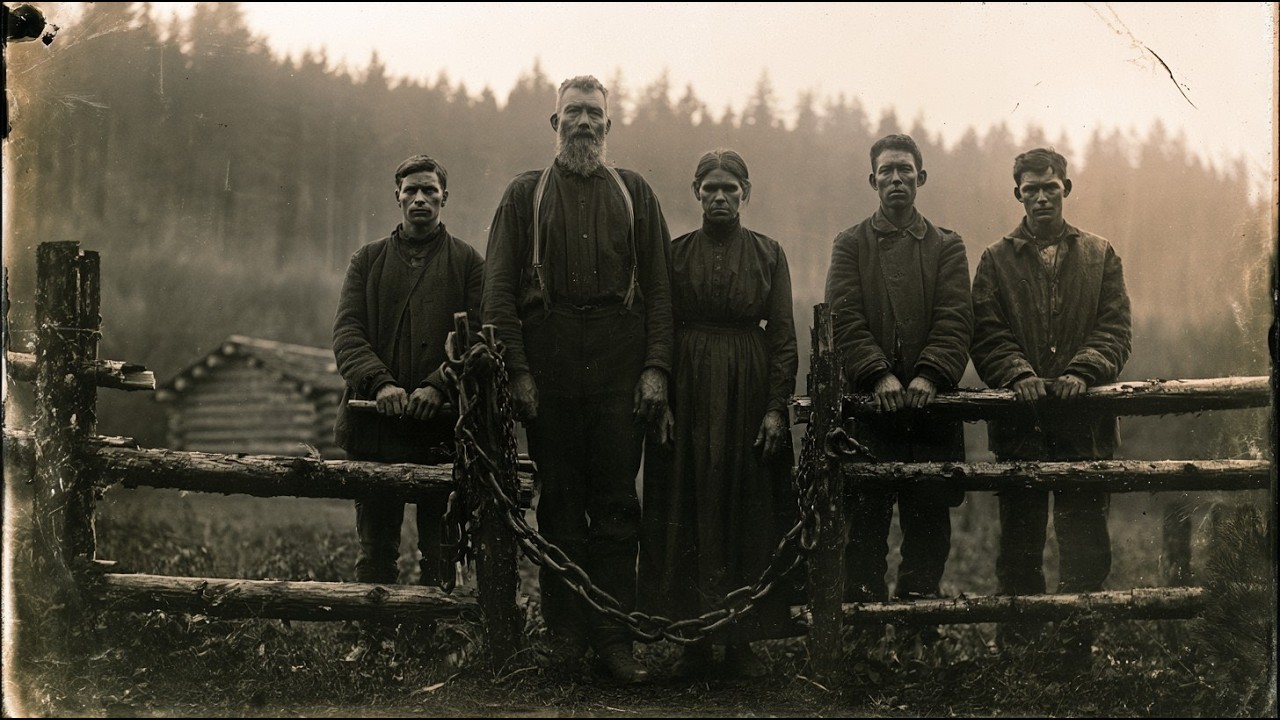
Beneath an oilcloth on the kitchen table, she discovered a file with a note resting on top. The note explained that these were the Ashfall documents, and that should she be uncertain what to do with them, she ought to hand them to the county historical society with the instruction that nothing be published until every Halloran listed in the county record was confirmed deceased. Which, the note continued, had not yet come to pass. For Verity Halloran, niece of Caster, born in 1894 and visible on the property in the 1921 photographs, had never been confirmed dead or alive.
Her final appearance in any record was 1938, and Marshbanks did not regard her as accounted for. The sister delivered the file to the historical society. The society, a modest affair overseen by three retired schoolteachers, placed it in a box and stored the box in a cabinet in the basement of the old library. There it remained for thirty years.
In 1991, a graduate student from the state university, at work on a thesis about the missing of the Pacific Northwest between the wars, drew it out. He read it. He completed his thesis, including a chapter on the Halloran cases. His committee turned it down, not because of the calibre of the research, but because the material was deemed unsuitable for academic work.
He consigned the chapter to a drawer. He is the man from whom the tale of the Hallorans and the Ashfall Woods at last emerged, forty years afterward. The story does not begin with a house, nor with something that drifted among the trees. It begins with a family—one that possessed a name, a fence line, and a grave marker or two in the county records.
The Hallorans dwelled in a valley on the western slope of the Cascades for close to seventy years, and throughout that time, in no record that can be located, did they ever provide a direct answer to any man in uniform. Their valley bore the name Ashfall Woods, taken from the fire of 1868 that blanketed the basin in gray for an entire season, and because nothing grew properly there afterward. The pattern was observed by a clerk. Sylvanus Marshbanks was forty-one in 1893, already half bald, meticulous in correcting the errors of others, and stationed behind the small desk in the records office of Halstead County.
He remained at that same desk until he was seventy-nine. In 1955, one year before the office relocated to the new courthouse and half the old files were consigned to the incinerator, he sat down and undertook something no one had requested of him. He read every case in the county records pertaining to the land west of Winnick Ridge. Every deed, every sheriff’s report, every missing person filing, every marginal notation.
He laid them out on his kitchen table in the sequence they had occurred. He was searching for something. He was not certain what. When he had finished, he possessed a stack of papers the size of a Bible, and he had a single word for it, penciled lightly at the top of the first page.
He wrote “Ashfall.” Beneath it he wrote “Halloran.” Beneath that he wrote a number that appeared in no official record: 23. That number was what he had been seeking.
Not the number itself, but the pattern concealed behind it. For thirty-six years, he had read the Ashfall files one at a time as they crossed his desk and set the questionable ones apart in his mind. Each morning before the office opened, he sat with a cup of coffee that had gone cold on the walk from his house and read a single file. “Do not read for content,” he wrote to a graduate student in a letter that still survives.
“Read for the feeling.” He maintained that if you read county files in that manner long enough, you begin to recognize the ones that do not feel right. The ones whose words are accurate, whose papers are orderly, whose everything is classified as it should be, but which remain, in some way, a lie. He said the Ashfall files were all like that, every last one of them.
By the time he sat down in 1955 to arrange them all, he already knew what he would discover. He merely wished to see the shape of the whole thing. The first name in the pile was Alcott Rein. He was a timber surveyor, thirty-six years old in the summer of 1893, from a mill town three counties to the east.
Broad-shouldered, long-legged, the sort of man who could cover fifteen miles in a working day and eat cold pork for supper without complaint. He was contracted by a Portland lumber company that wanted the standing spruce on the north side of Winnecook examined. Two men from the office rode with him as far as the last store on the wagon road, a place called Elwood’s Corners, then turned back. Rein proceeded alone on foot, carrying a compass, a measuring rod, a bedroll, a week of hard bread, and a Colt he had carried since his army days.
He told Elwood, the storekeeper, that he would return by this same road in nine days. Elwood watched him set off up the trail toward the valley at about ten in the morning on a Tuesday. The sun was bright. There was no wind.
Elwood said the last thing he noticed was that Rein did not turn and wave, which was unlike him. Rein was a friendly man, always waved. Nine days passed, then ten. On the twelfth day, Elwood sent his hired hand on a mule to look for him.
The man covered four miles of trail and reached a place where the trees began to lean strangely over the path, turned around, and came back. He did not want to say why. Elwood went to the county seat and reported to Sheriff Roswell Kirkpatrick, a serious and fair man, who formed a party of six and went up. They went up on the fourteenth day, mid-August, in good weather.
At the four-mile mark, the point where Elwood’s man had turned around a week earlier, the temperature dropped enough that two men had to put their coats back on. The sheriff recorded in his official report that the temperature dropped. He did not record from what or to what. In his private journal, a small brown book, he wrote that the mercury in his pocket thermometer fell from seventy-two to fifty-three over a distance of about a hundred feet of trail, and did not rise for the rest of the day.
He noted that beyond the four-mile point they heard no birds. Not distant birdsong—none whatsoever. He noted that one of his deputies, Cyrus Vanock, a scout in the Modoc campaign and not a man given to worry, got down from his horse without being told, pressed his palm flat against the earth, rose after a moment, and said—in a tone the sheriff described as sheepish—that the ground was warm. Everywhere else was cold.
The trail itself felt warm to the touch. Kirkpatrick never laid his own hand on it. In his private journal he admitted he later regretted that. He admitted he could not say what he had hoped to feel.
The compass turned up first. It lay flat on a mossy stump roughly three miles into the valley, and its needle refused to point to magnetic north. It pointed back along the route they had just traveled. Kirkpatrick took note of it, lifted it, and tucked it into his coat.
Another hundred yards on, they came upon the survey rod propped against a fir, as though a man had rested it there briefly while he stepped away to inspect something. No bedroll. No supplies. No boots, no coat.
They came upon Rein on the fourth day, seated. He was in a small clearing roughly a mile beneath the Halloran fence, his back against a tree trunk, his hands folded in his lap in the manner of a man awaiting someone. He had no boots, no coat, no shirt. His eyes were open.
His mouth was shut. There was not one mark on him that anyone in the party could trace to any cause. No wound, no bruise, no bite—nothing to account for what had stopped him. Kirkpatrick did what a country sheriff does.
He wrote a short report. He wrote that Rein seemed to have sat down to rest and died of exposure or heart failure, and he underlined the word “appeared. ”
He walked the final mile to the Halloran gate—three split cedar rails and a chain—and knocked. The man who came to the gate was Absalom Halloran, sixty-four, thin as a clothes hanger, with a beard that reached the second button of his shirt and hands that had not touched soft work in fifty years.
Behind him, in the doorway of a long, low cabin, a woman stood with her arms folded. Kirkpatrick asked whether the family had seen a large man pass through the valley in the past two weeks. Absalom Halloran said no. Kirkpatrick asked whether any of the Halloran sons had been up on the north slope in the past two weeks.
Absalom Halloran said no. Kirkpatrick asked whether he might look around the property. Absalom Halloran replied, with what the sheriff recorded in his journal as perfect politeness, that the Hallorans did not receive visitors, and he stood at the gate with his hand on the chain until the sheriff and his men turned and left. No one in the party looked at the woman in the doorway.
Kirkpatrick put that in his report as well. He wrote, “We did not look at the woman, and I do not know why. ” Rein’s body was carried out on a mule, buried at Elwood’s Corners beneath a wooden marker, and a letter containing the word “appeared” three times was sent to his widow. The Portland company hired another surveyor and did not send him to the north side.
The file was closed. Fifteen years went by in Ashfall Woods without a single new name entered in the county records. Not because nothing happened, but because nothing happened that anyone reported. Over that span, three itinerant timbermen went up Cold Water Fork in search of work and never returned.
They were the sort of men whose absence no one reported, because no one was waiting for them. A hunter named Ossie Fenwick crawled out of the valley on his hands and knees one January morning in 1898 and could not say his own name for three weeks. Once his speech returned, he moved to Idaho. But before he moved, he sat one night in a Salem inn with a man who wrote for the Statesman, and told him three things the reporter wrote down but the editor refused to print.
First, Fenwick had lost a compass, a knife, and a small canvas pouch holding two dollars on his way up, and found all of them, on his way down, arranged in a line on a flat rock about a quarter mile from where he lost them. Second, on his last night in the valley, he heard a woman singing from a distance in a language he did not know, and the singing did not stop even when he covered his head. Third, he had not entered the valley to hunt at all. He had gone in on a bet.
The bet was to spend one night on the Halloran side of Cold Water Fork and return with a piece of bark from the black spruce nearest the cabin as proof. He had the bark. It was in his pocket when he crawled into Elwood’s Corners. He gave it to the reporter.
The reporter kept it less than a week. He wrote, in a letter Marshbanks pulled from an old bundle of newspaper correspondence in 1954, that the bark went soft in his coat pocket in a way bark does not ordinarily go soft, and that he threw it in the river within the week, and that he was writing not because he wanted anyone to know, but because he was old enough not to want to die with things like that in his desk drawer. A peddler named Robin Brule, who ran a horse-drawn wagon up the stage road once a season selling wire and buttons, stopped going up that road in 1903. When asked why, he said only that he had made his last mistake at the Halloran gate and was lucky to be allowed to leave.
He declined to explain the remark. Marshbanks copied it into his pile and set a small question mark beside it. Then he crossed the question mark out. Between 1894 and 1907, at least four separate parties looked at the timber of the west basin, and every one of them stopped.
A Portland lumber company sent a scout in 1896, who came out the same day, refused to file a report, asked for his pay, and left. Two surveyors from Eugene tried the southern entrance in 1900, and came back on the morning of the second day after one of them, who later gave an interview to a Register-Guard reporter, said he had woken to find his boots pointing the wrong way at the foot of his bed. He did not think he had turned them. The whole camp was facing one direction, he said, and his boots were facing the other.
When asked what he made of it, the surveyor replied that it meant somebody had entered their camp overnight, that whoever it was intended them to realize it, and that they would travel no farther up that road than they already had. In 1902 a federal agent with the General Land Office wrote a letter suggesting a survey of the west basin. The answer arrived from Salem the next week, and Marshbanks described it as the briefest official reply he had ever transcribed. It said, in its entirety: “Don’t.
” It was signed with a name Marshbanks was unable to identify. The second documented case arrived in the summer of 1908, and it loomed larger because it involved four men, a mule, and a contract with the United States government. The men were surveyors. The Cascades were being charted for a proposed forest reserve, and the party advancing from Salem was headed by a man named Ozias Trueblood.
He was forty-nine, a Union Army topographer in his younger days, afterward a professor of applied geography at a small college that no longer existed, brought onto this job because he had built a name for entering hard country and returning with exact field books. His three men were younger: a chainman called Harlow Feder, a surveyor called Anselm Browe, and a cook and packer called Isadore Ganswindt. They departed Elwood’s Corners on the third of July under orders to chart a preliminary route from Winnick Ridge down through the west basin and be back within four weeks. They lasted eleven days.
Trueblood, unlike Rein, put something down every night. His field notebook turned up years afterward, in the twenties, in a box in a Salem barn, found by a nephew going through his uncle’s belongings. The nephew tried to sell it as a curiosity. Nobody wanted it.
It came to Marshbanks in 1954, when a woman named Alma Trueblood-Finn wrote to the county records office asking whether her great-uncle’s disappearance had ever been cleared up. Marshbanks answered that it had not, and inquired, in a postscript, whether she still held any of his papers. She sent him the notebook wrapped in oilcloth, with a note saying she had never read it, because even holding it made her uneasy. The notebook is a peculiar document, since the first six days are precisely what a surveyor’s notebook ought to be.
Bearings, distances, elevations, sketches of drainage, notes on tree species, and not one word about anything out of the ordinary. Then, on the seventh day, at the foot of the page, in the same careful hand but a little larger, a single sentence: “The woman on the bank across the creek stood in the same place from noon until dusk, did not move once, and we did not go to her. ” The following day, the eighth, opens normally, with three ordinary entries. Then comes a drawing.
Not a map drawing, but a face, with a long jaw, dark eyes, and hair reaching the collarbone. Beneath the drawing, Trueblood wrote: “Ganswindt says he woke last night and she was inside the tent looking at the coffee tin. He says she was not there when Feder turned in. The coffee tin was on the ground outside.
This is the fourth night. ” At the bottom of the eighth day’s page there is another note, in different ink, added afterward. It reads: “I have decided not to draw her again. Drawing her seems to bring her closer.
Feder agrees. Ganswindt has stopped speaking to either of us and sits across the fire staring at his hands. He has eaten nothing. ” The ninth day, a single line: “We will move camp two miles east tomorrow.
” The tenth day, a single line: “Feder refuses to take point. ” Then a second entry at the bottom of the tenth day’s page, in a less steady hand: “We did not move camp. We were supposed to move camp. When I ask Feder why we did not move, he says we did.
We moved two miles east, and he is looking at a place I do not know. Ganswindt is not with us today. Feder says Ganswindt left yesterday. I do not remember yesterday.
” The eleventh day, the last entry: “Browe is gone. Bedroll folded. Boots by the fire. No tracks at all.
The packer is packing. We leave at first light. If I am not out of this basin by the twenty-fifth, please tell my wife I loved her, and that I did not leave willingly. ”
There is no twelfth day.
The mule came out by itself on the twentieth of July, walked into Elwood’s Corners with an empty saddle and rope trailing, and stood in front of the store waiting to be watered. Elwood said the mule was calm. He said that was the part that unsettled him. A mule that had been through anything difficult was not calm.
This one was calm. Sheriff Kirkpatrick, the same Kirkpatrick from 1893, older now, gray-bearded, three winters from retirement, went up again. This time he brought twelve men and a warrant. The warrant was thin.
It permitted him to enter the Halloran land on suspicion that the party had crossed it, and to make inquiries. It did not authorize a search. Kirkpatrick understood the difference. A different Halloran met him at the gate this time.
Absalom was dead. The man at the gate was one of the sons, Caster Halloran, forty-two, taller than his father, with the same beard and the same hands. Caster heard the sheriff’s questions with what was later described as the patience of a man listening to a lesson he had heard before. No, no surveyors had crossed the family’s land.
Yes, he knew the government had sent a party, and no, the family had not seen them. Then he said, and Kirkpatrick set it down word for word, because it stayed with him for the rest of his life, that the woods did not always return a man the way he went in, that this was not the family’s doing, and that the sheriff was welcome to search along the creek if it would ease his mind. Kirkpatrick and four men went up the creek. They found a boot print, size ten and a half, with the heel worn on the outside, in soft mud beside a pool.
Anselm Browe, the missing surveyor, wore size ten and a half and walked heavily on the outer edges of his heels. There was no print coming out on the other side of the pool. Kirkpatrick turned back, thanked Caster Halloran, and left. In his private journal, the little brown book he kept for himself and which was found among his effects after his death, he wrote one sentence that Marshbanks copied and underlined: “I looked at the woman in the doorway this time, and I wish I had not.
”
Ozias Trueblood, Harlow Feder, Anselm Browe, and Isadore Ganswindt were never found. The federal government sent another expedition the following spring, larger and armed, and that expedition finished its mission without incident and came out. But it plotted its route on the south side of the Winnick highlands. It did not enter the west basin.
It never set foot in the west basin. On the map issued in 1914, still preserved in the National Archives if you know where to search, a stretch of roughly eleven thousand acres in the west basin of Winnecook is left empty, marked only with the word “Ashfall” in tiny type and no contour lines whatsoever. By 1921, thirteen years after the Trueblood expedition, the world had shifted somewhat. A road now ran to Elwood’s Corners, wide enough for a Model T provided the driver was cautious.
A telephone line connected to the county seat. Kirkpatrick had retired long ago and passed away. The sheriff of Halstead County was a younger man, Merritt Vanderburgh, forty-four, returned from France with a limp and no tolerance for tales of valleys that swallowed men whole. When he read the old file on Ashfall Woods, he wrote in the margin, in fresh ink: “Superstition poorly archived.
Needs review.” He never did review it. There was no time. The person who entered Ashfall Woods in the summer of 1921 was a woman named Ilona Vandegriff.
She was thirty-two, unmarried, a photographer. She had trained in New York and spent five years taking pictures for a magazine that specialized in what she called vanishing country. She had worked in Kentucky, West Virginia, and the Pine Barrens of New Jersey. Now she was working the quiet slope.
She had heard, from a man in a hotel bar in Salem, about a family in the Cascades who lived in a valley that no map showed and received no visitors. That was all she needed to hear. She hired a wagon. She hired a driver.
She loaded her camera, her plates, her tripod, and a box of magnesium flash powder. She arrived at Elwood’s Corners on a Thursday and asked the way to the Halloran place. She was small, five foot two, thin, with hair cut short in a way that was unusual for the time. Her voice was quiet and her jaw was set, and according to the driver, she had a habit of humming to herself when working with her camera, which the driver found soothing in ordinary places and did not find soothing after the four-mile mark.
She had done her homework. In her wagon she had a folder of newspaper clippings about the Trueblood party, copies of two published articles about Alcott Rein, and a hand-drawn map of the road to the Halloran property, bought for two dollars from an old man in a Salem bar who claimed he had driven cattle through the gate in his youth. The map, according to Elwood, who saw it that morning over his counter, was accurate as far as the second gate and stopped there. There was a note on the map in the old man’s hand: “After this point, you are on your own, ma’am.
” Vandegriff had circled the note and written beside it, in her own hand: “Noted.”
This Elwood was a different Elwood by then, the first one’s son, a bigger man, less friendly, and not more helpful. He asked her to sit. He poured her coffee.
He told her, in short sentences, about Rein and about the Trueblood party. He told her he did not know of a woman who had gone up into that valley and come out on her own two feet. He told her the Hallorans did not give interviews, did not have their pictures taken, and did not open their door to people they did not know. He asked her to think about taking her wagon back to Salem.
She thanked him. She drank the coffee. She paid for the coffee. And she left with her driver, up the road, while Elwood watched her go.
Then he did something he had not done in twenty years of running that store. He closed early, at three in the afternoon, drove to the county seat, sat in Sheriff Vanderburgh’s office, and told him where she had gone. Vanderburgh said he would go up in the morning. Elwood said he did not think the morning would be soon enough.
Vanderburgh said, in the firm tone of the new sheriff, that an adult woman with a camera was not a matter requiring county intervention at three in the afternoon. Elwood went home. Ilona Vandegriff was gone six days. What is known of those six days comes from two sources.
The first is her driver, a man named Pharaoh Killett, twenty-six, hired in Salem, who came out of the valley on the third day on foot, without wagon, without horses, without a hat. He reached Elwood’s Corners, sat down on the porch, and did not get up again. When Elwood put a cup of water in his hand, he drank it. When Elwood asked where the lady was, he said, “She is at the house.
” When Elwood asked which house, he said, “The long house.” When Elwood asked where the horses were, he said, “The horses would not go past the second gate.” When Elwood asked why he had come back without her, he said, “She ordered me to. She told me to come back and tell Mr.
Elwood she was fine and would be staying.” He said this in a voice Elwood later described as that of a man reading a prepared lesson. Killett refused food. He refused a bed.
He sat on the porch all night and into the next morning. When the sun came up, he stood, began walking south on the wagon road, and Elwood never saw him again. A body matching his description was found in a ditch outside Eugene four weeks later. Cause of death was recorded as exhaustion.
That was one of the words Marshbanks circled twice in his pile. The second source is a package that arrived at the magazine’s offices in New York on the twenty-second of August, 1921. It was addressed in Ilona Vandegriff’s hand and postmarked from a coastal town she had never visited, as far as anyone could establish. Inside were twenty-three exposed glass plates and a note.
The note, in her hand, said: “Please develop these and keep them for me. I will come for them. Do not open the box until I do.” She never came for them.
After two years, the magazine developed them. There were nineteen usable images. Marshbanks obtained a set of prints in 1951 when the magazine’s archive was cleared out, from an old photo editor who remembered the story and had kept them in a drawer because he did not know what else to do with them. Marshbanks describes them in his notes.
The first plate is the road going up. The second is the gate. The third is the long, low cabin from about a hundred yards away in the flat light of late afternoon. Plates four through nine are exterior shots of the outbuildings: a smokehouse, a woodshed, a spring house, and a small barn with a door partway open.
Plate ten shows a tree stump in a clearing behind the cabin, with something resting on it that Marshbanks admits he could not identify and had no wish to. He describes the object only as roughly the size and shape of a folded coat, dark, throwing a shadow that struck him as wrong for the hour at which the picture was taken. He also observes that the trees behind the stump, ordinary Douglas firs in plates three and four, look in plate ten like some hardwood species he could not name, which is impossible, since trees do not change species between exposures. Marshbanks marked the note with a star and never came back to it.
Plates eleven through fourteen are interior views of the cabin: a plain kitchen, a plain sitting room, a hallway with three doors, and a room containing a made bed. Plate fifteen shows Caster Halloran seated on a chair beside a window, gazing straight into the camera. He was fifty-five by then, with the same beard and the same eyes as his father. Plate sixteen shows a woman Marshbanks could identify from later documents as Delphine Halloran, Caster’s younger sister, forty-eight, standing in a doorway with one hand on the frame.
Plate seventeen shows a room that Marshbanks did not think could be in the cabin, judging by the interior shots that came before it. It has no window. A wooden chair stands at its center and there is nothing else. Marshbanks tried to match plates eleven through fourteen against a rough floor plan of the cabin he had drawn from later Halstead notes, in order to work out where plate seventeen might have been taken from.
The plain kitchen lay front left. The plain sitting room lay front right. The hallway with three doors ran behind the sitting room. The room with the bed was the first door on the right off that hallway.
The remaining two doors opened onto a small pantry and onto the room where Halstead would eventually find the note on the chair. There was no space in the cabin for another windowless room, and no space in a house of that size, on a foundation of that size, for a room that appeared in no entrance. Marshbanks laid the drawing on the desk beside the photograph and studied both for a long while. In the margin of his notes he wrote that the room in plate seventeen was inside the cabin, and that the cabin was not the shape it seemed to be from outside, and that was as far as he was prepared to go.
Plate eighteen shows the same room. The chair has been moved. Plate nineteen shows the same room, the chair moved once more, no one in the frame. Marshbanks’s description ends there.
The magazine covered Vandegriff’s rent for a year, then gave up her apartment. Her family in Ohio was informed. Vanderburgh, the sheriff, went up on his own time in October after the story reached his ears once more. He met Caster Halloran at the gate.
Caster Halloran said that a woman with a camera had come briefly in July, taken a few pictures of the outside of the property, been offered coffee and refused it, and gone back down the road with her driver. Vanderburgh set this down in his report. He underlined it. He wrote no follow-up.
He resigned in 1923 and moved to California, and according to his daughter he refused for the rest of his life to talk about that trip. Which brings us to the last one. The one that ended the family, or at least the one that appears in the file as the last of them, because after 1938 the record goes silent in a way that is different from the earlier silence. The earlier silence was the silence of no one caring.
The later silence is the silence of a door being shut. The man who went up in 1938 was a state game warden named Percival Krober. He was twenty-nine, young for a warden, with the temperament of a man set on building his reputation early or not at all. He was tall, thin-shouldered, wore round glasses, and had a manner that people found irritating in inverse proportion to how well they knew him.
Up close he was patient and calm. At a distance he was a preacher. He had graduated from the state college in Corvallis with a degree in what was then called wildlife conservation, and was assigned to Halstead County in the spring. By the end of the summer he had made himself a small enemy of every timberman and hunter in the district by writing citations for things no one had ever been cited for before.
Someone in a bar at Elwood’s Corners told him about Ashfall Woods. Krober’s official interest was elk. There were quiet reports, from hunters who had come out of the west basin pale-faced and never gone back, that the elk numbers in the Winnecook watershed had collapsed. Not declined.
Not migrated. Collapsed. A whole herd, large, present in 1932, gone by 1937. No carcasses.
No wolf sign. Nothing. Krober wrote to Salem for permission to survey the west basin, and Salem, which had by then forgotten why the west basin was blank on its maps, approved. He went up in September.
He went alone because he was that kind of man. He left a schedule at the county office and a copy with the postmaster at Elwood’s Corners, and told both that if he was not out by the first of October they should call Salem. He carried a rifle, a sidearm, a bedroll, a signal mirror, and a notebook. Two timbermen saw him at the trailhead at seven in the morning on a Wednesday.
He waved. He was in good spirits. He said, “If I am not back by Friday supper, you boys come up and get me.” The timbermen laughed.
They said, “Warden, we would not go up there for you or for the president.” He laughed too. He said, “Well, then I will come down myself.”
He came down on Saturday, not Friday.
Saturday, about four in the afternoon. He was alone. He had lost his rifle. He had lost his sidearm.
He had lost his hat. His notebook was in his coat pocket, and there was blood on the outside of the coat, dried in a pattern a doctor later said was not his blood. He walked into Elwood’s Corners and asked, in a normal voice, for a glass of water. He drank it.
He took a seat on the porch—the very same porch—while Elwood, who had already been out there when he arrived and never once left it for the remainder of the day, observed him doing so. Elwood would later state that Krober asked nothing as he came in, cast no glances around, never inquired whether anyone had been expecting him. Elwood said Krober mounted those porch steps the way a man does after a hundred repetitions, despite never having set foot in the store before that Wednesday. Elwood said the oddest detail of all was Krober’s shadow.
It stretched long, since the sun hung low, but according to Elwood it did not quite match the outline of the man who threw it. Elwood studied that shadow for a whole minute before he could talk himself out of what he was seeing. In the statement he gave two days afterward, he said he was ready to swear on a Bible that the shadow did not belong to Krober, and that he would likewise swear it remained with Krober all through the rest of the afternoon. And that when the sheriff came at dusk, the shadow had vanished, and Krober was casting his ordinary shadow once more.
Elwood could never decide which of those two truths unsettled him worse. Krober wrote in his notebook for roughly twenty minutes, in a small, level hand that a doctor later described—after inspecting the notebook for evidence of trauma or drugs—as steadier than the doctor’s own writing on any normal day. Nobody ever settled how much of what Krober set down that evening on Elwood’s porch was meant for himself and how much for the official record. The notebook survives to this day in the county archive.
There is nothing striking about it. A small black cover, ruled pages. Four pages of writing carry that Saturday’s date. The opening two pages hold dates and coordinates, the sort of thing a warden jots down to remind himself he is a warden.
The third page lists names in Krober’s hand, which Halstead afterward checked off one by one against the county record: Alcott Rein, Ozias Trueblood, Harlow Feder, Anselm Browe, Isadore Ganswindt, Ilona Vandegriff, Pharaoh Killett. Every name from the Ashfall file, in sequence, plus a single added name at the bottom, written in somewhat larger letters: his own. The fourth page holds nothing except a single sentence. That sentence reads: “Do not send the next one alone.
” He underlined it three times. Then he shut the notebook, tucked it into his coat, rose, and asked the storekeeper to summon the sheriff, and to please tell him to bring men. The sheriff at that time was a man named Emery Halstead, forty-eight, sober, grandson of a nephew of the man the county took its name from, which is either chance or the sort of thing counties do to themselves. Halstead arrived that evening with six deputies and a doctor.
Krober had not left the porch. He had not shifted. He was not trembling. When Halstead asked what had taken place, Krober replied, in that same flat tone, that he had passed four days on the Halloran property.
That during those four days he had been shown things he had no words for. That on the fourth night he had woken, walked out on his own, and had not been stopped from leaving. That his professional judgment, as a security officer of the state of Oregon, was that the family ought to be arrested that very night, since there would be no second opportunity. Halstead asked him to name a specific charge.
Krober said—and this is preserved in Halstead’s report—”I cannot give you a specific charge. I can describe the shape of the thing. If you go up now, in the dark, with six armed men, you will find the shape. If you go up in the morning, you will find nothing at all.
That is my professional opinion.” Halstead was a country sheriff. He had six deputies who had already ridden two hours. A light rain was falling.
The road to Ashfall Woods at night, in the rain, was precisely the sort of road a man avoids when he has any choice. Halstead said they would head up at first light. Krober said, quietly, that this was a mistake. He said it once and never said it again.
He slept at the Elwood inn that night, and by Elwood’s account, he slept with the light burning. At first light, Halstead’s party rode up. They found the gate open. As far as anyone could recall, this was the first time in seventy years that the Halloran gate had stood open.
They rode through. They drew near the long, low cabin. The door stood open. The chairs sat in their usual places.
The stove was cold, though it had been used within the past two days. The dishes were stacked and clean. The beds were made. Coats hung from hooks.
Boots rested by the door. There was no one in the house. Halstead dispatched men to inspect the outbuildings. The smokehouse was empty.
The spring house was empty. In the barn, two horses, calm, had been fed and watered that morning. The woodshed was full. No one was anywhere.
Halstead’s report for that morning is dry and methodical, the work of a security officer working through a checklist, yet one entry near the end stands out. He wrote that at about ten in the morning, while his deputies were inspecting the barn, he stood alone on the cabin porch and heard, from somewhere he could not pinpoint, a woman humming. Not singing. Humming.
A tune he did not recognize. He wrote that he called out. He wrote that the humming ceased. He wrote that he waited a full minute, called out again, giving his name and position, and received no answer.
He wrote that when he stepped back inside the cabin, one of the coats hanging by the door had been shifted to the next hook. He was certain of it. He had looked at those coats on his way in. He told none of his deputies.
He kept it out of the county report. He set it down in his private journal, the one that turned up among Marshbanks’s papers thirty years later. Beside it he wrote: “I am 48 years old and I do not want to hear that sound again in my life.”
They combed the place for two days.
They found no recent grave. They found no trace of a struggle. They found, in a locked room at the back of the cabin, whose door they had to force, a room with no windows and a wooden chair. They found nothing whatsoever except the chair, standing in the center of the room, and on its seat, a folded slip of paper.
Halstead unfolded it. On it was a single line, in a hand no one could later identify. It read: “We have gone up.” That was the last of the Halloran family in the county records.
Percival Krober delivered his complete statement in Halstead’s office two days afterward. He wouldn’t permit another soul in the room. Halstead transcribed it himself, placed it in the file, and shut it away. In 1949, upon retiring and relocating to Idaho to stay with his sister, he handed the key to Marshbanks.
According to Marshbanks’s account, he said only this: “Read it if you like. I never did. That was what he wanted to say, and I don’t want to know what he meant by it. If it needs to go somewhere after I’m gone, you decide.”
” Marshbanks read it. He read it a single time, in 1949, at his kitchen table after dark, alone. He never read it again. He didn’t place it in the file when he put together the case papers.
He placed it in a separate envelope, sealed it, and wrote across the front: “Krober Statement, do not open.” He paper-clipped the envelope to the file and left it there. The envelope was still sealed when it turned up among his papers following his death. In his last years, Marshbanks tried to locate Verity Halloran.
He wrote to the death registrars of every county across the western half of the state. He wrote to the Baker City diocese inquiring about baptisms and confirmations. He wrote to the Grange. He wrote to the postmasters of every town within a hundred miles of Winnick Ridge, asking plainly whether they had ever handled mail addressed to Verity Halloran, and if so, when the last piece had been.
The Grange replied. The diocese replied. The registrars replied. Every answer said the same thing: no.
There was no marriage for Verity Halloran to anyone. There was no baptism of any relative in the western half of the state. No hospital admission. No land purchase in her name.
In the 1930 census, a woman named Verity Halloran, thirty-six, occupation housewife, residence the Halloran property in Ashfall Woods. And beyond that, nothing at all. Except one thing. A woman walked into a general store in Bend, Oregon, in the summer of 1952, paid for a sack of flour and a tin of coffee with silver dollars, told the clerk, when he asked, that her name was Halloran and that she was from the Cascades, and left.
The clerk mentioned it to a friend, who mentioned it to a cousin, who mentioned it to Marshbanks in a letter in 1953. Marshbanks put the letter in the file. He wrote in the margin: “Unconfirmed. Not disproven.
That is the last one.”
Ashfall Woods now belongs to the Forest Service. It has since 1962. On current maps, the good ones, the 7.
5-minute quads, there is a section in the west basin of Winnecook that is drawn, but if you look closely, not drawn quite like the country around it. The contour lines look too clean. The streams look too regular. A cartographer asked about it, when the print was put in front of him, said that section had been drawn from a distance without anyone ever setting foot in it, and that the Forest Service has a name for areas surveyed that way: “inferred areas.
” The section is labeled “Ashfall” on the current map, in small letters, and it is not open to the public. There is no trail to it. There is a locked gate on the road that once led to Elwood’s Corners, and Elwood’s Corners itself was removed in 1971, so that now there is only a concrete pad and a wellhead. No one has filed a case from that basin since Krober, but no one goes in, either.
When the four cases were laid out in a single row — Rein in 1893, Trueblood in 1908, Vandegriff in 1921, Krober in 1938 — the intervals between them were fifteen years, then thirteen, then seventeen. No pattern there. But the ages of those who went in: Rein at thirty-six, Trueblood at forty-nine, Vandegriff at thirty-two, Krober at twenty-nine. Decreasing.
Slowly, irregularly, but decreasing. And the number who came out able to speak about it: one, none, none, one. And what those two did with the rest of their lives: Killett walked south until his heart stopped, and Krober gave one statement and never spoke of it again. What was in the Ashfall Woods was not finished.
It was waiting for the next one. The note on the chair in the windowless room said, “We have gone up.” No one knows what “up” meant, or whether the person who wrote it was calling someone or warning someone. Marshbanks thought about that note for a long time and never found an answer.
Verity Halloran, if she was alive when Marshbanks wrote his note, would have been sixty-seven. If she is alive now, she would be older than anyone known to be living in the state. That is not likely. But there is no death record, no marriage record, no census entry after 1930.
Marshbanks wrote, in the margin of the file, in reference to the 1952 sighting: “Unconfirmed. Not disproven. This is the last one.
“
