The dining room at Ralph’s held only ten tables, and every one of them belonged to somebody. On East 114th Street in East Harlem, on the evening of Thursday, November 13th, 1969, the most exclusive Italian restaurant in New York City was doing what it always did: hosting the people who actually ran the city. Reservations were impossible without connections.
The food was excellent, but the real currency was access, recognition, the ability to sit among men who controlled significant portions of the legitimate and illegitimate economy. Mob bosses, politicians, celebrities, people whose power was measured not by how much money they had, but by whether they could get a table at Ralph’s when they wanted one.
At table four, the best table in the restaurant, positioned so that everyone entering had to see who was sitting there, sat Carmine Galante. He was fifty-nine years old, a capo in the Bonanno crime family, a man who had spent decades building power through violence and strategic alliances. He controlled significant heroin distribution operations throughout New York.
He was positioning himself to take over the entire Bonanno family and possibly to become one of the most powerful mob bosses in America. His ambition was matched only by his reputation for brutality and his absolute refusal to show respect to anyone he viewed as inferior. He was dining with three associates, discussing business that required the privacy Ralph’s provided: heroin distribution, territorial disputes, payments that were overdue.
The kind of business that made Galante wealthy and powerful, and that required the kind of connections and organizational capability only established mob families possessed. It could not be built overnight, or through individual ambition alone. It required generations of accumulated power, political connections, and relationships with legitimate businesses that could launder money and provide cover for criminal operations.
At 8:47 p.m., Frank Lucas entered Ralph’s.
He was thirty-nine years old, at the peak of his power as the most successful independent heroin distributor in New York. He had built an empire by importing pure product directly from Southeast Asia and selling it wholesale at prices that undercut the Italian mob’s traditional distribution networks. He had made himself extraordinarily wealthy through methods that bypassed the mob’s control over heroin importation.
His very existence threatened the Italian families’ monopoly over drug distribution. He represented everything that traditional organized crime viewed with suspicion and hostility: an outsider, specifically a black criminal who had achieved success without asking permission, without paying tribute, without acknowledging that the Italian mob controlled who could and couldn’t operate in New York’s drug trade.
Lucas had come to Ralph’s deliberately, intentionally, as a statement. He had obtained a reservation through connections he had built with legitimate businessmen who had access to tables. He had dressed in an expensive suit that announced wealth without being ostentatious.
He had arrived alone, because bringing associates would suggest he needed protection or backup. He wanted to demonstrate that he was confident enough to walk into an Italian mob stronghold without fear, that his power was sufficient, that he didn’t need to worry about being attacked in a restaurant full of witnesses.
Lucas knew that Carmine Galante would be at Ralph’s that Thursday evening. Everyone who followed mob activities knew that Galante dined there every Thursday at table four. It was his routine, his statement about his status and his power.
Lucas had chosen to come to Ralph’s specifically because Galante would be there. He wanted to make it clear that he wasn’t intimidated by the Italian mob, that he belonged in spaces they considered their exclusive territory, that being black and being independent didn’t mean he had to hide, or to limit himself to Harlem, or to accept that certain restaurants and certain establishments were off limits to criminals who hadn’t been born into Italian families.
The owner showed Lucas to his table. He recognized him. He understood that Lucas’s presence would create tension, but he also understood that refusing to seat a legitimate customer with a reservation would be bad business, and would potentially create problems with the people who had facilitated Lucas’s access.
Lucas sat at table seven, positioned so he could see Galante and Galante could see him. He made no attempt to hide his presence, or to pretend he hadn’t noticed that the most powerful Italian mobster in the restaurant was sitting fifteen feet away.
The atmosphere in Ralph’s changed immediately. Conversations at other tables stopped or lowered to whispers. People glanced between Lucas and Galante, understanding that these two men represented competing power structures in New York’s drug trade.
Lucas’s presence in Galante’s territory was either extraordinarily brave or extraordinarily stupid. Something significant was about to happen, because men like Galante didn’t tolerate challenges to their authority without response.
Galante noticed Lucas immediately. He recognized him despite having never met him personally. He understood that Lucas’s presence at Ralph’s was deliberate provocation, designed to demonstrate that Lucas didn’t respect the boundaries that traditionally separated Italian mob operations from independent black criminal enterprises.
Galante’s face flushed red with anger, with indignation that this outsider, this black drug dealer who had built his operation without Italian permission, would dare to enter Ralph’s on a Thursday evening when Galante was dining, would dare to sit at a table as if he belonged there, as if he was equal to the Italian mobsters who had controlled New York’s organized crime for generations.
Galante stood up from his table. His movement was sudden enough that his associates immediately tensed, understanding that their boss was about to do something, that the evening was about to become complicated in ways that might require violence, or at least aggressive confrontation.
Galante walked across the restaurant toward Lucas’s table. His body language was aggressive and confrontational. This wasn’t going to be a friendly greeting or a respectful acknowledgement of a fellow criminal.
It was going to be a public assertion of dominance, a statement about hierarchy and power, about who really controlled New York’s drug trade.
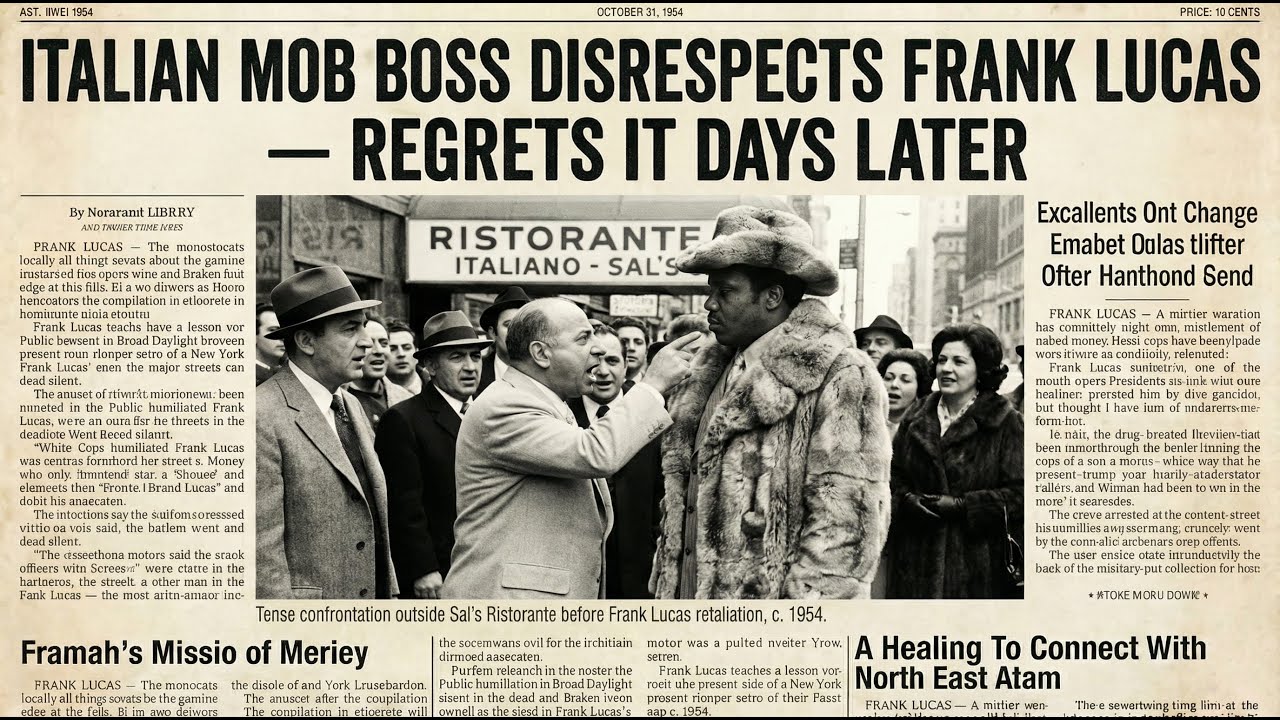
Galante reached Lucas’s table and didn’t wait for invitation or acknowledgement. He simply began speaking, his voice loud enough that everyone in the restaurant could hear. This was clearly intended as public theater, designed to humiliate Lucas in front of witnesses, to establish that despite Lucas’s wealth and success, he remained subordinate to the Italian mob, remained an outsider who existed only with their tolerance.
“Frank Lucas,” Galante said, his voice carrying contempt that was almost palpable. “Look at this. The famous Frank Lucas, the black drug dealer who thinks he’s a real gangster, sitting in Ralph’s like he belongs here, like this is his restaurant, like he’s somebody important enough to dine where real organized crime does business.
You’ve got some nerve coming here. You’ve got some nerve thinking you can just walk into our places, sit at our tables, act like you’re our equal.”
The restaurant went completely silent. Even the kitchen staff stopped making noise. Everyone present understood that Carmine Galante was publicly humiliating Frank Lucas, was asserting mob dominance in ways that couldn’t be ignored or dismissed, was creating a situation that would require response.
Not responding would mean accepting degradation that no one with power could tolerate without losing that power.
Lucas didn’t stand up. He didn’t react visibly to the insult. He simply looked up at Galante with eyes that showed no emotion, no fear, no anger, just cold calculation about whether this moment required immediate violence, or whether it would be better handled through methods that were more strategic and more devastating than anything that could be accomplished by attacking Galante in a crowded restaurant full of mob associates who would immediately retaliate.
Galante, interpreting Lucas’s silence as weakness or fear, continued his public humiliation.
“You know what you are, Lucas? You’re a nigger who got lucky. You found a way to import heroin that bypassed our suppliers.
Good for you. Very clever. But you’re still just a nigger playing at being a gangster.
You’re still someone who operates only because we haven’t decided yet whether killing you would be worth the trouble. You don’t belong at Ralph’s. You don’t belong in our world.
You belong in Harlem running your little operation until we decide to take it over or shut it down.”
Galante leaned down closer to Lucas, his voice dropping but still audible to nearby tables.
“Here’s what’s going to happen. You’re going to finish your meal quickly and quietly. You’re going to leave Ralph’s and never come back unless I personally invite you, which will never happen.
And starting next week, you’re going to pay tribute to the Bonanno family. Twenty percent of your gross revenue from heroin sales. That’s the price for operating in our city without permission.
That’s what you owe for thinking you could build an independent operation without acknowledging that the Italian mob controls who can and can’t distribute drugs in New York.”
The silence in Ralph’s was absolute. Everyone was watching Lucas, waiting to see how he would respond to this public humiliation, to these demands that he pay tribute and stay out of Italian establishments, to this use of racial slurs and explicit statements that Lucas was inferior because of his race and his lack of connection to Italian organized crime.
Lucas took a sip of his wine, set the glass down carefully, and looked at Galante with an expression that made several witnesses later describe feeling frightened despite being outside the conflict, despite not being targets of whatever Lucas was planning.
“Mr. Galante,” Lucas said, his voice quiet and controlled, showing no emotion except perhaps a cold amusement that suggested he found this entire confrontation more interesting than threatening. “You just made several mistakes.
First, you used that word to describe me in front of all these witnesses. Second, you demanded that I pay tribute to your family despite the fact that I’ve built my operation independently without using your suppliers or your distribution networks. Third, you threatened to shut down my business as if you have the capability to do that without consequences.
And fourth, you did all of this publicly in front of dozens of people, which means there’s no way for either of us to back down without looking weak.”
Lucas continued. His voice was still quiet, but now it carried something that made Galante’s associates move their hands toward weapons, made other patrons in the restaurant understand that they were witnessing something dangerous.

“I’m going to finish my meal. I’m going to leave Ralph’s when I’m ready, not when you tell me to leave. And I’m not going to pay one dollar in tribute to the Bonanno family or to any other Italian family.
I built my operation independently. I import my product from sources you don’t control. I distribute through networks you can’t access.
And I’m going to continue doing exactly what I’ve been doing regardless of whether you approve or not.”
Lucas stood up, still moving slowly and deliberately, positioning himself so that he and Galante were face to face, so that everyone in the restaurant could see that Lucas wasn’t backing down, wasn’t showing fear, wasn’t accepting Galante’s assertion of dominance.
“But here’s what I am going to do, Mr. Galante. I’m going to remember this conversation.
I’m going to remember that you called me that word in front of all these people. I’m going to remember that you demanded tribute and threatened my operation. And I’m going to respond to your disrespect in ways that will make you regret every word you just said.
You want to know what happens when Italian mobsters forget that black criminals can be just as ruthless and just as powerful as any traditional organized crime family? You’re about to find out.”
Lucas walked past Galante toward the exit, leaving money on his table to cover his bill. He moved through the silent restaurant where everyone watched him leave, where everyone understood that this confrontation wasn’t over, but was instead just beginning. Galante’s public humiliation of Lucas would require response that would reshape power dynamics between the Italian mob and independent black criminals in ways that would affect New York’s drug trade for years.
The next morning, Friday, November 14th, 1969, Carmine Galante received a message at his social club in Little Italy. The message was delivered by a young man who walked into the club, handed an envelope to Galante’s bodyguard, and left before anyone could question him.
The envelope contained a single sheet of paper with typed text.
“You demanded tribute. You threatened my operation. You used language that can’t be forgiven.
You have 7 days to close every heroin operation the Bonanno family controls in Harlem. After 7 days, your people start dying. Not arrested, not beaten, dead.
You disrespected Frank Lucas in public. Now you pay the price.”
Galante showed the message to his associates. He laughed at it. He called it an empty threat from a criminal who didn’t understand how real organized crime worked, who didn’t comprehend that the Italian mob had survived for generations by destroying anyone who challenged their authority, who didn’t realize that making threats against a capo in a major crime family would trigger massive retaliation, that Lucas couldn’t possibly survive.
But Galante also took precautions. He increased security for his key heroin distributors in Harlem. He ordered his people to be vigilant, to watch for any signs that Lucas was planning attacks, to be ready to respond with immediate violence if Lucas’s organization made any moves against Bonanno operations.
Galante believed he had prepared adequately, believed that his organization’s size and resources and connections would be sufficient to protect his people and to retaliate overwhelmingly if Lucas was stupid enough to follow through on his threats.
Monday morning, November 17th, 1969, three days after the Ralph’s confrontation, the first body was discovered.
Vincent “Vinnie” Russo, a Bonanno family associate who ran heroin distribution in East Harlem, was found in an alley behind his social club, shot twice in the head execution style. He had been killed with professional precision that suggested Lucas’s people had tracked Russo’s movements, had identified when he was vulnerable, had executed him without witnesses or evidence that could lead to arrests.
A note was pinned to Russo’s body.
“One down, six to go. Carmine Galante disrespected Frank Lucas at Ralph’s. This is the cost.”
Tuesday brought another death. Anthony “Tony” Benedetto, who collected heroin proceeds from dealers throughout Harlem, was found in his car in the Bronx, shot multiple times, killed in what appeared to be an ambush that had been carefully planned. It demonstrated that Lucas’s organization had intelligence about Bonanno operations that shouldn’t have been available to outsiders.
Wednesday, Michael “Mikey” Costello was dead. Thursday, James Romano was dead. Friday, Peter “Pete” Lombardi was dead.
Saturday, Thomas “Tommy” D’Angelo was dead. Sunday, Robert “Bobby” Marques was dead.
Seven Bonanno family associates dead in seven days. All of them involved in heroin distribution in Harlem. All of them killed with professional precision.
All of them found with notes that explicitly connected their deaths to Carmine Galante’s public humiliation of Frank Lucas. These weren’t random killings or territorial disputes. They were systematic retaliation for specific disrespect shown at Ralph’s restaurant.
The response shocked New York’s organized crime community. The Italian mob had faced challenges before, had dealt with competitors and with territorial disputes, but they had never experienced this kind of systematic targeting, this kind of professional military-style elimination of key personnel, this kind of message that made it clear that disrespecting Frank Lucas carried costs that exceeded anything the Italian families were willing to pay.
Carmine Galante tried to respond. He ordered hits on Lucas’s known associates. He sent people to attack Lucas’s distribution networks.
He attempted to use mob influence with police to get Lucas arrested.
But Lucas had disappeared. He had gone into hiding immediately after leaving Ralph’s, had continued running his operations through intermediaries while remaining personally unreachable. Galante’s organization struggled to find targets for retaliation, because Lucas had compartmentalized his operations so effectively that even killing his known associates didn’t disrupt his ability to continue importing and distributing heroin.
By Sunday, November 23rd, 1969, ten days after the Ralph’s confrontation, the Bonanno family’s heroin operations in Harlem had effectively collapsed. Seven key people were dead. Other associates had gone into hiding or had quit rather than risk being next on Lucas’s list.
Distribution networks that had taken years to build had been destroyed in ten days, because Frank Lucas had demonstrated that he could systematically eliminate anyone involved in mob operations in Harlem without being caught or stopped.
Carmine Galante, facing pressure from other mob families who were watching this situation carefully, facing questions from his superiors about why he had provoked Lucas in ways that had led to massive losses, facing the reality that continuing this conflict would result in more deaths and more disruption, made a decision that was humiliating but necessary.
He ordered the complete withdrawal of Bonanno family heroin operations from Harlem. He abandoned territory they had controlled for decades. He accepted that Frank Lucas had won this confrontation through superior violence and superior organizational capability.
A message was sent to Lucas through intermediaries. The Bonanno family was withdrawing from Harlem. No tribute would be demanded.
No further attacks would be made on Lucas’s operations. The mob acknowledged that Lucas’s independence would be respected, and that Italian families would not attempt to force him to pay for the right to operate in New York.
Lucas emerged from hiding. He resumed his normal operations. He made it clear to everyone in New York’s underworld that the seven deaths in seven days had been a message.
Disrespecting Frank Lucas in public, using racial slurs, demanding tribute from someone who had built his operation independently — all of that carried consequences that even powerful Italian mob families couldn’t afford to pay.
For Carmine Galante personally, the incident was devastating. He had lost seven associates. He had been forced to abandon territory.
He had been humiliated in front of other mob families who viewed the Bonanno withdrawal from Harlem as evidence that Galante wasn’t capable of handling challenges from independent black criminals. Galante’s reputation never fully recovered. His ambitions to take over the Bonanno family and to become one of New York’s most powerful mob bosses were undermined by the perception that he had started a war with Frank Lucas and had lost decisively.
The broader significance of the November 1969 confrontation was that it demonstrated the limits of traditional mob power when confronting independent criminals who had built operations outside the usual structures. The Italian mob had controlled heroin distribution in New York for decades through connections, through political influence, through violence that was supposed to deter challenges. But Lucas had proven that intelligence and strategic thinking and willingness to use systematic violence could overcome traditional advantages.
Being outside the mob structure was actually an advantage, because it meant Lucas could act without the bureaucratic constraints and the political considerations that limited what Italian families could do.
Thursday evening, November 13th, 1969, at Ralph’s restaurant on East 114th Street, Carmine Galante made the catastrophic decision to publicly humiliate Frank Lucas, to use racial slurs, to demand tribute, to threaten Lucas’s operations in front of dozens of witnesses. The confrontation lasted perhaps five minutes. It triggered seven days of systematic killings that destroyed Bonanno family heroin operations in Harlem, and forced the Italian mob to acknowledge that Frank Lucas’s independence would be respected, because the alternative — continuing the war — would cost more than any mob family was willing to pay.
The insult that cost an empire. The racial slurs that triggered systematic retaliation. The demand for tribute that resulted in seven deaths and complete withdrawal from territory the mob had controlled for decades.
In November 1969, Carmine Galante learned too late that Frank Lucas wasn’t someone who could be publicly humiliated without consequences, that black criminals who had built independent operations were just as capable of violence and just as willing to use it as any Italian mob family, that disrespect carried costs that exceeded any benefits that might come from asserting traditional mob dominance. The night at Ralph’s, when pride met ruthlessness and lost everything in seven days of systematic violence, changed power dynamics in New York’s drug trade forever.
