On a November morning in 1985, a hunter walking through woods outside Allenstown, New Hampshire, found an oil drum sealed shut and buried beneath the leaves. Inside were the remains of a woman with brown hair, between 30 and 40 years old, and a young girl between 6 and 11. They had been placed inside the barrel together and left there, hidden with a care that suggested someone believed they could erase a human being completely. Allenstown was the kind of small town that felt safe.
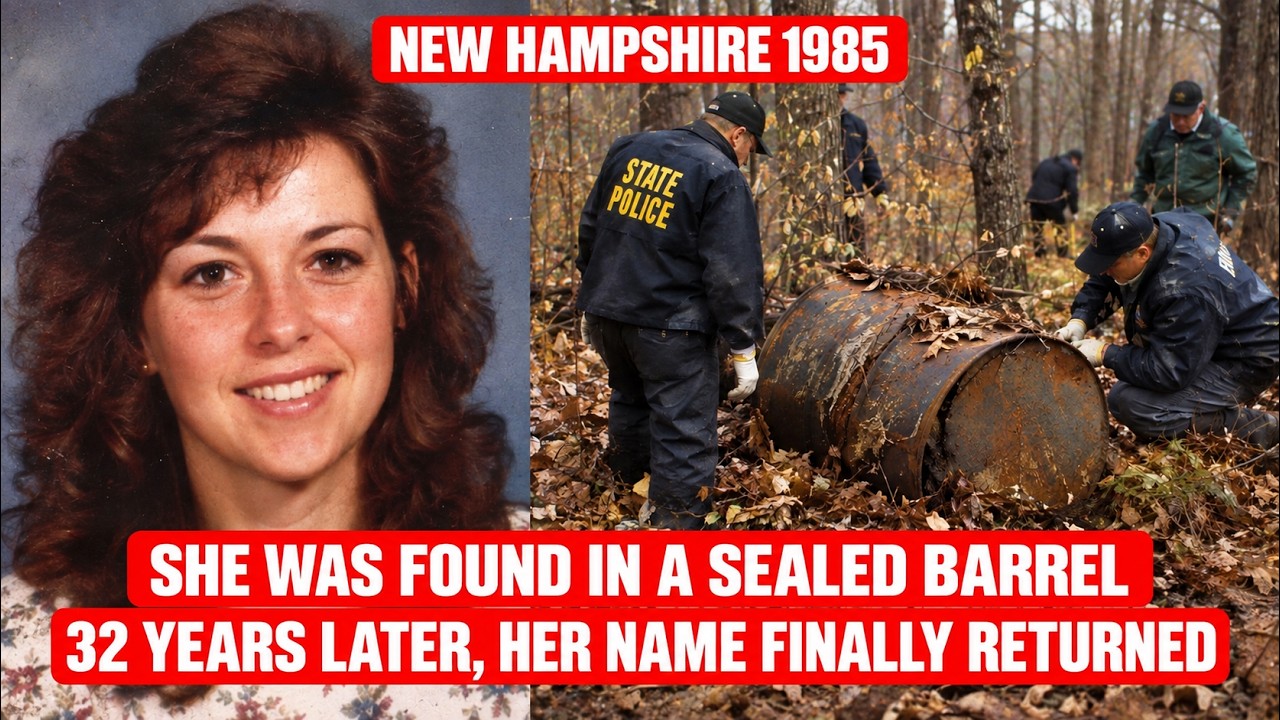
Bear Brook State Park stretched across more than 10,000 acres of rolling forest just south of Concord, the kind of place where most people stayed on marked trails. The idea that something monstrous could be waiting in those trees seemed impossible to residents. But Sergeant Russell Lamson of the New Hampshire State Police drove out to the site on November 10, 1985, and understood immediately that this was not an accident. Someone had wanted these two people to disappear.
What investigators could establish was limited by the forensic tools of the era. The woman was likely from outside New Hampshire. She had borne children. She had lived a life that had taken her far from whatever community she came from.
There was no identification, no matching missing persons report, no fingerprint or dental record on file. The system built to find the missing had no record that either of them had ever existed. They were listed in state police files as Jane Doe, the woman and the child both. The case generated hundreds of leads that produced nothing.
Lamson coordinated with the FBI. He cross-referenced missing persons reports across the northeastern United States. He circulated facial reconstructions to law enforcement in eleven states. Every lead stalled.
Every potential identification failed. Then in May 1988, a man walking in the same area found a second barrel. Inside were two more victims: another young girl, estimated between two and four years old, and an infant. Four victims total, transported to this forest and sealed inside drums by someone who acted with a confidence that suggested he believed he would never be found.
The discovery changed the case entirely. This was not an isolated act. This was a pattern. Someone had made two separate trips, years apart, to the same stretch of woods.
Detective John Cody took over coordination of the cold case in the mid-1990s. He had worked major crimes for the New Hampshire State Police for more than fifteen years and had seen cases go cold before. What he had not seen was a case that had stayed this cold for this long. He pulled the files, reviewed every lead, visited the site, stood in the trees where the barrels had been found, and made a private decision to stay with the case until it broke open.
The investigation ran on two tracks: officially, detectives matched physical descriptions against unsolved missing persons cases nationwide; unofficially, they relied on tips from hunters, hikers, and local residents whenever the story was revisited in the press. Leads came in. They were investigated. They led nowhere.
The most frustrating aspect, one investigator later noted, was not the absence of evidence but the nature of it. They had four victims. They had physical evidence. They had biological material preserved across decades.
What they did not have was a name. And without a name, everything else was unreachable. The community of Allenstown held vigils. Churches organized prayer services.
Park service members placed markers near the discovery site. People in that town felt the weight of what had been left in their woods and did not want it forgotten. But the case file stayed open and went nowhere. By 2000, fifteen years had passed.
Facial reconstructions had been updated twice. The case had been featured on America’s Most Wanted. A reward had been offered and later doubled. None of it produced a breakthrough.
By 2007, twenty-two years had passed. The hunter who found the first barrel had died. The first detective assigned to the case had retired. The infant found in the second barrel would have been in her twenties had she lived.
Cody kept the file in a cabinet in his office. He was one of the few people who still worked the case actively, and the work looked less like investigation and more like an act of faith. He believed science was moving faster than the law could track. He believed the biological evidence in that evidence locker could tell them more than the technology of earlier decades could read.
He kept waiting for that technology to catch up. In 2017, it did. Genetic genealogy had been transforming forensic investigation since the early 2010s. The process worked by uploading biological material from an unidentified person to a public ancestry database, identifying distant relatives through shared DNA segments, and building out a family tree until investigators arrived at a candidate who fit the known facts of the case.
It was painstaking work, requiring weeks of genealogical research alongside forensic analysis, but it could do what no other technology could. It could give a nameless person back their name. Colleen Fitzpatrick, a genetic genealogist hired by the New Hampshire Attorney General’s office, had been cross-referencing a genealogy database against the Bear Brook DNA profile for several months when she found what she was looking for. A name kept appearing.
A pattern pointed to a specific region and a specific family. She called Cody. He had learned not to get ahead of the evidence. He listened, was quiet for a long moment, and said, Let’s verify it.
Verification took months. At the end of the process, investigators had something they had not had in 32 years: a name. The woman was identified as Marlyse Elizabeth Honeychurch. She had been born in 1953 in Hardwick, Vermont.
She had grown up, married, and moved around the Northeast with her husband, Terry Rasmussen, a man who appeared unremarkable to everyone who encountered him. He blended into any community he moved through, left behind few records and fewer lasting impressions. He worked manual jobs. He relocated frequently.
He kept his life as simple and undocumented as possible. The three children found with Marlyse were her daughters. Their identities were confirmed through the same genetic genealogy work. Maria Elizabeth Vaughn, around six years old.
Sarah McWaters, around two. And an infant, the youngest daughter. Four members of one family, a mother and her three children. Terry Rasmussen had been their last known contact, and investigators determined through an expanding web of records and DNA evidence that he had been responsible for their deaths.
The Bear Brook case had always been a New Hampshire case. What the investigation also revealed was that Rasmussen was the primary suspect in the death of a woman in California, a case opened in 1984, the year before Bear Brook. Her name was Denise Beaudin. She had disappeared with her young daughter, and that daughter, the only surviving child, had been raised by Rasmussen under a false name.
She was located alive and healthy in her forties, having spent most of her life not knowing where she came from. The forensic net closed around Rasmussen’s name from multiple directions. DNA confirmed his biological connection to multiple victims. Records confirmed his presence in both New Hampshire and California during the relevant periods.
The pattern of his movements, his relationships, his method, all pointed in the same direction. But Terry Rasmussen could not be arrested. He had died in 2010 in a California prison, serving time for an unrelated crime. He had never been charged with a single death connected to Bear Brook.
He had spent more than two decades free, lived an ordinary life in plain sight, and died without ever being held accountable for what he had done in those woods. The Allenstown community gathered outside the park. Local officials held a press conference. The pastor at the First Congregational Church rang the bell four times, once for each victim.
People stood in the cold New Hampshire air feeling something complicated: relief that the names had finally been found, and grief that justice in the form most people recognize, a trial, a sentence, a verdict, could never come. Marlyse Elizabeth Honeychurch was remembered by distant relatives who had not known she was gone. She was described as a quiet woman who loved her daughters, who had found herself in a relationship that became dangerous in ways that were, in the 1980s, very hard to escape. She has a grave marker now in a cemetery in New Hampshire with her name on it.
Her daughters are buried beside her. Her surviving niece, who had known nothing about Marlyse’s fate for decades, told a reporter she felt as though someone had been carrying a very heavy thing for a very long time and had finally been allowed to set it down. We didn’t know she was missing, she said. We just knew she was gone.
Cody attended the identification announcement. Asked afterward how it felt, he said the feeling was less like relief and more like something being returned to its rightful place. Marlyse Honeychurch had a name. Her daughters had names.
That, he said, was what the case had always been about. The Bear Brook case permanently changed how law enforcement approached the identification of unidentified remains. Genetic genealogy, experimental and controversial in 2017, became a standard forensic tool in the years that followed, used to solve cold cases across the United States. The work done by Fitzpatrick and the investigators who collaborated with her created a template applied to dozens of other Jane Doe and John Doe cases, people who had been sealed in an evidence locker of time, waiting for science to find them.
Terry Rasmussen lived for 25 years after the last barrel was buried. He used those years. He moved freely. He committed at least one more crime that landed him in prison for reasons entirely unrelated to New Hampshire.
And yet the evidence he left behind, biological, chemical, molecular, survived him. It did not expire. It did not give up. It waited, sealed in that evidence locker, for the world to build the tools capable of reading it.
Truth in this case was more patient than the man who tried to bury it.
