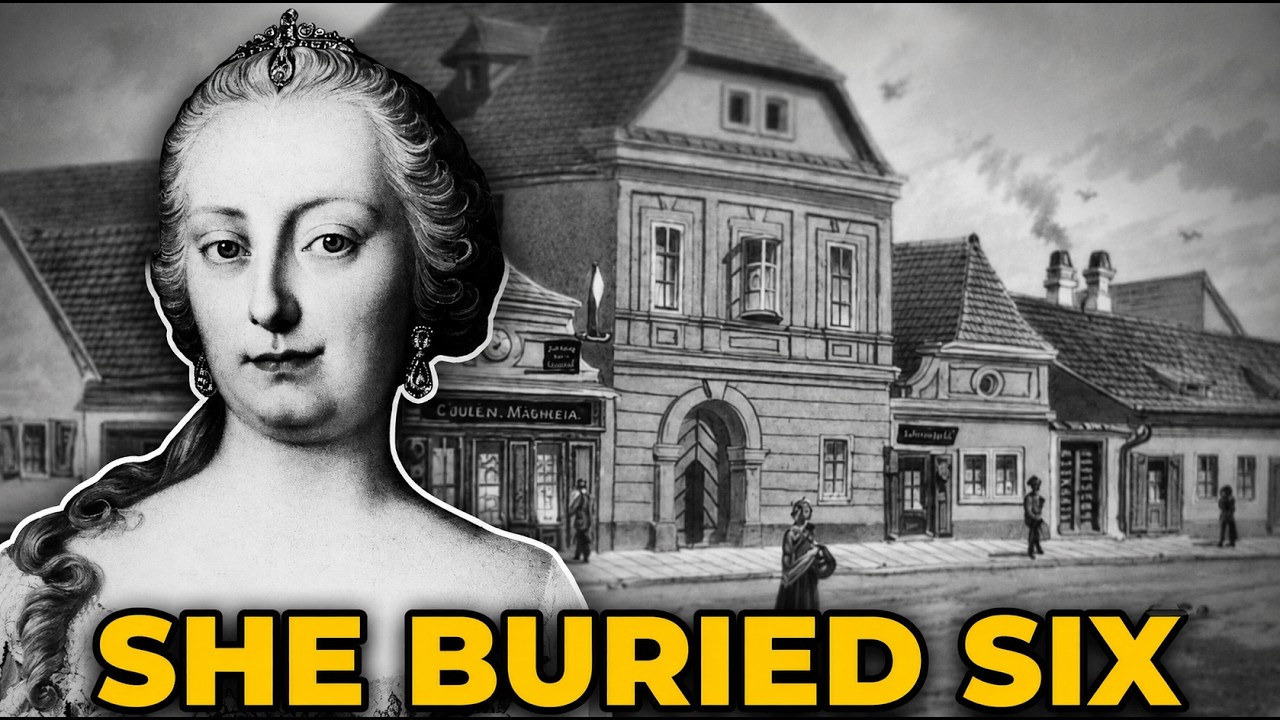
Maria Theresa of Austria reached the nadir of her power in October 1740. Twenty-three years old, seven months pregnant, and almost entirely untrained in statecraft, she inherited an empire on the brink of collapse. Her father, Charles VI, had died after eating a dish of poisonous mushrooms while hunting in Hungary, leaving his daughter a patchwork of territories stretching from the Alps to the edges of Poland. The treasury was empty, the army demoralized and barely one hundred thousand men strong, and a continent of rivals stood ready to dismantle what the Habsburgs had spent centuries building.
Within weeks, Frederick the Great of Prussia invaded the mineral-rich province of Silesia. Bavaria, France, and Spain lined up against her. Only Britain and the Dutch Republic stood uneasily beside her. For eight years, Maria Theresa fought not merely to hold territory but to prove that a woman could occupy the throne at all.
She won that argument, if not the war outright. The Treaty of Aix-la-Chapelle in 1748 formally recognized her right to rule. Silesia was lost for good, but everything else remained hers, and she had accomplished it while pregnant or newly delivered for nearly the entire conflict. She had been born in 1717 at the Hofburg Palace in Vienna, a disappointment from the first moment.
Her father had already lost an infant son, and the entire machinery of the Habsburg court had spent years waiting for a male heir. Instead, they received a girl. She was raised among Jesuit tutors who taught her Latin, rhetoric, history, and the etiquette of a baroque court. Deliberately absent from her education was any instruction in how to govern.
Her father passed the Pragmatic Sanction in 1713, quietly rewriting the rules of succession so his territories could pass to a daughter, but he never actually prepared that daughter to rule them. At fourteen, she was permitted to sit in the room during meetings of his government council. She was allowed to listen. She was never once asked her opinion.
The marriage that would define her life came early. Francis Stephen, Duke of Lorraine, had been groomed for years as a possible match. Something genuine grew between them. They were betrothed in January 1736 and married two weeks later.
Together, they produced sixteen children over the following decades. And together, they would bury six of them. The first loss came in the summer of 1740, while the family was traveling through southern Austria. Three-year-old Maria Elisabeth, nicknamed Liesl and doted on by her grandfather the Emperor, was suddenly gripped by stomach cramps and violent vomiting.
Her mother, pregnant again, was reportedly too distraught to remain in the room and was led away. Her father stayed. At nine that night, the child sat upright, looked directly at Francis, and said in a clear voice that she commended herself to God. Then she fell back into his arms and died.
She was buried in the Imperial Crypt beneath the Capuchin Church in Vienna, the beginning of what would become, over the following decades, a small, crowded row of children’s coffins. More would follow. The 1760s brought the losses that would define the family’s private mythology. In January 1761, fifteen-year-old Charles Joseph died of smallpox at Schönbrunn Palace.
The following December, his twelve-year-old sister Maria Johanna died of the same disease, despite having been inoculated against it, one of a small minority for whom the primitive inoculation itself triggered a fatal case. Then, in October 1767, sixteen-year-old Maria Josepha, engaged to the King of Naples and Sicily, contracted smallpox and died as well. A popular story circulated afterward that the young Archduchess had fallen ill after her mother sent her to pray at the tomb of her recently deceased sister-in-law, whose casket, according to the rumor, had not been properly sealed. Whether the story is literally true or court folklore assembled after the fact, no one at the time could say for certain.
Four of Maria Theresa’s children were now dead of the same disease. That same year, the disease nearly took the Empress herself. She contracted smallpox while comforting her dying daughter-in-law, and for roughly a week her survival was genuinely in doubt. The entire city of Vienna filled its churches with prayers.
She survived, though visibly scarred, and returned to public life in July with a Thanksgiving service at St. Stephen’s Cathedral. The public response to these losses was choreographed grief: court mourning, masses, the careful continuation of state business. The private response, based on the letters that survived, was closer to dread.
Maria Theresa understood smallpox not as an occasional misfortune but as a stalking, patient threat inside her own household. There was another private wound that ran alongside the deaths. Her husband, Francis, had long since built a second life parallel to his public one. By the mid-1750s, when a seventeen-year-old maid of honor named Countess Maria Wilhelmina von Neipperg arrived at court, Francis, then in his late forties, began an affair with her that would last for years.
It was not especially hidden. Foreign ambassadors wrote about it in their dispatches home, treating it almost as routine court gossip. Everyone at Schönbrunn seemed to know. The Empress, by most accounts, knew as well.
Maria Theresa did not respond with confrontation. She responded with control over almost everything else. She founded the Chastity Commission in 1752, a body devoted to policing sexual morality across her territories, prosecuting adultery, monitoring supposed libertine social clubs in Vienna, and imposing fines and public punishments on ordinary subjects for exactly the kind of behavior her own husband practiced under her roof. There is no surviving document in which she explains this contradiction.
Historians can only note the timing. The marriage that each of her eleven surviving daughters would be sent out into Europe to imitate was privately already broken. She adored Francis with an intensity that bordered on possessiveness. He, for his part, never gave anyone reason to believe he had married for anything other than the obvious dynastic advantage.
On the 18th of August 1765, Francis Stephen collapsed and died in an anteroom of the palace at Innsbruck, returning from the theater after suffering what appears to have been a fatal seizure the previous day. He was fifty-six years old. What followed was not choreographed mourning. It was total.
Maria Theresa cut her hair short. She had every room in her private apartments painted black. She wore only mourning dress for the remaining fifteen years of her life. She wrote to a friend that she no longer knew herself, that she had become like an animal without spirit or reason.
Every August for the rest of her reign, she withdrew entirely from public life for the full month. Every eighteenth day of every month, the anniversary of Francis’s death, she spent alone. Her household knew not to disturb her. She kept working through all of it.
She continued to review state papers, correspond with her scattered, married-off children across the courts of Europe, and manage in exhausting detail the smallest particulars of lives she could no longer actually reach. Her eldest son, Joseph, became her official co-regent that same year, and the fifteen years that followed were marked by escalating, often bitter disagreement between mother and son over the direction of the empire. Among her daughters, the costs of her dynastic ambitions were unevenly distributed. Maria Anna, weakened from childhood illness and a spinal deformity, received almost none of the physical affection her healthier siblings enjoyed and found her only real intellectual companionship with her father, conducting chemistry and physics experiments alongside him.
She turned down a prestigious position as Abbess of a royal convent in Prague, choosing instead a small unfashionable convent in Klagenfurt, where she spent the rest of her life assembling mineral and insect collections, participating in archaeological digs, and corresponding with scientists across Europe. Her sister, the second Maria Elisabeth, considered the great beauty of the family, contracted smallpox just as serious negotiations opened with the elderly widowed King Louis XV of France. She survived. Her face did not.
Considered permanently unmarriageable at twenty-four, she too became an abbess, in Innsbruck, living far less like a nun and far more like a wealthy, witty noblewoman who had simply relocated her social calendar. Maria Amalia, married off in 1769 against her wishes to Duke Ferdinand of Parma, never forgave the arrangement. Once installed, she quickly outmaneuvered the French ministers who had been running the Duchy, replaced them with a cabinet loyal only to her, and dismissed most of her ladies in waiting in favor of an entourage of young men, several of whom became her lovers. She dressed as a man to move incognito through the streets at night, drinking and gambling in public.
Maria Theresa wrote her furious, repeated letters of reprimand. Maria Amalia ignored them completely. And then there was the youngest. In 1768, a French clergyman named Mathieu Jacques de Vermond arrived in Vienna with a narrow task: prepare thirteen-year-old Maria Antonia for a marriage that had already been decided years earlier, to the heir of the French throne.
What Vermond gave her, no one else at that court had bothered to provide: months of careful instruction in French language, literature, and the exacting social codes of Versailles. His own reports described a bright but poorly prepared teenager, behind in her reading, with an education that had focused overwhelmingly on music and dance. He rushed to fill the gaps in a matter of months. It was nowhere near enough time.
Maria Antonia married the Dauphin in the early summer of 1770. She was fourteen. She would not see her mother again in person. Everything from that point on was conducted through an extraordinary decade-spanning correspondence, hundreds of letters in which Maria Theresa alternated between tenderness and something close to surveillance, correcting her daughter’s posture and spending habits from four hundred miles away.
The girl the world would soon learn to call Marie Antoinette had been sent alone into a hostile court with only a handful of months of preparation, monitored for two decades by a mother who never once let her forget how easily she could disappoint an empire she had never chosen to marry into. By late November 1780, Maria Theresa’s health took a final unmistakable turn. She had spent much of the previous decade unwell in ways her court had come to consider routine. This time was different.
On the 28th of November, in her private apartments at the Hofburg in Vienna, the same palace where she had been born sixty-three years earlier, she received the last rites of the Catholic Church. Her son Joseph remained close by her bedside through her final hours, a presence that stood in quiet contrast to the years of friction that had defined their working relationship. She died the following day, the 29th of November 1780, at sixty-three years old, the only woman ever to rule the House of Habsburg in its more than six hundred fifty year history. She was interred in the Imperial Crypt beneath the Capuchin Church, laid to rest beside the husband whose death fifteen years earlier had never stopped shaping her days.
The same vault already held four of her children. After her death, a note was found tucked inside her personal prayer book, the book she is believed to have used daily in private for the whole of her widowhood. On it, in her own hand, she had recorded the precise length of her marriage to Francis: twenty-nine years, six months, and six days. She had then converted that span into months, into weeks, into days, into hours.
Two hundred fifty-eight thousand seven hundred forty-four hours, by her own careful count. A woman who ruled an empire of millions, who buried six of her own children, who painted her walls black and never repainted them, chose, in the privacy of a prayer book no one was meant to read, to spend some unrecorded evening doing arithmetic on the exact duration of a happiness that disease and time had already taken from her. Joseph succeeded his mother and spent the following decade pushing through reforms so aggressive they helped trigger revolts across his territories. He died in 1790, exhausted and largely unmourned.
Of the surviving children, the fates diverged sharply. Maria Christina and her husband were twice driven from the Austrian Netherlands by revolution and invasion, losing one full ship of their art collection to a hurricane along the way. Maria Amalia, having watched Napoleon’s armies annex Parma, fled to Prague after her husband’s death and died there two years later. Maria Carolina ruled Naples in practice for decades, outliving eight of her own eighteen children, and died in exile.
And then there was Marie Antoinette. On the 16th of October 1793, in a cell at the Conciergerie Prison in Paris, thirty-seven years old, widowed, and separated from her surviving children, she wrote her final letter by candlelight in the hour before dawn. It was addressed to her sister-in-law, Madame Elisabeth, the last member of her adopted family she still trusted. She wrote of her sorrow at leaving her children, forgave those who had condemned her, and signed off with a farewell repeated twice, as though once could not carry the weight of it.
The letter was seized before it left the prison. Madame Elisabeth never received it. She was executed herself within the year without ever knowing the letter had existed. Marie Antoinette was guillotined that same afternoon at a quarter past noon and buried in an unmarked grave.
The letter did not resurface publicly until long after the revolution had ended, discovered, according to some accounts, among the private papers of Robespierre himself, the very machinery that killed her having quietly kept for years the last words she ever wrote. Maria Theresa built an empire that outlasted her by more than a century. She could not build a family immune to the century it lived in. She kept the number.
She never got the years back.
