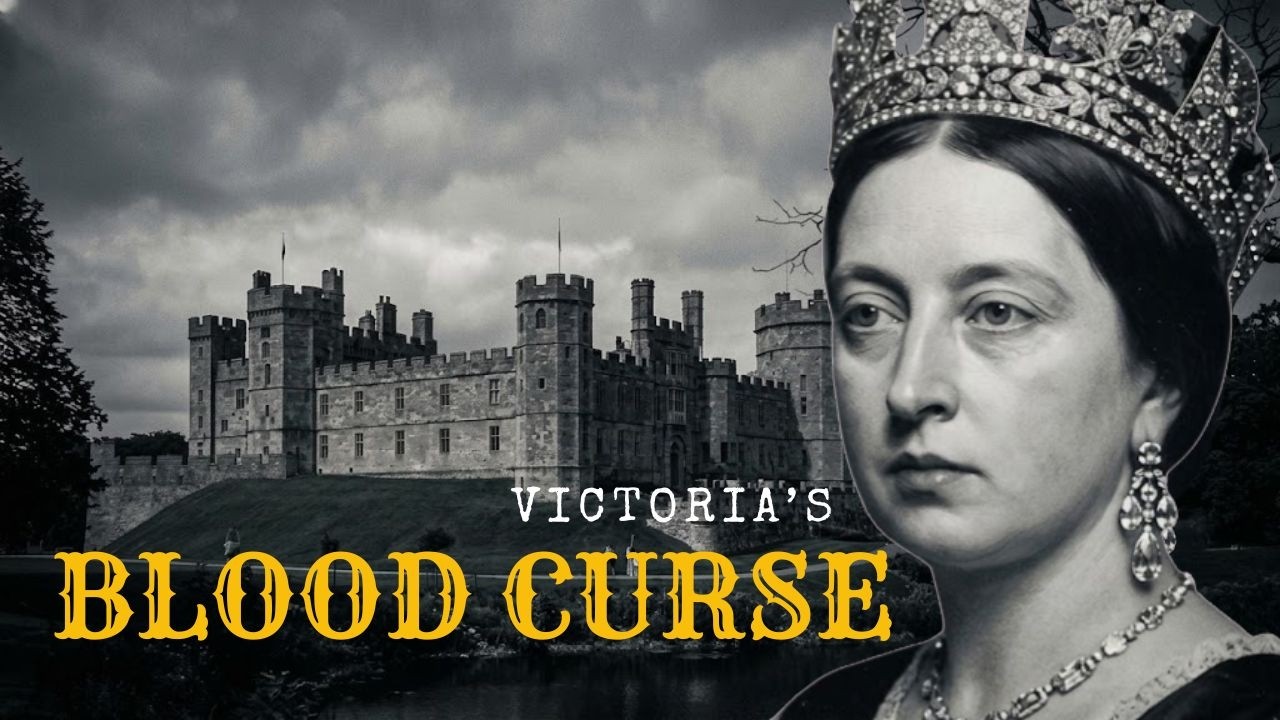
She became queen at eighteen, in the small hours of a June morning in 1837, informed by riders who had traveled through the night from Windsor to Kensington Palace. She was barely five feet tall, dressed in a hastily wrapped dressing gown, and she asked for an hour alone to write in her diary that she was young and inexperienced but sure that few had more real goodwill and desire to do what was right. Her name was Victoria, and the empire that had just become hers covered nearly a fifth of the earth’s surface. She would rule it for sixty-three years, give birth to nine children, outlive three of them, and carry inside her body a single broken gene she would never understand, one that would eventually help destroy the Russian Empire.
The young Victoria, before her marriage, was almost helplessly romantic. She had met her German cousin Albert twice, and by seventeen she had decided she would marry him. They married on the tenth of February 1840. She was twenty, he was twenty-one, and their first child, a daughter named Vicky, was born exactly nine months and twelve days later.
Eight more children followed over the next sixteen years. The pressure to produce heirs was relentless. Vicky was followed by Bertie, the future Edward VII, then Alice, Alfred, Helena, Louise, Arthur, Leopold, and finally Beatrice, born in 1857 when Victoria was thirty-eight. By any reasonable calculation, she had been pregnant for more than seventy-two of the previous two hundred months.
The first decade of her marriage was, by every account, the happiest of her life. The couple worked side by side at twin desks, read dispatches together, and built a model of the modern royal family that every monarchy in Europe would copy. At their private estate on the Isle of Wight, Albert designed nine bathing huts on the beach, one for each child, with glass windows and small brass plaques engraved with their names. On summer mornings the family walked down to them in single file, Victoria leading, Albert behind, the nine children in order of age between them.
In 1857 a photographer captured them all together on the lawn outside Albert’s cottage, Victoria holding four-month-old Beatrice in her lap, Albert standing behind her with one hand on her shoulder, the other eight children arranged in a careful semicircle. It was the last photograph of all nine children together in good health. Albert was tired by the summer of 1861, suffering from chronic stomach pain and insomnia, but he was alive and working, planning the next phase of his eldest son’s military training. Bertie, nineteen years old, had been sent to the Curragh camp in Ireland to learn discipline.
Albert believed his son was lazy, easily distracted, unsuitable for the throne. In his private study at Windsor hung a small pencil drawing Albert himself had made of Bertie asleep in an armchair, with a line beneath it in German: what will become of this boy. He would not live to find out. In September 1861, on the night of the sixth, three of Bertie’s fellow officers smuggled a twenty-two-year-old Irish actress named Nelly Clifton into the heir apparent’s tent.
She returned every weekend for the remaining six weeks of his attachment. Bertie did not tell his parents, but by mid-November the story had reached London and then the palace. Three days after the full report was placed in his hands, Albert boarded a train in cold rain, traveled to Cambridge, and confronted his son. He returned to Windsor that evening with a fever.
He would never recover. Princess Alice, eighteen years old, nursed her father through eleven days of fever and delirium. Victoria had retreated sobbing to the next room, and Alice had read to him, bathed his forehead, held his hand. On the evening of the fourteenth of December 1861, Albert opened his eyes for the last time.
He could not speak, but he raised his right hand and placed it palm down on top of his daughter’s. He held it there for nearly twenty minutes before his breathing changed. Victoria entered the room in her dressing gown, her hair unbound, and knelt at the other side of the bed. He died ten minutes later.
The last face he looked at was not his wife’s. The official cause of death was typhoid fever. Victoria, for the rest of her life, blamed Bertie and the actress in the tent. She referred to Nelly Clifton in letters to her eldest daughter as that wretched creature, and she wrote of Bertie that she never could or shall look at him without a shudder.
She wore black every day for the remaining thirty-nine years of her life. She had Albert’s bedclothes laid out every morning and hot water brought to his washstand at the same hour for the next forty years. In 1853, Victoria had given birth to her eighth child, a son named Leopold. The labor was the hardest of all nine, and chloroform was administered during the final stages, a controversial decision that defied the Church’s teaching that women should bring forth children in sorrow.
The boy was perfectly formed, but at fourteen months he fell from a small chair and cut his lip. The cut was minor, perhaps half an inch long, and it bled for nearly four hours while Victoria sat on the nursery floor holding her son, watching him grow paler as the blood soaked through one cloth after another. The bleeding stopped at three in the morning. The doctors did not yet have a name for what was wrong, but they knew by morning that something was very wrong and that it had come from his mother.
Leopold was forbidden from running, climbing, riding faster than a walk, swimming, playing with toy swords, or any sport involving physical contact. He read instead, spoke fluent French and German, attended Oxford, and studied modern history under John Ruskin. He was the wittiest of Victoria’s children, and he kept a private journal written partly in a cipher of his own invention, containing observations about his mother that, if published, would have caused a constitutional crisis. The entries were sealed and sent to the Royal Archives with a single instruction: they were not to be read in any present generation.
They have not been published to this day. Alice married Prince Louis of Hesse seven months after her father’s death and gave birth to seven children in fourteen years. In November 1878, diphtheria swept through her household. Six of the seven children fell ill, and on the sixteenth of November, four-year-old May died.
Alice was instructed not to touch her surviving children, because the disease was highly contagious. She stood at the doorway to break the news, and her eldest son Ernie, aged ten, ran to her and threw his arms around her neck. Alice kissed him on the forehead. She contracted diphtheria within forty-eight hours and died on the fourteenth of December 1878, seventeen years to the day after her father had died in her arms.
Victoria wrote in her diary that night a single line: this terrible day come round again. Alice’s second daughter, named Alix, would grow up to marry Tsar Nicholas II of Russia and carry the same broken gene her grandmother had carried. It would destroy her own son and help bring down the entire Russian Empire. Victoria never knew that.
Leopold, married for twenty-three months and the father of an eleven-month-old daughter, traveled to Cannes in March 1884 on his physician’s recommendation. On the morning of the twenty-seventh, he slipped on a tiled floor, hit his head against a marble step, and died of a brain hemorrhage at three-thirty the following morning. He was thirty years old. His wife was eight months pregnant with a son he would never see.
The Highland servant John Brown, who had been at Victoria’s side for nineteen years and addressed her as woman, died in March 1883. Victoria commissioned a marble statue of him and placed it at Balmoral where he had stood each morning. She wrote a three-hundred-page private memoir of him intended for publication, but her son Bertie and her private secretary prevented it, and the manuscript was destroyed after her death. Brown had once told Victoria, in reference to Bertie, that the boy was no more guilty of his father’s death than he was, that he grieved it as she grieved it, and that the difference was that she had allowed herself to say so and he had not.
She never again publicly blamed Bertie for Albert’s death. She never fully forgave him. Her son Alfred, Duke of Saxe-Coburg and Gotha, lost his only son in 1899 under circumstances officially recorded as natural causes but described in private letters as a suicide attempt with a revolver. The young man survived fourteen days before dying at twenty-four.
The last letter he had written, never sent, said, Mama, I cannot any longer live in this body. I am sorry. I have tried. Alfred himself died of throat cancer in July 1900, the second of Victoria’s children to die before her.
Her eldest daughter Vicky, Empress Frederick of Germany, mother of Kaiser Wilhelm II, was diagnosed with cancer of the spine in 1899. She did not tell her mother, and she hid her condition in her weekly letters, continuing to write about the weather and her grandchildren. Her letters describing her actual condition were smuggled across the German border sewn into the leather lining of horse saddles. Victoria died first, on the twenty-second of January 1901, at Osborne House, aged eighty-one, with her son Bertie and her grandson Wilhelm at her bedside.
Vicky learned of her mother’s death by reading a German newspaper. She died on the fifth of August 1901, outliving her mother by 226 days, in terrible pain because her son the Kaiser had forbidden her physicians from giving her the morphine her English doctors had recommended. Beatrice, Victoria’s youngest child, spent the thirty years after her mother’s death executing a final instruction: she edited every page of Victoria’s private diaries, more than 120 bound volumes containing over two and a half million words. She recopied them by hand, removing every passage she judged unsuitable, and she burned each page she finished in a small fire pit in the courtyard at Osborne House.
She burned them daily for three decades. The first page she destroyed was the journal entry Victoria had written on the morning after her own wedding night. More than two-thirds of the private record of the most documented life of the nineteenth century went up in that fire. We will never know most of what Victoria thought in private about the people she loved most.
The date her husband and her daughter Alice both died, the fourteenth of December, was never written about in her surviving diary. Beatrice may have removed it, or Victoria may never have been able to write it down. She had borne nine children in seventeen years, married them into every reigning house in Europe, and outlived three of them.
In the end, in a small bedroom at Osborne House, surrounded by her son the new king and her grandson the German emperor, she became exactly what every mother who outlives her own children eventually becomes: quiet, alone, survived.
