In April 1981, engineer Lee Felsenstein carried two suitcase-sized computers four blocks through the streets of San Francisco toward the West Coast Computer Fair in Brooks Hall. Each machine weighed twenty-four and a half pounds, and by the time he reached the exhibition floor, the weight had nearly pulled his arms from their sockets. The machines were prototypes of the Osborne 1, the first mass-produced portable computer ever offered to the American public, priced at $1,795 in a market where comparable desktop systems cost twice that or more. Inside each beige plastic case sat a Z80 processor running at 4 MHz, 64 kilobytes of RAM, two floppy disk drives, a fold-down keyboard, and a 5-inch monochrome screen so small that engineers at neighboring booths laughed out loud when they saw it.
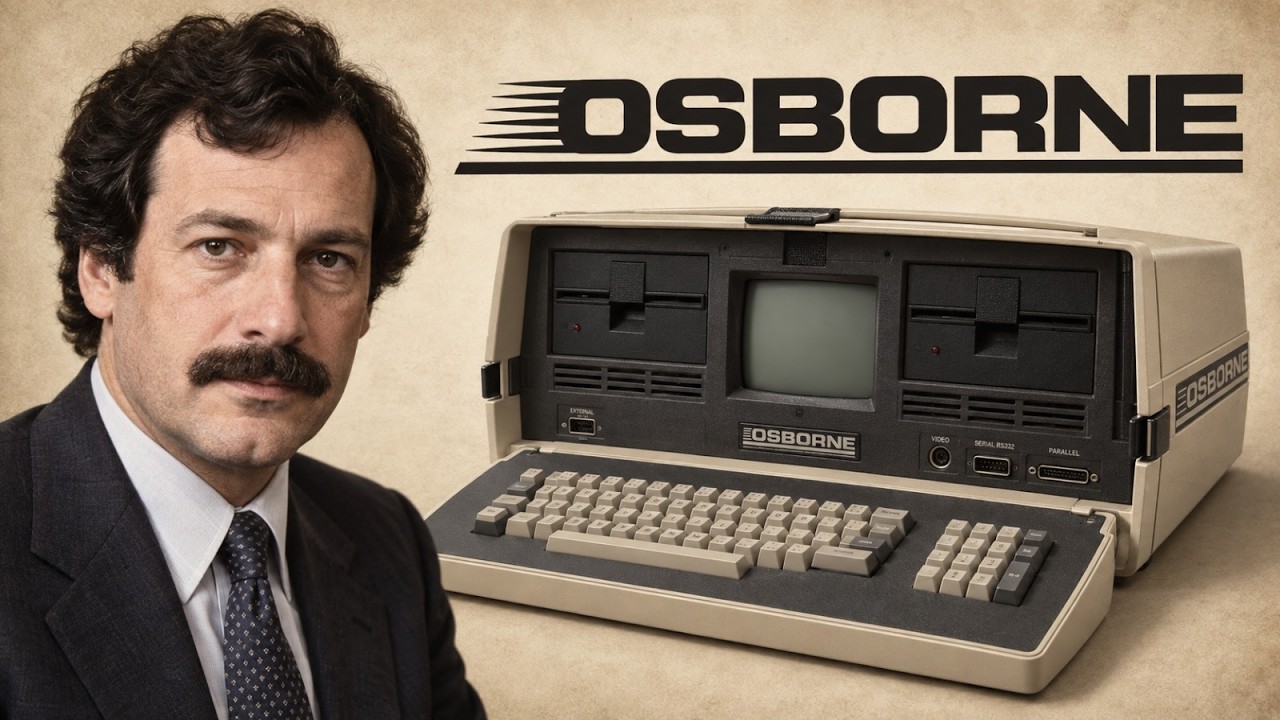
Nobody laughed for long. Within eight months, 11,000 units had shipped and 50,000 more sat on back order. Within twelve months, the company behind those machines had grown from two employees to 3,000 and hit $73 million in annual revenue, the steepest growth curve in Silicon Valley history. And within twenty-nine months of that day in Brooks Hall, Osborne Computer Corporation filed for bankruptcy with $45 million in debt against $40 million in assets.
Adam Osborne was born on March 6, 1939, in Bangkok, Thailand, to British parents. When the Second World War arrived, the family relocated to southern India, and young Adam grew up surrounded by contemplative silence and very little technology. At age eleven, he was sent to England alone, enrolling in a Catholic boarding school in Warwickshire. He earned a degree in chemical engineering from the University of Birmingham in 1961, crossed the Atlantic for a PhD at the University of Delaware in 1968, and took a position as a chemical engineer with Shell Oil in California.
Shell fired him. The pattern was already visible. Adam Osborne was brilliant, relentless, and nearly impossible to manage. What saved him was the microcomputer revolution.
In the early 1970s, documentation for personal computers was impenetrable, written by engineers for engineers. Osborne saw the gap and walked straight through it. In 1972, he founded Osborne and Associates, a publishing company dedicated to writing computer books that ordinary people could actually read. His 1975 book, An Introduction to Microcomputers, sold 300,000 copies and became one of the foundational texts of the personal computing era.
In 1979, McGraw-Hill purchased the company, making him wealthy. But Osborne did not disappear into retirement. He became arguably the first technology columnist with a genuine following, writing a combative opinion column called From the Fountainhead for Interface Age magazine and later for InfoWorld. The column made him one of the most recognized voices in personal computing, and it gave him an audience of exactly the people he would soon be selling to.
Osborne had developed a conviction that the computer business was making a fundamental mistake. Companies were cramming ever more power into ever more expensive boxes, building machines for enthusiasts while ignoring the millions of ordinary office workers, accountants, lawyers, and small business owners who simply needed a machine that worked. These people did not need the best computer on the market. They needed a good enough computer.
And nobody was building one. Building one required an engineer who understood constraint as a design principle. That engineer was already well known. Lee Felsenstein had come to computers through an unusual door.
As a student at UC Berkeley, he was arrested in the Sproul Hall sit-in during the Free Speech Movement in the winter of 1964. He later engineered Community Memory, one of the first public access computer networks, and designed the SOL-20, one of the first fully assembled personal computers, and the VDM-1, the video display module that became the standard display architecture for a generation of machines. When Adam Osborne called him in late 1980 with a proposition, the fit was immediate. In January 1981, Osborne incorporated Osborne Computer Corporation in Hayward, California, with $100,000 of his own money and $40,000 from venture capitalist Jack Melchor.
The company was two people, a rented office, and a philosophy that Osborne stated publicly almost proudly. “Adequacy is sufficient. Everything else is irrelevant. ” The philosophy drove a series of deliberate engineering compromises that Felsenstein executed with precision.
The screen would be 5 inches, not the 9 or 12 that desktop monitors offered, because a larger display would make the case too heavy and the price too high. The floppy drives would hold 90 kilobytes per disk. The processor would be a Z80 running at 4 MHz, proven and cheap. The whole package would weigh 24 1/2 pounds, heavy, but light enough, Osborne insisted, to carry onto an airplane and stow under the seat.
The price would be $1,795. But the hardware was only half the insight. For that single purchase price, the buyer received not just the machine but a stack of commercial software that would have cost more than $1,500 if purchased separately at retail. The package included Digital Research’s CP/M operating system, WordStar for word processing, SuperCalc for spreadsheets, CBASIC and MBASIC for programming, and dBase II for database management.
A reviewer for Byte magazine calculated the arithmetic that every buyer was already doing. Subtract the retail value of the bundled software from the purchase price, and the computer itself cost roughly $265. The debut at the West Coast Computer Fair on April 3, 1981, was pandemonium. InfoWorld reported that the single most frequently asked question at the entire show was about the Osborne computer.
By the second day, the booth was overwhelmed. The company had projected total lifetime sales of 10,000 units. They reached that number in a single month. By the end of 1981, revenue stood at $5.
8 million. Lawyers, accountants, journalists, and small business owners, the exact audience Adam Osborne had predicted, were buying the machines as fast as anyone could build them. But the company had no professional management structure, no experienced finance team, and no systems built for inventory at this velocity. Adam Osborne was a publisher, a writer, and a natural salesman.
He was not an operations executive. He would later say it plainly. “I didn’t know business. I didn’t understand finance.
”
By 1982, the scale had become staggering. Monthly production reached 10,000 units. Revenue for the year hit $68. 8 million on 110,000 orders.
The company had expanded from two employees to 3,000 in barely twelve months. David Bunnell, the founder of PC Magazine and PC World, offered a judgment that would have seemed preposterous for a company that still had only one product. “There were three major people in the industry,” Bunnell said. “Bill Gates, Steve Jobs, and Adam Osborne, and not necessarily in that order.
” The bravado disguised a structural crisis. The board brought in Robert Jaunich, a seasoned executive from Consolidated Foods, to serve as CEO and steer the company toward an initial public offering. The plan was logical. Professional management would stabilize operations.
The IPO would raise the $20 million needed to fund a new generation of products. The internal politics turned corrosive almost immediately. The executive suite fractured into camps while the engineers kept building. And in the middle of this quiet war for control, Adam Osborne made the choice that would define his name for the rest of business history.
He decided to show journalists the next machine before it was ready to sell. The forces that would have tested Osborne Computer Corporation even without its founder’s misstep were already in motion. In August 1981, four months after the Osborne 1 debuted, IBM released the IBM PC. The machine ran an Intel 8088 processor and an operating system called MS-DOS, licensed from Microsoft.
In raw capability, it offered little that the Z80 machines could not match, but it carried four letters on the case that no startup could answer. IBM meant institutional safety. IBM meant the corporate purchasing department would approve the order without a fight. IBM meant that software developers would write for the platform first.
Within two years, the IBM PC and its growing family of legal clones began to reorganize the entire personal computer market around a single architecture. CP/M, the operating system that ran the Osborne 1, entered an irreversible decline. Competitive pressure also arrived from KAYPRO, which released a portable machine with a 9-inch screen and a lower price, and from Compaq, which shipped a portable machine that ran every program written for the IBM PC. Osborne Computer needed to pivot to IBM compatibility or die.
The engineers understood this. The board understood it. Adam Osborne understood it. But the transition required at least $20 million in fresh capital, and the IPO that was supposed to deliver that money had stalled.
The capital was not coming. In early 1983, word of the Osborne Executive, the company’s next machine with a larger screen and more memory, spread through the dealer network like a virus. Retailers who still had Osborne 1 units on their shelves heard that a better machine was coming. Customers who had been considering the Osborne 1 heard that a bigger screen was weeks away.
The rational response for both groups was to wait. And that is exactly what they did. Dealers canceled orders for the Osborne 1 in waves. Customers stopped buying.
The pipeline dried up. This phenomenon would later be named the Osborne effect. But the documented record is messier than the clean cautionary tale suggests. Adam Osborne himself claimed in his 1984 book, Hypergrowth, that he had fabricated the pre-announcement narrative himself, planting the story with the Wall Street Journal on July 13, 1983, to cover up a more damaging truth.
The real problem, he wrote, was that the company had zero dollars of income in April and May of 1983. Later investigation found no media coverage of the Osborne effect before that July date, lending weight to the possibility that Osborne invented the narrative as a shield. The truth is that Osborne Computer Corporation did not die from one cause. It died from all of them at once.
KAYPRO was selling portable CP/M machines at lower prices. The entire CP/M ecosystem was losing ground to IBM-compatible systems. Inside the company, management spent $2 million converting surplus motherboards into finished units that nobody wanted. The accounting was so disorganized that the company accumulated what amounted to eight years of losses in the span of two months.
On September 13, 1983, Osborne Computer Corporation filed for Chapter 11 bankruptcy protection. The filing listed $40 million in assets against $45 million in debt. Three thousand people lost their jobs. Adam Osborne surveyed the wreckage with the bluntness that had defined his entire career.
“The company, plain and simple, committed suicide. ” He did not blame the market or the competition. He blamed the company, which in practice meant he blamed himself. The company emerged from bankruptcy protection in January 1985 and managed to ship two more machines, but neither came close to recapturing the momentum.
On April 9, 1986, after defaulting on a $4 million debt payment, Osborne Computer Corporation was liquidated. The fastest-growing company in Silicon Valley history had lasted five years from incorporation to dissolution, and its period of actual relevance lasted twenty-nine months. Adam Osborne then founded Paperback Software International, selling affordable MS-DOS applications, including a spreadsheet priced at $99 to undercut Lotus 1-2-3 at $500. Lotus sued for copyright infringement, and on June 28, 1990, the court ruled against Paperback Software.
The company dissolved. In 1992, Osborne founded another venture focused on artificial intelligence, but by then his health was failing. He had been diagnosed with an organic brain disorder that produced frequent minor strokes. He returned to southern India to the hill town of Kodaikanal, not far from the school he had attended as a child.
He died there in his sleep on March 18, 2003. He was 64 years old. Lee Felsenstein, the engineer who had actually designed the machine that made the company possible, continued building. He consulted, he taught, and he kept designing systems meant to put computing power into the hands of people who had been excluded from it.
In 1994, the Electronic Frontier Foundation named him a pioneer of the Electronic Frontier. In 2016, the Computer History Museum inducted him as a fellow. When reporters asked about the Osborne 1, Felsenstein noted that Adam Osborne had once told the press that any of 500 designers could have designed it. Felsenstein’s reply was precise.
“Any of those 500 designers would have made it lumpier, slower, and more expensive. ”
The Osborne effect entered the permanent vocabulary of business strategy, cited whenever a company announces a future product and kills demand for the current one. The category the Osborne 1 created, the portable personal computer, outlived the company by decades. Every laptop, every ultrabook, every tablet with a keyboard case traces a line, however indirect, back to the beige plastic suitcase that Lee Felsenstein designed in a rented Hayward office.
The Osborne 1 did not invent the idea of mobile computing, but it was the first to prove that ordinary people would pay real money for one. The entire multi-hundred-billion-dollar laptop industry rests in some foundational sense on the commercial proof that a 24 1/2-pound machine with a 5-inch screen provided in April 1981. The machine was heavy, limited, and by the standards of what came after, almost comically crude. And every single one of them worked.
They worked in law offices and newsrooms and hotel rooms and airport lounges. They proved that a computer did not need to be perfect to be transformative, that adequacy honestly delivered was enough to change the way millions of people worked. Adam Osborne built the fastest-growing company in Silicon Valley history on that principle, and he destroyed it the moment he stood in front of a room full of journalists and admitted that his adequate machine was no longer good enough.
