The photograph lay on the table in front of her, the woman still looking to the left with that terrible frozen expression, the three young girls still staring straight ahead. For a moment, Alera Vasquez could not move. She had been sitting in the climate-controlled basement of the University of Minnesota’s Anderson Library for six hours, working her way through boxes of abandoned family photographs, and she had just found something that should not exist. The date on the back read July 12th, 1911, written in faded pencil.
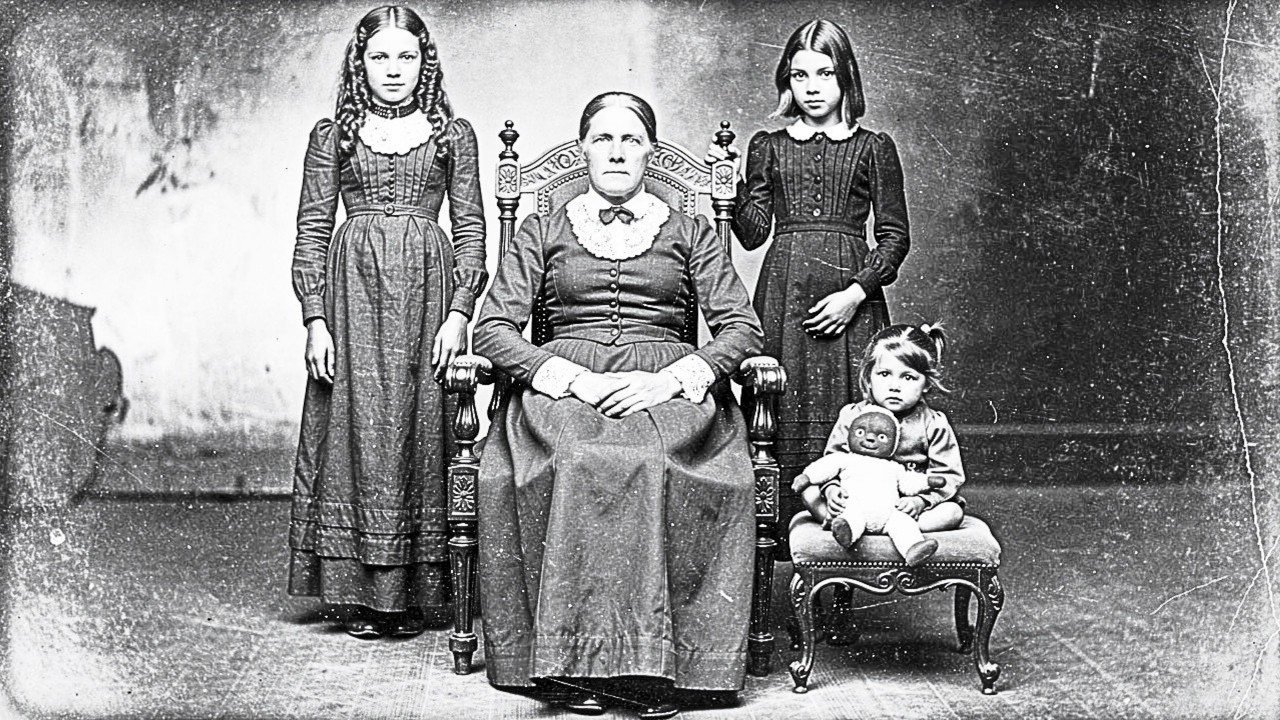
But everything in the image itself pointed to a different time. The lace on the mother’s collar was a pattern that did not appear in commercial catalogs until 1923. The cloth doll clutched by the youngest girl was a mass-produced item sold exclusively by a Chicago department store that did not open its doors until 1921. The wallpaper behind the family, a repeating pattern of ivy and small roses, was a design Alera had seen before in a trade catalog from 1926.
On the woman’s left ring finger sat a ring made of two metals, gold and silver twisted together, a style called a reconciliation ring, produced by a single jeweler in Philadelphia between 1928 and 1930 as a promotional item for couples who had survived the stock market crash. Fewer than two hundred were ever made. A wallpaper pattern from 1926. A department store doll from 1921.
A lace collar from 1923. A reconciliation ring from 1928 or 1929. And a handwritten date on the back that read July 12th, 1911. She sat in the basement holding a photograph that could not possibly exist.
Alera was a 37-year-old archival researcher who studied the history of domestic clothing, specifically how working-class women altered and maintained their garments between 1890 and 1920. She had requested seven boxes from the archives’ Treadwell Collection, an enormous donation of abandoned family albums and loose photographs purchased from estate sales across the Upper Midwest throughout the 1970s. Most of it was exactly what she expected: formal studio portraits of stern-faced men in stiff suits, babies posed on sheepskin rugs, graduation photographs, wedding parties, the occasional tintype of a soldier who would not survive the war he was dressed for. She had worked through five boxes in six hours, cataloging clothing details with the patience of someone who had long ago learned that discovery was mostly a matter of showing up and paying attention.
The sixth box was different. It held an intact carte de visite album, its leather spine cracked but holding, its brass clasp tarnished but unbroken. The album was small, maybe six inches by four, and held twenty-four portraits mounted on heavy card stock. The first twenty-three were unremarkable.
A man with a magnificent beard and a missing left hand. Two young women with matching brooches and identical expressions of exhausted patience. A boy clutching a dead rabbit. A wedding couple who looked less like lovers and more like business partners who had just agreed to unfavorable terms.
Then she turned to the final page. The photograph showed a woman and three young girls posed in what appeared to be a parlor. The woman sat in a high-backed wooden chair, her hands folded in her lap. She wore a dark cotton dress with a simple lace collar.
She was maybe thirty-five years old, though the hardness around her eyes suggested she had lived more years than that. To her left stood a girl of about ten, her hair pulled back severely, her small hands clasped at her waist. To her right, slightly behind the chair, stood a second girl of perhaps seven. Seated on a small ottoman at the woman’s feet was the youngest, a girl of maybe four, clutching a cloth doll missing one button eye.
At first glance, nothing was remarkable. It was the kind of image produced by the thousands in the 1910s. Alera noted the clothing details automatically. The mother’s collar was machine made, not hand crocheted, suggesting a family with enough income to purchase ready-made trim.
The girls’ dresses were all made from the same bolt of cotton, a practical choice that spoke of careful budgeting. The youngest girl’s doll appeared homemade. Normal. Unremarkable.
She was about to turn the page and move on when something caught her attention. It was not a single detail. It was the accumulation of several details that, taken together, made no sense. She told herself she was inventing a mystery where none existed.
She told herself to focus on the clothing. Then she noticed the mother’s hands. In the photograph, the woman’s hands were folded in her lap, fingers interlaced. A common pose.
But on the woman’s left ring finger sat the reconciliation ring. Alera sat in the basement for a long time holding the photograph. Then, because she was a researcher and researchers are trained to follow evidence even when it leads to absurd places, she began to look more closely at the faces. That was when she noticed the second impossibility.
The mother was not looking at the camera. The three daughters were, all of them staring directly into the lens with the fixed, slightly uncomfortable expressions of people holding still for a long exposure. But the mother’s eyes were angled slightly to the left, like she was looking at something just out of frame. Or someone.
Alera turned the photograph over again. There was only the date, July 12th, 1911. No names, no studio stamp, no location. But someone had written something else.
She had missed it before because the pencil was so faint, so worn by a century of unknown hands. There, in the lower right corner of the cardstock backing, barely visible even under her magnifying glass, were four words. They were not written in English. She recognized the alphabet, Cyrillic.
She could not translate them herself, but she copied them into her notebook exactly as they appeared, letter by letter. Then she pulled out her phone and sent a photograph of the writing to a colleague in the linguistics department, a woman named Dr. Svetlana Petrov, who specialized in pre-revolutionary Russian paleography. The translation arrived at 7:43 p.
m. , just as the library’s lights began their automated dimming sequence. A single message from Dr. Petrov.
The message read, “Where did you get this? I need to see the original. ”
Alera typed back, “What does it say? ”
A pause.
Then four words translated from the Cyrillic scroll on the back of the photograph. They were not the words she expected. She had assumed it would be a name, a date, a location. The kinds of things people wrote on the back of family portraits.
Instead, Dr. Petrov sent this: “They are not hers. ”
Alera read the message three times. Then she called.
Dr. Petrov answered on the first ring, her accent thickening the way it always did when she was agitated. She explained that the handwriting was not from 1911. The Cyrillic reform of 1918 had simplified several letters.
Whoever wrote this used the old pre-reform characters. That meant the note was written by someone who had learned to write before 1918, likely an adult during the Russian Revolution. But the photograph was dated 1911. So the note was added after the photograph was taken, possibly years after.
Someone had looked at this photograph years later and written “They are not hers” on the back. Not hers. Not her what? Not her daughters.
“That is the obvious reading,” Dr. Petrov said carefully. “But there is another possibility. The pronoun in Russian does not specify gender the same way.
They are not hers could mean the children, or it could mean something else. The belongings, the clothes, even the faces. ”
Alera thanked her, hung up, and sat in the deepening silence. If the children were not hers, whose were they?
And if the woman in the photograph was not their mother, then who was she? She began to work backward. The anachronisms suggested the photograph was taken much later than 1911, but the date on the back was written by hand. Someone had written July 12th, 1911 in pencil.
That same someone, or maybe a different someone, had later added the Cyrillic note. Examining the marks under stronger light, Alera realized the date was written in a soft, dark graphite, while the Cyrillic was written in a harder, lighter pencil that left shallower grooves in the cardstock. Different hands. Different times.
She pulled out her research notebook and began a timeline. The photograph was taken sometime between 1928 and 1930, based on the reconciliation ring. Someone, likely the woman herself or someone close to her, wrote the date July 12th, 1911 on the back. Why?
To make the photograph appear older, to hide its true origin. Then later, someone else wrote “They are not hers” in pre-reformed Cyrillic, a Russian speaker, an older person educated before the revolution. She looked at the three daughters again, this time focusing on their faces. The oldest girl had a small mole beside her left nostril.
The middle girl had a gap between her front teeth just wide enough to notice. The youngest had unusually asymmetrical ears, the left ear sitting noticeably lower on her head than the right. Something about these three girls was nagging at her. She had seen them before, somewhere in the thousands of photographs she had cataloged over the years.
She pulled the other five boxes back toward her, the ones she had already examined. She had been efficient, methodical, noting clothing details and moving on without paying much attention to faces. That had been a mistake. It took her forty-five minutes.
She found them, not together, not in a single photograph, but scattered across three different boxes, in three different portraits. The oldest girl, the one with the mole, appeared in a small tintype dated 1916, wearing a maid’s uniform, standing beside a woman Alera did not recognize. The middle girl appeared in a cabinet card dated 1919, seated alone, holding a book, her expression hollow and exhausted. The youngest appeared in a photograph that made Alera’s stomach clench.
It was a postmortem portrait. The little girl was laid out on a white sheet, her eyes closed, her cloth doll placed on her chest. The date on the back was 1924. Three girls.
Three separate photographs. Three different dates. None of them pictured with the woman from the parlor photograph, the woman who was not their mother, the woman who had looked to the left with her terrified eyes while three children who belonged to someone else stared straight ahead into a camera that was capturing something that should not have been possible. Alera gathered all four photographs and laid them side by side on the table.
Then she sent a single message to Dr. Petrov. This time she did not ask for a translation. She asked a different question.
Can you find out if any Russian immigrants arrived in the Midwest between 1925 and 1930 who were fleeing something more than poverty? The answer would come, but not that night. That night, Alera did something she had never done in fifteen years of archival research. She copied every photograph in the Treadwell collection that showed a woman with three girls.
Then she copied every photograph that showed a girl with a mole beside her nose, a gap between her teeth, or an ear that sat too low. And then she took the original group portrait, the impossible one, and slipped it into her bag. She was not stealing it. She would tell herself that later.
She was protecting it, keeping it from disappearing back into the anonymous chaos of the archive before she could understand what it meant. But as she walked out of the Anderson Library into the frozen Minnesota night, the photograph tucked inside her coat, she knew she had crossed the line that responsible researchers were not supposed to cross. She also knew she would cross it again if she had to. The mother in the photograph had not been looking at the camera.
She had been looking to the left. Walking through the snow toward her apartment, Alera realized something else. The woman had not been looking at something outside the frame. She had been looking at someone.
The photographer, maybe, or someone standing beside the photographer. Someone whose face the camera had never captured. Someone who had written, years later, in a language that did not belong in a Minnesota archive, “They are not hers. ”
Alera reached her apartment, a small one-bedroom in the old Merriam Park neighborhood of St.
Paul. She lived alone. Tonight the silence felt oppressive. She turned on every light in the living room, laid the photograph on her coffee table, and stood over it.
She needed evidence, not guesses. The Treadwell collection had come from a single source, a woman named Harriet Treadwell who died in 1972 at the age of ninety-three. Her donation to the university came with a handwritten note that Alera had read months ago and promptly forgotten. The note said, in Harriet’s spidery script, “These are the faces that haunted me.
I do not know their names. I only know that someone wanted them forgotten. ”
Now she pulled up the digital scan of Harriet’s note on her laptop and read it again. There was a postscript she had missed before, folded under at the bottom of the page.
It read: “The Russian woman came to my father’s photography studio in the winter of 1929. She had three girls with her. They were not her daughters, she said. She wanted a portrait taken.
My father asked why. She said because someone must remember what they looked like before. He never saw her again. The girls were left at the studio.
He tried to find her. He couldn’t. He raised the girls himself. He never told me their real names, but he kept the photograph and I have kept it ever since.
It is the most important one in the box. ”
Alera read the postscript four times. The Russian woman. The winter of 1929.
The three girls who were not her daughters. The photography studio. The father who raised them. The names that were never told.
She had been wrong about the date. The photograph was taken in the winter of 1929. And the woman in the photograph, the one looking to the left with terror in her eyes, was not the mother. She was the Russian woman, the one who had brought the girls to the studio, paid for a portrait, and then disappeared, leaving the children behind like unwanted luggage.
If Harriet Treadwell’s father had raised the three girls, then the girls had grown up in Minnesota. They had lived lives. They had married, maybe, had children, died. And somewhere along the way, someone had written on the back of the photograph in pre-reform Cyrillic, “They are not hers.
” That someone was likely Harriet’s father himself, or maybe one of the girls who might have learned the phrase from the Russian woman before she vanished. But the biggest question remained. Who was the Russian woman, and why had she brought three children to a stranger’s photography studio, posed for a portrait, and then walked out of their lives forever? Alera spent the next three days doing something she had never done before.
She abandoned her research on domestic clothing entirely. She told her supervisor she was sick. She lay on her living room floor surrounded by printouts of every photograph in the Treadwell collection that showed a female face. She sorted them by estimated date, by clothing, by expression.
She built a wall of images. And she looked for patterns. On the third night, she found one. The three girls appeared in other photographs after 1929, dozens of them.
Harriet Treadwell’s father had documented their childhoods thoroughly. The oldest, the one with the mole, grew up to become a nurse. Alera found her graduation photograph from St. Paul City Hospital Training School in 1936.
The middle girl became a seamstress. There were photographs of her at a sewing machine, her fingers stained with dye, her smile missing the same tooth. The youngest was the most mysterious. She appeared in only two photographs after 1929.
One showed her at age twelve, standing beside a much older man Alera assumed was Harriet’s father. The other showed her in 1941, wearing a military uniform, the Women’s Auxiliary Corps. She disappeared from the photographic record after that. But the Russian woman never appeared again.
No other photographs, no letters, no mentions in Harriet’s notes. She had stepped into that studio in the winter of 1929, sat for a portrait with three girls who were not her own, looked to the left at someone or something, and then vanished into the frozen streets of St. Paul. Except that was not quite true.
Because Alera had the photograph, and she had noticed something else, something so small, so easy to overlook, that she almost missed it. Under the bright lights of her apartment, with a magnifying glass borrowed from her father’s old stamp collection, she studied the woman’s hands. The left hand was folded over the right in her lap. But the right hand, the one underneath, was not relaxed.
The fingers were curled slightly inward, like she was holding something, a small object hidden from view by the placement of her left hand. Alera had assumed it was just the way her hands rested. But now, studying the grain of the silver gelatin print, she could see the faint outline of something pressed against the woman’s right palm. Something small.
Something flat. Something with edges that caught the light differently than skin or fabric. It was a photograph. The woman was holding a photograph in her right hand, concealed beneath her left.
A photograph within a photograph. A hidden image that the camera had captured without meaning to. And the Russian woman had been looking to the left, not at the photographer. She had been looking at the person whose image was hidden in her hand.
Alera did not sleep that night. She took the original print to a professional imaging lab the next morning, paying out of her own pocket for a high-resolution scan that could be digitally enhanced. The technician, a young man with purple hair and a kind face, asked her what she was looking for. She said the truth.
He stopped asking questions after that. Eight hours later, she had it. The enhanced scan revealed the hidden photograph with startling clarity. It was a small portrait, maybe two inches by three, worn and creased from being held.
It showed a man. A young man with dark hair and a thin mustache, wearing a military uniform unlike any Alera had seen before. Not American, not British. The insignia on his collar was unfamiliar, but the shape of the epaulets and the cut of the tunic were unmistakably Russian.
Imperial Russian. Pre-revolutionary. Alera sent the enhanced image to Dr. Petrov with a new question: “Do you recognize this uniform?
”
The response came within minutes, and it contained a name. Colonel Andrei Vasilyevich Morozov, an officer in the Imperial Russian Army’s 147th Infantry Regiment, known as the Samara Regiment. According to military records from a database of pre-revolutionary Russian officers, Colonel Morozov had been declared missing in action in August 1914, during the first weeks of the Great War. Missing, not dead.
That distinction mattered. If the photograph was taken in the winter of 1929, then Colonel Morozov had been missing for fifteen years. Missing, presumed dead. And yet here he was, a hidden image pressed against a woman’s palm, his face worn soft by the pressure of fingers that refused to let go.
Alera called Dr. Petrov again. This time the conversation lasted two hours. Together they pieced together a story that existed only in fragments scattered across archives and databases and the fading memories of people who had never known they were holding a secret.
Dr. Petrov found a passenger manifest from the port of New York dated October 1923. A woman named Irina Nikolaevna Morozova had arrived aboard the SS Berengaria, traveling alone, listing no occupation and no permanent address. She was thirty-two years old.
She spoke no English. She had $140 in her possession. Under purpose of travel, someone had typed a single word: private. Irina Morozova.
The wife of Colonel Andrei Morozov, assuming she had married before the war. A woman who had survived the revolution, the civil war, the purges, the famine, and crossed half the world looking for a man who had been declared missing fifteen years earlier. But the girls. Alera could not stop thinking about the girls.
They were not hers. That was written on the back of the photograph. So whose were they? And why had she brought them to that studio?
Alera went back to the Treadwell collection, not the photographs this time, but the accompanying paperwork. Harriet Treadwell had donated more than images. She had donated letters, receipts, newspaper clippings, and a single diary that Alera had dismissed as unremarkable because it was written in a child’s handwriting. That diary belonged to the youngest girl, the one with the uneven ears, the one who had joined the Women’s Auxiliary Corps in 1941 and then disappeared from the photographic record.
The diary was small, brown, its cover scuffed and its pages brittle. It arrived in a protective acid-free box accompanied by a stern note from the archivist about handling procedures. Alera ignored the note. She opened the diary to the first page and began to read.
The handwriting was careful, the letters formed by a child who had learned to write not long before. The first entry was dated March 3rd, 1930, just a few months after the photograph was taken. It read: “Today Papa told us the truth. He said the woman who brought us to the studio was not our mother.
Our real mother died in a place called Siberia. He said the woman’s name was Irina. She was looking for her husband. She found us instead.
She brought us to Papa because she could not take us where she was going. She said we look like children who deserve to live. ”
Alera’s hands were shaking. She turned the page.
“I am writing down what Papa told us so we do not forget. Our real mother’s name was Maria. Our real father’s name was Piotr. They were friends with the woman Irina and her husband Andrei.
Before the war, they all lived in a city called Samara. Then the war came. Then the revolution. Then the terrible cold.
Papa said our real mother gave us to Irina before she died. She told Irina to find our father. But our father was already dead. So Irina looked for her own husband instead.
She looked for a long time. She crossed an ocean. She came to a place called Minnesota because someone told her a man with her husband’s face had been seen there. She did not find him.
She found us. She said we were like a sign. She said she would keep us safe until she could not. Then she brought us to Papa’s studio and left.
”
The diary continued for another thirty pages. Alera read every word. The story that emerged was not one of villainy or dark conspiracy. It was something worse, honestly.
It was a story of ordinary people caught in extraordinary circumstances, making choices that would not make sense to anyone who had not lived through what they had lived through. Irina Morozova had been the wife of Colonel Andrei Morozov. When the Great War broke out, Andrei went to the front. Irina stayed behind in Samara, where she befriended a seamstress named Maria and Maria’s husband Piotr, a railway worker.
The two families were close. When the revolution came, Andrei was reported missing. Piotr was conscripted into the White Army. Maria was left alone with three young daughters.
Irina, who had no children of her own, helped her friend survive the winters, the shortages, the fear that arrived at night in the form of men with red armbands. Piotr died in 1919. Maria died of typhus in 1921. On her deathbed, she made Irina promise two things.
First, that she would find Andrei if he was still alive. Second, that she would take the three girls somewhere safe, somewhere far from Russia, somewhere the past could not reach them. Irina kept both promises. She spent two years crossing Eastern Europe, trading what little she had for passage, for papers, for silence.
She reached New York in 1923. She spent the next six years searching for Andrei, following rumors from Chicago to Detroit to Minneapolis. She never found him. But in 1929, she found a lead that brought her to St.
Paul. A man who had seen someone matching Andrei’s description. A man who ran a photography studio. A man named Treadwell.
Harriet Treadwell’s father. The man who would raise the three girls. The man who looked at Irina Morozova and saw a woman who was dying. Not literally.
Not yet. But dying in the way that people do when they have spent too many years searching for something they will never find. He offered to take the girls. He offered to give them a home.
He offered to never ask their real names. And Irina, who had kept them alive across oceans and years, finally let go. She sat for one last photograph with the girls. She held Andrei’s picture in her hand.
She looked to the left, not at the photographer, but at the empty chair where Andrei should have been sitting. And then she walked out into the winter and was never seen again. The diary said that Harriet’s father searched for Irina for months. He never found her.
He assumed she had gone back to Russia, or to Europe, or maybe to some other city where another rumor had taken root. He never knew that the woman who had brought him the greatest gift of his life, three daughters to raise, three lives to save, had vanished like smoke from a frozen breath. Alera closed the diary. She sat in her apartment, the photograph still on the coffee table, the hidden image of Colonel Morozov staring up at her with eyes that had seen a war and then nothing afterward.
She thought about Irina crossing oceans, crossing years, holding a picture of a man who was almost certainly dead, refusing to let go of the one thing that kept her moving forward. She thought about the three girls who had lost everyone and then found a new father in a photographer who asked no questions. She thought about the photograph itself, which had sat in an archive for fifty years waiting for someone to notice that a mother’s hands were holding a secret, that a mother’s eyes were looking at an absence, that the mother in the photograph was not a mother at all. She thought about the words on the back.
They are not hers. A warning, a revelation, an epitaph for a woman who had given everything to children who would never call her mother. Alera did not return the photograph to the archive. She could not bring herself to do it.
Instead, she wrote a letter to the university’s special collections department explaining what she had found. She included the diary entries, the passenger manifest, the military records, and a request. She asked that the photograph be exhibited with a new label. Not “Mother and Daughters, 1911.
” But “Irina Morozova and the Children She Saved, St. Paul, 1929. ” She asked that the names of the three girls be included, the real names that Harriet’s father had never spoken aloud. Maria, Anna, and little Katya.
The daughters of a seamstress and a railway worker. The children of a woman who died in Siberia so that they might live in Minnesota. The university agreed. The photograph now hangs in a small exhibit on the fourth floor of the Anderson Library, in a climate-controlled case under soft light that will not damage the silver gelatin print.
Visitors walk past it every day. Most of them see a mother and her daughters. Some of them stop and read the label. And a few, a very few, look closely enough to notice that the woman’s hands are folded strangely, that her eyes are angled to the left, that there is something hidden in her palm that the camera saw but the world forgot.
Alera never learned what happened to Irina Morozova. No record of her death has ever been found. No grave, no obituary, no passenger manifest leaving the country. She walked out of that photography studio in the winter of 1929 and disappeared into the ordinary oblivion of a life that no one thought to document.
But Alera likes to imagine that she kept walking, that she crossed another ocean, another border, another frozen plain, that somewhere, in a city she had never heard of, she finally sat down beside an empty window, opened her hand, and saw the face of the man she had been looking for. Not because he was there, but because she had carried him so long that he had become a part of her. A photograph within a photograph. A secret that no amount of time could erase.
That is the truth that photographs were never meant to hold. Not the dark secrets of villains and crimes, but the quiet, impossible secrets of ordinary people who loved each other across wars and revolutions and oceans. Who saved children who were not their own. Who looked into cameras with terrified eyes because they were about to let go of the only thing that had kept them alive.
Alera returned to her research on domestic clothing, but she never forgot the lace collar from 1923, the doll from 1921, the wallpaper from 1926, the reconciliation ring from 1928. She never forgot that a photograph is never just a photograph. It is a door.
And if you look closely enough, not at the obvious things, but at the hidden things, the folded hands, the angled eyes, the faint outlines of secrets pressed against palms, you just might walk through.
