She pressed the paper against the iron and held her breath. If it burned, the tongs were too hot, and her hair would be next. That was the professional standard for stove-heated Marcel curling tongs in the 1870s, a test that separated a perfect wave from a scalded scalp. In 1872, the French hairdresser Marcel Grateau had grabbed his curling iron, turned it upside down by accident, and created the most famous wave in the history of hairdressing.
The Marcel wave, the cascading, soft, undulating wave that Josephine Baker wore, dominated two full decades of beauty culture and still shows up on every red carpet whenever someone wants old Hollywood hair. What is strange is what happened to the man himself. Grateau eventually emigrated to the United States, changed his name to François Marcel Wooffly, filed a United States patent in 1905, then a second patent for an electric version in 1918. His obituary ran under a third different name.
The man who defined women’s hair for fifty years spent his career reinventing himself almost as aggressively as he reinvented their hair. The objects that filled a woman’s vanity table in the mid-twentieth century tell a story that runs much deeper than makeup. Some were practical tools that became works of art. Some were born in hospitals and morgues before finding their way onto the most elegant tables in Paris.
Some promised things they could never deliver. And some, buried in the center of the table, were never meant to be seen at all. Consider the hatpin. It was a legally recognized problem.
So long, so sharp, and so frequently used as a deterrent against unwanted touching on public transport that several cities passed ordinances requiring women to cap the exposed ends. Some women removed the caps anyway. Eight, nine, ten inches long, topped with a crystal, pearl, or rhinestone cluster, the hatpin was a structural necessity when hats were enormous and hair elaborately piled. On the vanity sat the holder, a small porcelain column that kept the pins displayed like a tiny sculpture.
At the high end, this was a jeweler’s commission. Van Cleef and Arpels made hatpins in rock crystal and platinum in the 1920s. The revival is real but specific. Structured hats are back.
Pillbox styles, fascinators, wide-brimmed occasion hats, and the hatpin has followed. The folding triptych vanity mirror solved a problem most people did not know they had. A flat bathroom mirror shows your face head-on. It does not show what you look like from the side, or at the angle everyone else sees you at a dinner table.
The triptych, three hinged panels with a center for face-on and two angled wings for profile and back, was designed to do what no single-panel mirror can. The format came from religious altarpieces. The same structure used to present sacred images in medieval churches is what a 1950s woman used to check her lipstick. That connection was not accidental.
The vanity table was always treated as a kind of altar. Modern versions sell for up to five hundred dollars. Interior designers are specifying them. The drawback is space.
But anyone who has put on an outfit, felt confident, walked past a shop window, and immediately questioned every decision understands why someone in 1952 thought a three-angle mirror was non-negotiable. A complete vanity set, hand mirror, hairbrush, comb, was a standard wedding or milestone gift from the 1890s through the 1950s. Sterling silver for luxury, Bakelite for durability, celluloid for that soft cream look that felt elegant without requiring a fortune. Here is the detail that makes collectors laugh.
A monogrammed set lowers resale value. Nobody wants someone else’s initials on their most personal beauty tools. The personalized gift meant to last a lifetime accidentally became the object least likely to be passed on. Finding a truly complete set, mirror, brush, comb, all matching, all original, is difficult.
The mirror survives. The brush bristles age. The comb loses teeth. Dealers call a mint match trio almost impossible to find.
That difficulty is exactly why they are worth hunting for. The small porcelain jar painted with pink roses looks like a sugar bowl. It is not a sugar bowl. It is a hair receiver, and the finger-wide hole in the center of the lid is the giveaway.
Every morning, a woman would push shed strands of her own hair through that hole. Inside, the hair collected until there was enough to shape into a rat, a padded roll of your own hair pinned under your hairstyle to create the signature volume of the era. The enormous upswept hair of the 1900s built on previously shed strands, the original hair extension made from yourself. The practice was so universal that Godey’s Lady’s Book published a specific warning about rescuing drowning women.
Grab the dress, not the hair, because the extra padding might come away in your hand. The kidney-shaped vanity table became such a defining feature of 1950s domestic life that it appears in a 1954 German historical archive as a literal emblem of the post-war economic recovery. When West Germany described what prosperity looked like inside a family home, the kidney table was part of the image. In American bedrooms, it typically had a ruffled skirt, a gathered fabric valance in pink or powder blue that wrapped around the legs and made it look like furniture from a fairy tale.
This was not just a surface for makeup. It was a destination, a room within a room. One surprising footnote: IKEA sold its own vanity table in their 1950s Mobla line. Most people assume IKEA is recent.
It is not. The kidney vanity is having an undeniable revival, and here is what stays true. Nobody who has one ever gets rid of it. They survive every move, every purge, every partner who suggests you do not need a dedicated beauty table.
Imagine a powder jar that is also a doll. The figure’s upper body is the lid. Her billowing crinoline skirt is the base. Lift her away, and underneath is a container holding your face powder or perfume.
The porcelain half-doll powder box peaked in the 1910s and 1920s, made in Germany and France, hand-painted, occasionally gilded. By the 1950s, a British company called Betterware produced a pink injection-molded plastic version called the Crinoline Lady, now in the Museum of Design and Plastics collection. The ornate porcelain versions descended from Meissen figurine traditions. The plastic version democratized them.
Same silhouette, same function, accessible to anyone who walked into a Betterware shop. The object is entirely impractical. Loose powder inside a doll’s skirt is awkward to access. Nobody bought one because it was convenient.
They bought it because a powder jar shaped like a woman in a ball gown is not a practical object. It is joy given physical form. Before gel, before press-ons, before disposable nail tools, there was the manicure set. A velvet-lined case fitted with a nail file, scissors, cuticle pusher, and buffer.
Bakelite and celluloid at the lower end, sterling silver with engraved handles at the higher end. Some of these were never opened. You can still find unused manicure sets in original velvet boxes from the 1940s and 1950s, sealed, complete, untouched. Gifts given for a special occasion and then considered too precious to use.
They are worth considerably more now than they cost originally. The luxury manicure set is genuinely returning, with premium leather cases, weighty metal tools, and branded velvet interiors. The difference between a 1950s sterling silver nail file and the plastic one from a Christmas stocking is the same difference between a paperback and a first edition. Both do the job.
One of them matters. In the years bridging Art Deco luxury into mid-century glamour, there existed a category combining two things a woman always needed. The powder compact and the timepiece. Some compacts had a tiny watch face embedded in the lid.
Others reversed it, with a powder compartment inside a jeweled watch bracelet. Cartier produced Art Deco versions. The social reason is specific and wonderful. Checking your watch at a dinner party was considered mildly rude.
Opening your compact was not. So you could check the time while appearing to attend to your face. The compact watch was a socially sanctioned deception device. Most vintage examples no longer keep time.
The mechanisms are rarely serviced. But working examples exist, and they command serious collector attention. The wristlet compact was a mesh metal bracelet with a built-in compact attached. Made primarily by the Evans Case Company through the 1950s with luxury versions from Volupté, it held a powder well, lipstick slot, pull-down mirror, and sometimes a dance card compartment.
The entire thing clasped around your wrist. It was designed for ballroom dancing. At a formal dance in 1953, you did not carry a clutch purse onto the floor, but you absolutely needed to touch up your powder between songs. The dance card detail stops every collector.
There were enough dances and enough people requesting them that you needed a written record to track who you were dancing with. That world required this object. Working examples run from around forty dollars for a plain Evans piece to over two hundred for a Volupté rhinestone version. The wrist weight is real.
The compartments require small modern products. But as a statement piece at an event, there is nothing else like it. The carryall was the wristlet’s more sophisticated older sister. A larger case on a gold-tone chain functioning as a tiny evening bag.
Evans Case Company and Volupté dominated the market. A good carryall held a full powder compact with mirror, lipstick holder, comb, sometimes a cigarette compartment, and often a hidden section revealed only by pulling the mirror forward. Some of those hidden compartments held folded currency. Some held notes.
Objects from the 1950s with secret compartments feel impossibly cinematic. Here is the oddly intimate detail. Some carryalls still have residual lipstick in the original slot. Dried, unusable, but datable.
The pigment can tell you what shade a woman was wearing to her dances in 1953. Every lipstick shade was a social choice. The carryall preserved the evidence. Most compacts were meant to be used privately.
The rhinestone minaudière compact was specifically not that. It was designed to be placed on a table to catch the light of a chandelier, to be noticed. Volupté produced versions completely encrusted in crystals. The case was rigid, hard-sided, like a miniature evening clutch.
The compact was the bag. Some of the most spectacular examples were made in limited runs for department store Christmas displays, genuinely never meant to be used, only admired. The idea that a beauty object could be too beautiful to use is a very 1950s concept we have nearly lost. Even a piece with a few missing stones is visually arresting on a vanity tray.
There is a 1950s powder compact that, when you open the lid, plays the Blue Danube Waltz. A British company called Mascot produced a compact shaped like a miniature handbag with a Swiss Thorens movement inside. GME produced luxury compacts in partnership with Rouge and Thorens, the watchmaking companies behind the finest music box movements ever made. They made the mechanism smaller and put it inside a powder case.
Opening your compact at a dinner party in 1957 and having it announce itself with a waltz is not a beauty product. That is a performance. It is the most deliberately theatrical way to check your face that any human civilization has ever designed. Working examples still play.
Prices run from around eighty dollars for a plain example to over four hundred for a signed piece with provenance. Everything so far has been things you hold, things you wear, things you carry. Now come the things that change the air around you. And then, the most alarming thing anyone ever sat underneath in a beauty salon.
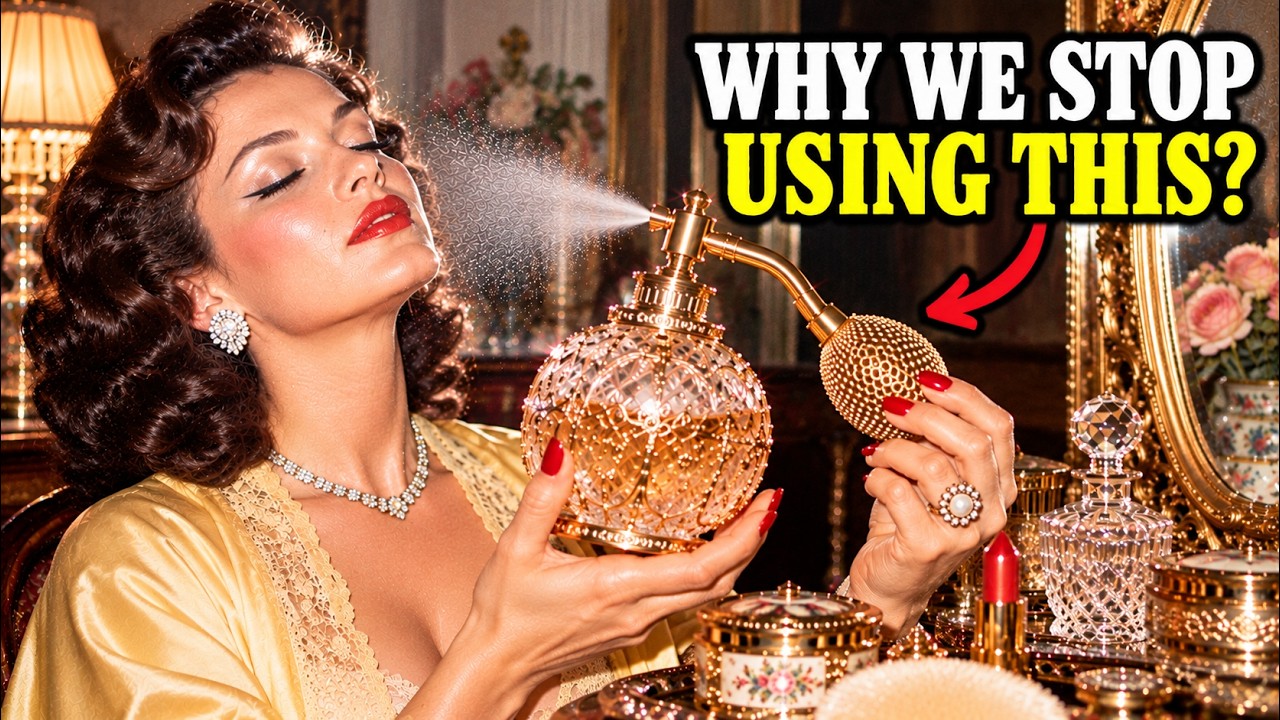
In 1887, Allen DeVilbiss invented a medical atomizer for treating throat conditions. His son Tom inherited the business in 1905 and had a different idea. Women should spray their perfume through something beautiful. By the mid-1920s, DeVilbiss was selling close to a million atomizers per year in America alone.
Here is what almost nobody knows. DeVilbiss made only the hardware, the pump, brass fittings, silk-covered tubing, gold-threaded tassel. The glass came from Steuben, Durand, Fenton, and Czech glass houses. When you find a signed DeVilbiss atomizer with stunning art glass, the glass is by someone else entirely.
DeVilbiss assembled the dream. The hand-crocheted netting over the rubber squeeze bulb was made by local women employed part-time to crochet silk mesh coverings by the hundreds. A cottage industry of women hand-making the element closest to your fingers, completely invisible to anyone who just sees the finished object. Buy a vintage atomizer for the object.
The inner rubber almost always needs replacing. Buy a new one to actually use. In 1898, a French pharmacist named Maurice Berger invented a catalytic combustion lamp to purify air in hospitals and mortuaries. He filed the patent as a new lamp system for purifying the air.
By the 1910s, Parisian department stores were selling crystal Berger lamps as luxury accessories. By the 1940s, Coco Chanel had one, Picasso had one, Jean Cocteau had one, Colette had one. A device invented to deodorize death became the most elegant thing on a French intellectual’s side table. The brand still exists, Maison Berger Paris, and sells over five million liters of fragrance and eight hundred thousand lamps per year across fifty-six countries.
This is not a nostalgia item. It has a direct line back to a pharmacist’s concern about hospital air quality. The wick needs care, and the refill oils are proprietary. But the scent diffusion is genuinely different from a candle or reed diffuser.
There is a reason Picasso kept one. The mirrored gold perfume tray turned a surface into a still life. A mirrored tray holding matched crystal bottles, perfume bottle, atomizer, powder jar, sometimes four or five pieces in coordinated crystal cuts. Baccarat made them.
Lalique made them. Czech crystal houses exported them across Europe and America. The point was arrangement, that your vanity table, seen from the doorway, looked like a curated display in a shop window. Beauty as visual intention.
Finding an intact match set today is genuinely difficult. One bottle chips, a stopper goes missing. An almost complete set, three out of five pieces, similar cuts, still achieves the effect at a much lower cost. The modern interior design world has rediscovered the perfume tray almost entirely.
West Elm and Anthropologie sell versions. None have the weight of original Czech crystal, but the concept is identical. The original permanent wave machine looked like a chandelier. Literally.
Debuted in London in 1909 by Karl Nessler, it had cloth-wrapped wires with heated rollers hanging from a dome structure, each clamped to a section of hair. Nessler’s first two test runs, both on a human head, resulted in burning off all the hair. He kept going. In 1928, a Black American hairdresser named Marjorie Joyner invented an improved version.
Her dome helmet used electrical current to heat hair in one-inch sections simultaneously. Faster, more consistent. She was granted patent number 1,693,515, the first patent issued to an African-American woman for an invention that would be used nationally. Marjorie Joyner never profited from it.
Her employer, Madam C. J. Walker’s company, owned the rights. A Black woman invented a machine used in salons across the entire country and received none of the financial return.
The modern dome heat cap used by the natural hair community for deep conditioning and twist setting is the direct technological descendant of Joyner’s invention. The concept survived. The credit took much longer. A Swedish physician named Gustav Zander designed vibrating massage devices in the late nineteenth century for medical use.
John Harvey Kellogg, the cereal guy, promoted a version at his Battle Creek Sanitarium from 1927. By the 1950s, beauty salons and homes were using wider versions marketed as passive fat-dissolving machines. You strapped a canvas belt around whatever concerned you most and stood there. The vibrating belt appeared in I Love Lucy.
It appeared in The Flintstones. Popular culture was already joking about it while it was actively being sold. Scientific consensus by the 1980s confirmed what the comedy had been suggesting. Zero fat reduction benefit.
None. As recently as 2002, similar devices were still being marketed with false slimming claims. What is interesting is not the failure. It is the human need it addressed, the desire for something that transforms the body without the inconvenience of moving it.
That desire did not end in the 1950s. It has simply been re-marketed in different packages. Unlike the vibrating belt, the electric facial steamer actually works. Facial steamers in salon use predate home versions.
Heated steam directed at the face for circulation, pore preparation, and softening makes everything applied afterward absorb more effectively. Home versions appeared in the 1950s and 1960s. Then the steamer disappeared for a generation. Women moved to active cleansers, AHAs, retinols.
The facial steamer felt fussy and old-fashioned. And then it came back, in nano-ionic, Panasonic, Conair, and boutique versions. Dermatologists are split on it for acne-prone and rosacea-prone skin, where heat can cause flushing. But for dry or mature skin, or as prep before a mask, the case is solid.
The 1950s bathroom had it right. We just put it in the back of a cupboard for thirty years before remembering it worked. Commercial aviation changed beauty in the 1950s in a way nobody quite talks about. Flying became accessible to the middle class for the first time.
Travel became a social statement. And beauty had to be portable. The train case, hard-sided, pastel pink or powder blue, fitted interior tray, mirror inside the lid, small lock and key, was the symbol of glamorous portability. It appeared in advertisements alongside Pan Am luggage sets.
The lock matters more than it sounds. It existed because the contents were worth securing. Your lipstick, foundation, and pressed powder were not cheap daily consumables. They were an investment treated accordingly.
Brands like Globetrotter and Impressions Vanity have produced direct revivals. Same silhouette, same pastel colorways, same interior tray design. The only difference is the current version costs considerably more than the original. The luxury version of the train case was made from Lucite, transparent acrylic with glitter suspended inside, or formed as a clear dome over a reverse-carved and foil-backed interior.
The reverse carving technique is what makes these extraordinary. A craftsperson carved a design, roses, leaves, geometric patterns, from the underside of the Lucite dome. That carved surface was set against a metallic background. When light hit the piece, it traveled through the clear Lucite, refracted through the carved shapes, and reflected off the foil underneath.
Three-dimensional glittering depth that no surface printing could replicate. British makers Kigu, Mascot, and Melissa produced these through the 1940s and 1950s. Mainstream luxury items sold in department stores. Gift items.
Christmas items. The Lucite used was the same material in Cadillac dashboard details. A prestige plastic. Modern, optimistic, catching light in a way that felt genuinely new.
It yellows with UV light. Even with light yellowing, the reverse-carved designs remain extraordinary. In 1951, the bonnet hair dryer arrived for home consumers and changed the relationship between women and professional beauty care permanently. Before this, a salon blowout meant going to a salon.
After 1951, you opened a pastel suitcase on your dressing table, unfolded a fabric and lace bonnet, connected it to a hose, and the salon came to you. By 1962, some models were designed so the motor could be strapped across your shoulder and worn while you moved around the house. A woman in 1962 walking through her kitchen with a motor on her shoulder, a hose running to a bonnet on her head, doing housework while her hair set. General Electric’s bonnet dryer doubled retail sales from 1960 to 1961.
At roughly $21. 98, close to a full week’s wages for many households, that adoption rate tells you how much women wanted this. GE commissioned Sally Victor, an award-winning New York hat designer, to create decorative bonnets in the fabrics from her hat collections. The thing touching your damp hair was designed by a professional fashion designer.
The bonnet dryer is back, not as a retro curiosity, but as a genuine functional tool. The natural hair community uses heat caps on exactly the same principle for deep conditioning and twist setting. The concept was right in 1951. It is still right.
Every other item on this list is about going somewhere. The carryall is for a dance. The wristlet is for a party. The train case is for a trip.
The hairdryer is for getting ready. They are all objects oriented toward departure, toward being seen, toward arriving somewhere. The swansdown powder puff is different. A large goose down or high-quality synthetic puff, paired with a heavy glass powder jar, sat at the center of the vanity table.
Not at the edge. At the center. Because it was used in the private moment before any of the going somewhere began. You lifted the lid of the glass jar, sometimes silver-plated, sometimes mirrored on the interior.
You pressed the puff into the loose powder. You dusted it across your face and your neck, and then you were ready. No brush, nothing compact about it. This was a large, soft, extravagant object designed to make a single step in your routine feel like something more than a step.
The sensation of a real swansdown puff on your face is genuinely different from pressing a compressed pad against your cheek. There is a reason it survived from the Edwardian era through the 1950s essentially unchanged. There was a French version called the Houppette Pli, a retractable swansdown puff patented in the 1920s, where the mechanism worked like an umbrella. Push the handle upward and the swansdown opened from inside the case, the powder stored in the handle itself.
A beauty tool operating with the engineering logic of an umbrella. The honest drawbacks: swansdown sheds. Loose powder is less portable than pressed. The glass jar takes up surface space.
None of that is why it is number one. It is number one because of what it represents. The idea that getting ready deserves a private ritual, not just a transaction. That the moment before you walk out of the room, just you and the mirror and the soft weight of something beautiful in your hand, that moment matters.
The 1950s vanity table was built around that belief. Charlotte Tilbury sells swansdown puffs. Chanel and Dior sell them. The glass jar with the silver lid is back everywhere, being sold as a cotton ball holder, a counter accent.
The loose powder ritual is coming back specifically because people have discovered it gives a finish no compact can replicate. The rest of the list is beauty as performance. This is beauty as quiet ceremony. That is why it sits at the center of the table.
And all twenty-three of these objects were treated like they mattered. That might be what we are actually trying to recover.






