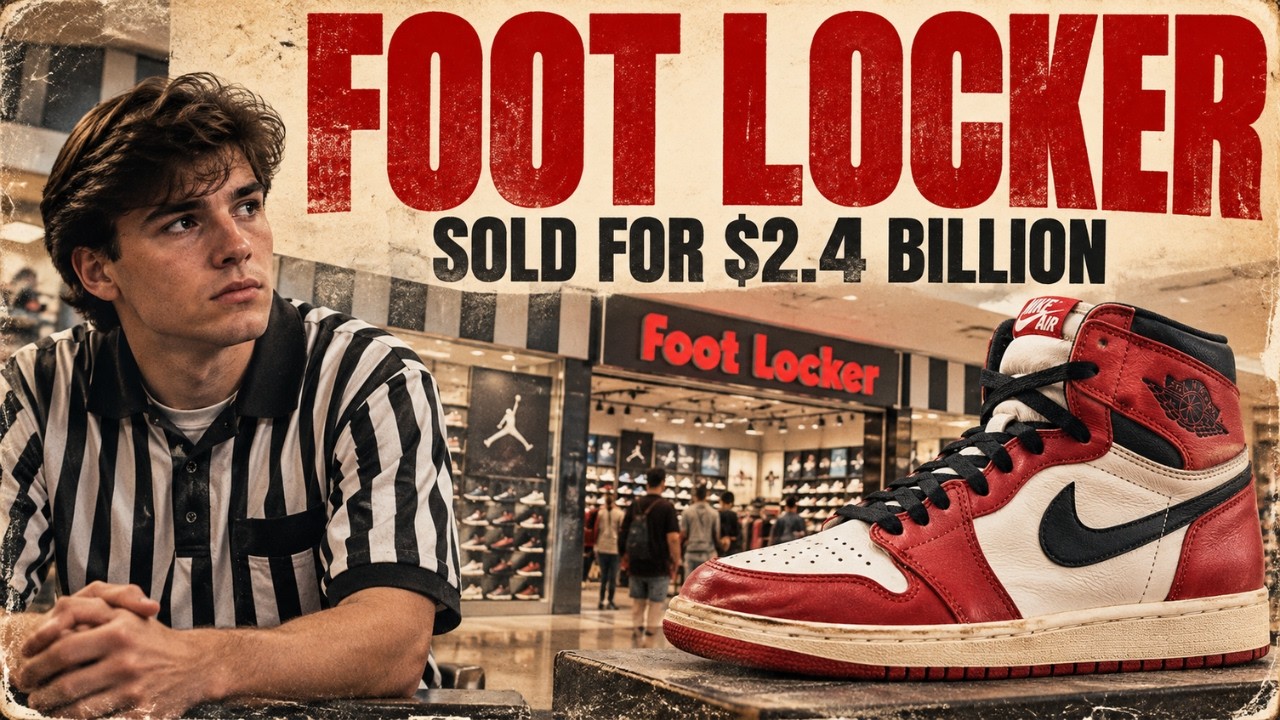
Foot Locker stopped belonging to itself at eight o’clock on the morning of September 8th, 2025. A press release from Pittsburgh, only a few hundred words long, announced that the company behind the striped shirts had been acquired. Fifty-one years after the first store opened in a California mall, the chain that once defined sneaker culture had become a subsidiary of its old rival, Dick’s Sporting Goods. The ticker symbol FL vanished from trading screens, and the executives who had led the company through its final years walked out the same morning.
The story did not begin with a sneaker. It began in 1879, when Frank Winfield Woolworth opened a five-cent store in Utica, New York, promising to sell almost everything as cheaply as possible. A second store in Lancaster, Pennsylvania worked, and the idea grew into a retail empire. By the early twentieth century, Woolworth’s was a fixture on Main Street in towns across America, a place where families bought thread, candy, toys, and kitchen goods under one roof.
In the 1960s, Woolworth bought the Kinney Shoe Corporation, a traditional retailer that sold school shoes and church shoes. Kinney began experimenting with narrow, single-category stores. In 1974, it tried again, opening a store in the Puente Hills Mall east of Los Angeles that sold only athletic shoes. The staff wore black and white referee stripes, and the store was called Foot Locker.
It had no founder, no garage origin story. It was a corporate experiment, born inside a subsidiary of one of the biggest retailers in America. The experiment did not stay small. As America discovered jogging, aerobics, and basketball shoes, the striped shirts spread from mall to mall.
Foot Locker was standing at the center of teenage life during the decades when the shopping mall ruled it. By the 1990s, the child had outgrown the parent. Foot Locker accounted for more than seventy percent of Kinney’s sales. Woolworth’s itself was fading, and in 1997 the last stores under that name in the United States closed.
The old corporation changed its name to Venator Group, then finally, in 2001, took the name of its most successful child. Foot Locker Incorporated. The years that followed were the high tide. The employees in referee shirts became known as stripers, and release days drew lines outside mall entrances before the gates opened.
The engine underneath it all was Nike. Foot Locker was treated as a most favored partner by nearly every brand it carried, and fiscal 2015 became the high-water mark, with $7. 412 billion in sales, the highest in company history. But the success ran through a single supplier.
In 2017, Nike announced a strategy called Consumer Direct Offense, built around selling more of its own shoes directly to shoppers through its own stores, websites, and apps. Nike said it could earn more than double the profit on a pair sold through its own channels than through a wholesaler. It concentrated its best products on a small group of retail partners, and named Foot Locker as one of the forty. For a short time, that looked like good news.
As Nike pulled product away from smaller shops and department stores, Foot Locker became one of the few places left to buy it. It leaned in harder and bought more Nike product than ever. In 2019, seventy-one percent of everything Foot Locker purchased came from Nike. The following year, that figure rose to seventy-five percent.
Then the pandemic arrived, and Nike stepped on the accelerator. In June 2020, chief executive John Donahoe unveiled Consumer Direct Acceleration, a digitally empowered phase of the earlier strategy. Nike set a goal for direct sales to reach sixty percent of its business by 2025. It named Foot Locker, along with JD Sports and Dick’s Sporting Goods, as large strategic partners.
On paper, Foot Locker had survived the cut. But the message was clear. Foot Locker had built three quarters of its business on a supplier openly telling the world it wanted to keep more of its customers for itself. On the morning of Friday, February 25th, 2022, Foot Locker reported the best year in its history.
Sales for fiscal 2021 rose to nine billion dollars, and net income nearly tripled to $893 million. Then came the forecast. Foot Locker said no single vendor was expected to account for more than about sixty percent of its purchases in the coming year, down from seventy percent, falling to no more than fifty-five percent by the fourth quarter. The company explained the change as an accelerated strategic shift to direct-to-consumer selling by one of its vendors.
Everyone knew which vendor. The stock opened lower and kept falling. By Friday afternoon, shares were down about thirty-five percent, touching a 52-week low. It was the worst single-day loss in more than four decades.
Roughly $950 million in market value was gone before the weekend. On the earnings call, chief executive Richard Johnson admitted, “When that much of a business depends on one supplier, there is not much room for choice. ” Analysts were stunned. One downgraded the stock, saying plainly, “We were not expecting this.
”
Foot Locker scrambled to diversify, leaning on Adidas, Puma, and Timberland, but no other brand drew a line around a mall entrance the way a Jordan release did. In August 2022, Johnson retired, replaced by Mary Dillon, the former chief executive of Ulta Beauty. In March 2023, she unveiled a turnaround plan called Lace Up. The company announced it would close roughly four hundred underperforming stores by 2026, most of them in malls.
For a company born in a mall, it was a remarkable admission. Dillon also told investors the relationship with Nike had been repaired, with joint planning reestablished and results expected by the holiday season. But five months later, the floor gave way. In August 2023, Foot Locker reported second-quarter sales down nearly ten percent and a net loss.
The forecast was cut again, and after one final payment in October, the company paused its quarterly dividend. The stock dropped more than thirty percent, the lowest price in twelve years. Then something strange happened at Nike. The direct-to-consumer strategy had worked brilliantly while shoppers were stuck at home, but as the world reopened, Nike found itself with too much inventory and too few places to sell it.
It began welcoming wholesale partners back. It returned to regional chains and launched joint loyalty programs. By June 2024, Nike reported the first decline in its digital sales in its history. But the wholesale door Nike reopened was a wide one, and many retailers walked through together.
Foot Locker’s old position, the favored partner at the center of the sneaker world, did not come back with it. Foot Locker pushed on. The fiftieth anniversary arrived in 2024, marked by partnerships, new store concepts, and a multi-year deal with the Chicago Bulls. There were signs of life, with comparable sales rising in the second and third quarters.
But when the year ended, sales had fallen to about 7. 9 billion dollars, down from 8. 1 billion the year before. The celebration had not changed the direction of travel.
Then came 2025 and a new storm. Tariffs and trade uncertainty swept through an industry that makes most of its shoes overseas. Investors fled retail stocks, and Foot Locker shares lost about forty percent by the middle of May. After fifty years, two chief executives, and a turnaround plan, Foot Locker no longer had the strength to decide its own future.
Someone else was about to decide it. On Wednesday, May 14th, 2025, the Wall Street Journal reported that Dick’s Sporting Goods was nearing an agreement to buy Foot Locker. Shares jumped nearly seventy percent in after-hours trading. The deal was announced the next morning.
Dick’s would acquire Foot Locker for about $2. 4 billion, with shareholders able to choose $24 in cash per share or a fraction of a share of Dick’s stock. The offer was eighty-six percent higher than the closing price before the news leaked. Ed Stack, Dick’s executive chairman, admitted a big part of the pressure on Foot Locker had come from its relationship with Nike and Nike’s turn toward selling directly.
Dick’s planned to run Foot Locker as a stand-alone business, keeping its name and its banners: Kids Foot Locker, Champs Sports, WSS, and Atmos. The final steps took less than four months. On Friday, August 22nd, 2025, shareholders approved the sale, with about ninety-nine percent of votes cast in favor. Three days later, the waiting period under antitrust law expired.
On Monday morning, September 8th, 2025, at eight o’clock Eastern time, the press release went out. Dick’s had completed its acquisition. Mary Dillon’s name was not in the release. Neither was the name of Foot Locker’s president.
According to a company filing, the entire executive team left that same day, and every member of the board resigned. In their place, Dick’s installed new leadership, including Anne Freeman as president of Foot Locker North America, who had spent twenty-six years at Nike and helped run its North American business. Dick’s did not wait long to reveal what it had found inside the company it had bought. In November 2025, Ed Stack described the new owner’s plan in four words: clean out the garage.
That meant clearing out unproductive inventory and closing underperforming stores. A new program called Fast Break cut the number of products in each store by roughly thirty percent, cleared clutter from the walls, and brought back apparel. In the first quarter of 2026, Fast Break expanded from eleven stores to about one hundred, and Dick’s said those stores delivered double-digit growth in comparable sales. But the fleet kept shrinking.
Between February and August of 2026, Dick’s closed 110 stores and opened 27. The man overseeing the closures was Tony Aversa, a thirty-year Foot Locker veteran who had announced the 2023 plan to shut four hundred mall locations under the old ownership. He had outlasted the chief executive who designed the plan and the company’s independence itself. For a moment in the spring of 2026, it looked as though the new owners might succeed.
Foot Locker returned to growth in comparable sales and to profitability. Then came the second quarter. Dick’s own stores grew comparable sales almost five percent, lifted by the 2026 World Cup. Foot Locker’s comparable sales fell 3.
6 percent, and the business lost almost $32 million. There had been fewer major sneaker launches that quarter, and the ones that did arrive performed worse than expected. The sneaker launch, the same Friday release that had once drawn lines around mall entrances, was still the heartbeat of the business. And Foot Locker still did not control it.
As of this account, the story has no ending. Foot Locker is not dead. It still runs nearly 2,500 stores across the world, and its striped shirts still work the floor. But it no longer reports its own results, answers to its own board, or sets its own course.
Its fate now appears as a single segment line in another company’s quarterly filing. The pattern is not complicated. A business that depends on a single supplier is not fully its own. For years, Foot Locker’s closeness to Nike looked like strength.
It turned out to be leverage held by someone else. And the story turned in a circle. The child that once outgrew Kinney, outlived Woolworth’s, and took the parent company’s name for itself became someone else’s subsidiary. On September 12th, 1974, a single store opened in the Puente Hills Mall selling one kind of shoe, its staff wearing referee stripes as if someone had to keep the game fair.
Fifty-one years later, the referees were still there. They just worked for a different team.
