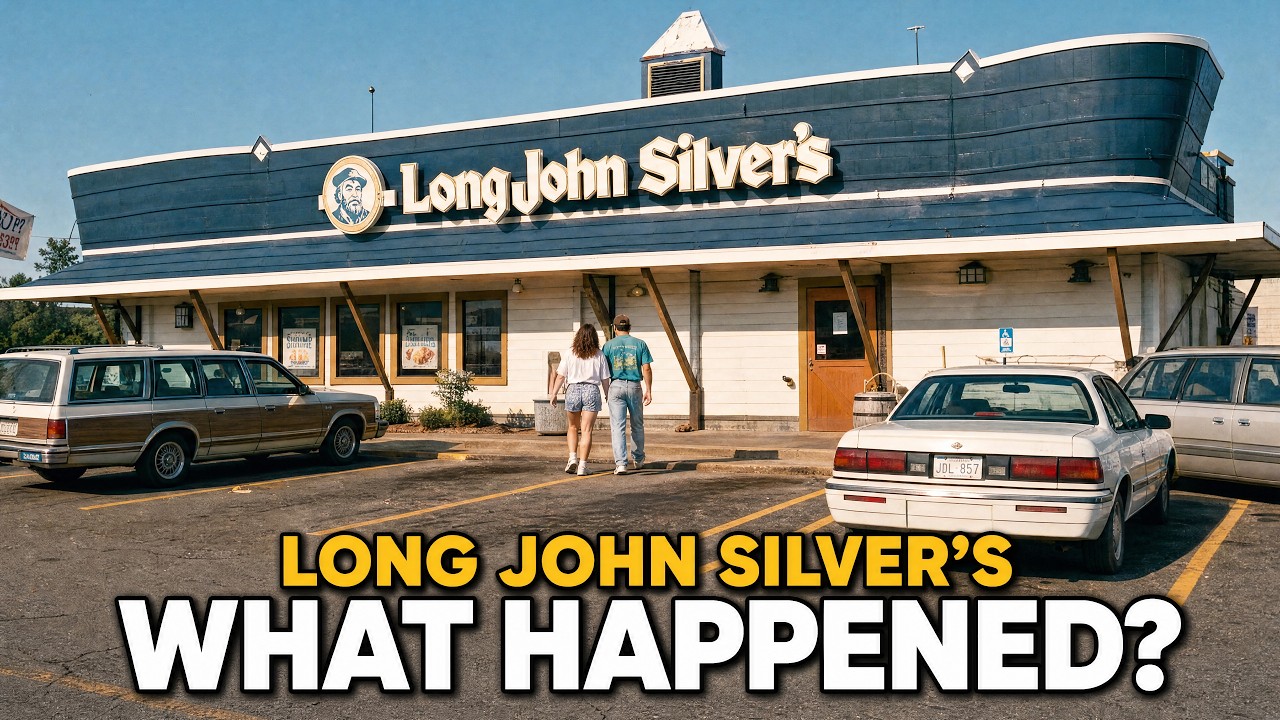
By the early 1980s, Long John Silver’s was the largest fast-food seafood chain in the United States, with more than a thousand restaurants and no serious rival in its corner of the industry. In a country built on burgers, fried chicken, and pizza, it had made cheap battered fish a national habit, planting little wooden ships in strip malls from coast to coast and convincing millions of landlocked Americans to pull off the highway for a cardboard box of fried fish, hushpuppies, and the crispy loose batter scraps known as crumblies. At its peak, the chain approached roughly 1,400 locations. Today, only a few hundred remain, and the standalone seafaring restaurants are vanishing.
The largest fast-food seafood empire America ever built has spent the last three decades slowly sinking, and the story of how that happened begins somewhere surprising: not on a coast, but in Kentucky, with a hamburger stand. The roots of Long John Silver’s reach back to 1929, when Jerome Lederer opened a tiny six-seat hamburger stand called The White Tavern Shop in Shelbyville, Kentucky. The business grew through the Depression, was battered by wartime shortages, and regrouped after World War II, when Lederer founded Jericho Incorporated and launched a new restaurant called Jerry’s. Jericho was an early pioneer of the franchise model and relentlessly willing to test new concepts.
In 1948, Lederer hired a sharp young manager named Warren Rosenthal, and when Lederer died in 1963, Rosenthal took over and kept experimenting. Through the 1960s, Jericho tested a roast beef sandwich concept, a full-service seafood restaurant called Davie’s Dock, a Spanish food place called Don Q’s, and an upscale dining concept called The Governor’s Table. Most failed, but the company treated the restaurant business as a series of experiments, expecting most to fail in the hope that one would break through. Davie’s Dock taught the company about serving seafood, and Rosenthal paid attention.
He noticed the fish-and-chips concept catching on, studied a competing chain closely, and became convinced there was real untapped demand for fast, cheap, quality seafood. In 1969, that conviction produced Long John Silver’s. Rosenthal recruited a Jerry’s franchisee named James Patterson to help build it, and together they opened the first Long John Silver’s Fish and Chips in Lexington, Kentucky. Patterson became the chain’s first president.
They named it after the one-legged pirate from Robert Louis Stevenson’s Treasure Island, a name that conjured the sea, adventure, and ships, and they built the restaurants to match. The early locations were designed in a New England Cape Cod style, with blue roofs, square cupolas, wooden benches and tables, lobster pots, and ship’s wheels on the walls. The idea was to transport a person in a strip mall in Ohio or Texas, a thousand miles from any ocean, into a little seaside fish shack on the coast of Maine. The food delivered on that fantasy.
The heart of it was whitefish dipped in a distinctive seasoned batter and fried until golden and crackling, served with fries, hushpuppies, fried shrimp and clams, coleslaw, and tartar sauce or malt vinegar. And piled on top were the crumblies, the free crispy fragments of loose batter scooped from the fryer, which people adored with an almost irrational passion. It was cheap, hot, salty, fried comfort, and for a while America pushed that button over and over. The concept worked fast.
By 1971, just two years after opening, Long John Silver’s had blown past two hundred locations and become Jerrico’s most successful chain, bigger than Jerry’s or any of the experiments. In 1973, the menu expanded and the chain was renamed Long John Silver’s Seafood Shops. Through the 1970s and into the 1980s, it grew aggressively, crossing a thousand locations in the early 1980s and standing as the undisputed king of fast-food seafood. This was the golden era.
Families across the Midwest and the landlocked heartland made it their Friday night ritual, a fun little pirate ship where a fish dinner was cheap and quick. But the success was built on two deep structural disadvantages that were always there, lurking beneath the surface. The first was that a huge number of Americans simply do not like seafood or do not trust it. Fish is one of the most polarizing foods there is.
Millions dislike the taste, millions more are suspicious of freshness, put off by the smell, or afraid of bones. This was especially true in the landlocked middle of the country, where Long John Silver’s did most of its business, regions with no coastal seafood tradition where people grew up on beef and pork and viewed fish with genuine wariness. The chain had voluntarily walked into the fast-food arena selling a product a large chunk of its potential customers would not eat under any circumstances. That it built a thousand-restaurant empire anyway was a testament to how well it executed, but the narrow, skeptical customer base was a permanent structural weakness with far less margin for error than a burger chain had.
The second disadvantage took longer to bite but proved even deadlier. Long John Silver’s entire identity was built on fried food at the exact moment in history when America was beginning a long, slow turn against it. Everything the chain sold, the fish, shrimp, clams, chicken, hushpuppies, and the beloved crumblies, was battered and deep fried. That was the appeal in 1975, when fried and crispy meant delicious.
But starting in the late 1970s and accelerating through the 1980s, 1990s, and 2000s, Americans became conscious of fat, cholesterol, and calories, and a chain whose entire menu was a monument to the deep fryer found itself on the wrong side of where the culture was heading. The very thing that made the food so satisfying became exactly the kind of food health-conscious Americans were supposed to avoid. There was a cruel irony here, because seafood itself should have been perfectly positioned for the health turn. Americans were told over and over to eat more fish.
But Long John Silver’s didn’t really sell fish; it sold fish encased in a thick fried batter shell, transformed by the fryer into something as indulgent as any burger. It got the worst of both worlds: it didn’t attract the health-conscious diners who wanted grilled, clean, light seafood, and it was increasingly avoided by the calorie counters who had once eaten there for a treat. There was also a quieter tailwind fading: for generations, American Catholics had observed meatless Fridays, especially during Lent, which gave the chain a reliable weekly reason to serve fish. As observance of that tradition softened across American life, that built-in reason to eat fish weakened too.
For years, the chain overcame all of this through sheer dominance, since it was the only real fast-food seafood game in town. That monopoly on the category masked the underlying fragility. But a business built on a narrowing base, selling an increasingly out-of-favor product, needs everything else to go right. It cannot afford a major mistake.
And then, in 1989, it made one. Jerrico, the Kentucky parent company, was taken private through a highly leveraged management-led buyout. In a leveraged buyout, a group of buyers purchases a company using a huge amount of borrowed money, then loads that debt onto the company itself. The company essentially takes on an enormous loan in order to buy itself and then has to spend years using its own profits to pay it back.
The buyers got their ownership; the company got the bill. From that day forward, a huge share of every dollar the restaurants earned was spoken for before it could be spent on anything that might actually help them. This kind of deal can work when a business is growing fast and has a wide, stable market. It is catastrophic when applied to a business that is fragile, needs to reinvent itself, and is already fighting structural headwinds.
Long John Silver’s was exactly the second kind. In 1990, the newly private company concentrated all the risk by divesting its other restaurant concepts. It sold off Jerry’s, sold off a growing Italian chain called Fazoli’s, and sold off the rest to focus entirely on Long John Silver’s. On paper, focus sounds good, but it meant the entire crushing debt load now rested on the shoulders of a single business, the fried seafood chain with its narrow customer base and out-of-favor menu.
One of the concepts sold off to prop up Long John Silver’s was Fazoli’s, which went on to do just fine on its own. The company had sold its healthier children to pay the debts piled onto its most vulnerable one. The combination was fatal. Debt is a permanent, relentless drain.
Every month, before Long John Silver’s could spend a dollar on anything else, it had to service that debt. There was no money to renovate the aging restaurants, which were starting to look dated and tired. There was little money to develop the healthier, grilled options that might have answered the health-conscious turn. There was no cushion to weather a bad year.
The 1990s were exactly the decade the chain most needed to reinvent itself, to answer the health turn, to renovate its tired buildings, to modernize its menu. And it was the exact decade it had no money to do any of it, because every spare dollar went to servicing the debt. The harder the times got, the more the chain needed resources to fight, and the debt guaranteed there were none. In 1998, the inevitable happened.
Jerrico, the parent company whose roots reached back to that 1929 hamburger stand, was forced to file for Chapter 11 bankruptcy. Long John Silver’s stopped being a proud, independent company and became a passed-around asset. In 1999, it was acquired by the company that owned A&W Restaurants, and the two were combined into a new firm called Yorkshire Global Restaurants. Then in 2002, Yorkshire was swallowed by Tricon Global Restaurants, the conglomerate that owned Taco Bell, Pizza Hut, and KFC, and which would soon rename itself Yum Brands.
The former king of fast-food seafood was now one small unit inside a giant portfolio dominated by tacos, pizza, and fried chicken. Yum Brands loved co-branding, combining their restaurants under one roof, a building that was half KFC and half Taco Bell, or half A&W and half Long John Silver’s, sharing a kitchen, a counter, and a dining room. It made sense for efficiency, but it destroyed the seafaring fantasy that was the entire emotional appeal of the brand. The blue roof, the Cape Cod building, the ship’s wheels, the lobster pots, the feeling of stepping into a little seaside fish shack, all of that was crammed into half of a generic combo building sharing space with a taco counter.
When you put a Long John Silver’s fish counter into the corner of a KFC, you stop treating it as a destination and start treating it as an add-on, a menu extension, a way to squeeze a little extra revenue out of a building that primarily exists to sell fried chicken. The seafood became an option for the person who didn’t want chicken, not the reason anyone came. The standalone wooden ships began to disappear, replaced by fried fish counters in the corners of somebody else’s restaurants. The brand lost its body, its physical magic.
Under Yum, Long John Silver’s was frankly an afterthought, the small, weird, non-core brand in a company whose real energy went to KFC and Taco Bell. It didn’t get the investment, innovation, or love a struggling brand needs. It just sat there, shrinking. In 2011, Yum Brands sold Long John Silver’s off to a group of franchisees and investors, a consortium that included some connection to the chain’s early leadership.
The idea was that people who actually cared about the brand, who ran the restaurants and knew it, might save it in a way a giant conglomerate never would. The franchisee-led ownership has tried to steady the ship, updating the menu, adding some non-fried and grilled options, and leaning into the nostalgia so many people feel for the brand. But affection and nostalgia are not the same as regular business. Many people love Long John Silver’s the way you love a memory, warmly, occasionally, from a distance, without actually going there very often.
A restaurant chain cannot survive on fond memories. It survives on people walking through the door this week and next week and the week after. People love what the place meant to them at eight years old, love the memory of their family in that booth, love the crumblies of 1985, but their actual eating habits have moved on to a hundred other options. A brand can be simultaneously beloved and dying, adored in memory and empty at the counter.
So today, Long John Silver’s hangs on with a few hundred locations, a shadow of the empire it once was. It has weathered its bankruptcy, its ownership carousel, its dilution into shared buildings, and the slow erosion of its aging restaurants. You can still get the fish, the hushpuppies, and the crumblies. The temptation is to blame the leveraged buyout for its decline, and it certainly delivered the crucial blow.
The debt from 1989 is the single clearest turning point, the weight that dragged the company under at the exact moment it needed to swim hardest. But the deeper truth is that the buyout was only fatal because of the two currents underneath. Long John Silver’s was uniquely vulnerable to that debt precisely because its business was already fragile, because it was selling a polarizing food that many Americans wouldn’t eat, in a fried form that America was increasingly turning away from. A burger chain with that same debt might have survived, because burgers have a huge, stable, forgiving customer base.
Long John Silver’s had no such cushion. Its narrow base and out-of-favor product meant it had zero margin for error, and the debt eliminated the last of that margin. The buyout was the blow, but the vulnerability was baked in from the beginning, from the fundamental decision to build an empire on fast-food fried seafood in a landlocked, increasingly health-conscious nation. What remains is a poignant achievement.
Long John Silver’s took a food half the country was skeptical of and built a thousand-restaurant empire on it. It took the romance of the sea and planted it in strip malls a thousand miles inland. For a couple of decades, it did this better than anyone ever had or ever would. That it couldn’t sustain it against the twin pressures of a changing diet and a crushing debt doesn’t erase how improbable and how real the achievement was.
Somewhere out there tonight, in one of the few hundred locations that are left, the fryers are hot. A basket of whitefish goes down into the oil and comes up golden and crackling. Someone scoops the loose crispy crumblies into a box, free, the way they always did.
The blue roofs are mostly gone now, the wooden ships hauled away one by one, but the fish still comes up golden, the crumblies are still free, and for the people who remember, that first crackling salty bite still tastes exactly like being eight years old on a Friday night in a pirate ship in the middle of America, a thousand miles from any ocean, and somehow, impossibly, right there at the edge of the sea.
