The work began in October 1958, with a segment of steel swinging out over the rim of Glen Canyon, seven hundred feet above the Colorado River. Below, the water was a thin ribbon. The segment hung from a wire stretched across the gorge, a temporary track that, from this distance, looked no thicker than a man’s arm. Crewmen guided it with hand lines toward the growing arm of the arch.
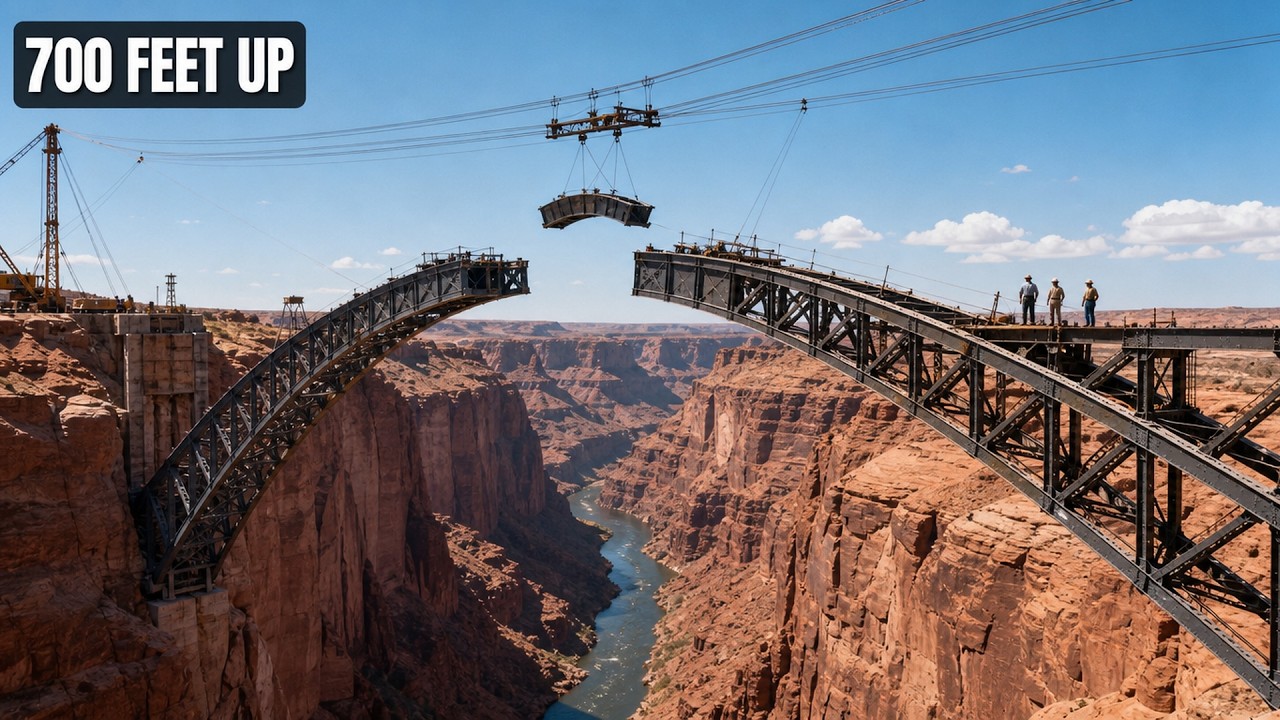
That arm extended dozens of feet into open air with nothing beneath it. Nothing. It was held in place only by cables running back to anchorages buried in the sandstone. If one of those moved, the arm moved with it.
Today, traffic on U. S. Route 89 crosses that canyon without slowing. The bridge is so embedded in the desert landscape that most drivers barely notice it.
They pass over the Colorado River on a steel arch assembled piece by piece across empty space, with no supports underneath, no falsework in the gorge, no tower rising from the water. What made that possible was not widely understood at the time, and it is now almost completely invisible. The arch looks as if it has always been there. It was not, and closing its center gap required a precision that depended on something no engineer could fully control: the temperature of the steel on a desert night.
Glen Canyon is not a gentle place. Its walls drop almost vertically toward the river. The gorge was so deep and sheer that when engineers began planning the crossing needed to build the dam, the obvious solution—erecting timber or steel falsework from the riverbed and setting the arch on top of it—was not feasible. A falsework tower tall enough to reach even halfway up would have required more material than the bridge itself, would have been dangerously unstable in the canyon winds, and would have needed an access road that did not yet exist at river level.
The traditional approach was ruled out before it was seriously considered. The alternative was a cantilever arch. Build both halves from the rims outward, growing each arm into the void, then join them at the center. It sounds direct.
It is the opposite of direct. An arch carries load through compression, each section pressing against the next, the whole structure supporting itself by its own geometry. But that geometry only works when the arch is complete. Before closure, each half acts like a diving board, a protruding arm that wants to rotate outward and fall.
The farther it reached into the canyon, the stronger that rotational force became. Something had to hold each arm until there was another arm to push against. The engineers solved the first problem with backstay cables. These were heavy steel cables anchored into the canyon walls above the abutments, running down at sharp angles to fittings at the tip of each growing arm.
The cables pulled the tip backward against its tendency to rotate forward and drop. Imagine them as a tightened rein preventing the arm from pitching down. Every new section added to the arm increased the load on those cables. The anchorages in the sandstone had to hold forces that grew heavier with each lift, and the anchor bolts and bearing plates that carried that weight were part of a temporary system, not the permanent structure.
Getting the sections to the tips was a separate problem entirely. There was no road into the canyon, no crane large enough to reach the work site, no way to build anything from below. The answer lay in a cableway system. A network of wire ropes stretched between the rims carried a traveling carriage.
Sections were attached to the carriage, lifted off the rim, and swung out over the gorge. Each section weighed several tons. The cableway ropes sagged under the load, which meant every section arrived at the tip slightly lower than it should have been. The men had to account for the geometry of the loaded rope before the section could be guided into place.
Tag lines held by crewmen at the tip kept each section from spinning in the wind as it approached. There was no room for hesitation among the ironworkers receiving those sections at the tip. The working surface was the top chord of the growing arm, a steel shape so narrow that two men walking in opposite directions had to squeeze past each other. Below them, nothing for hundreds of feet.
The canyon wind, accelerated by the opening between the walls, was unpredictable. Any section arriving at a slightly skewed angle could swing back as it was lowered. The men holding the tag lines had to absorb that motion without being pulled over the edge. They coordinated through hand signals and by watching each other, because the noise of the cableway machinery made voice calls unreliable at that distance.
Once a section was in position, the ironworkers drove temporary drift pins through the bolt holes to hold alignment, then replaced them with permanent high-strength bolts. After that, the backstay cables were retensioned to distribute the new weight across the anchorage system. Then surveyors on both rims read the tip’s elevation and position again. Then the whole cycle repeated.
Another section rigged, another lift, another controlled swing across the gorge. After each section was bolted into place, surveyors on both rims measured the angles and elevations of each arm’s tip. The two arms were growing toward each other from opposite walls across a span of roughly five hundred feet. Each arm had to reach the center at the correct elevation, the correct horizontal position, and the correct angle, all at once, or the closing section between them would not fit.
Any slight misalignment early in either arm would multiply across the entire span. The engineers had to be precise all the way through, with no possibility of adjustment once sections were bolted. So they measured constantly. Elevation readings after every section, horizontal displacement checks, and temperature corrections applied to the survey calculations, because steel tapes and survey rods change length with heat, and desert temperatures swung violently between day and night.
As summer gave way to cooler months, the arms themselves moved subtly with each thermal cycle. The surveyors corrected for it. It was precise, repetitive work, demanding the same exactness as the fitting and bolting, but carried out from a thousand feet away on the opposite rim. What the surveyors could not control was the steel itself.
The closing section, the last piece that would fill the gap between the two tips, was fabricated to precise dimensions. But those dimensions matched the gap at one specific temperature. Steel expands when heated and contracts when cooled. Over several hundred feet, a swing of forty degrees Fahrenheit could change the gap between the tips by more than an inch.
Glen Canyon is a desert. At the height of summer, the steel face of the arch could reach temperatures far above the surrounding air. By nightfall, that same steel could cool to near the air temperature within hours. The gap the closing section had to fill was not stable.
It breathed with the air temperature and the angle of the sun. The engineers calculated a target closure window, a range of temperatures at which the arch would expand or contract to produce exactly the gap the closing section required. That window tended to open in the early morning hours, before the desert heated up and the steel began to expand. The crew would have the closing section rigged on the cableway, tied off and ready for transport.
Thermometers were read on both sides of the arch. When the numbers fell within the target range, the crew moved. The thermal window proved, in practice, to be narrower than the engineers initially calculated. Desert conditions compounded the problem.
Wind, cloud cover, and the canyon’s orientation could change the arch’s temperature faster than expected. What this meant on site was that the crew had to be ready to stop mid-operation, return the closing section to the cableway, and wait for another morning when conditions aligned. The most dramatic moment in the construction of that arch was not a dropped bolt or a fallen section or a snapped cable. It was waiting for thermometer readings to stabilize on a calm morning in the canyon.
When the top chord finally settled into place, the pins driven, the splices closed, the bridge changed in an instant. The backstay cables, which had held each arm against the sky for the entire construction, began to shed their load as the now-complete arch took over. Men slackened them in sequence. The canyon walls that had served as temporary anchors for the cables became just abutments, two blocks of rock receiving the outward thrust of a compression arch, doing the job they had been designed for from the start.
Construction traffic began crossing almost immediately. Glen Canyon Dam could not have been built without a reliable means of moving heavy equipment, aggregate concrete, plant components, and hundreds of workers to the site. The dam required years of construction, millions of cubic yards of concrete, and a workforce that peaked in the thousands. None of that would have reached the other side of the canyon efficiently without the crossing the arch bridge provided.
Later arch bridges built by the same general method used precise cable cranes to control cable tension remotely, and laser instruments to verify alignment in real time. Fabrication tolerances became tighter, which shrank the acceptable temperature range and made the closure process faster and more predictable. But the basic sequence did not change. Extend the arms, hold them back with cables, watch constantly, close at the precise moment when the gap fits exactly.
The bridge still carries Highway 89 across the Colorado River at Glen Canyon. Below the deck, inside the painted steel ribs curving down toward the canyon walls, the bolted connections made by ironworkers on a narrow ledge over open space still transmit the loads. Near the center of the arch, where the two arms met on a cold morning when the temperature held steady just long enough, there is a top chord that fit because the desert cooperated for a few hours.
It carries everything that crosses over it.
