In the summer of 1913, a laborer stood on a temporary wooden platform two hundred feet above the floor of Tunkhannock Creek in Wyoming County, Pennsylvania, guiding a concrete bucket suspended from an overhead cable. The cable ran from an aerial tramway strung between towers on the hillside above. The bucket weighed hundreds of pounds when loaded. His job was to catch it as it swung over the arch formwork, open the discharge gate, and direct the concrete into the form while keeping his footing on a surface that was neither level nor flat and that hung two hundred feet above the stream below.
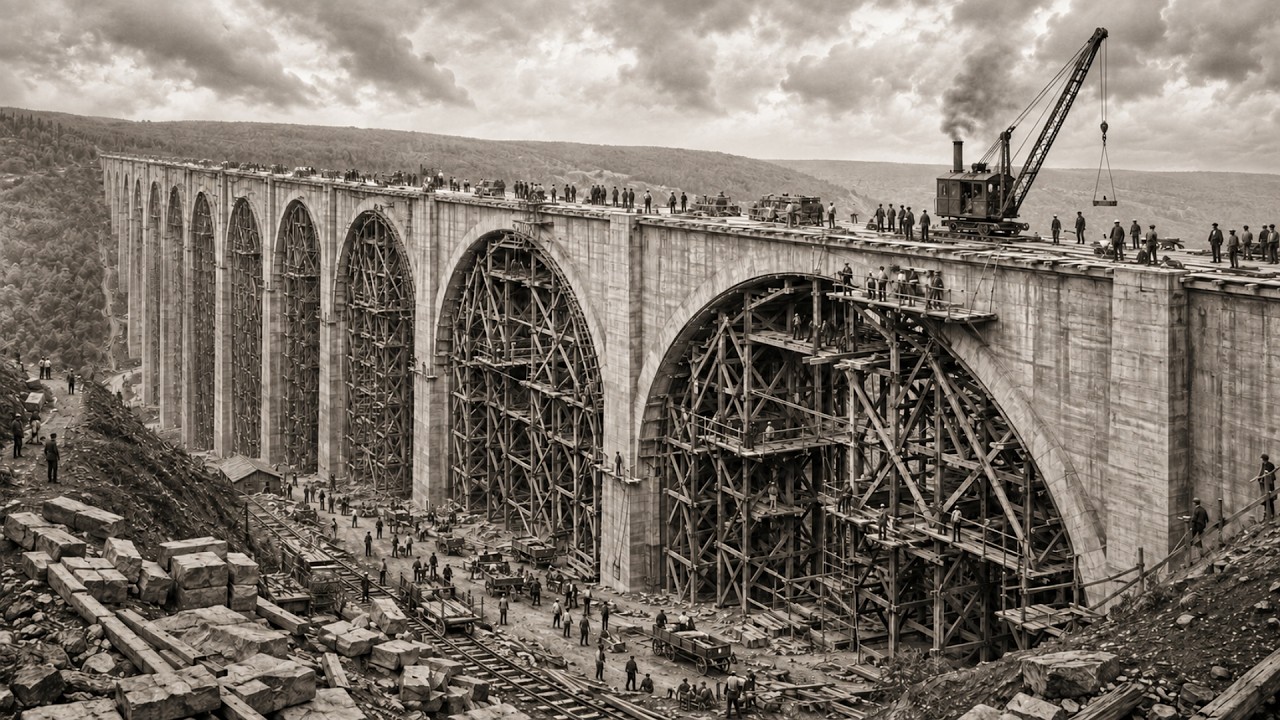
The creek at the bottom, two hundred feet down, looked like a line drawn through the hemlocks and birches in the valley floor. The hill above was close enough to see the mixing plant from which the concrete came. Other arch bays stretched in both directions along the valley. Some were complete.
Some were still open timberwork and empty forms. And some, like the one he was working on, were in the process of becoming what they would be for the next hundred years. What he was pouring was concrete. What he was building was the Tunkhannock Viaduct.
When it was finished in 1915, it would be the largest concrete structure in the world. It would carry the Delaware, Lackawanna and Western Railroad across Tunkhannock Creek on ten elliptical arches, each spanning 180 feet between abutment faces, with a total length of 2,375 feet from abutment to abutment and a maximum height of 240 feet above the valley floor. The viaduct still carries trains today. It is operated by Norfolk Southern on the former Lackawanna main line between Scranton and Binghamton.
Freight crossing it in the twenty-first century runs over the same concrete that the men poured on those platforms in 1912, 1913, and 1914. The man who caught the concrete bucket in the summer of 1913 was Italian. He had come to Wyoming County, Pennsylvania, from somewhere in southern Italy—Calabria, or Campania, or Sicily, or Basilicata. The province is not recorded in the published engineering records of the bridge.
He was one of several hundred Italian immigrant laborers who worked at the Tunkhannock site. His name, if it ever appeared in the surviving construction records at all, appears only in documents kept to track costs, not to track people. To understand why the Delaware, Lackawanna and Western Railroad built a concrete bridge 240 feet high and 2,375 feet long across Tunkhannock Creek in 1912, you have to understand what the Lackawanna main line was in 1900 and what the railroad needed it to become. Wyoming County sits in the northeastern corner of Pennsylvania, within the geological province known as the Ridge and Valley Appalachians.
The province is exactly what its name says: parallel ridges of hard sandstone and conglomerate running northeast to southwest, separated by valleys of weaker shale and limestone, drained by streams that cut through the ridges through water gaps and along the valleys between them. It is winding, repetitive terrain. A railroad running northwest from Scranton toward Binghamton crosses these ridges and valleys at oblique angles to the structure of the land. It climbs, descends, and climbs again.
The Delaware, Lackawanna and Western Railroad had been founded in its modern form in the 1850s to do exactly that. Its purpose at incorporation was to move anthracite coal from the Wyoming Valley coal fields around Scranton and Wilkes-Barre north and east to the markets of the northeastern seaboard. Anthracite from the Wyoming and Lackawanna Valleys was the home heating fuel of New York, Philadelphia, and Boston, and the industrial fuel for the iron furnaces and manufacturing plants of the northeastern corridor. It was dense, high-energy fuel with no close substitute in the domestic market of the nineteenth century.
The railroad that controlled the anthracite fields and the routes out of them controlled the fuel supply of the American Northeast. The Lackawanna controlled the route from the Wyoming Valley to the New York and New England markets. It did so effectively. By the 1880s, the Lackawanna was one of the most profitable railroads in the United States on a per-mile basis.
The freight it carried was not general merchandise. It was a single commodity, dense and consistent, with demand that fluctuated seasonally only in the expected direction of winter heating requirements—large and dependable. The Lackawanna did not need to build traffic. It needed to move what the mines produced at the lowest possible cost per ton to the coastal ports and consuming markets.
The problem with the Lackawanna main line between Scranton and Binghamton in 1900 was the same problem that afflicted most American railroads built in the 1850s with the tools and budget of that decade. The surveyors had found a line through difficult terrain that could be built and that the locomotives of the time could work. The result was a main line with steep grades of up to 1. 5 percent in places, and curves that forced trains to slow down and imposed wear on track and equipment out of proportion to the loads carried.
In 1855, that had been acceptable. The locomotives of that year were light and coal trains short. What a light locomotive pulling a short train could handle was what the engineers had designed for. By 1900, the locomotives and cars that the Lackawanna assigned to coal service between Scranton and Binghamton had exceeded what the 1855 surveys anticipated.
Coal trains on the line were longer and heavier. A grade that a locomotive once climbed unassisted now required two locomotives to haul the heavy coal trains. The second locomotive was cut in behind or pushed from the rear, adding costs in fuel, crew time, and extra locomotive mileage that operating accountants recorded for every train trip. Curve restrictions required speed reductions, increasing running time and occupying the line for longer periods in every schedule.
Railroad operating cost accounting in the early twentieth century was arithmetic that railroad managers performed constantly. Cost per ton-mile, fuel consumption per locomotive mile, crew hours per train trip—every element of the operation fed into that number. A main line with reduced grades and easier curves achieved a lower cost per ton-mile than a line with the grades and curves imposed by the surveys of the 1850s. That reduction multiplied with every train trip over the line, daily, for as long as the main line existed.
The chief engineer of the Lackawanna in the early twentieth century was Lincoln Bush. Bush was assigned to study the Scranton–Binghamton corridor for possible realignment. A new line achieving enough reduction in grades and curves to justify the capital construction cost would produce operating savings that the railroad’s financial officers could calculate against projected traffic over the life of the line. Bush found the right route.
The line he laid out would reduce the maximum grade in the corridor from 1. 5 percent to 0. 6 percent. It would eliminate the sharpest curves.
And it would shorten the distance between Scranton and Binghamton by eleven miles. The capital cost of the cutoff project, which Bush estimated at a few million dollars, would be recovered through reduced operating costs over a period that the Lackawanna’s financial analysis judged acceptable. The route achieved these results by the means the terrain required. The new line had to stay at ridge height to maintain the reduced grade.
Staying at ridge height while crossing Tunkhannock Creek meant building a bridge across the valley at that height. The Tunkhannock Creek valley at the crossing point Bush chose was 240 feet deep and roughly half a mile wide at the elevation the new line required. It could not be gone around. It could not be descended into and climbed out of without reimposing the grades the cutoff was designed to eliminate.
It had to be crossed. Crossing it required a bridge 240 feet high and 2,375 feet long. There was also Martins Creek, a few miles to the northeast. The cutoff project ultimately produced two major bridges: the Tunkhannock Viaduct at Nicholson and the Martins Creek Viaduct at Kingsley.
Both were concrete arch structures. Both were designed by Bush’s engineering department. Tunkhannock was the larger, and it was first. It set the standard for what was possible.
The decision to build Tunkhannock in concrete rather than steel was not the obvious choice in 1908, when the project was approved. American railroad engineering had a default material for large bridge structures in 1908. That material was steel. Steel had been the dominant material for American railroad bridge construction since the 1880s.
The Ohio River crossings, the Mississippi River bridges, the great steel truss and cantilever bridges carrying mountain railroads across gorges at heights comparable to Tunkhannock—all were steel. The Kinzua Bridge in McKean County, Pennsylvania, one of the most prominent high railroad bridges in the northeastern United States, was steel. The engineering firms that designed major railroad bridges in 1908 designed them in steel because steel was their accustomed material and what the industry built. Steel had real advantages.
It could be fabricated off-site in industrial quantities to precise specifications and shipped to the construction site for erection by ironworkers whose skills and practices were established across the American railroad system. Its dimensions could be engineered to carry specific loads with calculable safety margins. It had a performance record in American railroad service stretching back four decades. It also had a track record that Bush and the Lackawanna engineering department had to consider.
Loads on an active railroad main line were not constant. They increased as locomotives grew more powerful and as operating economics pushed toward longer, heavier trains. A steel structure designed for the loads of 1908 would carry those loads adequately. As loads increased beyond design limits, steel members would require reinforcement or replacement.
American railroad history from 1870 to 1908 proved beyond doubt that loads increase. The old camelback bridge the Pennsylvania Railroad replaced at Rockville in 1900 was one example among dozens. Designed for the locomotives of 1877, it was obsolete before it was twenty-five years old because the locomotives of 1895 weighed twice what the locomotives of 1877 had weighed. The Lackawanna was building the Tunkhannock crossing to last.
The operating savings the cutoff route was designed to achieve depended on the infrastructure remaining in service for the expected life of the main line. A structure requiring rebuilding in any foreseeable future cost twice: once to build, once to rebuild, and it imposed the disruption and capital expense of rebuilding on an unpredictable schedule. Concrete, in compression, had properties that distinguished it from steel in a way relevant to that calculation. An arch carries load through compression.
Concrete handles compression well. It is the material’s strong mode, the mode in which it is not stressed the way steel is stressed under tension and bending with repeated loading. Portland cement concrete gains compressive strength over time as cement-hydrate bonds continue to develop. A concrete arch built to proper specifications and loaded within those specifications becomes gradually stronger over the decades following its construction.
The failure mode of a concrete arch loaded beyond its capacity is visible before it becomes catastrophic. Cracking precedes collapse. That cracking can be observed during routine inspections. An arch approaching its load limit announces its condition.
A steel structure approaching fatigue failure may not announce itself as clearly. Bush performed the same fundamental calculation the Pennsylvania Railroad’s engineering department had performed at Rockville in 1899. What material, built to what specifications, would carry railroad traffic the longest without requiring reconstruction? At Rockville, the answer had been cut stone masonry.
At Tunkhannock in 1908, the answer was Portland cement concrete. Stone construction required dimensioned, precisely dressed stone laid by skilled masons, and the labor cost of that dressing had risen between 1899 and 1908. Concrete could be mixed on site from Portland cement and local aggregate, placed in timber forms, and achieve the compressive strength the design required without the quarrying and dressing operations stone construction demanded. The material decision was also a logistical one.
The Lackawanna main line ran right alongside the construction corridor. Portland cement arrived by train from the cement mills of the Lehigh Valley, which was and remains one of America’s principal Portland cement manufacturing regions. Aggregate came from local quarries in Wyoming County and from material excavated during the abutment and pier foundation work. Water came from the creek below and from a supply system developed as part of the construction process.
The railroad the bridge was being built to serve delivered the materials the bridge required. The engineering department specified a hollow arch construction. Above the arch crowns, side walls would rise on each side with openings between the transverse walls—a cellular structure reducing dead weight while providing the structural depth the track and roadbed required. The total concrete was about 167,000 cubic yards.
At the mixing rates achievable with the contractor’s available equipment, producing and placing that quantity over a three-year construction schedule meant operating a concrete production plant continuously through three construction seasons. The Lackawanna awarded the construction contract to Degnon-McLean, a heavy construction contractor with experience in large-scale concrete work. The contract set a completion date. The completion date set the construction schedule.
The construction schedule set how much work had to be accomplished each season. Degnon-McLean’s first task on site was not concrete. It was timber. The arch forms had to be built before any concrete could be poured.
The formwork problem at Tunkhannock was unlike anything American bridge builders had faced in 1912. At Rockville in 1900, the arch form spanned seventy feet and was supported from the bed of a relatively shallow river. The structure was massive by ordinary standards. At Tunkhannock, the form had to span 180 feet and be supported from a valley floor two hundred feet below the arch.
The timber structure required to support a 180-foot concrete arch ring while the concrete cured without settlement or instability was the largest temporary structure built in the United States up to that date. The forms were designed as trestle towers—heavy timber frames rising from footings in the valley floor, braced and tied to resist wind loads and the unsymmetrical loads of concrete placed progressively around the arch. The towers were spaced along the span and carried the arch form at the top. The timber came from the forests of the northern Pennsylvania plateau, available in required quantities because the plateau had been heavily logged for decades and a reclaimed timber trade was active.
The bridge carpenters who built these temporary structures were not ordinary carpenters. The usual experience of a bridge carpenter in 1912 included temporary structures of modest height over water or on level ground. The men who built the Tunkhannock forms worked on structures with no direct precedent in their trade’s knowledge. The principles were the same: tower spacing, bracing geometry, distribution of loads through the timber frame to the footings below.
The scale was entirely different. Each arch’s form was a separate structure. There were ten arches. The construction sequence required building each form, using it, striking it from the completed arch, and re-erecting it in the next opening between piers.
The cost of the timber and labor was consumed over ten uses. Each use required the structure to perform correctly: carry the concrete load without movement during placement, hold position while the concrete cured, and separate cleanly from the arch when the supports were removed. Striking the forms from a concrete arch is a different testing moment than striking them from a stone arch. A stone arch holds together because the geometry of its stones is balanced.
Wedge-shaped stones transmit load through contact and compression at joint faces. The arch becomes structurally complete the moment the keystone is set. A concrete arch is a single mass, but it does not gain its strength instantly. It gains compressive strength over time as the cement hydrates at a rate depending on temperature, humidity, and mix composition.
The supporting forms cannot be removed until the concrete has reached the compressive strength the engineering specifications require. At Tunkhannock, during winter construction periods, fresh concrete in the arch forms gained strength slowly. The construction seasons at Tunkhannock were governed on one side by the chemistry of concrete in winter, on the other by the requirements of the construction program. The Lackawanna’s operating schedule set the delivery date.
The delivery date set how much seasonal slowness in curing the schedule could absorb before it failed. The winter of 1912 to 1913 was a Pennsylvania winter in Ridge and Valley country, where freeze and thaw began in November and lasted through March in most years. Fresh concrete placed in November and cured through December gained compressive strength at a fraction of the rate of a September pour. Protecting new concrete from frost required erecting covering over the work, maintaining fires in the work area, and monitoring temperatures inside the forms.
It was slower work, requiring more management than summer placement. The summer of 1913 compensated in a different direction. Ridge and Valley terrain traps heat the way enclosed valleys everywhere do. The ridges hold air in the valley bottom.
In July, the valley floor is warmer than the surrounding country by the amount imposed by elevation and reduced airflow—not a trivial difference in northeastern Pennsylvania in July. The laborer working on a staging platform in direct sun two hundred feet above the valley floor in July had no artificial shade, and faced the full radiative load of a Pennsylvania midsummer from above, reflected off the concrete forms he was working on. The aerial tramway ran continuously during working hours. Loaded buckets moved from the mixing plant on the hill to the arch forms below via the cable.
The men on the staging platforms received the buckets, opened the gates, directed the concrete into the forms, and compacted it by hand with tools that worked the material into voids left by the aggregate in the mix. The pace of work was set by the production capacity of the plant and the carrying capacity of the aerial tramway. It was not set by the wishes of the men working at the forms. The workforce that built the Tunkhannock Viaduct was Italian.
Italian immigration to the United States in the first decade of the twentieth century was approaching its historical peak. Between 1900 and 1914, roughly three million Italians arrived in the United States. The vast majority came from southern Italy, from the provinces of Calabria, Campania, Basilicata, Abruzzo, Molise, and Sicily. They were not coming from regions of prosperity experiencing temporary disruption.
They were coming from a region where subsistence agriculture had been the economic base for generations, and where a series of overlapping disasters had shrunk the margin below subsistence. The phylloxera blight that devastated the vineyards of Campania, Calabria, and Sicily in the 1880s wiped out the one export crop that provided cash income to smallholder families across the Mezzogiorno. Land consolidation transferred holdings from smallholders to large landowners in the decades after Italian unification, reducing the class of men who farmed their own land and increasing the class of men who worked others’ land for wages that could not support a family in a bad year and barely supported one in a good year. The unified Italian state integrated the South economically, which meant extracting tax revenue and military conscription from it without building the industrial employment or transportation infrastructure that economic integration brought to northern regions.
A man unable to feed his family in Calabria in 1905 considered the options. Internal migration to the industrial cities of Turin or Milan was possible, and some took it. Emigration to Argentina or Brazil was possible, and many went there. Emigration to the United States was possible, and the wages the United States paid construction workers in 1905 were a figure circulated through the villages of the Mezzogiorno by letters from men who had gone before and through the networks of labor contractors who recruited there.
The wages were not high by American standards. By the standards of a day laborer’s annual income in Calabria, they represented a multiple that made the cost of the Atlantic crossing, the separation from family, and entry into a country whose language and legal system were entirely foreign a rational calculation. Enough to survive on, enough to send something home, but not enough to save in any way that achieved economic security on a foreseeable horizon. That margin above subsistence was the incentive that drove men across oceans.
It had driven Irishmen in the 1830s. It was driving Italian men in the 1890s and 1900s. The economic logic was the same. The men who came to Wyoming County, Pennsylvania, in 1912 to work on Tunkhannock construction arrived at the site through the padrone system.
The padrone was an Italian labor contractor, usually a man from the same region of Italy as the workers he organized, who had established working relationships with American construction companies and could supply a labor force of specified size to a specified site at a price a construction company’s budget could bear. The padrone recruited workers in Italy and in the Italian neighborhoods of Atlantic port cities where earlier immigrants had concentrated. He arranged transportation to the work site. He maintained the camp housing near the construction site where the workers lived for the duration of the project.
He ran the company store where the workers bought food, tools, and living supplies in a construction camp in the Tunkhannock Creek valley. He negotiated the labor contract with the construction company at a set price per man per day. He paid the workers what remained after deducting management fees, camp housing charges, and the profit margin on the goods he sold in the store. The net wage that reached the Italian worker at the Tunkhannock site was what remained of the market rate after the intermediary took his share.
The market rate for Italian construction labor in Pennsylvania in 1912 was between $1. 50 and $1. 75 per day. Native-born white workers doing similar labor in the same class of projects made two dollars a day or more.
The disparity was not hidden. It was the wage structure in force in the American construction labor market of 1912, entrenched by custom and sustained because the parties able to change it saw no reason to do so. The Italian worker’s actual wage after padrone deductions was whatever remained. That was what he sent to his family in Calabria, or saved if saving was possible from what was left of net pay.
By 1912, Progressive-era labor reformers had given the padrone system a name. The federal Bureau of Immigration had documented it. A Pennsylvania legislative body had discussed regulating it. The system continued to operate on major construction projects across the northeastern United States because the construction companies that needed mobile, fast-supplied labor and the contractors who supplied it were positioned to continue it.
The Italian workers harmed by it were not positioned to change it. They were not citizens. They were not organized. They did not vote in Wyoming County elections.
They worked on temporary staging platforms two hundred feet above Tunkhannock Creek. Construction company payroll records documented the Italian labor to the extent those records required. The padrone contractor received a lump sum for labor supplied at the agreed rate. Individual workers appear in surviving construction records at the level of the work gang, and in some cases by name in the daily time records kept by the foreman.
Many appear as aggregate numbers—so many men for so many days at the applicable rate recorded against a payment to the contractor. The workers below the level of the gang boss appear in those records at the level required to track costs. That level was not the level required to track people. The work the Italian workers performed at the Tunkhannock site was classified as unskilled labor in the 1912 employment records.
That classification set the wage. It did not accurately describe the work. A man working on a temporary staging platform two hundred feet above a Pennsylvania valley knew the properties of what he worked with. He understood the behavior of a loaded concrete bucket swinging on a cable from an aerial tramway—the arc it took, the correction required to bring it to the form without letting it swing wide, the weight of the load, the radius of the swing as the cable paid out.
He understood the surface he stood on, which was not designed for comfort and was not level. He was aware of the distance to the valley floor. He had been aware of it since the first day he climbed to that height, and familiarity did not make it abstract. The accident records of Tunkhannock construction documented injuries and fatalities to the level Pennsylvania law required of construction companies in 1912.
Pennsylvania’s workers’ compensation law was not yet in effect. It was enacted in 1915, the same year the bridge was completed. The legal framework governing employer liability for construction injuries during Tunkhannock’s construction was the common law of contributory negligence, under which a worker found to have contributed to his own injury could claim nothing from his employer. A man who fell from a temporary staging platform two hundred feet above a valley was, under the prevailing legal interpretation of the time, held to have assumed the risk of the height when he accepted the job.
The men who worked in the Portland cement mixing plant on the hill above the valley worked amid cement dust. Portland cement is highly alkaline. It reacts with moisture in the respiratory tract, on the surface of the eyes, and on the skin of the men who worked with it constantly. Chronic occupational exposure in the mixing and handling environment of a large concrete construction project produced respiratory and dermal conditions that industrial medicine in 1912 was beginning to characterize systematically, and that later decades documented more precisely.
The men in the plant knew what the work was doing to them. They knew it from experience, not from the medical literature. They kept working because the wage the work paid was the wage their circumstances required. The Pennsylvania winter that slowed the curing of concrete did not slow anything else in the construction process.
The pier courses still had to be laid above the valley walls in winter. The centering timbers still had to be fabricated and erected. The men who did this work in Wyoming County in January and February 1913 did it in the conditions Wyoming County in January and February created. The construction camps the padrone maintained for the Italian workforce near the work site represented the housing a contractor provided for a temporary workforce in 1912.
Adequate to keep the men effective for work. Not designed to withstand a Pennsylvania winter the way permanent structures were. The first arch of the Tunkhannock Viaduct had its supports removed to bear its own weight for the first time in 1913. The carpenter crew struck the trestle supports and pulled the bracing frame away from the underside of the arch.
The arch held. The concrete, placed in stages over weeks, cured amid the temperature swings of a Pennsylvania autumn and winter, had reached the strength the engineers required. It held the geometry the forms had given it and carried the weight the supports had been carrying. The supports were moved to the next opening between the piers.
The carpenters rebuilt them. The concrete crews poured the next arch. Ten times across the 2,375 feet of Tunkhannock Creek valley, the sequence repeated. The piers were built.
The forms were erected and loaded. The concrete cured. The forms were struck. The arch carried its own weight.
The engineering analysis proved correct ten times. The arch rings held. The hollow spandrel walls above them held. The pier footings set in the sandstone and rock of the valley walls at the depths the excavation reached did not settle.
The Tunkhannock Viaduct was completed and opened to Lackawanna train traffic in November 1915. The first trains crossing it on the new line ran on grades the old main line through the valley had not provided. The 0. 6 percent maximum that Lincoln Bush’s surveys had set became the grade locomotives faced from Scranton to Binghamton.
Coal trains that had required two locomotives to surmount the 1. 5 percent grades of the old line no longer needed them on the new line. The operating cost advantage Bush had calculated in the early 1900s became a reality on every train movement over the new line from November 1915 onward. What the Tunkhannock Viaduct was asked to carry in the decades after 1915 was the full development of Lackawanna motive power through the steam era and into dieselization.
The Pacific-type passenger locomotives the Lackawanna used in its New York–Chicago service through the 1920s and 1930s crossed the bridge because it was the main line. The Class L Pacifics and the later steam locomotives assigned to heavy coal trains crossed because the coal was still moving. The Mikados and Consolidations that handled the bulk of freight through the 1930s and 1940s crossed in the same way. The bridge was there, and the main line ran over it.
Anything the railroad sent over the main line crossed over these arches. The transition from steam to diesel in the 1950s brought locomotives that imposed their loads differently, without the reciprocating piston motion and valve gear that had generated dynamic forces on track and structure in addition to static weight. Diesel locomotives crossed the Tunkhannock arches without that additional dynamic component. The bridge carried the trains as it had carried everything before.
The Lackawanna merged with the Erie Railroad in 1960 to form the Erie Lackawanna Railway. The railroad that had justified the cutoff investment in 1908 and opened the line in 1915 ceased to exist as an independent entity forty-five years after the completion of its largest construction project. The Erie Lackawanna went into Conrail in 1976 following the Penn Central bankruptcy, the largest institutional collapse in American history at that time, which brought down the Erie Lackawanna along with the Pennsylvania Railroad’s successor and several other northeastern carriers. Conrail operated the former Lackawanna main line across the Tunkhannock Viaduct from 1976 until 1999.
Norfolk Southern acquired the lines in the Conrail split and operates them today. The railroad crossing the Tunkhannock Viaduct daily is the legal heir, through three generations of mergers and bankruptcies, of the Delaware, Lackawanna and Western Railroad whose route Lincoln Bush had surveyed in the early twentieth century. The bridge those men designed and those Italian workers built in 1912, 1913, and 1914 still stands on the main line. The Norfolk Southern freight crossing it today is the freight of the northeastern industrial corridor the Lackawanna system was built to carry: coal, container traffic, and general merchandise moving between the industrial cities of the East and the interior.
If you drive to Nicholson, Pennsylvania, and find the right vantage point in the valley bottom below the bridge, you can see all ten arches in one view. The concrete has weathered the way concrete weathers over 110 years. The surface has opened slightly where the cement paste has eroded. Mineral staining traces drainage paths down the pier faces.
Aggregate is visible in places where exposure has revealed it. The underlying geometry is unchanged. The curves of the arches are the curves Lincoln Bush’s engineers calculated in 1908. The pier faces are those shaped by Degnon-McLean’s carpenters in 1912 and 1913.
A Norfolk Southern freight train will give you enough audible warning to find the bridge before it crosses. The sound comes from the south and deepens as the train approaches the valley. Then the bridge absorbs the crossing—locomotive and train behind it, hundreds of tons at track speed across 2,375 feet of concrete arch. The crossing takes about ninety seconds.
The arches do not visibly respond. The piers do not move. The concrete the Italian workers placed in those forms through the summers and winters of 1913 and 1914 carries the load of modern freight trains exactly as it has carried every train the successive owners of the main line have sent across since November 1915. A historical marker stands near the Tunkhannock Viaduct in Nicholson.
The marker identifies the bridge’s structure, dimensions, and completion date, and describes it as the largest concrete structure in the world when completed. The name of Lincoln Bush appears in the engineering references on the bridge. The name of the Delaware, Lackawanna and Western Railroad appears on the marker. Degnon-McLean appears in the construction records to the level the contract documents required.
The Italian workers who caught the concrete buckets on the temporary staging platforms two hundred feet above Tunkhannock Creek in the summer of 1913 are not on the marker. The men who built and struck the timber forms ten times across the ten arch openings, the men who worked in the Portland cement plant amid the alkaline dust on the hill, the men who placed the concrete in the forms through Pennsylvania winters while it cured according to the temperatures—they exist in the construction company records at the level those records required. The construction records of the Tunkhannock Viaduct, the engineering drawings, the cost accounts, the contractor’s labor records, are distributed across several archival repositories. Whether the daily time sheets at the work-gang level, with the names of individuals under the gang foreman in the Italian crews, still exist in those repositories and at the level of detail the original recording may have captured is a question the published engineering histories of the bridge answer incompletely.
The engineering drawings survive in good condition. The cost accounts survive as the financial record-keeping of 1912 required. The accident records survive at the level Pennsylvania law required in 1912. The men who executed those engineering drawings at those heights, through Pennsylvania winters and summers, at wages administered by the padrone system and recorded in aggregate in the construction company’s labor accounts—those men exist in the records as a material cost only.
The concrete is still there. The arches are sound. The piers are solid. The engineers who designed the structure are in the record.
The contractor is in the record. The workers who built it are in the record as the cost of their aggregate labor. The Tunkhannock Viaduct is still the largest concrete railroad arch bridge in the United States. It was built once.
That was the point. The men who built it are not on the marker. The bridge is what is there.
