The drag line was already moving a mountain without ever driving into it. That was the strange part, the part that made people stop and stare. The machine sat back from the cut, a boom stretching out over open ground, a bucket hanging from cables far below. The operator dropped it, dragged it toward the machine, filled it with earth, lifted it, swung, and dumped the load somewhere else.
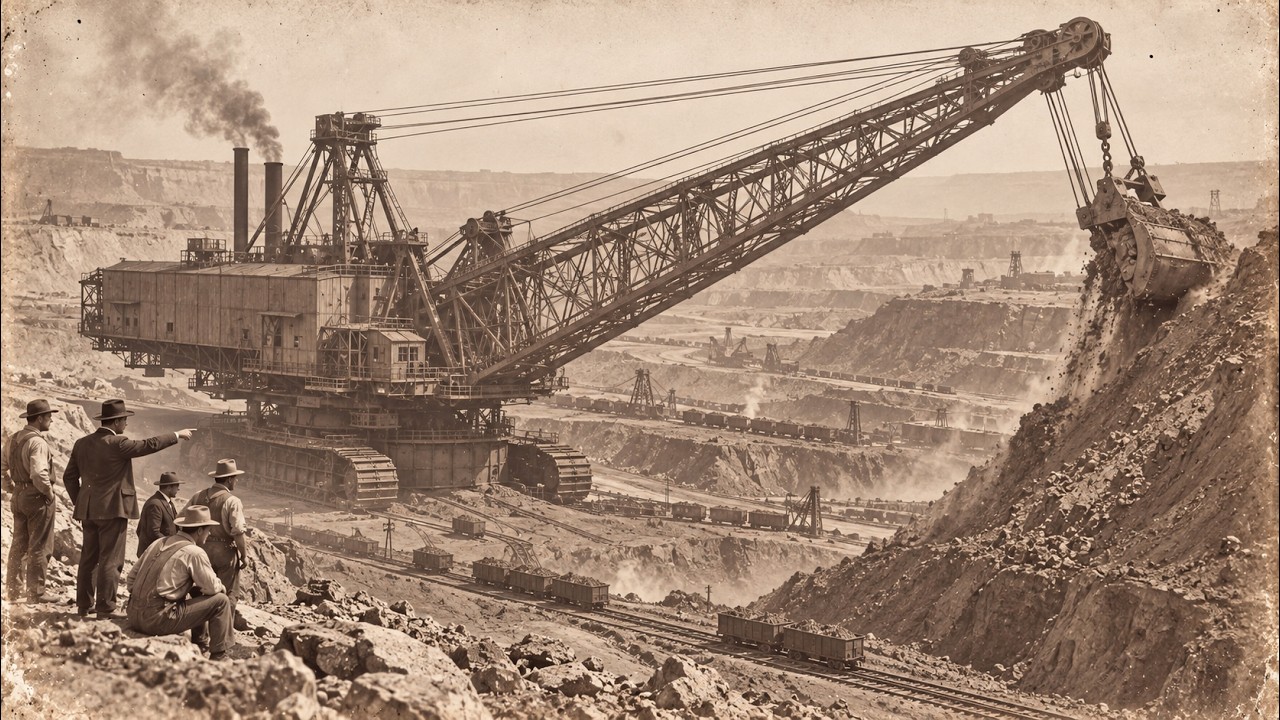
It did not carry dirt in the normal sense. It reached out, tore a bite from the ground, and threw the ground aside. Scale that idea far enough, and the machine stopped looking like construction equipment. It started looking like a building that could walk.
America built drag lines because strip mining created a problem too large for ordinary excavation. Coal seams could lie under tens or hundreds of feet of soil and rock, and before the coal could be mined, all of that overburden had to move somewhere. Trucks could haul it. Shovels could dig it.
But when the distances and volumes became large enough, engineers wanted a machine that could excavate and cast the material in one continuous cycle. The drag line became that machine. Its operating principle was older than the giants people remember. Early dragline excavators appeared in the first years of the twentieth century, and the design evolved quickly because it solved a specific geometry problem.
A shovel worked best when the machine could approach the face and crowd a rigid dipper into the material. A drag line could work from farther away and below its own level, the bucket controlled by ropes rather than a rigid dipper stick. Reach was everything in stripping work. Imagine a coal seam running beneath a hillside.
The mine wanted the coal, not the rock above it. Every cubic yard of overburden was dead weight that had to be moved before revenue started. The farther a machine could reach, the wider a cut it could work from one position. The larger the bucket, the more material moved each cycle.
Those two numbers, reach and bucket capacity, pushed drag lines toward enormous size. But size created a new problem. A machine weighing thousands of tons could not move on ordinary tracks or wheels the way a conventional excavator did. The ground pressure would be enormous, the undercarriage a mechanical nightmare.
Engineers needed the machine to relocate occasionally without turning mobility into the dominant design problem. The answer was walking. A walking drag line did not travel like a truck. It lifted and shifted itself in slow steps using large shoes.
The process was awkward to watch, because the machine seemed too large to move at all. Yet that slow movement was enough. A drag line did not spend its day driving around a mine. It spent its day digging from one position, then walked when the working geometry changed.
That was the first key to understanding these machines. They were mobile, but they were not transportation machines. They were factories for relocating earth. By the 1930s, walking drag lines were becoming serious stripping machines in American coal mining.
Industry history from the period describes the shift from drag lines working as helpers to drag lines acting as primary overburden machines. Bigger booms, stronger rope systems, larger buckets, and electric power let operators remove material at a scale that earlier mines could not match. Then the machines entered a size race. Bucyrus, Marion, Page, Monighan, and other manufacturers competed in the world of giant excavation.
Each step upward forced engineers to solve the same problems again at a larger scale. How do you support the boom? How do you control the bucket? How do you rotate the house?
How do you feed enough electrical power into the machine? How do you build components too large to ship assembled? How do you keep the structure from tearing itself apart under repeated load cycles? The final question was easy to underestimate.
A drag line did not simply lift a static load. Every cycle changed the forces in the machine. The bucket accelerated, bit into material, filled unevenly, lifted, swung, and dumped. Ropes loaded and unloaded.
The boom bent. The revolving structure started and stopped. Gears, bearings, drums, motors, brakes, and structural members repeated the same violent sequence hour after hour. A giant machine did not escape fatigue by being giant.
It magnified it. That was why the great drag lines were engineering systems rather than oversized cranes. The most famous American example was Big Muskie. In 1966, Central Ohio Coal Company contracted Bucyrus-Erie to design and build a machine for the Muskingum mine in southeastern Ohio.
Caterpillar, which later acquired Bucyrus, preserves the project’s history. The mine covered an enormous hilly property, and the company wanted a drag line capable of removing the deep overburden economically while also fitting its reclamation plan. The resulting machine was the Bucyrus-Erie 4250-W, so large that it could not be assembled in a factory and shipped whole. Components had to be manufactured, transported to Ohio, and erected at the mine.
Caterpillar’s history gives the logistics: 340 rail cars and 260 trucks carried the components. Construction required about 200,000 man-hours. The machine entered production in 1969. Before Big Muskie could move earth, America had to build Big Muskie where it was going to work.
The finished machine weighed more than 27 million pounds. Its boom was roughly 330 feet long. The bucket held 220 cubic yards. Caterpillar compared the bucket to the size of a twelve-car garage.
The bucket was the part most people understood immediately. A normal excavator bucket could be photographed beside a person and still look like equipment. Big Muskie’s bucket survives today as a monument because it looks like a building. People can stand inside it.
But the bucket only mattered because the rest of the machine could control it. The drag rope pulled the bucket toward the machine. Hoist ropes lifted it. The operator coordinated those motions so the bucket skimmed and cut through the overburden at the right angle.
Then the entire upper structure swung to the dump side. That cycle seemed simple when described in four verbs: drop, drag, lift, swing. Operating it well was not simple. The bucket had momentum.
The boom had limits. The ropes had limits. The material changed. Wet clay behaved differently from broken rock.
A poor cut could leave the bucket half full. An aggressive cut could shock-load the machine. The operator had to use timing and feel to keep production high without abusing the equipment. The controls were connected to a machine that responded slowly but carried enormous energy.
That combination created a strange kind of skill. The operator was not making quick movements like an excavator working a trench. He was managing a long mechanical rhythm. The best cycle was smooth.
The bucket landed where it should. The drag began before slack became shock. The bucket filled while moving toward the machine. Hoist tension increased at the right moment.
The bucket rose clear. Swing began. The machine reached the dump point. The bucket emptied.
Then everything reversed and repeated, minute after minute, shift after shift, year after year. That repetition was why maintenance mattered as much as spectacular dimensions. Wire rope was a consumable part of the system. Bearings and gears carried huge loads.
Electrical equipment had to deliver enormous power reliably. Structural inspections were critical, because small cracks in a giant welded structure did not remain small forever. Big Muskie was electrically powered. Like other large drag lines, it received power through a trailing cable rather than carrying a conventional diesel engine large enough to run the whole machine.
That choice made sense. The machine operated in a mine with access to industrial electrical supply and spent most of its time in one area. Feeding electricity into the machine avoided hauling fuel into a power plant that happened to be mobile. The cable itself became part of mine operations.
As the machine moved, the power connection had to move with it. Crews handled cable, maintained substations and electrical equipment, and coordinated relocation. The drag line was not one machine working alone. It was the center of a support system.
The mine also had to prepare ground capable of supporting it. A walking drag line could distribute weight through large shoes, but it still needed a reasonably prepared path. When Big Muskie relocated, the route was part of the job. The machine moved slowly enough that a relocation could become an event.
That slowness was another thing people misunderstood. Big Muskie was not inefficient because it could barely walk. Walking speed was not the production metric. The machine made money while standing still and moving dirt.
Caterpillar records that in 1976, Big Muskie could remove about 8,000 cubic yards of overburden per operating hour. Over 22 years of service, it moved an amount of earth Caterpillar compares with twice the volume moved during the original construction of the Panama Canal. That was the purpose of the scale. The machine was not built to be impressive.
It was built because each swing removed enough material to justify the extraordinary capital and support system around it. This was why giant mining machines should be understood economically as much as mechanically. Every increase in bucket size increased the amount moved per cycle. But it also increased structural load, motor size, rope size, bearing load, assembly difficulty, and capital cost.
Bigger was only better if the mine had enough material, enough years of operation, enough electrical infrastructure, and enough production demand to keep the machine busy. A giant drag line working the wrong mine was a financial disaster. Big Muskie existed because one specific mining operation believed the geometry justified it. The mine was stripping coal beneath hilly terrain.
The machine could stand on one level and cast overburden across the cut. That reduced the need to load every cubic yard into trucks and haul it away. The drag line turned distance into boom length. That sentence explains the whole machine.
A truck-based system moves material by driving it across the mine. A drag line-based system moves material by reaching across the mine. The longer the reach and the larger the bucket, the more earth could be relocated without building a road for every load. But that advantage depended on mine layout.
As mining methods changed, environmental rules changed, coal markets changed, and electricity costs changed, the economics of the giants became harder to justify in some places. Big Muskie shut down in 1991. By then, the machine represented both the peak and the problem of extreme scale. It could move extraordinary amounts of earth, but it also demanded extraordinary operating conditions to remain economical.
A machine that large was difficult to sell when its original job ended. You could not simply put it on a lowboy and send it to another mine. Relocating it across long distances would require disassembly, transport, and reconstruction on a scale approaching the original build. The next owner would need the right mine geometry and the financial reason to justify the move.
That market barely existed. Big Muskie sat idle for years. Preservation advocates wanted to save it, but preserving a machine weighing millions of pounds was not like preserving a locomotive or tractor. The mine site also faced reclamation requirements.
In 1999, Big Muskie was dismantled for scrap. The bucket was saved. That surviving bucket may be the perfect monument, because it gives a human body a reference point. Photographs of the full machine are so large that the eye loses scale.
Stand beside the bucket, and suddenly the machine becomes understandable. That one bucket was supposed to fill, lift, swing, dump, and return again and again without tearing the machine apart. Everything else on Big Muskie existed to make that possible. The boom existed to place it far away.
The ropes existed to control it. The motors existed to move it. The revolving house existed to swing it. The walking gear existed to reposition the whole system when the cut advanced.
The mine power system existed to feed it. The maintenance crews existed to keep the cycle alive. Seen that way, the machine became less mysterious. It was a bucket handling system pushed to an extreme.
That same logic applied to smaller drag lines that worked mines, canals, dams, and civil engineering projects across America. Not every drag line was Big Muskie. Most were far smaller. Many worked for decades because the basic concept was useful wherever material had to be removed from below machine level and cast some distance away.
Civil engineering used drag lines for channels, ponds, levees, and excavation. Mining used them for stripping. Quarries used them where reach mattered. Their flexibility came from the cable-suspended bucket.
The trade-off was precision. A hydraulic excavator could place a bucket with extraordinary control. A drag line bucket was suspended. It behaved like a controlled pendulum.
The operator managed motion rather than forcing every part of the linkage rigidly into position. That made the machine excellent at broad excavation and less suited to work requiring exact final surfaces. Again, the machine was built around the problem: move huge volume from here to there, not carve a perfect trench wall. This was also why drag line operators developed such distinctive skill.
The machine’s ropes, drums, and swing motion had to be coordinated by feel. An inexperienced operator could make the machine look clumsy. An expert could make thousands of tons of steel seem almost fluid. That contrast was one of the most impressive things in old footage.
The house barely seemed to move. The boom appeared fixed against the sky. Then the bucket traveled hundreds of feet through the cut with a smooth rhythm that made the scale disappear. Only when a truck or person entered the frame did the eye recover.
The machine was enormous. The operator’s movements were small. That was industrial leverage at its purest. A few control motions directed enough electrical power and steel cable to move hundreds of tons of earth in a single cycle.
The walking system added another layer of strangeness. A drag line’s walking shoes allowed the machine to shift its base without needing conventional tracks sized for the full weight. The movement was slow and deliberate. The body lifted enough to reduce pressure on the base.
The shoes repositioned, and the machine settled again. It did not walk often, but the ability meant the excavator could follow the mine. That was what separated a giant drag line from a fixed excavating plant. The mine itself moved.
The cut advanced. The spoil pile changed. The coal seam was exposed in one section and covered in the next. A useful machine had to follow that geometry.
The drag line followed slowly. Its huge size therefore represented a compromise between fixed infrastructure and mobile equipment. It was too large to behave like ordinary mobile machinery. It was too mobile to be a permanent building.
It lived in the middle. That middle ground was where some of America’s most extraordinary machines were built. The giant stripping shovel lived there too. So did bucket-wheel excavators in other countries.
So did certain cranes, tunnel-boring machines, and offshore structures. They were machines whose job was so large that movement itself became an engineering subsystem. That was why building them became part of the story. Big Muskie required hundreds of rail cars and trucks because manufacturing had to be divided into transportable pieces.
Assembly at the mine was not a final detail. It was part of the design from the beginning. Every component had to arrive in a sequence that allowed the next stage of assembly. Cranes, temporary supports, welding crews, electricians, mechanics, and engineers all had to coordinate around a machine that was becoming harder to access as it grew.
A project like that reversed the usual factory relationship. Instead of the product leaving the factory, the factory effectively followed the product into the field. Once construction was complete, the mine inherited not only a machine but an industrial ecosystem. Spare parts needed storage.
Specialists needed training. Lubrication schedules needed to be followed. Rope inspections needed records. Electrical systems needed maintenance.
Structural cracks needed monitoring. Major repairs might require custom fabrication, because no hardware store stocked parts for a one-of-one machine. That was the hidden cost of extreme scale. The machine could be extraordinarily productive, but it also became impossible to separate from the organization that supported it.
When that organization disappeared, the machine’s future became fragile. This was what happened to many giant mining machines when the pits closed or methods changed. A machine designed perfectly for one operation could become nearly useless anywhere else. The best industrial machine was therefore not always the most versatile.
Sometimes it was the most specialized machine whose job lasted long enough to repay the specialization. Big Muskie worked for 22 years. That lifespan was long enough for it to become a regional landmark. People who never operated it still remembered seeing the boom on the horizon.
Families in southeastern Ohio connected the machine to coal jobs, power generation, and the reshaping of the local landscape. Its scale became part of local identity. But the drag line story was larger than one machine. By the 1960s and 1970s, the American surface mining industry had pushed walking drag lines to sizes that would have been hard to imagine at the beginning of the century.
Bucyrus and its competitors built fleets of huge machines across coal country. Not all broke records. Many mattered more economically than the record holders because they worked every day without becoming famous. They stripped overburden so the coal beneath could be reached.
That work powered generating stations, factories, homes, and an industrial economy that rarely saw the machine responsible for exposing the fuel. The drag line remained far from the consumer. That distance was why the machines could feel forgotten today. A truck appeared on a highway.
A locomotive passed a crossing. A tractor worked beside a road. A giant drag line might spend its entire life inside one mine that most people never entered. Its work was hidden behind the edge of the pit.
Yet the physical consequences were enormous. The machine changed valleys, ridges, and spoil piles. It exposed geological layers that had been buried for millions of years. It made human-scale maps look small.
That power was also why reclamation became part of the engineering conversation. Mining did not end when the coal left. Land had to be graded, stabilized, drained, and in many cases revegetated. The same large-scale earthmoving capability that opened the mine could also help reshape it afterward.
Caterpillar’s history of Big Muskie noted that the original choice of a drag line was connected not only to overburden depth and terrain but also to reclamation planning. That detail was important, because it showed the machine was part of an earthmoving sequence rather than a single extraction step. The mine reorganized the landscape to reach coal, and then had to reorganize it again. The drag line was built to move the landscape both times.
There was no way to make that history small or clean. Surface mining provided energy and jobs. It also transformed land at a huge scale. The machines were both engineering achievements and tools of that transformation.
Understanding one side without the other missed why they existed. The giant drag line was built because America wanted enormous quantities of coal at a price low enough to make the mine worthwhile. The machine converted electricity, steel, cable, and operator skill into lower stripping cost. That was the business case hidden inside the spectacle.
And that was why these machines grew so large. Not because engineers were competing to build a mechanical monster for its own sake. Because every additional cubic yard in the bucket and every additional foot of reach could reduce the cost of exposing the next ton of coal, if the mine was big enough to use it. That if controlled everything.
Big Muskie proved how far the idea could go. It also proved where the idea begins to break down. When the mine changed, the market changed, or the support cost became too high, the biggest machine could become the least movable asset on the property. That was the paradox of giant industrial equipment.
Its power came from specialization. Its vulnerability came from the same place. The bucket sitting in Ohio today is therefore more than a relic from a larger machine. It is a reminder of a period when American industry looked at a layer of earth hundreds of feet thick and decided the cheapest answer was to build a machine so large that it could reach across the mine, scoop the ground into a 220-cubic-yard bucket, and throw the land out of the way.
That sounds absurd until you see the economics that produced it. Then it sounds inevitable. The most revealing comparison is not between Big Muskie and a modern excavator. It is between a drag line and the fleet of machines it could replace in the right mine.
Without a casting machine, overburden usually had to be dug, loaded, hauled, dumped, and sometimes spread. Each verb could belong to a separate piece of equipment. A shovel filled trucks. Trucks climbed out of the cut.
Dozers managed the dump. Roads had to be built and maintained for the haul fleet. Fuel, tires, drivers, and maintenance all followed those trucks around the mine. A drag line collapsed several of those steps into one swing.
It dug and dumped with the same bucket. That did not eliminate every supporting machine, but it changed the cost structure of the mine. There were fewer haul cycles attached to each cubic yard of overburden. The spoil could be cast directly where mine planners wanted it, if the geometry allowed.
This was why reach mattered just as much as bucket capacity. A bucket that held more dirt was useful. A boom that put the bucket farther away changed where the machine could stand, how wide a cut it could work, and where the spoil could land. The operator was not only excavating.
He was constantly working inside a large triangle defined by boom length, bucket path, and dump radius. Mine engineers designed around that triangle. The cut had a width. The coal seam had a depth.
The spoil bank had a slope. The machine had a maximum working radius and a safe operating envelope. If those dimensions lined up, a drag line could be remarkably efficient. If they did not, the machine could spend more time repositioning or rehandling material, and the advantage began to disappear.
That was why drag line planning was partly geology and partly choreography. The machine followed the coal seam, but it had to do so in a sequence that left room for itself. It could not simply dig the ground beneath its own base. It could not dump spoil where it would block the next cut.
It could not walk onto weak ground without preparation. It could not swing through structures, power lines, or other equipment. The largest machines turned those constraints into mine-wide planning problems. This was also why operators and engineers had to think several cycles ahead.
A clean bucket load now could create a bad spoil profile later. A poor dump position could force rehandling. A careless cut could leave a high spot that interfered with the next bench. The machine’s productivity therefore depended not just on fast cycling but on putting each bucket where it helped the next part of the job.
The machine looked like brute force from a distance. The work was actually geometric. That tension between size and precision ran through the entire history of drag lines. The boom might stretch hundreds of feet, but small changes in rope control altered where the bucket landed.
The bucket might weigh hundreds of tons when loaded, but the operator still had to place it into the cut at the right angle. The machine might consume industrial-scale electrical power, but wasting a few seconds on every swing could become a serious production loss over a long shift. This was why experienced crews cared about cycle time so intensely. A single slow swing meant almost nothing.
Thousands of slow swings meant lost production. The same was true of maintenance delays. A small excavator could often be replaced temporarily by another machine. A one-of-one giant drag line could not.
When a critical component failed, the mine could lose one of its central production systems. That changed maintenance culture. Lubrication was not housekeeping. Inspection was not paperwork.
Rope condition was not cosmetic. Every preventive task protected an investment whose downtime could stop the entire stripping sequence. Crews learned to listen for changes in gear noise, watch rope wear, monitor motors, inspect structure, and service components before a minor problem became a major outage. The machine size made maintenance harder, but it also made neglect more expensive.
Even routine access could be a job. Components sat high above the ground or deep inside the machinery house. Ladders, platforms, hoists, and internal cranes were part of daily work. Some repairs required specialized crews and heavy lifting equipment that would itself look large anywhere outside the mine.
That was another hidden feature of extreme machinery. The machine needed machines to maintain it. The larger the drag line became, the more the support equipment around it grew. Yet the human crew remained surprisingly small relative to the machine.
A handful of people could operate and support equipment capable of moving earth on a scale that once required enormous labor forces. That was the real industrial transformation represented by the drag line. It was not simply that the bucket became huge. It was that electricity and mechanical leverage allowed a small group of workers to reorganize terrain at a rate no previous labor system could approach.
The same transformation appeared across twentieth-century industry. One combine replaced a field crew. One continuous miner replaced armies of hand miners. One container crane moved cargo that once required gangs of longshoremen.
One drag line replaced an entire sequence of digging and hauling labor. When the site geometry cooperated, productivity rose because human effort moved from lifting the material to controlling the machine that lifted it. The skill did not disappear. It moved into operation, maintenance, planning, and repair.
That was why old miners remembered these machines with such specificity. They remembered which drag line had a smooth swing, which one was hard on ropes, which operator could fill the bucket cleanly, which machine had a troublesome bearing, which winter made cable handling miserable, which relocation took longer than planned. The public remembered the dimensions. The workers remembered the behavior.
That distinction was important, because industrial machines were not experienced as statistics by the people who used them. A 27-million-pound machine could still have a personality. It could start reluctantly. It could sound different after a repair.
It could respond better in one type of material than another. It could develop quirks that experienced crews learned to recognize before any instrument reported a failure. The same human relationship existed with trucks, locomotives, tractors, and ships. Size did not eliminate familiarity.
Repetition created it. Big Muskie worked long enough for generations of employees to become familiar with a machine that outsiders could barely comprehend. Then the machine stopped. That silence was what made its final years so strange.
A drag line was built around motion. Ropes moving, drums turning, house swinging, bucket dragging, motors humming, fans running. When a machine that large sat idle, the absence of movement became part of the spectacle. The boom remained against the skyline, but the mine no longer needed what it could do.
At that point, the machine’s scale turned against it. The same size that made it productive made preservation difficult. That was why the bucket survived while the machine did not. A bucket could become a monument.
The entire drag line would have required a museum the size of an industrial site. So the bucket now had to carry the memory of the whole system. It was enough if you knew what you were looking at. Stand beside it and imagine a cable lifting that object full of hundreds of tons of earth.
Then imagine the bucket traveling outward again, empty, while the machine prepared to repeat the cycle. Do that for years. That was the job. America’s giant drag lines were not built to move mountains in one heroic act.
They moved them one bucket at a time, so consistently that the landscape eventually had no choice but to change.
