On August 21, 2020, a flag-draped coffin was placed in the East Room of the White House. That room had held the bodies of Lincoln and Kennedy. It was the largest ceremonial space in the executive mansion, not a family funeral parlor. The man inside it was Robert Stuart Trump, dead at seventy-one, and the story everyone repeated about him and his brother was simple: Donald could not stand Robert.
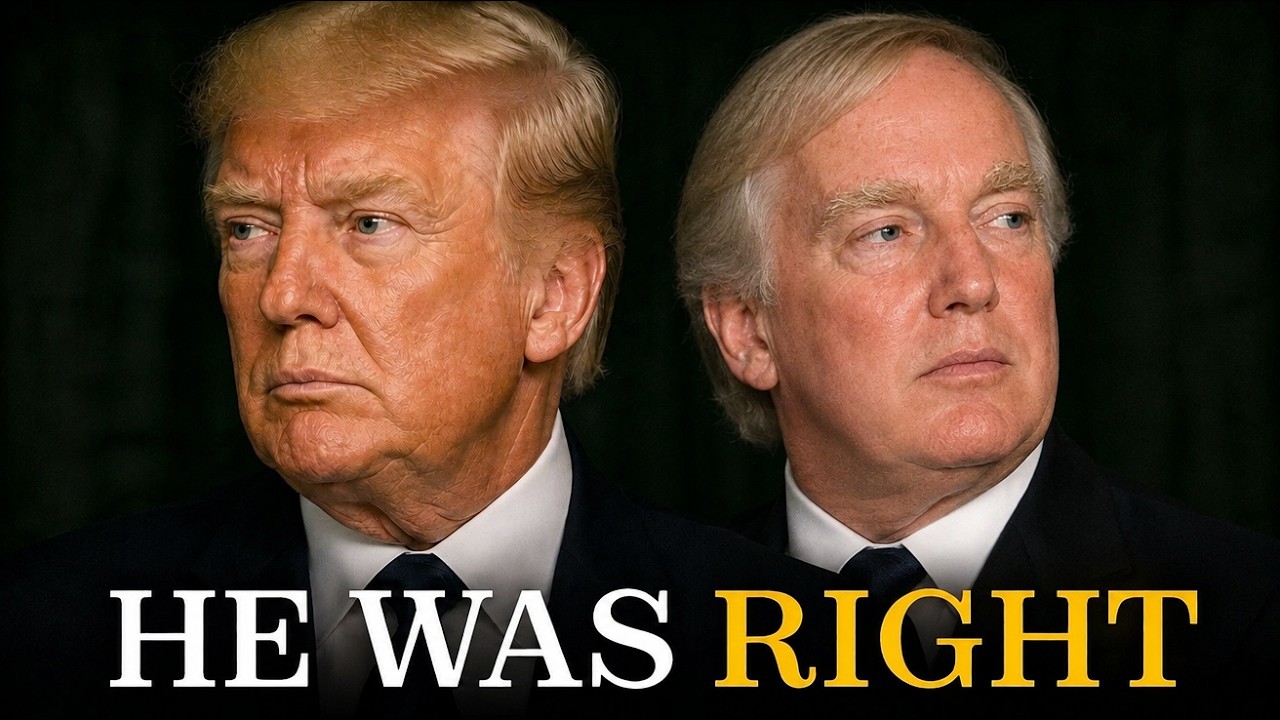
Yet five weeks earlier, Robert had walked into a New York courtroom to silence his niece and protect Donald’s version of the family. He lost. The book hit number one. Then he died.
And Donald gave him a room no brother had ever received. Thirty years earlier, Robert was said to have stormed out of a casino vowing never to speak to him again. He came back. He stayed.
That is the problem with the story that he despised his brother. It is not entirely false—it just cannot explain August 2020. Start with the room, because the room is the evidence. The East Room is where presidents lie in state, and the contemporary reports described a closed press service held there for Robert Stuart Trump, who died on August 15 at New York-Presbyterian Hospital.
The president ordered the flag placed on the coffin. No one else in that building could have done it. Now look at the calendar around it: the Republican National Convention opened on August 24. The ceremony came three days before.
The book Robert had spent his last healthy weeks trying to suppress—Mary Trump’s memoir, Too Much and Never Enough—had been published on July 14, and according to the publisher, roughly 950,000 copies sold in its first day across print, e-book, and audio. Robert’s lawsuit had already collapsed. So his last two public acts were a failed attempt to silence a family member on his brother’s behalf, and a funeral his brother held inside the seat of American executive power. You can read that sequence two ways, both available in the record: grief or image repair.
The honest answer is that it does not have to be only one. Whatever existed between these two men, it was not indifference. And it was not pure hatred either. It was something with a shape.
It had rules. It had a hierarchy. And it had a price Robert paid at least three times over thirty years. The question this whole story turns on is not whether Donald loved Robert.
It is a colder question, the one the family itself had to answer again and again: which of the two brothers could survive losing the other? In 1990, the answer was obvious. In 2000, it remained obvious. By August 2020, the verse had quietly inverted—and Robert was already dead, unable to enjoy it.
To understand any of this, you have to accept that Robert did not choose the family business. He initially refused it. He only entered after he saw what that work did to his older brother. Fred Trump Jr.
—Freddy—was the eldest son, born in 1938, ten years before Robert. He was the designated heir. In the Trump household, that was not an expression of affection; it was an assignment. Both Gwenda Blair’s history of the family and Mary Trump’s memoir agree on the basic structure, as does a rare and revealing interview Donald himself gave to the Washington Post in 2019.
Freddy was pushed toward managing Trump’s Brooklyn operation, and he was not good at it in the way his father wanted, and he was told so repeatedly. Freddy wanted to fly. He became a professional pilot for TWA. By multiple accounts, his father considered that a retreat from the career of collecting rent in outer-borough apartments.
Donald, by his own admission decades later, joined the attack. He said he regretted it. Freddy turned to drinking. His marriage ended.
He moved back to Queens. He died on September 26, 1981, at forty-two. Robert was thirty-three that autumn, and he had spent the previous decade doing something that looks in retrospect like a deliberate strategy: staying out of sight. Boston University, then Wall Street, corporate finance, Eastdil, Kidder Peabody, real estate lending and acquisitions—the prestigious Manhattan version of the family trade, with an employer who was not his father.
He was doing well. He was not doing it at 600 Z Street in Brooklyn, the low brick building where Fred Sr. ran the empire from an office he refused to have photographed for magazines. Then Freddy died.
And within roughly that period, Robert joined the family. Consider the sequence, because it contains the entire relationship compressed into a single turn. The brother who refused the position was destroyed for refusing it. The brother who had been watching accepted it deliberately—but chose the safe version.
Not the name, not the front, not the media. Robert came in as the one who would never compete, under any circumstances, for what Donald had already claimed. That was the agreement. No one wrote it down.
But it held for four decades. Because by 1981, Donald was no longer the second son of a Brooklyn landlord. He was the man who had just opened the Grand Hyatt on 42nd Street, who was building Trump Tower on Fifth Avenue, who had discovered something Fred Sr. never cared about: that publicity was a form of capital.
Fred Sr. built in Coney Island and Jamaica Estates and let the buildings speak for themselves. Donald built in Manhattan and made sure he did the speaking. There was only one seat for that role in the family, and it was already taken.
So what seat did Robert take? Look at what he actually did, and it becomes very clear very quickly. He ran the things Donald did not want to be seen running: the management portfolio of the outer-borough apartment buildings, the rent rolls, the boilers, the tenant complaints, the thousands of apartments in Brooklyn and Queens that were the family’s actual cash engine, and which the older brother’s Manhattan brand quietly depended on. Later he took on the Atlantic City casino side.
He was the operational manager with no public identity. The people who dealt with him in that period described the same man consistently: quiet, polite, soft-spoken, a bit formal. The exact opposite of the brother whose face was on paperback covers. There is a version of this story where Robert is just an employee and that is the end of it.
That version is wrong. The reason it is wrong is Blaine. In 1984, Robert married Blaine Beard, a former flight attendant from the South with a talent for the thing Manhattan money actually cares about—not money, but social status. She became a fixture of New York charity society, a name in the party columns, a woman who could fill a ballroom.
During the 1980s and 1990s, Robert Trump’s family was regularly photographed at charity galas, events, and hospital fundraisers. They had a son, Christopher. They had a home on the North Shore of Long Island. Here is the key point: that was Robert’s own domain.
It was adjacent to Donald’s world, but not inside it. He had a wife who made him socially independent, a life in rooms his brother did not run, a version of himself that existed without the Trump Tower apparatus. Socially independent. Remember that phrase, because it is the pivot on which everything that follows turns.
Robert built a life outside his brother’s orbit in every dimension except the one that determines outcomes. He never built an independent income. Everything Robert Trump owned—his job, his title, his share in the buildings, his potential inheritance, the trusts, the partnership stakes, the entire financial base on which that comfortable Long Island life rested—sat within structures his father had built and his brother increasingly directed. He could go to a gala where no one talked about Donald.
He could not go to a bank where the family name did not matter. That disparity was not a flaw in his character. It was the design. Fred Sr.
built the family the way he built the housing complexes: one controlling share, and everyone else on good leases. Which brings us to the part of the record everyone quotes and almost no one places in its proper timeline. April 2, 1990. The Trump Taj Mahal Casino Resort opens in Atlantic City.
At that moment it was the largest casino in the world, financed on a mountain of high-yield debt, and Donald had bet his entire public image on it. Robert was the family’s executive on site, tasked with running the operation. The slot machine operation failed almost immediately. The coin-counting system—the physical labor of collecting buckets of coins from thousands of machines and counting them, a process that in 1990 meant literally moving metal—could not keep up.
Machines sat idle. Money sat uncounted on the casino floor while journalists and high rollers walked around it. What happened next between the brothers on that floor is the most repeated anecdote about them. It carries a source warning.
The vivid account comes from John O’Donnell’s 1991 book, Trumped. O’Donnell had been president of the Trump Plaza hotel. He had just resigned. He was writing a book about the man he quit working for.
He is, in the literal sense, an interested witness. Donald disputed his account publicly. Wayne Barrett’s reports from the same period confirm the atmosphere, the panic, the blame-trading, and the executive turnover, without necessarily confirming every line. With that caveat, O’Donnell described Donald attacking Robert in front of staff, and Robert leaving the building declaring he was done with his brother for good.
Treat it as a documented scene rather than a transcript, because what makes it credible is not the dialogue. It is what the record shows afterward. Robert’s involvement in the casino division ended. He went back to the buildings.
The brother who was given operational responsibility for the biggest gamble in family history was quietly removed from it. The brother who made the bet stayed on the cover of every magazine in America. Keep the buckets of coins in your mind. We will return to them, and by that time they will not be about slot machines at all.
Because 1990 was not only the year Robert was humiliated. It was the year Donald nearly collapsed. And the family’s reaction to that crisis, compared to its reaction to Robert’s, tells you exactly the actual value of the two brothers in the records. By the summer of 1990, Donald Trump was personally responsible for roughly $900 million, with business debt several times that.
The Taj was devouring cash. Trump Castle was late on bond payments. The Plaza, the shuttle, the yacht, the Princess—all financed with a structure that only worked if revenue kept rising. Revenue stopped rising.
In June, bankers imposed a budget on him. Contemporary reports on the restructuring estimated a personal spending limit of about $450,000 a month. The tabloids mocked the figure, which was exactly the point of leaking it. But the substance behind it was serious: a consortium of banks now controlled what the most famous businessman in America could spend on himself.
He no longer owned his own cash flow. Here is the part that concerns the brothers. On December 17, 1990, Trump Castle had a bond payment of $18. 4 million due.
They did not have the money. A lawyer named Howard Snyder walked into the casino, went to the cashier’s window, and bought $3. 35 million in chips. He never bet.
He left. Under New Jersey law, that was an illegal loan disguised as a chip purchase, and the Casino Control Commission fined the Castle $65,000 for it. The money belonged to Fred Trump. Read that again from the family’s perspective rather than the balance sheet’s.
Eight months after the Taj opened, the eighty-five-year-old father, who still ran Trump Management from Brooklyn, sent a lawyer to a Boardwalk casino with a bag of cash to keep his son from defaulting. No one was sent for Robert. Robert’s failure cost him his position. Donald’s failure cost the family $3.
35 million in emergency cash plus a regulatory fine—and the family paid it with no apparent hesitation. That is the entire hierarchy documented in a single calendar year. It was not about emotion. Fred Sr.
had spent decades pumping money into Donald’s projects—loans, guarantees, land—and in the 1980s, a steady stream of value through structures the family kept discreet. The New York Times investigation of October 2018, by David Barstow, Susanne Craig, and Russ Buettner, built on more than 100,000 documents including Fred’s private tax returns, estimated the lifetime transfers to Donald at more than $400 million in today’s dollars. Fred was not rescuing a favored son out of sentiment alone. He was protecting the asset he had already invested the most money in.
The other children got money too—a great deal of it. What they did not get was rescue at that scale, because they were never put in a position that made that kind of failure possible. They were never given the outsized role that makes such failure possible. So Robert, in early 1991, was a man in his early forties with a damaged professional position; an angry story he reportedly told colleagues about never speaking to his brother again; a house on Long Island; a socially prominent wife; and a career that existed entirely inside a company owned by his father and fronted by his brother.
He came back. Quickly. The reason is not mysterious once you look at what was happening in Brooklyn. Fred Sr.
was beginning to decline. The precise clinical timeline is private, but the family later acknowledged Alzheimer’s disease. The surviving business records show the same thing from a different angle: starting around 1990, the sons began appearing on official papers where the father had once stood alone. In 1991, Fred signed a will.
It named Donald, Robert, Maryanne, and the family’s longtime accountant as executors. The will directed the estate into structures controlled by the children. Freddy’s son, Fred III, and his daughter, Mary, were positioned differently—materially—from their uncles and aunts. A fact that would explode nine years later.
Then, in 1992, came the entity that explains why Robert never left. All County Building Supply and Maintenance was incorporated that year at the address of one of the Trumps’ in-laws, with almost no real operations. On paper it was a purchasing agent that bought boilers, cleaning supplies, refrigerators, and repair services for the family’s apartment buildings. In practice, according to the Times investigation and the invoices it republished, All County bought equipment from vendors and resold it to Trump Management at a significant markup.
The markup came out of the buildings and went to the children: Fred’s tenants’ rent money became inflated expenses on one side and untaxed family income on the other. The owners of All County were Donald, Robert, Maryanne, Elizabeth, and a cousin. Robert’s name was on it. Not as an employee—as an owner.
His sister Maryanne, a federal judge since 1983 appointed by Reagan in New Jersey, was also an owner. When the Times reached her in 2018, she said she was not involved in any of it and that Donald ran it. She acknowledged Fred wanted the money to go to his children. She resigned from the bench the following year while a judicial conduct investigation into the arrangement was still pending—which ended the investigation.
This is the moment to close the first big question, the one the Taj story leaves hanging. Why did Robert return to a brother who had just embarrassed him in front of his own staff? Because leaving would have meant abandoning the vehicle carrying his inheritance while his father was losing the capacity to protect it. And because that vehicle would only work if the siblings stayed inside it together.
You cannot take your share of an entity like All County with you. You cannot litigate your way out of a family partnership without exposing the partnership itself. Whatever Robert felt on that casino floor in 1990, by 1992 he had signed onto a structure that made his financial future a joint venture with the brother who had just humiliated him. And that did something else, something quieter and more permanent: it made Robert complicit in the same papers.
Every year he stayed, the cost of public separation rose—not because Donald threatened him, and there is no evidence of that, but because the documents themselves were now shared. Two men who own the same embarrassing company do not quarrel loudly. That is the answer. Which raises the new question: what does a man turn into after thirty years inside such an arrangement?
The 1990s point to one answer, and it is not a grim one. This is the period when, by every available account, the brothers were fine. Robert settled into Trump Management and became what the family had needed since the father began to decline: the constant. He took charge of the buildings, tenant associations, maintenance contracts, and property managers.
When Donald’s Manhattan projects stumbled in the mid-1990s, the outer-borough rent rolls kept flowing, and Robert was the man overseeing the machine that produced them. He also served as an executive on Trump’s side of various projects, lending his name to boards where the quiet Trump was more useful than the loud one. One detail from this period is often missed: Robert kept his own office. He did not sit in the inner circle of Trump Tower.
His career was run from a physical distance from his brother and from the borough operations, and later increasingly from Long Island and then upstate New York. Distance was his working style. He never fought for proximity, which meant he never lost a battle for it. Meanwhile Blaine ran one of the busiest charity schedules in New York.
Flip through the society pages of 1996 and you would find Robert Trump at a hospital fundraising gala in formal wear, three paragraphs away from any front-page relevance. He liked being liked. Many people who worked for the family over the decades, including some with no reason to be kind to the Trumps, used almost identical language to describe him afterward: the nice one, the quiet one, the one who apologized. He was also—and this matters for what comes later—the brother who handled the aspects that brought the family no glory.
When Fred Sr. ’s condition deteriorated, the sons in New York managed the practical affairs of the dying man. Fred Trump died on June 25, 1999, at ninety-three. The funeral was held at Marble Collegiate Church on Fifth Avenue, the parish of Norman Vincent Peale, where Donald had married Ivana.
All five surviving family branches were present. Mary Trump later wrote that each of the children spoke, and that Donald’s remarks were largely about Donald. That is a characterization from an interested party, though it is consistent with the published excerpts from the memorial service. The estate was valued for tax purposes at between $50 million and just over $100 million, depending on the filing and appraisal.
A 2018 Times report concluded the true value transferred to the children over the years through All County, the trusts, and below-market building sales was far larger than the estate tax filing showed. The will was read publicly that autumn, and it contained the sentence that split the family for the next two years and set up everything that happened in 2020. Fred Jr. ’s children, Fred III and Mary—the son and daughter of the dead pilot—were to receive essentially what grandchildren receive, not what a fifth branch would have received.
Their father’s share did not pass to them. In a family where the other four children divided an empire, Freddy’s children were treated as grandchildren rather than heirs of a direct line. Fred III and Mary sued in Queens surrogate’s court in the spring of 2000, alleging the 1991 will had been made while Fred Sr. was already cognitively impaired and under the influence of Donald, Robert, and Maryanne.
The estate’s response came within weeks, in a form no one outside the family expected. William, the infant son of Fred III born in 1999, had seizures and would be diagnosed with a rare neurological condition requiring intensive, ongoing care. The baby’s medical coverage came through the family business’s health insurance plan, standard Trump Management policy covering the extended family. The estate cut it.
The coverage for Fred III’s infant son was cancelled within about a week of the lawsuit being filed in March 2000. The baby needed round-the-clock care. The family plan had been paying for it. Then it stopped.
When New York Daily News reporter Heidi Evans reached the story that December, Donald Trump did not deny the decision or hide behind lawyers. He explained it. He said his nephew and niece were suing him and he was angry about it, and essentially asked why he should be expected to keep paying medical bills for people who had taken him to court. Contemporary reports captured that logic clearly.
They attacked the family, so the family stopped writing checks. Robert did not say that. Robert’s contribution to the press coverage was grief. According to the same reports, he portrayed the lawsuit as an attack on his father’s memory and called it a sad day for everyone involved.
Two brothers, two different tones, one position. Hold onto that, because it explains the next twenty years. Robert was not the dissenting voice in that room. He was one of the estate’s executors.
The decision to withdraw medical insurance from a sick child during a will dispute was made by a group of executors that included him. Whatever he felt about it—and no surviving document tells us—he stayed inside the frame and spoke its language. The story that stuck to Robert Trump after his death is that he was the nicest one. This is not wrong.
The people who worked for him say so independently and consistently, including people with no motive to be generous to that family. The former president of Trump Plaza, who wrote the most damaging book about Donald in 1991, also described Robert as dignified, easy to work with, without the sense of entitlement the name later came to mean. Both things are in the record. He was a decent man in person, and he was simultaneously an executor of an estate that withdrew a child’s medical coverage as a litigation tactic.
Decency without leverage is just politeness. The coverage was eventually restored after the media outcry, and the case was mediated to a settlement in 2001. The settlement terms were sealed. Both Fred III and Mary received a payment.
Mary later estimated the amount in the tens of millions of dollars in a fraud complaint she filed in 2020, arguing the figure was calculated on deliberately undervalued estate properties. But the money is not the most important part of that settlement. The most important part is the clause. In exchange for the payment, Mary and Fred III signed a confidentiality agreement barring them from disclosing any details of the family or the litigation.
The language looked ordinary for a routine family settlement, signed in a mediator’s office by two grandchildren who had just lost a battle against three of their uncles and aunts. Nineteen years later, a seventy-one-year-old man with damaged lungs would try to use that paper as a weapon. It was the last thing he ever did in public. Look at what the 2001 settlement actually accomplished.
It did not just silence. It turned a family dispute into an enforceable contract. The four surviving children now had a legal instrument to control Freddy’s children. Whatever the emotional damage of 2000, the structural result was that the branch of the family with the best reason to speak had been gagged, and the branch that controlled the money had bought two contracts of quiet at a price that turned out to be quite reasonable.
Robert was a signatory to all of it—as executor, defendant, spokesman, and beneficiary. He was fifty-two. His brother was about to spend the next decade rebuilding his image on television. Robert, who had just spent two years as the family’s respectable face in a dirty inheritance battle, went back to Long Island and kept doing what he had always done: the buildings, the boards, the galas with Blaine—that version of Trump that never made a magazine cover.
That version lasted about six more years. Then Robert lost the only part of his life that was truly his own. In 2007, after twenty-three years, he and Blaine separated. Press reports at the time described him leaving for Ann Marie Pallan, a woman who had worked as his assistant at Trump Management.
Blaine was not quiet about it. She talked to the New York papers. Friends talked to the New York papers. The society columns that had spent two decades photographing Robert Trump’s family at charity events now ran a different kind of news.
The divorce was neither fast nor friendly, and by the time it was over, Robert had been removed from the world Blaine had built around him. This matters more than a tabloid divorce usually matters. Robert’s independence was never financial. It was social.
Blaine’s charity circles were the only arena of his adult life where he existed as someone other than Donald’s brother—the only place he was known as a Trump in his own right. When the marriage ended, that went with her. She kept the network, the calendar, the social standing. He moved upstate.
Robert moved to Millbrook in Dutchess County, about ninety miles north of Manhattan—horse country, quiet, the kind of place New Yorkers go when they stop wanting to be watched. He and Ann Marie lived there quietly. He almost entirely stopped appearing in society pages. The contemporary local coverage in later years tends to portray him as a neighbor, a donor, a man attending a charity event in Poughkeepsie—not as a Manhattan figure.
So let us take stock of where he stood by roughly 2010. Independent social identity: gone. Independent income: never existed. Professional standing: still inside the family firm.
Inheritance: still held through structures shared with his siblings. The one thing Robert Trump had accumulated over fifty years that was not tied to his brother had just been lost in the divorce. He was never closer to Donald than at that moment, when he no longer had anything else. Then came 2016, and the quiet brother did something he had hardly done in his life: he spoke publicly and officially.
Robert did not take a campaign job, did not speak at the convention, did not become a surrogate in any organized way. What he did was give occasional interviews, defending Donald in specific, useful terms: that his brother was serious, that he had been underestimated, that the family always knew he could do it. When the Times published its massive tax investigation in October 2018, revealing the trusts, the below-market transfers, the $400 million figure, Robert issued the family’s response. He called it a very sad attack, said the Trump family had always been close, and stated that everything had been done in full compliance with the law.
His name on that statement had a specific value. Maryanne was a sitting federal appellate judge and could not say anything useful. Elizabeth had spent her life out of the public eye. Donald was the subject of the controversy.
Robert was the only adult son of Fred Trump who could speak for the family without recusal problems or credibility issues. That is the role. It had finally taken full shape. Not the executive.
Not the social figure. The one who signs the statement. He was good at it too—the statements were short, warm, non-defensive in tone, full of absolute loyalty. They sounded like they came from a man who genuinely believed them.
There is no evidence he did not. Robert never moved to Washington. He never held an administration position, never asked for one as far as anyone knows, and rarely appeared at the White House. He showed up for occasional events, then went home to Millbrook.
That distance was the working style he had kept since the 1990s: stay away from the building, stay inside the family frame. In March 2020, at seventy-one, he married Ann Marie Pallan in a small ceremony. It was a private event, not widely covered—a man putting his personal affairs in order as the pandemic began. He had been unwell for some time.
The details were never fully announced, but the records show repeated hospitalizations, including a stay in intensive care at Mount Sinai in June of that year lasting more than a week. Compare that hospital stay to the calendar. In that same June, a manuscript was moving through Simon & Schuster with a publication date in late July and a title that tells you exactly what it was: Too Much and Never Enough: How My Family Created the World’s Most Dangerous Man. The author was Mary Trump, Freddy’s daughter, the niece who had sued in 2000 and signed the 2001 agreement.
She was now a clinical psychologist in her mid-fifties. She had also, it turned out, been a secret source for the Times investigation two years earlier, handing over boxes of estate documents she obtained during the will fight. The family knew the book was coming. The question was who would move to stop it.
Donald could not. A sitting president suing to stop a book about himself was a classic First Amendment story that wrote itself, and his own lawyers knew it. Maryanne, who had remained a federal judge until her 2019 resignation and was now retired, was compromised for different reasons—as it turned out, she was also vulnerable because Mary had been recording their conversations. So on June 25, 2020, exactly twenty-one years to the day after Fred Trump died, Robert Trump filed a lawsuit.
He first filed in Queens surrogate’s court, seeking to stop publication on the grounds that Mary had violated the 2001 confidentiality agreement. The Queens court dismissed it for lack of jurisdiction. Within days it was refiled in Dutchess County—Robert’s county, where he had moved after his divorce. There, on June 30, a judge granted a temporary restraining order against Mary Trump and against Simon & Schuster.
For about nine days, a member of the Trump family had successfully gagged a book in the United States. His lawyer was Charles Harder. That name deserves a pause. Harder is the lawyer who represented Hulk Hogan in the Peter Thiel-funded lawsuit that destroyed Gawker, and who had sent cease-and-desist letters on Donald Trump’s behalf to publishers before.
He is the most aggressive pre-publication lawyer in the country. The quiet brother had hired the loudest legal weapon available. Simon & Schuster appealed immediately. On July 1, an appeals judge freed the publisher from the injunction, ruling the company had never signed the 2001 agreement and could not be bound by it.
That left Mary alone under the order, which was legally neat but practically useless, because the book was already printed, shipped, and in warehouses. On July 13, Judge Hal Greenwald of Dutchess County lifted the remaining restriction on Mary. His reasons were straightforward: the First Amendment presumption against prior restraint is nearly absolute; the 2001 agreement concerned estate disputes, not a comprehensive lifelong gag order; and there were real questions about whether the settlement itself had been obtained through misleading appraisals. The book was published the next day.
Simon & Schuster announced sales of about 950,000 copies on July 14 across all formats—one of the largest single-day numbers in the company’s history. It hit number one. It stayed there. Then the tapes came out.
On August 22, the Washington Post published audio recordings Mary had made of Maryanne Trump Barry, in which the retired federal judge said very harsh things about her brother—his behavior, his character—and confirmed that Mary’s account of the family had support. The confidentiality clause Robert went to court to enforce had, in the end, done the opposite of silencing: it produced a lawsuit, which produced news coverage, which produced sales, which produced the most damaging family testimony of Donald Trump’s presidency. Notice something about that summer, because it is the part that changes your view of the man. Robert Trump was seventy-one.
He had been in intensive care only weeks earlier. By every available indication, he was seriously ill. He had spent fifty years avoiding conflict as a professional style—staying away from the building, keeping his own office, never seeking proximity to power. And in the last summer of his life, he walked into open court in his own name and tried to stop a book about a family that had already taken nearly everything from him.
That is not the act of a man easily used. It is the most operationally aggressive act of Robert Trump’s entire life. And he did it on behalf of his brother. There is no evidence Donald asked him to.
Which is what makes it interesting. The lawsuit was never publicly attributed to White House direction. Legally it made sense for it to come from Robert, because he was a signatory to the 2001 settlement in a way that gave him standing the president did not have. But standing explains only the name on the case file.
It does not explain why a sick man in his seventies did it. Loyalty is the obvious answer, and it is probably part of the truth. But loyalty to whom exactly? Read the logic of the complaint and the answer is narrower than family feeling.
Robert was suing to enforce the terms of the 2001 settlement—the document that ended the will dispute, closed the estate appraisals, and protected the arrangements that paid for his house, his retirement, his position. Mary’s book was not just an attack on Donald. It was a book about money. She had already handed over the estate documents to the Times.
In September 2020, weeks after Robert’s death, she filed a separate fraud suit against Donald, Maryanne, and Robert’s estate, alleging they had defrauded her of her inheritance. So when Robert went to court in June, he was defending his brother’s reputation and his own papers at the same time. They had been one thing since 1992. He lost both.
The practical consequences came quickly. He was hospitalized again in early August at NewYork-Presbyterian in Manhattan. On August 14, the president left the White House and went to see him. This was reported at the time and confirmed by the administration.
Donald spent roughly forty-five minutes at the hospital, then flew to Bedminster. Set everything else aside for a moment. That visit is real. It is documented.
And it is not routine. Donald Trump is not a man with a long public record of hospital visits to the dying. He went. The next day, August 15, the White House announced Robert’s death in a statement in the president’s name: “He was not just my brother.
He was my best friend. ” Now—was that true? You cannot answer definitively, and you should not pretend to. There is no surviving correspondence between them that would settle it.
No letters have been published. No diaries. What exists is behavior, and the behavior is genuinely contradictory: humiliation on a casino floor in 1990, a rescue of one brother and the sidelining of the other in the same year; four decades of joint companies; a will fight fought side by side; thirty years with no public break; a lawsuit filed in the last summer of a man’s life; a hospital visit the day before his death. You can build two coherent stories out of that.
Here is the third, the one the evidence actually supports. Donald Trump was closer to Robert than to anyone else in that family, and the terms of that closeness were non-negotiable. Robert never challenged the hierarchy, not once, in fifty years. He took the blame in 1990 and came back.
He fronted the family’s response to the tax investigation. He sued his niece at seventy-one. He never gave an interview that complicated the narrative. He was the only brother who cost Donald nothing: no competition, no criticism, no risk.
Affection and dependence are not opposites. In that family, they were a single condition. Freddy is the proof. The brother who resisted the arrangement was destroyed by it—and Donald has publicly said he regrets his role in that.
The brother who never resisted was called the best friend. Which brings us back to the East Room. The funeral service was held on Friday, August 21. The press was not admitted to the service itself.
A limited group of journalists was brought in afterward. The coffin was draped with the American flag—an honor with no legal basis for a private citizen who never served in the military. But the president of the United States controls that building and its symbols, and no one was going to object. The Republican National Convention began the following Monday.
Be careful here: timing is not motive, and people do not schedule their brother’s death. Robert died when he died. The funeral had to be that week. The proximity to the convention was a result of the calendar, not a plan.
What was a choice was the location. Nothing required the East Room. The family had a church, Marble Collegiate, where Fred Sr. ’s funeral was held in 1999 and where Donald married.
There was a family plot in Queens. Robert had a life in Dutchess County and a wife of five months. Any of those was available. The decision to hold the service inside the White House, in the room where presidents lie under the flag, four days before a convention centered on Donald Trump’s family, was made by one person.
Here is what makes the moment affecting. Robert Trump spent fifty years arranging his life at a physical distance from his brother’s seat of power: Brooklyn instead of Trump Tower, Long Island instead of Manhattan, Millbrook instead of Washington. He never held an administration job. He almost never came to that building.
He was brought into the building at the end, and he had no say in it. Robert was buried in the Trump family plot at All Faiths Cemetery in Middle Village, Queens—the German Lutheran ground where Fred and Mary Trump lie, where Freddy has been buried since 1981. The graves do not draw attention: flat headstones, a modest family stone, a cemetery bounded by Metropolitan Avenue and the Long Island Expressway. Whatever the East Room was for, it was not the burial.
The burial was in Queens, where it all began and where they all ended up eventually. The estate drew almost no attention. Robert died leaving a will signed in 2019 and a wife of five months. In the following months, court filings appeared in Dutchess County between Ann Marie Trump and Christopher, Robert’s son, over the administration of the estate—a routine second-marriage dispute over control of assets and handling of the will.
It raised no scandal and no headlines beyond the local papers. But it tells you something plain about what Robert had actually accumulated in seventy-one years: enough to fight over, and not enough to occupy anyone outside the family. Compare that to the machine that surrounded him his whole life. The man who co-owned All County, served as executor of Fred Trump’s estate, managed thousands of apartments, and signed the family’s public response to a $400 million tax investigation left behind an estate that produced a routine probate squabble in a rural county courthouse.
He spent his career inside one of the most financially aggressive real-estate families in America and came out at the end with a comfortable life, a house in horse country, and a modest fortune. That is not a tragedy. He was a wealthy man by any ordinary measure. It is just a measure.
The arrangements were not a partnership of equals. Mary Trump’s fraud suit against the estate moved forward. She had filed in September 2020 against Donald, Maryanne, and Robert’s estate, alleging they deliberately undervalued family real estate to give her and her brother a settlement worth a fraction of their father’s true share. The case dragged through New York courts for years.
In 2022, a judge allowed the core fraud claims to proceed. Appellate rulings later narrowed them on statutes of limitations, and by 2023 the case was effectively dismissed. Mary appealed. The legal outcome ultimately favored the family.
The narrative outcome did not. Because here is what actually happened to the 2001 confidentiality clause. Robert went to court in June 2020 to enforce it. The enforcement attempt produced weeks of national coverage about a book no one had read yet.
That coverage helped sell a million copies in a day. The book made the story of Fred Jr. ’s destruction, the will fight, and the cancellation of the medical coverage a permanent part of public circulation. Then Mary released Maryanne’s tapes, and the assessment of the retired federal appellate judge became part of the public record of his presidency.
That clause did not protect the family’s story. It promoted it. Maryanne Trump Barry died in November 2023 at eighty-six. She had resigned from the federal bench in 2019 with a judicial investigation pending, which ended that investigation—a legal move with a very specific effect: it ended the inquiry without a conclusion.
She never spoke publicly about her brother again after the tapes emerged. Elizabeth Trump Grau has given almost no interviews in her life. Of Fred and Mary Trump’s five children, three are dead. One never spoke.
The other is Donald. The only one who consistently defended the family in public was Robert. That was the role he played. Not as a brother, not as an executive—as a defense witness.
So let us answer the title directly. Donald Trump did not despise Robert Trump. The evidence does not support it: thirty years of joint ventures, a will fight fought together, four decades without a public break, a hospital visit the day before the end, a funeral in a room reserved for presidents. You cannot build all that from contempt.
What the evidence supports is quieter and worse. Donald absolutely and permanently outranked Robert, without ever having to say so. He humiliated him once in a casino lobby when the numbers turned bad, and the family’s response was to remove Robert from the casinos and send a lawyer to Atlantic City with $3. 35 million of their father’s money to cover Donald’s bond payment—eight months apart, in the same year.
No one in that family needed to be told what each was worth after that. And Robert came back. He came back because his inheritance lived inside structures he shared with the man who had just humiliated him, and because by 1992 his signature was on the same embarrassing papers. That is not weakness.
That is a correct reading of his position by a man who watched his older brother test the alternative and lose. Freddy is the control group in this experiment. Freddy refused the seat, and the family broke him for it. Robert took the seat, took a miniature version of it, and lived to seventy-one with a house, a son, a second wife, and a brother who called him his best friend.
Both paid the price. They only paid at different times. Look at the casino lobby again. April 1990.
The largest casino in the world, buckets of coins piling up because the counting operation could not keep pace. Money sat there uncounted while the machines’ lights went dark. John O’Donnell—an adversarial witness, and I have flagged him as one—described Donald turning on Robert in front of staff, and Robert walking out swearing he was done. Take that anecdote at its weakest, and it still tells you the truth, because the truth is not in the dialogue.
It is in what happened to the two men afterward. One never went near a casino again. The other kept the casinos, lost them through years of bankruptcy proceedings, and remained throughout it all the most famous businessman in America. The buckets were never about slot machines.
They were about which of the two brothers the machine could afford to lose. Now look at the flag again. The East Room, August 21, 2020. Closed to the press.
A flag over the coffin of a man who never served in the military and never held office. The largest ceremonial space in the executive mansion used for a private citizen from Millbrook, New York, four days before a national convention organized around the Trump family as an American institution. When it happened, it was read as grief, and the press covered it as grief, and I believe part of it was. The hospital visit on August 14 was not staged.
There was no camera in the room, nothing to be gained from spending forty-five minutes at the bedside. Donald Trump has done many cold things on the record. This was not one of them. But think about what that room accomplished that a Manhattan church or a Queens burial could not.
Five weeks earlier, Robert Trump’s name had been on the most embarrassing family lawsuit of the presidency: a failed attempt to ban a book that sold a million copies in a day and dominated coverage for a month. The last public act of the president’s brother was a loss—a visible, judicially documented First Amendment loss to their niece. The East Room replaced that image with another. The final image of Robert Trump’s public life is not a denial of an injunction.
It is a flag in the White House at the president’s order. I will not tell you Donald Trump planned it, because I do not know, and no one else knows either. Timing is not motive. A man died in mid-August and his funeral followed on the usual schedule.
What I can say is that the location was a choice, the flag was a choice, and both choices were made by the only person in the family who always controlled how the family looked from the outside. That was always the division of labor. Fred Sr. owned the buildings.
Donald owned the story. Robert ran the boilers. And in the end, the story was the only asset that appreciated. The buildings were sold.
All County was dissolved. The casinos went through bankruptcy. The estate money was divided, litigated, spent. What survived was the narrative, and by 2020 there were only two people telling narratives about the Trump family, and they were facing each other in a Dutchess County courtroom.
One was the president. The other was Freddy’s daughter. Robert was a party to that dispute. He was not telling a story.
He was trying to stop one. He hired the most aggressive publishing lawyer in America. He filed suit in his own name at seventy-one with damaged lungs, got a nine-day restraining order, and lost it. He never wrote a book.
He never gave a long interview. He left no letters anyone has published, no diaries, no memoir, no correspondence for a biographer to open forty years from now. That is the final measure of the whole arrangement, and it is the clearest one available. Every other significant figure in this story left something behind that speaks for them.
Fred Sr. left the buildings in the tax records. Donald left ten thousand hours of himself. Maryanne left the tapes, against her will.
Mary left the book. Freddy left the cautionary tale his brother has been telling about him for forty years. Robert left nothing. He spent fifty years arranging his life so that he was never the one speaking, and he succeeded completely.
The brother who refused the position was destroyed. The brother who accepted it was absorbed into the system. And when the man who was absorbed died, the man who absorbed him placed him in the largest room in the White House under a flag and said the word “friend. ” There was no one left from that side of the family to say whether he meant it.
That was the arrangement. Robert kept it to the end.
