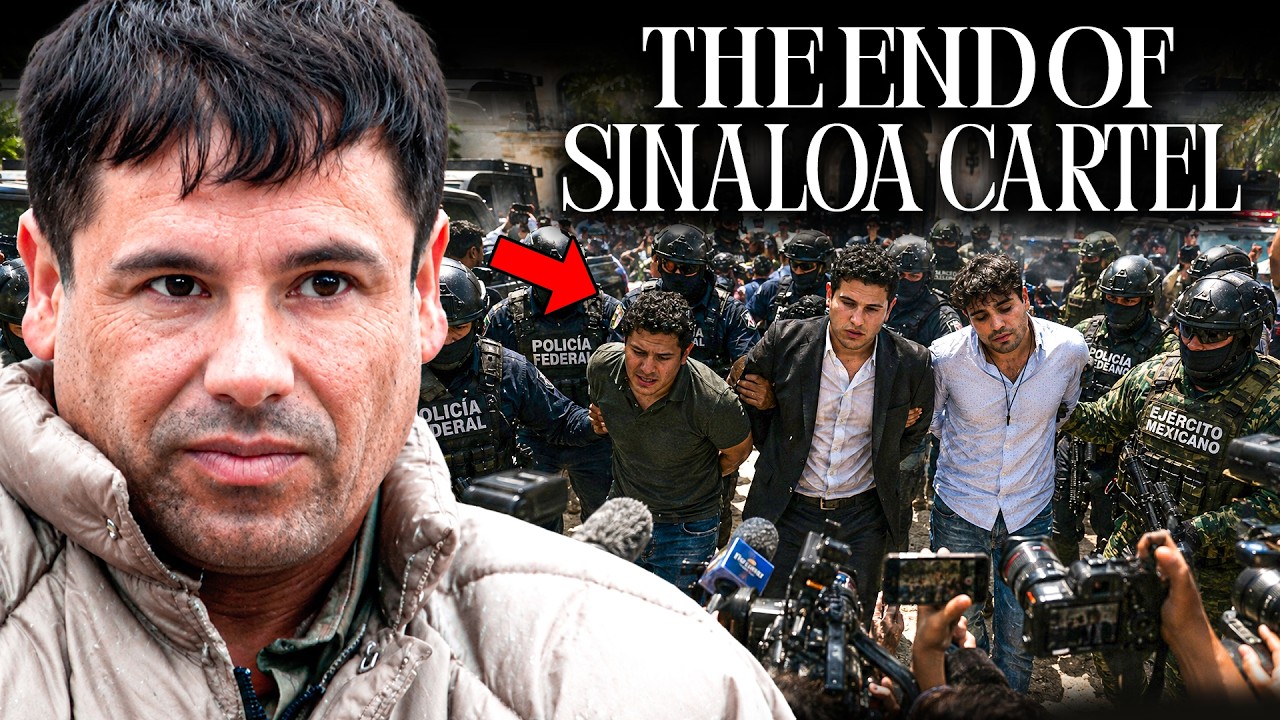
The most powerful drug trafficking organization in the history of the Western Hemisphere is collapsing in real time. Ten current and former Mexican government officials, including a governor, a vice attorney general, police chiefs, and prosecutors, have been federally indicted in New York City. The head of security for the entire state of Sinaloa was arrested in Arizona on May 11, 2026, and dragged to a federal detention facility in Brooklyn. And the sons of El Chapo, the heirs to the Sinaloa cartel throne, are reportedly negotiating a surrender deal with the US Department of Justice, preparing to walk themselves into federal custody and cooperate against everyone they ever worked with.
To understand how this empire fell, you have to go back to the 1980s. Mexico’s largest criminal operation was then the Guadalajara Cartel, which had grown rich on drug trafficking routes opened up as US and Colombian authorities cracked down on Caribbean smuggling lanes. In 1985, DEA agent Enrique Camarena was kidnapped, tortured, and murdered by cartel operatives. The US response was overwhelming, and by the late 1980s the Guadalajara Cartel had fractured into regional factions.
One faction, based in the state of Sinaloa, was led by Héctor Luis Palma Salazar and Joaquín Guzmán Loera, known to the world as El Chapo. El Chapo was a logistics revolutionary. He pioneered sophisticated tunnel systems under the US-Mexico border with rail systems, ventilation, and electricity. He built relationships with officials at every level of Mexican government, escaped from two maximum-security prisons, and was finally extradited to the United States in 2017.
After a trial in federal court in Brooklyn in 2018 and 2019, he was convicted on all counts and sentenced to life at ADX Florence in Colorado, where he remains in near total isolation. But El Chapo going to prison did not kill the Sinaloa Cartel. Two power centers stepped up to fill the void. The first was Ismael El Mayo Zambada, El Chapo’s longtime partner and co-founder, the quiet strategist who operated in the shadows.
He reportedly never spent a single night in jail for nearly 30 years while co-running one of the world’s most powerful criminal organizations. The second power center was Los Chapitos, El Chapo’s sons, specifically four brothers: Iván Archivaldo, Jesús Alfredo, Joaquín, and Ovidio Guzmán. Younger, more aggressive, and more willing to use open violence, they represented the next generation of Sinaloa leadership. For a while, the co-leadership arrangement held.
But the tensions between the factions never disappeared. In January 2023, the US government had been quietly building comprehensive cases for years. On January 5, Mexican forces moved into Culiacán to arrest Ovidio Guzmán. What followed was one of the most brazen displays of cartel power in the modern era.
Armed convoys flooded the streets, vehicles were set on fire to block roads, and the city shut down. The government had actually tried to arrest Ovidio in 2019 but had to let him go because the cartel response threatened to collapse the city. This time, they held firm, and Ovidio was arrested and eventually extradited to the United States. Once in federal custody in Chicago, he began cooperating, providing the US government with valuable information.
Meanwhile, his brother Joaquín made what might be the wildest individual play in modern cartel history. In July 2024, Joaquín arranged a meeting with El Mayo Zambada, telling him they were going to fly out and look at some property in Mexico. Mayo got on the plane. But the plane did not go where he thought it was going.
It landed near El Paso, Texas, where DEA agents were already waiting on the tarmac. Joaquín Guzmán López had kidnapped his own godfather, a man who had co-founded the cartel alongside his father and protected his family for decades, and handed him to the United States government. According to court documents, the US government did not request or plan the kidnapping, but they knew it was coming because Ovidio had already been cooperating. El Mayo, who had stayed out of US custody for three decades, was finally caught at 69 years old.
The internal war started immediately. On September 9, 2024, two factions clashed: Los Chapitos on one side and La Mayiza, Zambada loyalists, on the other. The battlefield was Culiacán, Sinaloa’s capital city. For nearly 20 months, the streets have been a war zone.
Hundreds of civilians have been killed in crossfire, thousands of families displaced, schools closed, businesses abandoned. The Mexican military deployed but could not contain it. Part of the reason is now clear: law enforcement in Sinaloa was already compromised at the highest levels. According to a federal indictment unsealed on April 29, 2026, in Manhattan federal court, Los Chapitos had allegedly been running a full-scale government corruption operation that reached the governor’s mansion.
The arrangement reportedly started as an electoral deal in 2021, with Los Chapitos providing money, logistics, and intimidation to help Rubén Rocha Moya win the Sinaloa governor’s race. Once in power, the payback began. Each official on the alleged narco payroll had a specific function. The state police were directed not to arrest Los Chapitos members, but to target rival criminal groups.
The vice attorney general, Dámaso Castro Xedra, reportedly pulled in around $11,000 a month to intercept intelligence about DEA operations and Mexican military raids, passing warnings to the cartel before they happened. Former investigative police chief Marco Antonio Almanza Avilés allegedly received $16,000 a month to allow vehicles carrying fentanyl precursor chemicals to move freely and to use court orders and arrest warrants as weapons against the cartel’s enemies. At the top of the corruption pyramid was Gerardo Mérida Sánchez, the secretary of public security for the state of Sinaloa. His alleged price was $100,000 a month in cash.
According to the indictment, he did not just look the other way. He actively coordinated. In 2023 alone, he allegedly warned Los Chapitos ahead of at least ten separate planned raids targeting drug labs, weapons storage sites, and safe houses. Every time law enforcement was about to move, his call got there first.
Personnel scattered, drugs moved, weapons disappeared. On May 11, 2026, Mérida Sánchez was arrested in Arizona, transferred to New York, and appeared before a federal judge in Manhattan on May 15. He was ordered held at the federal detention facility in Brooklyn, the same facility where El Mayo Zambada is awaiting sentencing. He faces 40 years to life in prison.
He was the first of the ten indicted officials to surrender. The other nine, including Governor Rocha Moya himself, remain outstanding. Rocha Moya stepped back from his gubernatorial duties but denied all charges, calling the indictment a political attack. Mexican President Claudia Sheinbaum said she would not defend anyone proven to have committed crimes but pushed back against Mexican officials being prosecuted in US courts.
Several of the indicted officials are members of her own ruling Morena party, turning the crisis diplomatic as well as criminal. The surrender negotiations for the remaining Chapito brothers may be the most consequential development of all. Iván Archivaldo Guzmán Salazar and Jesús Alfredo Guzmán Salazar, the two sons of El Chapo still free and still running Los Chapitos, are reportedly in active negotiations to turn themselves in. The Los Angeles Times broke the story, citing two sources familiar with the ongoing cases, saying the conversations have been going on for approximately a year.
The evidence suggests something is genuinely moving. They hired Jeffrey Lichtman as their defense attorney, the same lawyer representing their half-brothers Ovidio and Joaquín and El Chapo himself at trial in 2019. On April 6, 2026, a federal judge in Chicago signed an order reassigning the case files for both brothers to Judge Sharon Johnson Coleman, the same judge handling Ovidio and Joaquín’s cases, consolidating all four brothers under one judge. On that same April 6, for several hours, the federal court system stopped listing Iván and Jesús Alfredo as fugitives, as if their status had changed.
Two days later the court corrected it and relisted them as fugitives, but the case reassignment stayed. According to reporters tracking the story, Iván and Jesús Alfredo are watching the sentencing outcomes for their brothers before making a final call. Joaquín Guzmán López, the one who handed Mayo to the feds, is scheduled for sentencing on June 1, 2026. Ovidio’s sentencing is set for July 27.
El Mayo faces sentencing on July 20, with life in prison and potential placement at ADX Florence on the table. Reports suggest the brothers could be looking at sentences of 5 to 10 years maximum in exchange for full cooperation, US residency for themselves and their families, and the ability to keep a significant portion of their accumulated wealth. In exchange, they would testify and provide evidence, potentially the most detailed picture of cartel-government corruption ever to come out of Mexico. Their pilot already went first: Mario Alberto Núñez Oha, alias El Jando, Iván’s personal narco pilot, signed a plea agreement with the DOJ on April 9, 2026, admitting to conspiring to distribute cocaine with intent to import it into the United States.
On the street, the war between Los Chapitos and La Mayiza has grown into a brutal stalemate. Twenty months of open warfare has drained both organizations, with personnel lost and territory contested. The alliance Los Chapitos built with the Jalisco New Generation Cartel to offset La Mayiza’s pressure took serious hits when CJNG’s founder reportedly died and a key intermediary was captured. US enforcement pressure is relentless.
Just this month, a high-ranking Sinaloa cartel member was sentenced to 28 years in federal prison in North Carolina for conspiracy to distribute fentanyl, methamphetamine, and cocaine. In Los Angeles County, four family members were arrested for running a Sinaloa-linked fentanyl and meth distribution ring. The DEA is offering $5 million each for two brothers who have run the Sinaloa operation in Tijuana for 15 years. Security analysts have laid out scenarios for what happens if the Chapito brothers surrender and the leadership vacuum becomes permanent.
The least likely is that La Mayiza absorbs Los Chapitos’ entire operation and the cartel reunifies. After nearly two years of killing each other’s soldiers and displacing each other’s families, genuine reunification is almost impossible. The more likely scenario is fragmentation, with different plaza bosses aligning with different factions or attempting to go independent, breaking the unified Sinaloa brand into competing regional pieces. A third scenario is dissolution at the top, with the loss of leadership and political protection collapsing the international trafficking network entirely, leaving smaller regional organizations without the connections to maintain Sinaloa’s historic operations.
In every scenario, the violence goes up before it goes down, as factions fight to claim territory once controlled by a unified organization. In a matter of weeks in May 2026, the head of security for the state of Sinaloa sits in a Brooklyn detention facility. A sitting governor has been indicted in federal court in Manhattan. A handwritten narco payroll detailing monthly payments to over ten officials has been entered into court evidence.
El Chapo’s sons are either in federal custody, cooperating with prosecutors, or reportedly negotiating their own surrender. El Mayo Zambada awaits a life sentence. The cartel’s internal civil war is stuck in a bloody stalemate. And the political apparatus that protected the Sinaloa cartel inside the Mexican government has been publicly exposed.
The cartel built its empire over 40 years, survived the arrest of El Chapo, survived the Zeta wars, survived internal conflicts that would have destroyed smaller organizations. It survived because it had deep structural roots inside legitimate power. Those roots are now being pulled up. The fall of an empire is not a single moment.
It is a process, and the violence does not stop when the leadership collapses. It often gets worse before it gets better, because the rules that governed the conflict disappear along with the organization that enforced them. That is the reality the people of Sinaloa are living through right now.






