The royal family had just lost a king, and in the raw January of 1936, Princess Maud sat with the grief that came to every one of them. For nearly twenty-five years, her uncle had been the fixed point of her world, the man who gave his formal consent to her marriage, who stood as the quiet, dutiful anchor of a family scattered across the thrones of Europe. Now George V was gone, carried off by years of heavy smoking and the crushing weight of a crown he had never wanted. His heir was the glittering, restless Prince of Wales, the man the family called David, a king who seemed to belong more to the jazz age than to the solemn institution he had inherited.
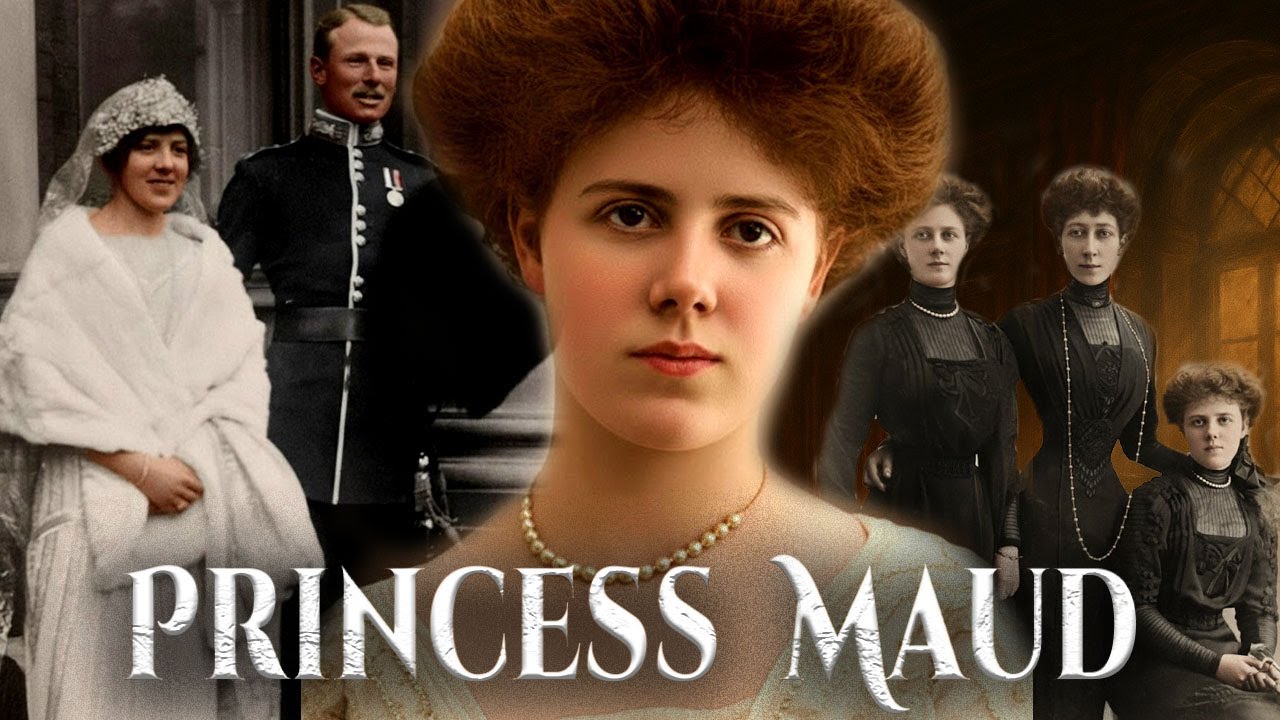
Within months, that glittering heir would tear the family apart, and Maud, the quiet princess who had spent her whole life stepping away from the spotlight, would watch her cousin throw away everything she had spent her life learning to protect. She had been born into the most dazzling world the nineteenth century could offer. On April 3, 1893, at East Sheen Lodge in Richmond, Maud Alexandra Victoria Georgina Bertha came into the world as the second daughter of Princess Louise, the eldest daughter of the Prince and Princess of Wales, and Alexander Duff, the 6th Earl of Fife, a Scottish nobleman of enormous wealth and ancient lineage. Two days after her birth, Queen Victoria created her father Duke of Fife, ensuring that his children would rank among the highest nobility in Britain.
The union itself was notable: a royal princess marrying a British subject rather than a foreign prince marked a quiet shift in a family that had for centuries married almost exclusively into continental royalty. It meant that Maud and her elder sister Alexandra, born in 1891, would grow up in a unique position, undeniably royal, yet a step removed from the suffocating pressures faced by cousins destined to rule. Their childhood was not spent in a palace but in the grand homes their father built: 15 Portman Square in London and Mar Lodge, a vast Victorian shooting lodge in Aberdeenshire, set amid the wild beauty of the Cairngorms. There, among the misty Scottish hills, Maud developed a deep love of the countryside and a taste for a quieter, more private life.
Her mother shaped her character profoundly. Princess Louise was shy, reserved, almost reclusive, and she loathed public life. She suffered from bouts of ill health and much preferred the seclusion of her family and her Scottish home to the demands of royal duty. Her personality was reflected in her second daughter.
Maud inherited her mother’s quiet, introspective nature and her dislike of the limelight. The two sisters were often referred to simply as “the Fife girls,” a collective name that hinted at their close bond and shared life. Their education, conducted at home by governesses, was typical for aristocratic girls of the time: French, German, music, drawing, and the art of polite behavior, designed not to spark intellectual curiosity but to prepare them for their expected roles as gracious hostesses, cultured companions, and above all, suitable wives. By the time Maud was growing up, that world was already beginning to fade.
The old notion of a princess’s duty to secure a dynastic alliance was becoming obsolete. The fall of monarchies in Portugal and Brazil and growing instability across Europe meant the list of eligible foreign princes was shrinking, and the political usefulness of such marriages was diminishing. Her grandfather, Edward VII, was called the “Uncle of Europe” for his vast network of royal relatives. He was uncle to both Kaiser Wilhelm II of Germany and Tsarina Alexandra of Russia, and his wife, Queen Alexandra, was the sister of the Empress Dowager of Russia and the King of Denmark.
Maud’s cousins were scattered across the thrones of Germany, Russia, Norway, Spain, and Greece. Family gatherings were effectively international summits. Yet these close blood ties, which should have guaranteed peace, proved meaningless in the face of rising nationalism and military ambition. In 1910, that glittering, interconnected world suffered a severe blow with the death of Edward VII.
His funeral was the largest gathering of monarchs the world had ever seen, a last, poignant parade of the old order. Nine kings rode in his funeral procession, including his nephew, the German Kaiser. It was a magnificent spectacle, but it was a farewell. The era of personal diplomacy conducted by monarchs had ended.
Maud’s uncle, George V, took the throne, a more dutiful and less flamboyant figure than his father, signaling a return to a more restrained style of monarchy. The long Edwardian summer was over, and the shadows were lengthening. Two years later, in 1912, tragedy struck the family. While sailing to Egypt, the ship carrying the Duke of Fife, Princess Louise, and their two daughters sank off the coast of Morocco.
All were rescued, but the Duke, who had bravely helped other passengers, contracted pleurisy as a result of the ordeal. He died shortly afterward. Maud was only eighteen. The sudden loss of her father was devastating, shattering the secure world of her youth.
It also accelerated a change in her sister’s status. Queen Victoria had granted a special remainder allowing the Dukedom of Fife to pass through the female line, so Alexandra became the 2nd Duchess of Fife in her own right. Both sisters were now not only princesses but also major nobles, and their futures and marriage choices became matters of even greater interest. Between early 1912 and the summer of 1914, Maud lived in a strange, dreamlike interlude, the last breaths of the old world.
There were quiet dinners, family gatherings at Sandringham and Balmoral, and the unasked question of marriage. Alexandra, as a duchess with great title and fortune, was an exceptionally desirable bride. She soon became engaged to her royal cousin, Prince Arthur of Connaught. For Maud, however, the path was less clear.
As the younger sister with a lesser title, her future was more flexible and open to shaping. There is no record of any serious foreign suitors for her, and it seems likely, given the personality she would develop, that she showed little enthusiasm for such a future. She had seen her mother’s introverted nature and perhaps realized, with wisdom beyond her years, that a life under the constant scrutiny of a foreign court was not the life she wanted. She was a princess of the United Kingdom, yes, but she was also of Scotland, and her heart seemed inclined toward home.
This period was also one of acute political and social unrest boiling beneath the surface of aristocratic life. The struggle for women’s suffrage intensified, with activists chaining themselves to railings and clashing with police just streets away from Maud’s London home. In Ireland, the issue of home rule was pushing the country to the brink of civil war. Across Europe, the great powers were locked in their intricate dance of alliances, each step bringing them closer to collision.
For Maud and her contemporaries, these were distant echoes, headlines in The Times to be discussed at breakfast, but they were tremors of an earthquake about to shatter their world. The spark, when it came, was in a city most Britons could barely locate on a map. On June 28, 1914, in Sarajevo, a Serbian nationalist assassinated Archduke Franz Ferdinand, heir to the throne of Austria-Hungary. At first, it seemed like just another distant Balkan crisis.
But the web of treaties, the Triple Entente between Britain, France, and Russia, and the Triple Alliance between Germany, Austria-Hungary, and Italy, worked like dominos. An Austrian ultimatum to Serbia, Russian mobilization to protect its Slavic brothers, a German declaration of war on Russia, then on France. Suddenly, the unthinkable was happening. The German war plan required a swift invasion of France through neutral Belgium.
Britain, honoring its treaty to protect Belgian neutrality, delivered an ultimatum to Germany. It was ignored. On August 4, 1914, Great Britain declared war on Germany. The initial reaction in Britain was not fear but a kind of jubilant patriotism.
Crowds gathered outside Buckingham Palace singing “God Save the King. ” Young men rushed to enlist, convinced the war would be a great adventure, a short, sharp conflict that would be over by Christmas. For the royal family, the war was a profound and deeply personal catastrophe. This was not a war against a faceless, distant enemy.
It was, in many ways, a family feud. George V’s cousin was Kaiser Wilhelm II of Germany. Another cousin was Tsarina Alexandra of Russia. The King of Norway was his brother-in-law.
The Queen of Spain was his cousin. The intricate web of blood that had been Queen Victoria’s pride was now a source of immense tragedy and political embarrassment. The “Uncle of Europe” was gone, and his grandchildren were now leading their nations into the greatest slaughter in human history. As the horrific reality of modern industrial warfare became clear, life in Britain changed.
Grim determination replaced the initial jingoism. The lists of dead and wounded grew ever longer, reaching from the grandest palaces to the most modest homes. George V and Queen Mary worked tirelessly, visiting troops, inspecting factories, and presenting medals to wounded soldiers. They embodied the spirit of national sacrifice, even imposing rationing at Buckingham Palace.
The new austerity spread through the entire aristocracy. Great London houses were converted into hospitals and convalescent homes. Women of the upper classes, formerly occupied with balls and dress fittings, now rolled bandages and trained as nurses to care for the endless stream of wounded returning from the trenches of Flanders and the Somme. In this environment, Princess Maud found urgent new purpose.
She and her sister Alexandra joined the Voluntary Aid Detachment, working in a supply depot for a time before training and serving in London hospitals. Here, the terrible reality of war was immediate and tangible. Maud, the quiet princess, now wore the stark white uniform of a volunteer nurse. Her days were no longer spent in elegant drawing rooms but in hospital wards amid human suffering and loss.
In the ward, she was not primarily Her Royal Highness, Princess Maud. She was a nurse, part of a vast, desperate effort to repair the bodies of a broken generation. The strict class barriers that had defined her entire life dissolved in the face of shared national trauma. This work, done with quiet dedication and away from the glare of the press, was entirely consistent with her character.
It was practical, concrete, a form of personal and direct duty rather than a ceremonial one. It forged within her a resilience and maturity that the social rituals of the pre-war world never could have. As the war continued, its political and social consequences deepened. One of the most significant for the royal family was the rising tide of anti-German sentiment in Britain.
The Kaiser was vilified in the press, and anything remotely German came under suspicion. This posed a serious problem for the British monarchy, whose very name was German. The royal house was the House of Saxe-Coburg and Gotha, a name inherited from Queen Victoria’s husband, Prince Albert. With German Gotha bombers flying over London, the name had become a liability.
In a masterstroke of public relations, George V made a radical decision. On July 17, 1917, he issued a royal proclamation changing the family name. Henceforth, the British royal house would be known by a thoroughly English name derived from the castle that had been the heart of the monarchy for centuries: the House of Windsor. Family members with German titles were asked to relinquish them and were offered British titles instead.
It was a symbolic severing of the last ties with their German relatives and a decisive declaration that the King and his family were British, and British only. But while the Windsors were consolidating their position at home, their relatives in Russia were facing annihilation. The war had been a catastrophe for the Russian Empire. Military defeats, food shortages, and political incompetence led to widespread unrest.
In March 1917, Tsar Nicholas II was forced to abdicate. He and his family, Tsarina Alexandra and their five children, Olga, Tatiana, Maria, Anastasia, and Alexei, were placed under house arrest. George V was placed in an impossible position. The Tsar was his cousin, and the Tsarina was his wife’s cousin.
He initially offered the family asylum in Britain. But the move was deeply unpopular. The Tsar was seen as an autocrat, and with socialist sentiment rising in Britain, there were fears that harboring the deposed monarch might ignite revolution at home. Under immense political pressure, the offer of asylum was withdrawn.
The consequences were horrific. The Bolsheviks under Lenin seized power in Russia and plunged the country into civil war. In the early hours of July 17, 1918, exactly one year after the founding of the House of Windsor, they woke the Romanov family in the cellar of their prison in Yekaterinburg and brutally executed them by firing squad. News of the massacre sent a shockwave of horror through every royal court in Europe.
It was a brutal, decisive end to the old world of interconnected monarchs. For Maud, this was not a distant political event. These were her relatives. The grief within the family was personal and profound, a stark and terrifying reminder of how fragile their world had become.
Finally, after four long, brutal years, the war ended. At the eleventh hour of the eleventh day of the eleventh month, 1918, the guns fell silent on the Western Front. A wave of jubilation and profound relief swept over Britain. But it was a victory bought at a terrible cost.
An entire generation of young men had been annihilated. The country was financially exhausted and psychologically scarred. The old certainties, the faith in progress, the deference to the established order, all had been shattered in the mud of Passchendaele and the Somme. Maud was now twenty-five.
The glittering, frivolous world of her youth was a distant memory, a lost civilization. She had witnessed firsthand the devastating consequences of war. She had seen the end of the great European empires and the murder of her own kin. She had found purpose, not in a palace, but in a hospital ward.
The war did not bring back the world that had existed before. That world was gone forever. In its place rose the turbulent, contradictory decade of the Roaring Twenties, a time of frantic celebration and deep trauma, of dazzling prosperity and suppressed social unrest. For women, the changes were especially revolutionary.
The war had pushed them out of the domestic sphere and into factories, offices, and hospitals. In 1918, the Representation of the People Act granted the vote to women over thirty who met property qualifications, a seismic shift in the political landscape. Fashion became a declaration of independence. The restrictive corsets and long skirts of the pre-war era were discarded in favor of shorter hemlines, lower waists, and bobbed hair.
Into this new, tumultuous, fast-paced world stepped Princess Maud. Now in her mid-twenties, she was a woman of the new era, yet deeply connected to the old. Unlike many of her contemporaries, she did not indulge in the frantic social scene of the Jazz Age. The quiet, reserved nature that had marked her youth remained her defining characteristic.
While society columns buzzed with the exploits of bright young things, Maud’s name appeared far less frequently. She attended necessary royal occasions, but her heart was not in the world of parties and nightclubs. The experiences of the war and the quiet dignity she had found in nursing seemed to have cemented her preference for a life of substance over appearance, of privacy over fame. Her elder sister Alexandra had achieved a more conventional destiny.
Her 1913 marriage to Prince Arthur of Connaught, a grandson of Queen Victoria and a distinguished military officer, placed her firmly within the upper royal circle. This gave Maud space to define her own life. She was not a duchess with vast estates to manage. She was Princess Maud, a title with great prestige but fewer defined obligations.
During this time, she began spending more and more time at Mar Lodge. In the wild, dramatic landscape of the Scottish Highlands, she found a peace that London’s postwar energy could not offer. She was a skilled horsewoman and enjoyed the country pursuits that were the cornerstone of noble life. Here, surrounded by family friends and the Scottish aristocracy, she found the man who would become her husband.
Lord Charles Carnegie was not a foreign prince or a senior royal. He was a Scottish nobleman, the eldest son and heir of the 10th Earl of Southesk. Born in 1893, the same year as Maud, he was a man of his time and class. Educated at Eton and Sandhurst, like nearly every man of his generation, he served in the Great War.
Commissioned in the Scots Guards, he fought on the Western Front, an experience that forged in him a quiet, unassuming strength. After the war, he served for a time as an aide-de-camp to the Viceroy of India. He was handsome, highly regarded, and possessed a reserved, intellectual nature that complemented Maud’s own. He also had a deep love of Scotland, its history, and its traditions.
Their courtship was not a stormy, headline-grabbing romance. It was a slow, gentle, private affair, developing naturally from their shared social circles and mutual love of the Scottish way of life. The attraction was not based on dynastic calculation but on genuine personal compatibility. Maud found in Charles a kindred spirit, a man who understood the weight of history and lineage but was not constrained by it, a man who valued privacy and the quiet rhythms of country life as much as she did.
The engagement was announced in the summer of 1923, and the news was received with quiet approval. George V, who held deep affection for his nieces, gave his formal consent to the marriage as required by the Royal Marriages Act of 1772. The days of using his relatives as pawns in European diplomacy were over. What mattered now was stability, and his niece’s happy, stable marriage to a British subject was a far better outcome than a miserable foreign alliance driven by political purpose.
On November 12, 1923, Princess Maud and Lord Carnegie were married. The wedding was a significant royal event, but it bore the couple’s characteristic desire for a more personal touch. It was held not in Westminster Abbey but in the Royal Military Chapel at Wellington Barracks, a more intimate setting. The King and Queen attended, along with Maud’s grandmother Queen Alexandra and a host of royal relatives.
Maud’s wedding dress was typical of 1920s elegance: a simple, straight-cut gown of silver and white brocade, trimmed with precious family lace. In choosing Lord Carnegie, she was making a decisive statement about the kind of life she wanted to live. She was turning away from the prospect of becoming a consort in a foreign land, with all its public duties and constant scrutiny. Instead, she chose to become the wife of a British nobleman, a life that still carried immense privilege but was lived largely away from the royal spotlight.
Although she retained her royal title and status by law, Maud made a personal decision to be known as Lady Maud Carnegie after her marriage. It was a clear statement that she wanted to be seen as Lord Carnegie’s wife rather than a princess who had married a nobleman. The couple settled into a life that was a blend of their two worlds. They had a home in London for the social season, but their true heart was in Scotland, where they spent as much time as possible at Elsick House, one of the Carnegie family seats.
Here, Maud could fully embrace the life she had always longed for. Her days were not filled with openings and charitable events but with managing the household, walking the estate, fishing, and, later, raising her children. In 1929, their only child was born, a son they named James. By all accounts, Maud was a devoted and loving mother, determined to give her son as natural an upbringing as possible.
Her decision to live a private life was itself a pioneering act. In an era when modern media was taking shape with the rise of newsreels and society magazines, the appetite for royal stories and pictures was growing voraciously. Maud’s cousins of the new Windsor generation, the handsome Prince of Wales, the future Edward VIII, and the charming Duke of York, the future George VI, were the stars of that age. Maud deliberately chose to step out of that brilliant light.
It was a choice that required quiet but firm resolve, a gentle, persistent resistance to the pressures and expectations of her station. For Lady Maud Carnegie, the years following her marriage were the fulfillment of a lifelong longing. She had successfully navigated the treacherous waters of royal expectation to reach a safe harbor of her own choosing. Her life with Charles was centered on the rhythms of country life.
At Elsick House and later at their principal home, Kinnaird Castle in Angus, Maud fully embraced the role of a Scottish lady. Managing these vast estates was a formidable task. She oversaw the household staff, planned menus, managed household accounts, and took an active interest in the welfare of tenants and the local community. It was a role of responsibility and quiet authority, performed with the same modest diligence she had brought to the hospital wards during the war.
It was a different kind of duty, not to the nation but to her family and home, and she clearly cherished it. The birth of their son James in 1929 brought new and profound joy. Maud was a present and involved mother, a departure from the distant parenting style common in aristocratic circles. She instilled in him a love of Scotland and the open spaces, and sought to give him a sense of naturalness that she herself had lacked in her childhood.
In her quiet, family-focused life, Maud seemed to have found the perfect antidote to the pressures of her royal birth. This life of domestic tranquility stood in stark contrast, almost defiantly so, to the lives of her royal cousins. The Prince of Wales, known in the family as David, was the true embodiment of a Jazz Age prince. He was a global superstar and fashion icon, every romantic entanglement eagerly reported in the international press.
Maud’s life, by comparison, was a mere footnote in the royal saga, and that was exactly what she wanted. When the family gathered for holidays at Sandringham or Balmoral, the difference must have been palpable. While her cousins were at the heart of the monarchy’s public duties, Maud and Charles were quiet, steady presences on the periphery. They were part of the family, loved and respected, but they were not part of what would later be called “the firm” or the working royal family.
This gave them a unique freedom: the ability to observe without being constantly observed, to participate without being on permanent display. Yet no refuge, however remote or well-protected, could remain entirely insulated from the seismic events shaking the world. The Roaring Twenties came to a stunning and destructive end with the Wall Street Crash of October 1929. The financial shockwave rippled across the Atlantic, plunging Britain and the rest of Europe into the Great Depression.
The era of champagne and the Charleston gave way to an age of soup kitchens and hunger marches. Mass unemployment left deep scars on the industrial heartlands. While the aristocracy, protected by inherited wealth and land, was largely shielded from the worst of the poverty, they were not immune to the atmosphere of fear and social unrest. The stark contrast between the lives of the rich and the suffering of the masses bred resentment and political extremism on both the far right and the far left.
For people like Maud and Charles, whose lives were intimately tied to the land and the communities that worked it, the Depression was not abstract news. They saw its effects firsthand in the hardships faced by their tenants and neighbors. Against this backdrop of economic hardship, the nation sought solace in the monarchy. In 1935, the country celebrated the Silver Jubilee of George V and Queen Mary.
It was a moment of genuine, sweeping public affection for a king who had been a symbol of stability and unwavering integrity through the shocks of the Great War and the uncertainties of the peace. For Maud, this was not just a formal occasion. It was a celebration of her uncle, the man who had been the steady paternal figure for her family for twenty-five years. The Jubilee was a resounding success, a brief golden moment of national pride in a dark decade, but it was a farewell.
The King’s health, worn down by decades of heavy smoking and the immense pressures of his reign, was failing. In January 1936, the news the nation had dreaded was broadcast over the radios that now sat in nearly every home. The King’s life was drawing peacefully to its close. He died on January 20 at Sandringham House.
His death marked the end of an era. He was the last pre-war king, a link to the vanished Edwardian world of Maud’s youth. For Maud, the loss was deeply personal. Another pillar of her world had fallen.
With his death, the crown passed to her cousin, the beloved and charming Prince of Wales, now King Edward VIII. The nation looked to its modern new monarch with a sense of hope and expectation. He was seen as a man in tune with his times, someone who could connect with ordinary people in a way his stiff, formal father never could. But within the royal family and the highest circles of government, there was deep and growing unease.
For years, the new King’s relationship with Wallis Simpson, an American woman on the verge of her second divorce, had been a carefully guarded secret, known in aristocratic circles but kept out of the British press by a voluntary code of silence. Now that he was King, the situation had become untenable. Edward was infatuated with Mrs. Simpson, whose sharp wit and sophisticated charm contrasted starkly with the more reserved ladies of the English aristocracy.
He was determined to marry her. But this was not merely a matter of the heart. For the King of Great Britain and Ireland and Emperor of India, it was constitutionally and religiously impossible. The King was the Supreme Governor of the Church of England, an institution that did not recognize divorce and certainly did not permit the remarriage of divorced persons.
Furthermore, the governments of the United Kingdom and the Dominions made clear they would not accept Mrs. Simpson as Queen. The unfolding crisis was a source of profound shock and private suffering for Maud and the rest of the royal family. They had watched David’s recklessness for years, his disregard for convention, his preference for the fast, luxurious life of international high society over his duties at home.
But they never believed he would sacrifice the throne itself for a woman. Maud’s entire life had been a lesson in how to achieve the delicate balance between personal desire and the responsibilities of her birth. She had found personal happiness not by rejecting her heritage but by finding a place within its framework that allowed for a private life. Her cousin was now proposing to do the exact opposite, placing his personal desire above everything else and blowing up the very foundations of the institution he was born to lead.
Throughout the autumn of 1936, the crisis escalated behind closed doors. The King refused to give up Mrs. Simpson. The government, led by Prime Minister Stanley Baldwin, refused to countenance the marriage.
Finally, in early December, the story broke in the British press, and the constitutional crisis became a public scandal. The King was given a choice: the woman or the throne. On December 10, 1936, Edward VIII signed the instrument of abdication. His reign had lasted only 326 days.
The following evening, he addressed the nation and the world by radio, declaring: “I have found it impossible to carry the heavy burden of responsibility and to discharge my duties as King as I would wish to do without the help and support of the woman I love. ” The crown passed immediately to his younger brother, the shy, stammering Duke of York, who had never expected or desired to be King. He ascended the throne as George VI. For Maud, the abdication was a family tragedy of the first order.
It was a betrayal, not just of the nation but of the family itself. The quiet stability she had so carefully built in her own life now stood against the backdrop of the biggest royal scandal in modern history. The crisis was over, but the world was not at peace. While Britain was absorbed in its internal drama, a more sinister threat was gathering strength across the English Channel.
Adolf Hitler, who had come to power in Germany in 1933, had tightened his grip, rearming the nation in defiance of the Treaty of Versailles and was now looking to expand his empire. His aggressive ambitions became increasingly clear as he remilitarized the Rhineland, annexed Austria, and began threatening Czechoslovakia. The policy of appeasement pursued by the British government in a desperate attempt to avoid another catastrophic war seemed increasingly futile. People in the late 1930s lived under a gathering cloud of dread.
The generation that had survived the Great War now had to watch its children face the prospect of another conflict, perhaps even more terrible. For Maud, now in her mid-forties, the peace she had known for two decades was crumbling. The refuge she had carefully built in the Scottish hills could not hold back the tide of history. War was coming again.
The declaration of war on Germany on September 3, 1939, was not met with the naive patriotism and flag-waving that had greeted the outbreak of conflict in 1914. There were no cheers, no cries to be home by Christmas. The generation that now had to fight, and the parents who had to send them, knew the true face of modern war. They had seen the casualty lists, nursed the wounded, and lived with the empty chairs around the dinner table.
This time, there was only quiet, grim determination. For Maud, now forty-six years old, the news must have felt like a recurring nightmare. The world she had known, the fragile peace she had cherished for two decades, was being swallowed up by violence once more. It seemed the lessons of the Great War had not been learned.
Her cousin, George VI, and his wife Queen Elizabeth became the focus of the nation’s will to resist. Their decision to remain in London at Buckingham Palace, even at the height of the Blitz, was a powerful symbol of solidarity with their people. The King’s broadcasts, delivered with his characteristic sincerity despite his stammer, were a source of immense comfort and strength. The monarchy, so badly shaken by the abdication, proved its enduring worth as a symbol of national unity in a time of existential crisis.
For Maud and her husband Charles, who had by then succeeded his father as the 11th Earl of Southesk, the war brought immediate and profound changes to their quiet Scottish lives. Large houses across the country were requisitioned to serve as hospitals, convalescent homes for wounded soldiers, schools for evacuated children, or military headquarters. Estates were given over to the “Dig for Victory” campaign, with manicured lawns and flower beds ploughed up to grow vegetables to feed a nation under blockade. The Southesk family, like all landowners, was deeply involved in these efforts.
Rationing, blackout regulations, and the constant lurking anxiety of war governed their lives. Maud, now Countess of Southesk, drew on the experiences of her youth. Once again, she threw herself into volunteer work. Although her age and position precluded a return to full-time nursing, she became a prominent figure in war-related charities in Angus.
She was involved with the Women’s Voluntary Service, helping to organize scrap metal collections, knitting clothes for soldiers, and assisting with the care of evacuees. These tasks were quiet and unglamorous, but they were essential and formed the backbone of the home front. Her work, as always, was done without fuss. It was a practical, personal contribution, a reflection of her ingrained sense of duty.
The war was also a deeply personal family matter. Her son James, Lord Carnegie, was a young boy when war broke out, but as he entered his teenage years, the constant threat of his future military service loomed. More immediately, her royal relatives were engaged in the war. Her cousin the King was the Commander-in-Chief of the armed forces.
His younger brother, the Duke of Kent, was serving in the RAF. The cost of this personal involvement was brought home in August 1942 when the Duke of Kent was killed in a military plane crash in Scotland, not far from where Maud lived. The death of a member of the royal family on active service was a profound shock to the nation and a deep, private grief for Maud and her family. It was a stark reminder that no one, regardless of rank, was safe.
Life during the war years was a strange blend of immense national drama and the mundane reality of daily deprivation. Although Scotland escaped the sustained bombing that devastated cities like London and Coventry, it was a vital center of the war effort, home to naval bases, training grounds, and vital industries. Nights were dark with blackout measures. Travel was restricted, and news from the front was often grim.
Yet, amid the fear, there was a strong sense of shared purpose and community. The strict class distinctions that had begun to dissolve during the first war dissolved further. Everyone was in it together, from the King and Queen at Buckingham Palace to the villagers in the Scottish Highlands. For Maud, these years must have been a time of immense strain.
The constant worry for her family and her country, combined with her tireless charity work, took its toll. Her health, never particularly robust, began to decline. Scottish winters were long and harsh, and in the draughty, under-heated conditions of the wartime castle, respiratory illness was a constant danger. By the winter of 1945, the tide of war had turned decisively.
Allied forces were closing in on Germany from the west and east. The defeat of the Nazi regime was now a matter of time. A feeling of cautious, exhausted optimism began to spread across Britain. After nearly six long years of darkness, the end was in sight.
People began to dream of peace, of reunions with loved ones, of a world where they no longer had to live under the shadow of constant death. But for Maud, the peace she longed for would never come. During that final, harsh winter of the war, she fell ill. It began as a bad cold, but in the damp, cold atmosphere of her Scottish home, it quickly developed into a serious respiratory infection.
With the country’s medical resources stretched to the limit by the war, and with drugs like penicillin still scarce and precious, reserved for the military, a common illness could be a death sentence. Her condition deteriorated rapidly into severe bronchitis. In a quiet room in a nursing home in London, far from the Scottish hills she loved, the life of Princess Maud came to an end. She died on December 14, 1945, at the age of fifty-two.
Tragically, she had survived two devastating world wars but had little time to enjoy the peace she had so longed for. She saw the end of the conflict but died before the dawn of a new world being built from the ashes. Her death was not front-page news. In a world still reeling from a conflict that had claimed tens of millions of lives, the passing of a quiet, reclusive princess from a respiratory illness was a mere footnote in the symphony of global tragedy.
Her funeral was a private affair, attended by her grieving husband, her young son, and her closest family members. She was not buried in a grand royal mausoleum but in the quiet seclusion of the small chapel at Kinnaird Castle. It was a fitting final resting place for a woman who had spent her entire life seeking refuge from the storms of public life. The timing of her death carries a heartbreaking, almost poetic tragedy.
She was a woman whose entire life had been shaped between the two great conflicts of the twentieth century. Born in the long, quiet summer of the late Victorian era, a world of absolute confidence and order, she witnessed its complete and utter destruction in the First World War and found her quiet purpose amid the slaughter. Then she built for herself a life of peace and privacy during the short, turbulent years between the wars, only to see that world consumed by an even greater conflagration. She lived through the Second World War and contributed to the war effort with the same steadfast duty she had always shown.
But she did not live to see the final, lasting peace. She died in the last moments of the world’s darkness, just before the dawn. Princess Maud of Fife is not a name that leaps from the pages of history books. She led no armies, signed no treaties, and delivered no major speeches.
Her life was a quiet, deliberate counter-narrative to the public prominence of the royal family in the twentieth century. Born into a world of gilded certainty, she was destined for a life of ceremonial duty as a pawn in the games of dynastic empire. Yet when that world was shattered by war, she found a deeper purpose, not in a palace but in a hospital ward. In an age of revolution and constant change, she sought solace not in rebellion but in seclusion.
She chose love over the crown, a quiet Scottish home over a foreign court, and the private life of a wife and mother over the public role of a princess. It was a choice that required a gentle, unwavering strength and a quiet rebellion against the expectations of her birth. Her life was a testament to the fact that fulfillment is not always found on the grand stage but in the authentic personal spaces we create for ourselves. Hers is a poignant whisper in the face of history’s roar.
She lived through the collapse of an empire and the brutal birth of a new world order, enduring two global catastrophes. Yet after a life spent enduring storms, she was denied the peace that followed. She departed at the height of the new era, a final, gentle casualty of a world in violent transition. Her story is not just a record of what was, but also a haunting meditation on what could have been.
It is the quiet, human story of a princess who simply wanted a life of her own. And in finding it, she left a legacy built not on power or fame, but on dignity, grace, and the timeless pursuit of peace.
