In the winter of 1899, sixty-one people entered a stone convent in the Ozark hills. Nuns, orphans, two visiting priests, and a country doctor from Springfield who had come to treat a fever and never returned home. By the time the snow melted that March, every door of the building had been chained shut from the outside, and every window on the lower two floors had been bricked up from the inside. None of those sixty-one people were ever seen alive again.
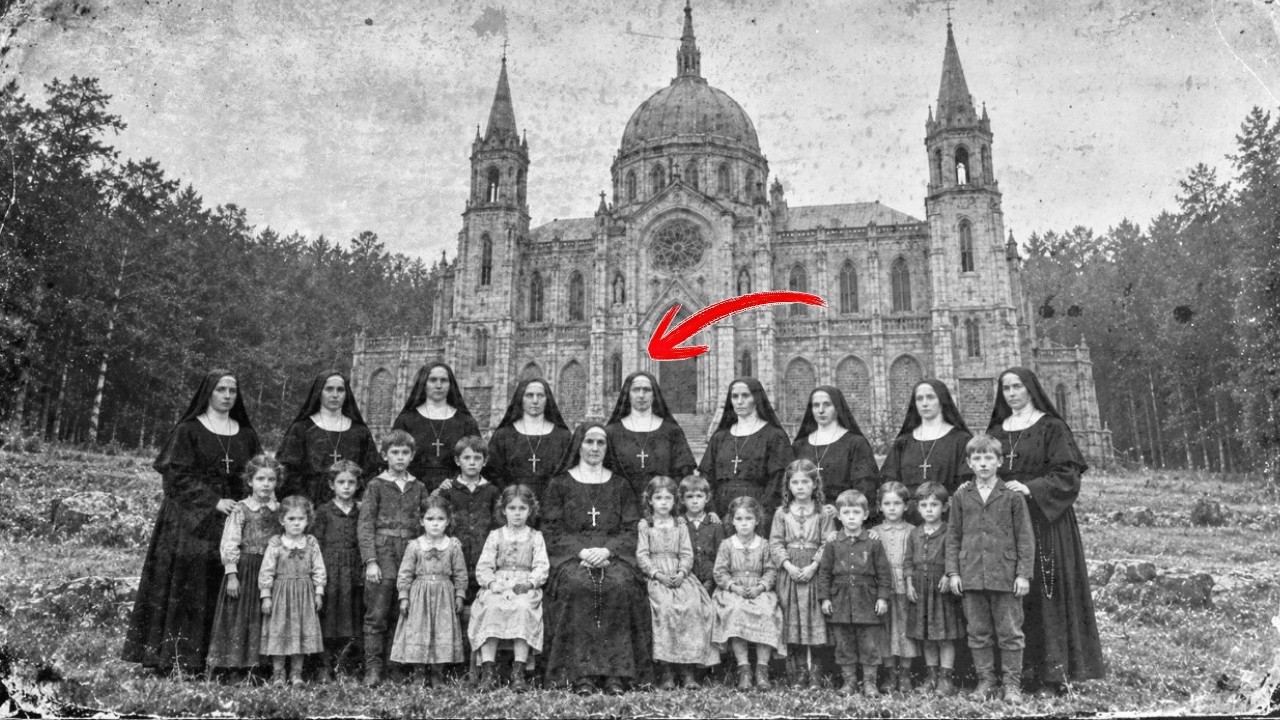
The building still stands today. You can find it above the limestone hills of the Missouri Ozarks if you know exactly where to look, surrounded by a rusted iron fence. The signs hung on it do not say what signs usually say. They do not say “No Trespassing.
” They say “No Entry by Order of the State. ” The narrow road that once led to its gate was quietly removed from every survey map printed after 1911, as if someone in some office had decided that the simplest way to keep people away from a place was to make sure they could never find it in the first place. No one will tell you who built it. And the deeper you look, the more you come to realize that no one can tell you who built it.
Because the women who gave the place its dreadful name, the Sisters of Sorrow Mere, did not lay a single stone in it. They did not commission it, did not design it. They found it finished. In the autumn of 1896, a small group of nuns climbed that hill expecting to find an empty plot of land donated for farming.
Instead, they found a ready-made cathedral of gray stone standing silent among the trees. Older than the county, older than the state, with no builders, no records, no explanation. What they eventually discovered in the sealed floors beneath the building is the reason it has remained locked to this day. To understand what happened at Sorrow Mere, you first have to understand the ground it stands on.
The Ozark Plateau is not actually a mountain range, though everyone who lives there calls the hills mountains. It is something rarer. It is an ancient seabed lifted whole hundreds of millions of years ago and then left alone. The Appalachians are middle-aged.
The Ozarks are ancient, eroded, soft, and green. And under that green cover, the entire plateau is hollow. The Ozarks are made of limestone and dolomite, soft stone that water eats the way mold eats wood. Under those quiet green hills run thousands of miles of caves, rivers flowing in total darkness, sinkholes that open overnight in a farmer’s field and swallow a barn, and springs that rush from the earth colder than ice water and never stop, not after a hundred years, not after a thousand.
The people who settled that country understood something in their bones. They knew the ground under your feet is not solid, that there is a whole hidden country down there in the dark, and that things go into it and do not always come back. The local Osage had names for certain depressions and refused to camp in them. The early white settlers, hard Scots-Irish stock not easily frightened, avoided certain hills without being able to say exactly why.
One of those hills, a long tongue of high ground above a valley the old maps called Sorrow Hollow, is where this story takes place. Even the name is a warning if you slow down and listen to it. Sorrow Mere. “Mere” is an old word, an English word, older than America itself.
It means a lake or a pond of still water. A lake of sorrow. But there is no lake on that hill. There never was.
So why did someone, at a time lost to history, look at that high, dry place and name it after a body of water that did not exist? There is something else about this country you need to know. The Ozarks are terrain that has been buried and uncovered more than once. Dig anywhere in that country and you will discover that the ground is not one thing but many things piled on top of each other.
Old riverbeds forty feet down, whole forests turned to stone under the living forests growing above them. Layers of clay and gravel that geologists say took eons to form, but the old-timers who actually dug wells and cellars and graves always swore were laid down fast, all at once, in a great flood their grandparents remembered only dimly and would not speak of after dark. And under it all, the caves, the dark hollow heart of the plateau, where rivers run that have never seen the sun, and where every few years a hound dog chasing a rabbit slips into a hole and is never seen again. And where the hill folk will tell you, if you sit with them long enough, that there are rooms, not caves.
Rooms cut square with straight walls and level floors and entrances deep in the darkness that no human hand in this country ever made. Remember that Sorrow Mere extends downward. Whatever it was, the part the sisters could see was only what stuck out of the ground. And the ground in that country has a long history of swallowing things whole and holding onto them.
The story truly begins in 1896 with a woman named Mother Agnes Colquhoun. What we know of her comes from the records of a small diocese and from a handful of her letters that survived. She was in her early fifties. She came from a teaching order in the East that had run out of money and lost its purpose.
She had been given a difficult, unglamorous task. She was to establish a new foundation, a working convent and orphanage somewhere in the raw Missouri Ozarks, on a plot of land donated to the church by a man whose name appears in no record anyone has ever found. The deed lists the donor simply as “a settled estate” and describes the land as “improved. ”
That word, “improved,” is the first strange thing.
In the real estate language of the time, improved land meant land with an existing structure on it. Unimproved land was raw. Improved land had a building. They prepared for a construction project.
They brought canvas tents, tools, seed, and a small treasury to hire local labor and haul stone. They expected to spend two hard years building a home out of the wilderness with their own hands. No one told them the home already existed there. Someone knew.
Someone classified that land as improved with a building on it, and someone chose not to mention to the contingent of nuns that the building they were heading toward had been standing empty on that hill for a time no one could estimate. Mother Agnes and eleven nuns made the final approach on foot in October 1896, leading two wagons up a road a local guide swore had not existed the previous spring. That detail is recorded in her own hand. She wrote to her superior that the guide, a taciturn man from the nearest settlement, grew more anxious the higher they climbed, and that at the tree line he stopped his mule, took his pay, pointed up the hill, and refused to go a step further.
He did not say why. He only told her, and she quoted him verbatim in her letter, that the local people did not go up to Sorrow Mere, that his grandfather had told him the place was already old when the first settlers came, and that whoever built it did not build it for us. She thought he was just a skittish mountain man. She would learn the truth later.
They crested the last rise at dusk, and there in a clearing no axe had ever made, surrounded by old-growth trees that had grown up to touch the building’s walls but somehow never touched them, stood the structure. They had come expecting barren ground. Instead they were looking at a building of polished gray stone that would not have looked out of place in a European capital. It was enormous.
It rose three stories above the ground, and its architecture shared nothing with the rough timber and stone everyone in that region built with. This was cut, carved stone, every block squared and fitted so precisely that Mother Agnes wrote: “You cannot insert a knife blade between the joints. ” There was a central dome. There were soaring arched windows, most of them dark, some still holding their original glass.
There were two slender towers, and between them, rising from the dome, a single spire of black metal, taller than both towers, catching the last light. And here is the detail she returned to again and again in her letters, the detail that clearly troubled her more than she wanted to admit. The building was clean. Not clean in the sense of being cared for, but clean in the sense of never having been touched.
There was no ivy on the walls, no bird nests under the eaves, no fallen leaves piled at the doorways, even though the clearing was ringed by trees shedding their leaves in the peak of autumn. The stone was not weathered the way stone weathers after a century in the open. It was sharp and fresh, as if the work on it had been finished last week. Yet the trees surrounding it were at least three hundred years old, which meant the clearing had been open for centuries, which meant the building was old, which meant the stone should have been soft and green and crumbling.
It simply was not. A building clearly ancient, standing in stone that had not aged a single day. That is the contradiction at the heart of Sorrow Mere, and no one has ever solved it. They spent their first night in their tents, unwilling to enter in the dark.
In the morning, Mother Agnes and two of the nuns approached the great front doors. The doors were bronze, finally green with age, the only part of the entire structure that showed its years. Carved on them in relief was a scene that deeply disturbed the nuns. It was not a Christian scene.
There was no cross, no saint, no lamb, none of the imagery a group of Catholic nuns might recognize and find comfort in. Instead, the doors showed a great crowd of small figures, hundreds of them, marching in a long line down steps toward what appeared to be an opening in the earth. Above them, cut into the bronze, was a single row of characters in an alphabet Mother Agnes did not recognize. She was an educated, well-traveled woman who read Latin and Greek and some Hebrew, and she could not read it.
She wrote that the doors were unlatched, that they swung inward at a touch without a sound on hinges that should have screamed with rust after all those years, but they moved smoothly as if oiled that morning. She wrote that the air that came out of the building when the doors opened was warm. It was October in the high Ozarks, cold enough that they could see their breath. But the air the building breathed out was warm and dry, and carried a faint smell she could only describe as the smell of a cellar that had been closed for a very long time, mixed with something sweeter underneath that she did not like at all.
They went inside. The interior was as impossible as the exterior. The entrance hall rose all three full stories to the inside of the dome, and that dome was not solid. It was perforated with an intricate pattern of small openings that let the morning light fall in columns, so the whole vast space filled with slowly moving shafts of dusty golden light.
The floor was a single piece of pale stone, polished smooth with no seams or joints, no trace of how it had been laid. And in the exact center of the room was an inlaid design, a large disc perhaps twenty feet across of dark inlay, decorated with the same incomprehensible symbols that were on the doors, arranged in rings around a central point. When the sisters stepped onto that floor and spoke, the room answered them. The acoustics of the entrance hall were, in Mother Agnes’s careful words, unnatural.
A whisper on one side of the room could be heard with perfect clarity on the other, forty feet away. A tune sung by one of the young sisters, a girl with a sweet voice, hung in the air of that dome for what the mother superior swore was a full thirty seconds after the girl stopped singing, not fading but somehow growing richer until the sister became afraid and would not sing again. The building held onto sound. It gathered it, shaped it, broadcast it back.
And it did so with no visible mechanism, no organ, no bells, nothing but the geometry of the stone itself. There is more to be said about its shape, for the shape is where the real questions lie. From the ground, standing in the clearing and looking up, Sorrow Mere looked like a cathedral. But two of the sisters came from families that had surveyed and built land for a living.
They were the ones who noticed, over that first winter, that the building was not designed like any church ever built. A church is a cross. You walk down the long arm and the altar sits at the crossing, and that shape has meaning. Sorrow Mere was not a cross.
Sorrow Mere was a star. Its outer walls, when the sisters measured them on a cold clear day, formed an eight-pointed star with sharp-angled bastions protruding at each of the eight points. That is not the floor plan of any church anywhere on earth. That is the floor plan of a star fortress, the same shape found in a strange, scattered ring of fortifications across every continent on the map, always attributed to some obscure forgotten military engineer, always older and stranger and more numerous than any simple explanation can account for.
Then there was the tower. A single spire of black metal rose from the dome, taller than the two stone towers. The nuns first thought it was iron, perhaps a lightning rod, though no one in the nineteenth century would raise a lightning rod eighty feet into the sky. But it was not iron.
It did not rust in the rain the way iron rusts. It stayed black and smooth, and slightly warm to the touch even in the depths of winter. And in storms, Sister Beatrice wrote, it did not merely attract lightning. It sang.
The whole building sang in a storm, the dome and the towers, but above all that black tower, gathering charge from the air and turning it into that same low hum, but louder, until in a hard thunderstorm the entire building vibrated like a struck bell, and water danced in its stone basin, and the children hid their heads under their covers and found no comfort. A church protects you from the storm. Sorrow Mere rose toward the storm and drank from it. And if you looked closely in the right light, you could see veins of thin reddish metal thread, the nuns guessed copper, running through the masonry in long branching lines.
They ran along the walls inside, down the grand staircase, always downward, toward the depths, as if the entire building had been wired from its roots and branches to whatever waited at the bottom of that well. No one in that country had wired anything for electricity. There were no electric lights within a hundred miles of that hill. Yet this building was threaded with metal like nerves through a body, warm without a fireplace, humming without an engine, reaching out for lightning, built on a plan no church uses, in stone that would not age, over a well no one had ever found the bottom of.
This is the point where the official story and the truth begin to separate. If you look up Sorrow Mere in traditional history books, in the few places it is mentioned, you will be told it was a convent built in the 1890s by a group of nuns, that it suffered an outbreak of disease, and was then abandoned. But that tidy story cannot survive five minutes against Mother Agnes Colquhoun’s private letters. She did not build the place.
She said so again and again in her writings to her superiors. She found it finished. And her superiors wrote back, and their letters also survived, and none of them expressed the slightest surprise. None of them asked what she meant by “finished building.
” They already knew. The Church knew about the structure before it sent those women up the hill. The only ones who did not know were the nuns themselves. Why do that?
Why send twelve nuns, and shortly after, dozens of orphaned children, into a building known to be ancient and strange, and let them believe they were the ones who built it? What did the people who arranged all this understand about that place, and what were they hoping those women would find? Or perhaps, what were they hoping those women would keep sealed? Because there was far more to the building than what stood above ground.
There was much, much more. The nuns climbed the hill and found three stories of impossible stone. But the first time they looked for a cellar, a root cellar, a cool place to store winter food, they discovered that the three stories they could see were only the top of it. Below the great entrance hall, reached by a wide stone staircase descending from behind the central disc in the floor, there was a fourth level.
Below that, a fifth. The stairs kept going down. Each level was a ring of stone rooms around an open shaft in the middle, so that if you stood at the top and looked down, you could see the stairs twisting away beneath you into a darkness their lamps could not reach the bottom of. Mother Agnes sent two nuns down with a ball of string, as if exploring a cave.
They came back after letting out four hundred feet of it without reaching the bottom. Four hundred feet. Deeper than a thirty-story building, cut straight into the limestone of the hill, in a country where no one possessed the engineering skill to dig a well a tenth that deep. The nuns reported that the deeper they went, the warmer the air became and the stronger that sweet smell from below grew.
And there grew in them that fixed feeling that the humming they heard was not the wind. There was a sound in the lower levels of Sorrow Mere. It was very low, barely audible, more like a pressure in the chest and teeth than a sound in the ears. It never stopped.
They could not find its source. It rose from the shaft, from the depths, a steady, endless tone. When they held a lamp near some of the walls down there, the lamp flame leaned toward the stone as if a current of air were pulling it, though there was no draft, and the metal parts of their lamps became slightly warm to the touch. One nun swore that her hairpins, cheap steel pins, tugged gently at her scalp, as if something in the walls wanted them.
A structure built with impossible precision, older than it should be, of stone that does not weather, humming with an endless low tone, generating heat from nothing, moving metal. That is not a convent. Whatever Sorrow Mere was, whatever its true purpose, it was not built by a Catholic order in the 1890s, and it was not built to house nuns. It was built for another purpose by someone else, long ago, and the Church did not put it there.
The Church found it the same way the nuns found it, and did what institutions do with things they do not understand and cannot destroy. It put a familiar face on it. It hung a cross on it and called it a convent, and hoped that would be enough to keep whatever was inside it asleep. For a while, it worked.
In fact, for a while, Sorrow Mere was close to a miracle, and it would be dishonest to tell this story as though it were darkness from the start. It was not. The first two years, by every account, were good ones. Better than good.
And that is exactly what makes the end so hard to bear. The sisters settled in. They chose to use only the three upper levels, those above ground, and Mother Agnes gave strict instructions that the great staircase to the depths remain locked behind a bolted door, and that no sister, and above all no child, ever go below ground level. She was afraid of the lower levels, and she was right to be, but she was also a practical woman with an institution to run.
She admitted that living in the building above ground was exceptional. It was never cold, even in the harsh Ozark winter, thanks to the warmth that rose endlessly from below. It was never damp. The strange acoustics that had frightened them at first turned out, in the small chapel they established on the ground floor, to be almost unbearably beautiful.
When the sisters sang their prayers in that room, the building caught their voices, held them, and gave them back so richly that visitors wept. Word spread through the valleys. People climbed the hill, the same people whose grandparents had refused to set foot on it, and they came for the water. In the lowest above-ground level, in a small room adjoining the kitchens, there was a spring.
It rose from the earth into a carved stone basin, and it never froze and never ran dry, and it was cold, painfully cold, as all Ozark springs are. But this water was different. The sisters noticed it first among themselves. Wounds healed faster.
An old sister who had come to the hill nearly crippled with rheumatism found within a single season that she could kneel for prayer again without pain. A child who had come on the orphan train with a hacking cough, a cough the sisters secretly expected to bury him for, drank that water for a month and became strong and well and began running and shouting in the halls. Mother Agnes was a cautious woman and did not want to make claims, but she wrote to her superior, carefully, that she believed the spring of Sorrow Hill possessed properties, and that she did not think it wise to publicize them because she did not fully understand where the water came from or what it might carry with it as it rose through all that deep stone. Word of the water spread anyway, as word of miracles always spreads faster than any caution the sisters tried to impose.
Through the winter of 1897 and into the spring, people began climbing the hill in numbers. The sick, the crippled, the desperate came from three neighboring counties, following a trail a local guide had refused to walk only a year before. Mother Agnes, anxious but unwilling to turn the suffering from her door, allowed them to drink. And they were helped.
This is the maddening, seductive heart of it. They were actually, measurably helped. A blacksmith from the valley who had lost the use of his right arm returned home able to hammer iron again. A young mother wasting away with fever rose from her bed within a week.
The nuns kept a record of all of it. That record, of which only burned fragments now remain, reads like a ledger of impossibilities. But Sister Beatrice, always watchful, noticed something written between the lines of that ledger that Mother Agnes either did not see or did not allow herself to see. The people who drank the water came back, not once, but again and again.
They said they felt wonderful, better than they had felt in their lives, but they could not stay away. And the more they drank, the more often they returned. Some of them, a small and growing few, eventually stopped going home altogether. They lingered in the clearing, sleeping in the open at the tree line, drawn toward the building as iron filings are drawn across a table toward a hidden magnet.
When Mother Agnes gently returned them to their families, they would be found again at the gate days later, thinner and quieter, with distant looks in their eyes, asking only for the water. She began rationing it that spring. And she began, in silence, to fear it. But by then it was too late, because the ones the water had truly begun to affect were not the visitors at all.
It was the nuns and the children who drank from that spring every day. It is a trade. A place like Sorrow Mere is a trade. It gives, and gives generously: warmth, healing, beauty, more than those poor hill folk had ever known in their lives.
And while it gives, you do not notice what it has begun to take, silently and patiently. It was an orphanage, remember. As much as it was a convent. In the late nineteenth century, America had a great many orphans and a peculiar way of moving them around.
If you have never heard of the orphan trains, look them up; they are a real and largely forgotten piece of American history, a grim story in their own right. For nearly seventy-five years, from the 1850s to the 1920s, charities in the crowded cities of the East Coast gathered tens of thousands of orphaned, homeless, unwanted children and loaded them onto trains heading west. The trains would stop in town after town, and the children would line up on platforms or on the steps of a local hall, and the townspeople would come and inspect them and choose which ones they wanted. Some children found real families that way.
Many found unpaid farm labor or worse. And the ones no one chose, the sick, the odd, the too-old or too-young or too-quiet, were sent to institutions at the end of the line, remote places that took in the children no one wanted. Sorrow Mere was at the end of that line. The children who came up that hill were, literally and deliberately, the children the rest of the country had looked at and rejected.
No one came to check on them. No one wrote letters to ask how they were. In the eyes of the world, those children had already fallen off its edge. Some of them deserve to be named, because they were real people no matter what the erased records now claim.
There was a boy the nuns called Thomas, though that was certainly not his real name, about eleven years old, who got off the train mute and stayed silent for months. Then slowly, thanks to the warmth of that place, he began to speak again. His first full sentence in over a year, which Sister Beatrice recorded with overwhelming joy, was asking whether he could stay at Sorrow Mere forever. There were two little girls, sisters, Ruth and Naomi, six and eight years old, who had been passed over at every stop along the line because no family wanted the burden of two children, and neither would agree to be separated from the other.
They arrived at that hill holding onto each other and refused to be parted even in sleep. There was a fourteen-year-old girl the nuns called only “the Quiet One,” who never gave a name for herself, who had clearly come from a place so bad she flinched from any raised hand or sudden movement, and who found in that strange humming refuge among the trees the first real safety of her short and terrible life. These were the children the whole world had studied and cast off. For a season or two, on that edge in that warm impossible building, by every honest account we have, they were loved.
Whatever came for them in the end, those forgotten children knew kindness at last. The horror of Sorrow Mere is not that the children were treated cruelly there. It is the exact opposite. It is that Sorrow Mere was the first place in their entire lives that truly seemed to want them.
They simply never understood, until the final night, what it was that wanted them, or why, or what it had been patiently waiting in the darkness beneath their beds to do. By the summer of 1898, there were forty-three children living at Sorrow Mere, ranging from toddlers to youths of fifteen or sixteen, along with the twelve sisters and Mother Agnes. By every account we have, they were happy. The letters from that period are full of ordinary life, lessons in the morning, chores, games in the clearing.
Healthy, plump, red-cheeked children growing up in a warm, safe, strangely beautiful place, cared for by women who, whatever else is said about this story, clearly loved them. Had Sorrow Mere ended there, it would be the happiest of stories, a miracle in the hills, a refuge for unwanted children. But there was the humming, always below. There was the locked door to the depths.
And there were the drawings, the first sign that something was wrong. The first crack in the miracle came from the children, and it came through their pictures. The sisters ran a school, and the children drew, as all children draw, and at some point in the autumn of 1898, Sister Beatrice began to notice that all the children were drawing the same thing. Not similar things, the same exact thing.
Children who had never met before the orphan train, children of different ages and different cities with no shared memory, were independently drawing, over and over, the same picture. It was a picture of a tall figure standing at the bottom of a flight of stairs. The figure was always drawn very thin and very tall, too tall, so that its head touched the top of the page the child had been given. It had no face.
When Sister Beatrice gently asked about it, they would fall silent and look a little confused, and tell her, in different words that always came to the same meaning, that it was the thin man who lived below, and that he came up the stairs at night when everyone was asleep and stood at the doorways of the dormitories watching them, and that he was waiting for the sisters to open the door below because he could not open it himself, but he was very patient and did not mind the waiting because he had waited a very long time. There were other details in those drawings that Sister Beatrice found increasingly hard to explain. The children always drew the stairs the same way, twisting downward with far more steps than any child would bother to draw, dozens and dozens of them, precise and specific. They always drew the thin man at the bottom, faceless, too tall.
But that autumn, some of the older children began adding something new. Around the thin man at the bottom of the stairs, they began drawing small shapes, little figures holding the thin man’s long hands, clustered around him. When Sister Beatrice asked, with as much steadiness as she could manage, who those small figures were, the children told her simply, the way a child tells you the sky is blue, that those were the ones who had already gone down. That the thin man was not alone anymore, that he had friends down there now, and that soon everyone would have friends because the door would be opened and everyone would go down together, and no one would ever be cold or hungry or unwanted again.
One little girl, when gently pressed by Sister Beatrice with the horror rising in her throat, added something else. She said the thin man had told her that here in the light they were nobody, that no one here had ever wanted them or ever would, but that in the dark at the bottom of the stairs they were wanted more than anything else in the whole wide world. “And besides,” the child asked, with the pure, painful logic of children the world had cast off, “is it really wrong to want to go somewhere that finally wants you? ” Sister Beatrice had no answer to give her.
She wrote in her letter that she had no answer, and that she lay awake all that night without an answer, and that it was the first night she knew in her bones that Sorrow Mere would never let any of them go. Sister Beatrice reported it to Mother Agnes, and Mother Agnes, God help her, did the reasonable, responsible thing, the thing any sane person would do. She reassured the children. She checked the locked door to the depths and found it bolted as it always was.
She reminded herself that children have nightmares, that new children in a strange place scare each other with stories, that the humming and the acoustics of that building could plant strange ideas in anyone’s head. She was rational. She refused to be superstitious. And that refusal, that sound, logical refusal, is the tragedy of Sorrow Mere.
Because the children were not making it up. The children who slept closest to the depths, who had the least defense against it, were the first to notice what was coming up the stairs. But the sisters were changing too, so slowly they did not notice it in themselves, and only partially noticed it in each other. Sister Beatrice is the one who left us the record again, and her later letters grow darker and stranger and more afraid.
You can almost watch, in her handwriting, as the thing that inhabited Sorrow Mere reached out from the depths and closed its grip around that small community, finger by finger. The sisters stopped sleeping. Not all at once, not entirely, but the house that once kept regular convent hours began, through the winter of 1898 and into 1899, to keep stranger and stranger hours. Sister Beatrice wrote of waking at three and four in the morning to find other sisters already awake, standing in the corridors doing nothing, just standing, facing the locked door to the depths.
When she spoke to them, they would start as if waking up, and could not explain what they were doing there. The singing changed. The hymns that had once been so beautiful took on, she wrote, a monotonous, drone-like quality. The sisters held the notes far longer than the music required, spontaneously harmonizing with the low unceasing hum from below, until the singing and the humming became one sound and she could no longer tell them apart.
And Mother Agnes, that practical, rational, protective woman, began spending long hours alone before the bolted door. Sister Beatrice caught her there one night, in the bitter cold of January 1899, with her ear pressed to the wood and her hand on the key. Mother Agnes turned to her with an expression Sister Beatrice said she would never forget and could never describe, and said only: “They are singing for the children now, Beatrice. They have learned the children’s names.
” Then she seemed to come back to herself, felt the shame, and hurried away and locked herself in her room. But she did not, Sister Beatrice noticed, turn the key in the cellar door. She had been about to open it. She had stood there with the key already in the lock, and only being discovered had stopped her.
After that night, Sister Beatrice quietly, alone, began keeping a second, private record of the changes she saw creeping through the convent. That private record is the most terrifying document to come out of Sorrow Mere, more terrifying than all the others, because it is the testimony of a sane, frightened woman watching everyone she loves slip away from her, one by one, powerless to stop it. She wrote that the sisters no longer felt the cold, going out into the January snow without their shawls and seemingly never noticing. She wrote that they had almost stopped eating, living on the water, and that they did not grow weak from it, which frightened her far more than if they had.
She wrote that in the evenings they began to gather at the top of the great stair, sitting on the steps in the dark facing the depths of the cellar, not speaking a word for hours, and that when she came to lead them to their beds they would follow her with the obedience of children but always return the next night. She wrote, in an entry she clearly struggled to set down on the page, that she had begun to catch the other sisters looking at the children with an expression she could not name and did not want to name, a soft, tender, loving expression, the look you might give to something you loved with all your heart and knew you would soon have to give up. She realized she was the last one. Whatever was coming up from the depths, whatever had already taken Mother Agnes and the others, had not taken her.
She did not know why, and she did not know how long her strange, stubborn immunity would last, and she was utterly alone in a house full of people she no longer knew, on top of a mountain in the snow, behind a bolted door that fewer and fewer hands wanted to keep bolted. She wrote a letter begging her superiors to recall her. She never sent it. It was found later, folded in her cell with all her other possessions.
Something, in the end, kept Sister Beatrice there too. It was around that time that the sickness began. And here is where the official story appears, the story of the epidemic, the tidy, forgettable ending. It should be seen for what it is: a lie.
Yes, people fell ill at Sorrow Mere in the late winter of 1899. That much is true. But it was not an illness the country doctor from Springfield had ever seen, and his notes, which survived because they became part of an official investigation, describe something with no name in any medical dictionary of that age or ours. The doctor’s name was Ezra Hallam.
He was called in February of 1899 when the first of the children took to their beds, and he expected influenza or perhaps typhoid from the water. He rode up the hill on a borrowed mule through the snow, expecting an ordinary tragedy and a routine week of work. He found something else. He wrote that the patients did not have fevers, or at least not natural fevers.
Their skin was cold. Their pulses were slow, far too slow, slowing as the illness progressed instead of quickening as fever should. They slept almost all the time and could barely be roused, and when they woke, they talked, but not to anyone in the room. Dr.
Hallam wrote that they spoke as if answering questions no one had asked, in a low, flat voice, and that many of them, children and sisters alike, spoke in a language he did not know when he leaned in to listen. The same phrases, the same sounds, repeated from patient to patient in different beds, in different rooms, people who could not possibly have coordinated, murmuring the same unknown words in the same low flat voice, as if they were all listening to the same thing and repeating it. He noted that every one of them, when any word in English could be pulled from them, said the same thing when asked how they were. They said they were fine.
They said they were just waiting. They said it would not be long now. There is something else in Dr. Hallam’s notes, the thing that convinces more than any ghost story that what happened on that hill was real.
Hallam was a man of science, a skeptic, clearly contemptuous of hill folk superstition, and his early notes are dry, practical, a little arrogant. But the notes change. You can see it happening across the pages, the same slow way you can see it in Sister Beatrice’s letters. His handwriting deteriorates.
His sentences grow shorter and shorter. And on his fourth day at Sorrow Mere, he recorded something he clearly did not know how to handle. He wrote that he had begun to hear the humming. That at first he dismissed it as the sound of his own blood in his ears, or exhaustion, or wind across the towers, but it had grown through his days in the building until he could no longer pretend it was nothing.
And it seemed to him, and he underlined this, and a man like Ezra Hallam does not underline things, that the humming was not continuous. That it rose and fell. That it carried, as he wrote, the rhythm of speech. And on the fourth night, lying sleepless in the cell they had given him, he found himself listening to it.
Really listening. Straining to make out words. And he realized, suddenly, with a pure animal terror that drove him from his bed to pace that freezing room until dawn, that he was beginning to understand it. He was beginning, as he wrote, “to understand what it was saying.
”
He did not write down what it was saying. Perhaps he could not bring himself to. Perhaps there are no letters in our alphabet for it. But after that fourth night he wrote his desperate letter to the county requesting the evacuation of the population.
And after that fourth night he stopped sleeping entirely. It is this writer’s belief that one night not long after, Dr. Ezra Hallam, who had climbed the hill a skeptic to treat a common fever, quietly removed his boots, placed them neatly side by side on a stone step, and walked down into the depths with the rest of them. Dr.
Hallam was not a fool or a coward. He quickly realized he was in over his head. He wrote a letter to the county authorities, a cautious, frightened letter, stating plainly that he did not believe this was a natural illness, and that he believed the entire community of Sorrow Mere was under an influence he could not identify, possibly connected to the building itself, possibly to the water, and that in his professional judgment every person on that hill should be evacuated immediately and the place sealed. He gave the letter to the guide who had brought him, to carry down to the valley and post.
Then he went back inside to tend his patients, because that is what a doctor does. That letter is the last anyone ever heard from Ezra Hallam. It reached the county seat eleven days later. By the time anyone moved, it was March.
When a party finally climbed Sorrow Hill, driven by the doctor’s warning and the sudden, utter silence from a place whose chimney smoke had never stopped, the thing this story has been building toward had already happened. They found the building exactly as described at the beginning: chained from the outside, its windows bricked up from the inside, silent, completely silent, with no living soul among the sixty-one people known to be inside. The party broke the locks, forced the great bronze doors open, and went in. Of the four men who entered that day, two never spoke of it to anyone for as long as they lived.
One left the state within a month and was later committed to an asylum in Illinois. Only one, a deputy named Koyle, gave a full account, and he did so decades later, as a very old man, to a nephew who wrote it down. What follows comes to us indirectly, through the memory of a frightened old man. Judge it as you will.
But it matches, horribly, everything in the letters. They found the upper floors empty, the dormitories empty, the beds neatly made, the chapel empty, the kitchens cold, the spring still pumping its cold, endless water into its stone basin. No bodies, no sign of struggle, no trace of the sixty-one people who had been there. The building was warm as it always was, warm from below.
And the faint humming was there as it always was. Koyle said that the moment their feet crossed the threshold, every one of them was seized by a wild, instinctive urge to turn and leave, and that it took all their strength to force themselves deeper. The door to the depths was open. That bolted door, the door Mother Agnes had guarded and feared, the door she had nearly opened herself, stood wide open at the top of the great descending stair.
From below, from the depths of that place, rose the humming, louder now, with that faint sweet smell the sisters had first noticed at the beginning, three years before. They did not go down. Four grown men, armed, sworn officers of the law, standing at the top of that stair with the mystery of sixty-one missing souls waiting for them in the dark below, and they did not go down. Koyle said they descended perhaps a dozen steps below the ground floor to the first of the buried levels, far enough to feel the heat increase and the humming rise up into their chests, and to see the stair twisting away beneath them farther than their lamps could reveal.
And on those first twelve steps, they found the only trace of the missing anyone ever found. Shoes. Rows of small shoes and larger ones, children’s shoes and sisters’ shoes, placed neatly side by side on the stair, pointing downward the way you would remove your shoes at the door of a house you were entering with respect. Sixty-one pairs, though of course they did not count them.
They simply fled. Koyle said they went down as a group and came up as a stampeding herd, and that none of them looked back. And that as they fled up through the great echoing hall toward the daylight at the open doors, the humming behind them changed for a moment into, and he swore this until his death, the sound of many voices singing below, and he could hear children’s laughter clearly woven through that singing. They came out into the light and did not stop.
Within a week, by orders that came from the state, and some say from authorities higher and quieter than the state, men came up the hills with mules and stone and mortar and sealed Sorrow Mere forever. They did not bury the dead because there were no dead to bury. They did not investigate, not really, beyond Dr. Hallam’s letter and Koyle’s report and the quiet gathering of Mother Agnes’s papers into a closed archive.
They simply sealed it. They re-chained the doors. They bricked up the lower windows that had already been partly bricked from inside. They removed the great bronze doors entirely, those doors with the carving of the small figures descending into the earth and the incomprehensible writing above them, and according to Koyle, they melted them down so that no one would ever read what that writing said.
Then, over the next decade, with a patience that tells you this was policy and not panic, they erased the road. They redrew the county maps. They let the name Sorrow fade from the records until it lived only in the fearful memories of hill families who had always known to stay away. A few more facts from that spring are worth recording, because they make clear this was not the panicked reaction of a few frightened local men.
It was a deliberate, patient operation by people with real authority and real reach. The collection of Mother Agnes’s papers, Sister Beatrice’s letters, and Dr. Hallam’s notes was thorough and fast. Someone knew those documents existed, and someone wanted them out of circulation, and so they went into a closed church archive and sat unread for nearly a hundred years.
The men who actually sealed the building were not from the county. Koyle was very clear about that. They came from somewhere else. They did their work without a single word to the townspeople.
When they finished, they left and never returned. The order to erase the road did not come from the county either. The county surveyor’s private correspondence, which survives, shows him receiving instructions from the state capital that he clearly did not understand and clearly did not like, instructions to remove an existing, well-maintained road simply from all future maps, and to record the removal not as a change but as a correction of a previous error, as if the road had never been there. He complied.
People in those days complied. And over the next decade, the quiet machinery of official forgetting did the rest of its patient work, until a place that had drawn the sick and dying from three counties, a place with a written record of impossible healings, forty-three missing children, thirteen missing women, and a missing doctor, became an empty gray space on the map and a story grandmothers told to keep children away from a certain hill. Nothing more. That is not how you handle a disease outbreak.
You do not pull roads out from under a place where people merely caught a fever. You pull roads out from under a place that the whole world needs to forget ever existed. And the very thoroughness of that forgetting is itself the truest confession in this entire story. So who built Sorrow Mere?
The Church did not, and the nuns did not. Whatever the truth is, it is a truth someone at the highest levels decided the public should never know. Setting the ghost stories aside for a moment and looking only at the stone: Sorrow Mere is a structure of cut masonry impossible in its precision, at a scale and standard the frontier Ozarks of the nineteenth century simply could not produce. It is built of stone that does not weather, defying everything known about limestone and time.
It descends hundreds of feet into solid rock, an engineering feat that would challenge us even now. It is warm with no fireplace. It hums with no engine. It moves metal with no magnet anyone has ever found.
It has an acoustic design so advanced it can contain and shape the human voice in ways only the finest modern concert halls approach. And it was standing, finished, empty, and untouched in a clearing surrounded by three-hundred-year-old trees before the first settlers ever climbed that hill. The official world has only one way of dealing with a building like this. It says it was an ordinary building.
It says nuns built it in the 1890s. It draws a small, neat box around the impossible, labels it “convent,” and hopes you will not look too closely at the label. But the label does not fit the box. It never did.
And the moment you remove the label and look honestly, you face the same question posed by the star forts, the buried basements under hundreds of old cities, the great stone works we are assured were raised in a year or two by hand with mules and muscle. What if the story we have been told about who built this world, and when, and how, is simply wrong? What if there was something here before us, something that built in stone that does not age, and engineering that contains the human voice, and shafts descending into the earth farther than we have dared to follow? Sorrow Mere is not an anomaly.
It is not a haunted house, not a unique case, not a local curiosity. It is one box. The label on it says “convent. ” But under the label there is an eight-pointed star fortress, wired with copper, warm without fire, humming with the rhythm of speech, built in stone that does not age, over a shaft more than four hundred feet deep, full of thread laid out in darkness that armed men fled from with lanterns in their hands.
And if the label on that box is a lie, then you are forced to ask, with a real coldness settling into your stomach, how many other boxes are lying to you too.
