The afternoon of February 13th, 2017, began much like countless others for fourteen-year-old Libby German and her closest friend, thirteen-year-old Abby Williams. School was out for the day, and they intended to spend part of it the same way they had passed plenty of other afternoons: outdoors, side by side, strolling the Delphi Historic Trails, a picturesque route that follows Deer Creek and passes over an old abandoned railroad trestle that locals refer to simply as the Monon High Bridge. Libby’s older sister gave the two girls a ride to the trailhead that afternoon. The plan could not have been simpler.
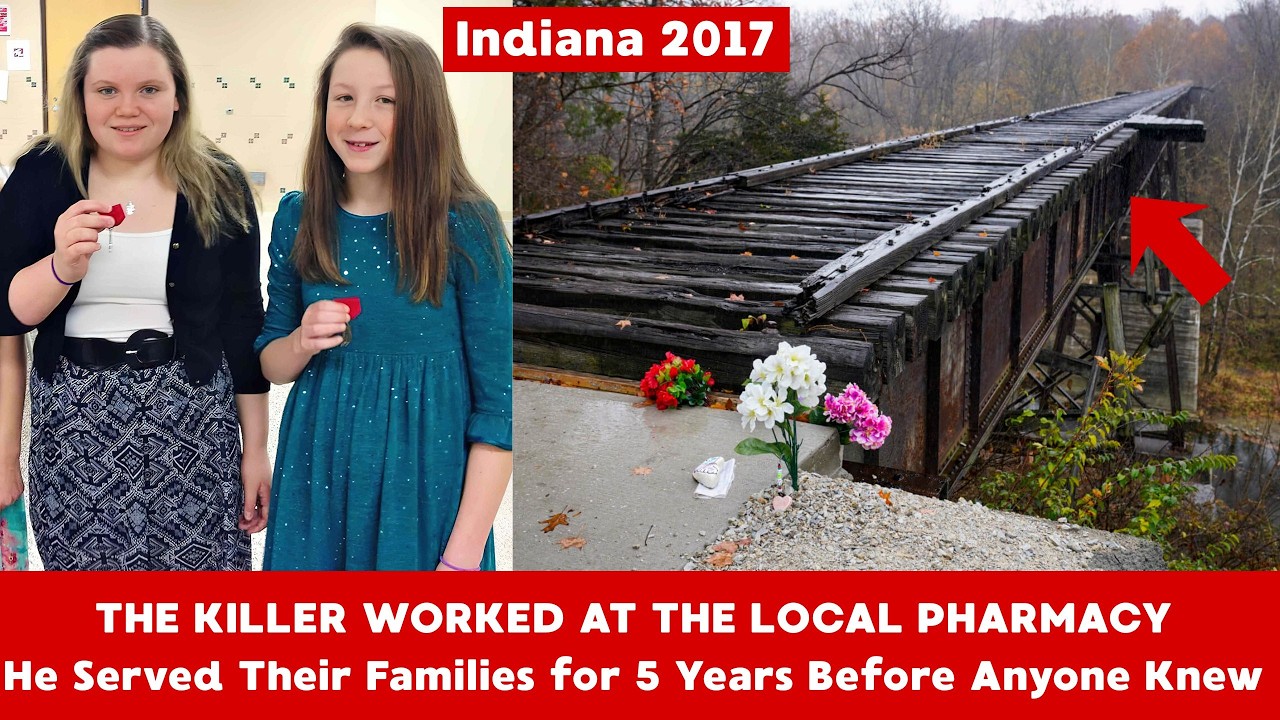
They would walk the trail, snap a few photos, and be collected again a couple of hours later. No one came for them that afternoon, because by the time anybody sensed that something was wrong, both girls had already vanished. When they failed to appear at the agreed pickup time, relatives set out looking, and it took very little time for real fear to take hold. This was a small town.
Two teenage girls do not just disappear from a public hiking path in broad daylight without something being terribly wrong. A massive search got underway almost at once, drawing in local police, state troopers, and before long hundreds of volunteers who scoured the woods along Deer Creek through the night and on into the following day. On February 14th, the searchers found them. Abby and Libby were located in a wooded spot close to the trail, and everyone at that scene understood immediately that this had been an intentional, violent crime, not a tragic mishap.
Both girls had been killed with a knife. What matters for the investigation that would follow is that whoever did this to them meant it to be savage, and that person left behind something worse than nearly any piece of physical evidence: a record of his own presence, caught on a young girl’s phone during the final minutes of her life. Before the five years of silence that came afterward, it is worth remembering who these girls really were, because in a case covered this heavily, debated this endlessly online, it becomes oddly easy to forget that Abby Williams and Libby German were simply two middle schoolers who enjoyed spending their day off outdoors together. Libby was the one carrying her phone that day, the one who would ultimately leave behind something far more important than anyone in that moment could possibly have known.
People who knew Abby described her as warm and easy-going, the sort of friend who made ordinary afternoons a little brighter just by being around. They came from the same tight circle of friends and family that shapes so much of life in a town the size of Delphi. The kind of place where children grow up walking the same paths their parents walked. Where a hike on a day off from school is about as uneventful an afternoon as a teenager could hope for.
They were best friends out for a walk on a day off from school. That is the whole ordinary truth of how this started. And here is the detail that transformed this case into one of the most discussed unsolved investigations in the history of American true crime. At some point in that window before they were killed, Libby’s phone recorded a brief video and captured in the background both an image and the audio of a man on the bridge behind them.
He can be seen approaching the girls. His voice can be heard giving them what investigators would later call an instruction, something brief, something that made plain he wanted them to alter course, to head down off the main trail with him. Within days, police released that image to the public, together with the audio, in the hope that someone, anyone, in a town where most people know most other people, would recognize the walk, the voice, or the description that accompanied it. That image, grainy and backlit, taken from a young girl’s phone in the last minutes of her life, became known throughout the true crime world simply as Bridge Guy.
To this day it remains one of the most widely shared pieces of evidence in the history of unsolved cases, precisely because it is genuine, and because it captures, however briefly, the actual presence of the person responsible for what came next. And for five years, it was not enough. Over the following two years, investigators released not one but two separate composite sketches of Bridge Guy, in 2017 and again in 2019. The two sketches differed enough from each other that some people tracking the case questioned whether they were even searching for the same man.
Tips flooded in from all over the country, thousands of them by some counts. For half a decade, every single one of them led nowhere firm enough to justify an arrest. In the meantime, Delphi, a town of roughly three thousand people, lived inside this case every single day. Year after year, anniversaries were observed publicly with vigils and searches and fresh appeals from the families for anyone, anywhere, to step forward.
Online true crime communities treated Bridge Guy’s photo and voice as a puzzle to be examined over and over, a genuinely uncommon piece of real, unfiltered evidence sitting out in public for anyone to study, frame by frame, syllable by syllable. Amateur investigators built entire forums devoted to nothing but analyzing that walk, that jacket, that handful of spoken words. Years after most missing person cases would have quietly slipped from public view, local businesses still had posters hanging in their windows. And still, no one came forward with the one detail that would have closed the gap.
A name. For their part, detectives never stopped working the case. Task forces assembled and reassembled. As the years passed without resolution, Indiana State Police brought in additional resources, re-interviewing witnesses, returning to old leads, chasing down tips that arrived by the thousands from true crime forums, psychics, amateur sleuths, and ordinary residents who simply could not let it go.
For a stretch of years, it became one of the most heavily discussed unsolved cases in the country, precisely because there was real footage, an actual voice, evidence that felt tantalizingly near an answer without ever quite delivering one. When the break finally arrived in October of 2022, it came with an almost unbearable irony resting quietly beneath it. The man investigators ultimately charged, Richard Allen, was no stranger who had passed through town unnoticed. He was a long-time Delphi resident.
He worked as a pharmacy technician at a CVS just a few blocks from the very courthouse where, years later, he would stand trial. And according to authorities, police had in fact interviewed him back in 2017, in the earliest days of the investigation, specifically because he told them he had been on that trail on the same afternoon Abby and Libby disappeared. Somewhere amid the flood of leads and tips that followed, that interview simply led nowhere at the time. He, as investigators would later phrase it, fell through the cracks.
He remained in that blind spot for over five years, holding down an ordinary job at an ordinary pharmacy in the same small town where the murders of two teenage girls had settled into the community’s memory like a wound that would not close, and in all likelihood ringing up some of those same searching, grieving families across the counter more than once. When the arrest finally came in October of 2022, a single piece of physical evidence drew the whole thing together. An unspent .40 caliber bullet recovered from the ground between where Abby and Libby’s bodies were found had, per forensic testimony, at some point been cycled through Allen’s own SIG Sauer handgun.
It was never fired at the scene, only left there, chambered and later ejected. The sort of small, nearly accidental detail that someone in the middle of an unthinkable act might not even register slipping free of their weapon. What unfolded once the case actually reached a courtroom was far from smooth, and some of what surfaced during that process is nearly as disturbing as the crime itself. Two more years passed between Allen’s arrest and trial, with repeated delays, a leak of case evidence to the public, and the withdrawal of Allen’s own public defenders followed by their eventual court-ordered reinstatement by the Indiana Supreme Court.
Jury selection ultimately took place in Fort Wayne, more than two hours away, since assembling twelve people in the immediate area who had not already formed a view on a case this locally consuming had become nearly impossible. The jury was then brought to Delphi for the proceedings themselves, seated in the same small town where the murders occurred, listening to testimony about a trail most of them could have walked to from the courthouse steps. The defense advanced an alternate theory pointing away from Allen altogether, contending the girls had been killed in a ritual sacrifice carried out by a group of white nationalist Odinists, adherents of a pagan Norse belief system, rather than by their client acting alone. The judge sharply restricted how much of that theory the defense could put before the jury, deeming much of it speculative and unsupported.
What the jury did hear at length was something else entirely. Recordings of Richard Allen, while jailed awaiting trial, confessing to the murders. Not once, according to prosecutors, but more than sixty separate times, to his wife, to his own mother, to a psychologist treating him in custody, to the facility’s warden, to guards, to fellow inmates. The defense contended these confessions were involuntary, made while Allen was in a documented mental health crisis, at one point back on suicide watch.
The jury heard the audio regardless, and they heard the ballistics testimony linking that single unspent bullet directly to his gun. And in closing argument, prosecutors were careful to acknowledge something striking in its own right. No DNA, no fingerprint, no forensic trace evidence directly tied Richard Allen to the scene of the murders. The case that convicted him rested almost entirely on a bullet and his own repeated words.
The jury deliberated for roughly nineteen hours over three days. In November of 2024, they returned guilty verdicts on all four counts against Richard Allen: felony murder in the death of Abby Williams, felony murder in the death of Libby German, and two additional counts of knowing murder for both girls. In December of that year, a judge sentenced him to sixty-five years for each murder, to be served consecutively, a total of 130 years, the maximum the law permitted. Allen showed no visible reaction as the sentence was read.
No one from his family attended. Libby’s grandmother, Becky Patty, addressed him directly at that hearing. She told him before the courtroom that she hoped he would live with the same fear he had inflicted on the girls in the final hour of their lives. Abby’s grandmother, Diane Erskine, spoke of something almost harder to hear than anger: the ordinary, quiet passage of time she had been forced to watch go by without her granddaughter in it.
Watching Abby’s friends graduate high school, then college. Wondering, she said, how many great grandchildren had effectively been murdered on that trail as well. The whole unlived future that vanished along with one thirteen-year-old girl on an ordinary afternoon in February. Allen’s attorneys have said he maintains his innocence and intends to appeal, hoping for a new trial.
That process, as of this telling, is still working its way forward, the way appeals in cases this significant often do, slowly and with no guarantee of a different outcome. For the community of Delphi and for two families who spent nearly eight years without a single name attached to their daughters’ murders, the wait for whatever comes next is simply one more chapter in a wound that has already stretched on far longer than anyone in that small town in 2017 could have imagined. There is a particular kind of horror at the center of this case worth naming outright, because it is not really about Bridge Guy, or the bullet, or even the confessions. It is about the interview in 2017 that led nowhere.
Richard Allen told police in the earliest days of this investigation that he had been on that exact trail that exact afternoon. He said it himself, voluntarily, to the very detectives searching for a killer who had, according to everything that followed, already been standing directly in front of them. And somehow, amid the noise and volume of an active, sprawling investigation, that thread simply was not pulled hard enough. Not for another five years.
It is the kind of detail that makes you wonder how many other cases right now have exactly that same thread sitting quietly in a file somewhere, already answered, already sitting in plain sight, simply waiting for someone to look at it again. Abby Williams was thirteen. Libby German was fourteen. They took a walk together on a day off from school along a trail they had probably walked before without a second thought, in a small town where everybody more or less knew everybody, including, as it turned out, the man who would take both of their futures from them in the span of an afternoon.
For five years, that man worked behind a pharmacy counter a few blocks from where he would eventually be sentenced, in the same town that never stopped looking for him, filling prescriptions presumably for some of the very people who spent those same five years wondering whether they had ever passed their daughter’s killer on the street without knowing it. Delphi is still a town of about three thousand people. It is also now permanently one of the most discussed small towns in America, known to millions of people who will never visit it for a single afternoon in February that two teenage girls never got to walk away from.
