On October 12, 2024, art conservator Sarah Mitchell was reviewing a recent donation to the Salem Local History Museum in Massachusetts when a single photograph stopped her cold. The image, dated on the back as September 1898, showed four children posing formally in front of a Victorian house. The children, apparently between eight and twelve years old, wore the typical clothing of the late nineteenth century: dark suits for the boys, long dresses for the girls. Their expressions were serious, as was common in photographs from that era.
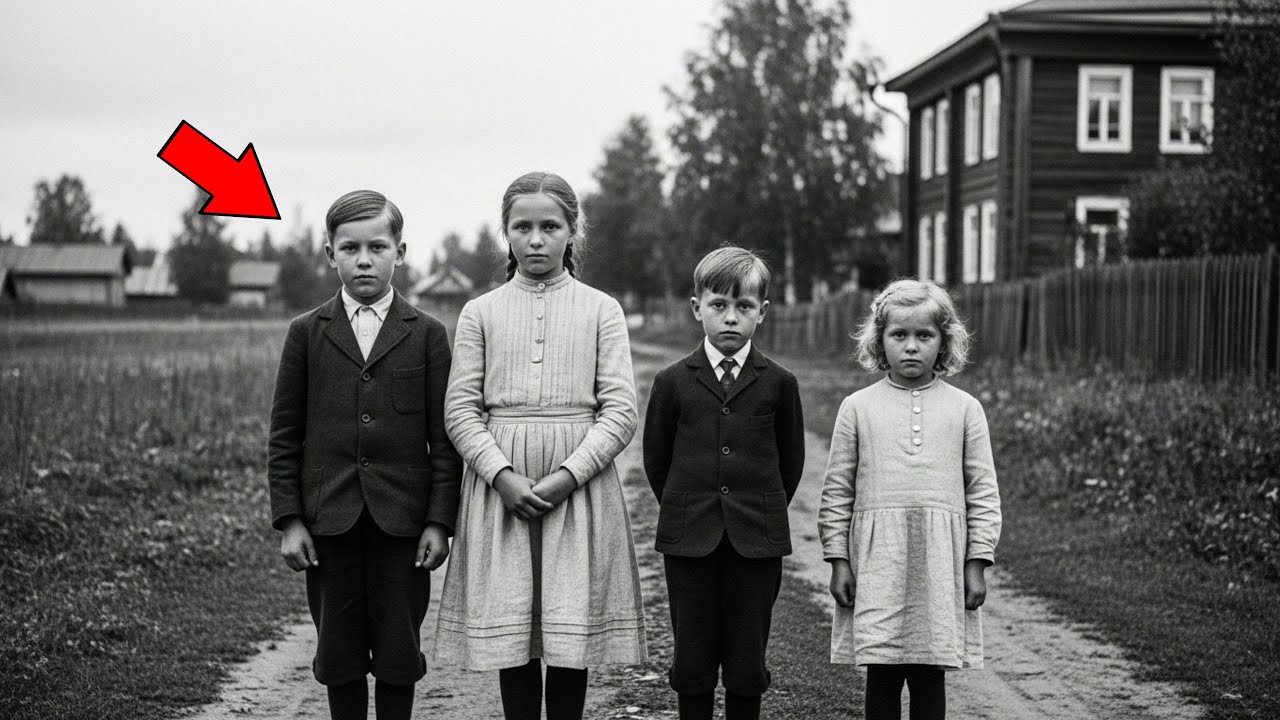
What struck Sarah was the extraordinary preservation of the image—every detail visible even after 126 years. As she began cataloging the photograph for the museum’s collection, Sarah noticed something peculiar. Examining the details with a magnifying glass, she found that the children had a strange expression in their eyes. It wasn’t fear exactly, but a kind of emptiness that didn’t seem natural in children of that age.
Victorian-era children usually showed some reserve in portraits, but this was different. It was as if something essential had been extracted from their souls, leaving only empty shells where childhood innocence should have shone. She decided to scan the photograph in high resolution to preserve it digitally. While the machine processed the image, Sarah felt a strange sense of unease.
When the scan was ready, she opened the file and began examining the details more meticulously. Zooming in on the area around the children, she noticed something that left her frozen. In the background, barely visible in a window of the house, a silhouette could be distinguished that seemed to be watching the scene. The figure didn’t appear to be another family member posing.
It had a peculiar posture, as if it were hidden, watching in secret. By October 14, Sarah had spent the weekend investigating the history of the Blackwood family. Genealogical records revealed that the family had been prominent in Salem during the 1890s, but their history contained disturbing gaps. The house in the photograph belonged to Cornelius Blackwood, a wealthy textile industrialist who had made his fortune during the economic expansion of the late nineteenth century.
According to municipal records, Cornelius and his wife Margaret had adopted four children between 1896 and 1898—an unusual practice for the era. The names of the children, according to adoption documents, were Thomas, twelve; Elizabeth, ten; Samuel, nine; and Mary, eight. What disturbed Sarah was the speed of the adoptions and the absence of information about the children’s origins. Sarah contacted Dr.
Helen Morrison, a historian specializing in New England social history. Helen had extensively studied adoption practices in Massachusetts during the nineteenth century and knew the protocols of the era. After reviewing the information, Helen said, “Sarah, what you’re describing is very strange. In 1898, adoptions were long and strictly regulated processes.
A family that adopted four children in such a short time would have raised significant suspicions in the community. ”
Sarah sent the digitized photograph to Helen. After examining it carefully, Helen called back with evident urgency in her voice. Sarah needed to look more closely at the children’s clothing.
The fabric and style weren’t typical of garments for well-off children of the era. They looked like institutional uniforms. Sarah enlarged the image, focusing on the clothing. Helen was right.
The girls’ dresses were identical down to the smallest details—same cut, same fabric, same buttons. The boys’ suits also showed this suspicious uniformity. Institutional. What type of institution would use uniforms like this?
Sarah asked, though she feared the answer. Orphanages, asylums, or, Helen made a significant pause, institutions for children with mental problems. In the late nineteenth century, there were many places where they sent children they considered problematic or deficient. That night, Sarah found a disturbing record in the county archives.
Cornelius Blackwood had been listed as the principal benefactor of the Salem Institution for Disturbed Children, a facility that had operated from 1885 to 1902. The institution had been abruptly closed following serious administrative irregularities, but specific details had been sealed in the archives by court order. On October 16, Sarah headed to the Essex County Archives, determined to find information about the mysterious institution. The archivist, James Crawford, an older man who had worked there for decades, received her with an expression of curiosity mixed with concern.
“The Blackwood Institution,” James said when Sarah mentioned the name. “It’s been years since anyone asked about that place. The documents are in the sealed archives in the basement, but I can get you temporary access if you really need it. ”
James led her to a dusty basement where the oldest and most sensitive documents were kept.
The boxes were marked with dates spanning 1885 to 1902, the complete period of the institution’s operation. “Be careful with what you find,” James warned her with a grave voice. “There were very specific reasons why that institution was closed so abruptly. Officials of the era preferred to bury the information rather than face the consequences.
”
Sarah opened the archive boxes with trembling hands. The documents revealed a progressively more disturbing story. The institution had been officially founded to treat children with mental imbalances and antisocial behaviors, but internal reports told a completely different story. A medical report from 1897 described in detail experimental treatments applied to children between six and fourteen years old.
The methods included prolonged isolation therapy in containment cells, severe nutritional modification to alter behavior, and psychological conditioning techniques through sensory deprivation. Reading an internal memo dated August 1898, Sarah whispered, “My god. ” The memo read: “Experiment 247. Subjects show signs of complete docility and absence of resistance after 6 months of intensive treatment.
We recommend proceeding immediately with the photographic documentation phase. ”
Sarah found a detailed list of children who had been subjected to these treatments. The names matched exactly those in the photograph. Thomas Witmore, Elizabeth Hayes, Samuel Porter, and Mary Campbell had been their original surnames before being adopted by the Blackwood family.
A document dated September 15, 1898 contained a note that left her frozen: “Subjects have reached the desired state of total compliance and elimination of individual personality. Proceed with documentary photography before proceeding with the final phase of the experiment. ”
Sarah realized with growing horror that the photograph she had found wasn’t a family portrait. It was scientific documentation of an experiment.
The children had been subjected to systematic psychological conditioning that had completely eliminated their personality and individual will. A final document left her completely breathless. It was an order signed by Dr. Morai Blackwood, Cornelius’s brother, dated September 20, 1898: “Experiment completed satisfactorily according to established parameters.
Proceed immediately with final disposition of subjects to avoid future complications. ”
By October 18, Sarah had spent two days intensively investigating Dr. Morai Blackwood. Massachusetts medical records revealed he had been a controversial psychiatrist who had studied experimental techniques in Europe before returning to Salem with radical ideas.
In Harvard Medical School archives, Sarah found Blackwood’s doctoral thesis dated 1885: “Advanced Methods of Psychological Conditioning for Permanent Modification of Aberrant Childhood Behavior. ” The thesis described detailed techniques for completely reforming children considered problematic through isolation, sensory deprivation, and systematic psychological manipulation. Dr. Robert Hayes, a medical historian at Harvard, explained when Sarah contacted him: “His methods were considered extreme even by the standards of the era.
Blackwood firmly believed he could completely reset a child’s personality through controlled psychological trauma and intensive conditioning. ”
Sarah found personal correspondence between Morai and his brother Cornelius that revealed the true nature of their criminal association. Cornelius had provided the necessary financing and the respectable facade of social benefactor while Morai conducted the experiments in absolute secrecy. In a letter dated July 3, 1898, Morai wrote with scientific enthusiasm: “Dear brother, the current subjects are responding exceptionally well to treatments.
We have managed to completely eliminate their previous personalities and emotional connections. They are like completely blank slates, absolutely malleable to our purposes. ”
Sarah felt physical nausea reading Cornelius’s enthusiastic response: “Excellent progress, brother. Government investors are eager to see concrete results.
If we can definitively prove that problematic children can be completely reformed, we’ll have guaranteed federal contracts for decades. ”
The investigation revealed that the Blackwood brothers had been developing mind control techniques specifically to sell to the federal government. The children weren’t patients needing treatment. They were human test material to perfect brainwashing and psychological control methods.
A personal diary of Morai found in family archives contained disturbing daily entries about the four children. September 15, 1898: “Thomas no longer responds at all to his original name. Elizabeth has completely lost the ability to cry or show emotional expression. Samuel obeys any command without the slightest questioning.
Mary doesn’t speak unless specifically ordered. The experiment has been a total and complete success. ”
Sarah realized the photograph had captured the exact moment when these children had been completely stripped of their fundamental humanity. Their vacant eyes weren’t a natural expression, but the direct result of months of systematic psychological torture and deliberate dehumanization.
On October 20, Sarah decided to investigate more deeply the mysterious figure in the window. Using specialized image enhancement software, she managed to progressively clarify the silhouette. The figure was definitely human, but its posture was strange and threatening. It seemed to be watching the photographic session from the shadows as if it didn’t want to be seen, but also couldn’t resist witnessing what was happening.
Sarah enlarged the image as much as technology allowed. The figure wore what appeared to be a white medical coat, and in its right hand, a large syringe could be clearly distinguished. The figure’s position suggested it was waiting patiently, as if the photographic session were a signal to proceed with some final procedure. Sarah contacted Marcus Weber, an internationally recognized expert in forensic analysis of historical images.
Marcus had worked on similar cases where old photographs had revealed crucial details about historical events covered up for decades. “Sarah, this is absolutely extraordinary,” Marcus said after examining the image with specialized equipment. “The figure is definitely holding a large medical instrument. And look here,” he pointed to a part of the image Sarah hadn’t noticed previously.
“There are other figures in the background barely visible. It seems there were multiple people watching this session. ”
Detailed analysis revealed that at least three adult figures were present during the photographic session, all watching from different windows and doors of the house. The session hadn’t been a simple family photograph, but some kind of carefully orchestrated and documented procedure.
Sarah returned to the archives and found a disturbing entry in Morai’s diary dated September 16, 1898: “Tomorrow, we will proceed with the final phase of the experiment. Government investors have arrived from Washington to personally witness the demonstration of our methods. The photograph will serve as documentary evidence of the subject’s completely docile state before the definitive terminal procedure. ”
Sarah realized with absolute horror that the photograph had been taken as official documentation for government investors.
The children had been exhibited as successful products of an experiment, and the figures in the windows were probably federal officials observing the demonstration of mind control techniques. An additional document confirmed her worst fears: a detailed invoice from the local funeral home dated September 22, 1898, for four child burials. Commercial account of Blackwood Institution, emergency procedure. The children had been systematically executed after the photographic session.
The image Sarah had found wasn’t just evidence of psychological experiments—it was the last photograph taken of four innocent children before they were murdered to completely cover the evidence. By October 22, Sarah had been intensively investigating the government connection. Archives from the US Department of War from 1898 contained specific references to psychological research projects secretly funded during the Spanish-American War. In the National Archives, Sarah found official correspondence between Secretary of War Russell Alger and a mysterious psychological research consortium based in Massachusetts.
The letters revealed that the federal government was secretly funding experiments to develop advanced interrogation and mind control techniques for military use. “Traditional methods of obtaining information from enemy prisoners and dissidents have proven completely ineffective,” Alger wrote in a classified letter dated August 5, 1898. “We urgently need to develop more sophisticated and permanent techniques to guarantee total compliance and elimination of resistance. ”
Sarah discovered that Dr.
Morai Blackwood had been specifically hired as principal consultant for this ultra-black project. The experiments with children had been deliberately designed to perfect techniques that would later be applied to prisoners of war, enemy spies, and political dissidents. In a report classified as top secret, dated September 10, 1898, Blackwood described with scientific detail the results: “Child subjects have proven ideal for initial testing. Their natural psychological plasticity allows complete personality modification in relatively short periods.
The perfected methods can be applied to adults with slight technical modifications. ”
Sarah felt physical horror realizing that Thomas, Elizabeth, Samuel, and Mary had been specifically selected because they were orphans without families who could search for them or ask questions. They had been considered completely disposable human test material to develop psychological weapons. The investigation revealed that high-level Department of War officials had been personally present during the September 16 photographic session.
The demonstration had been designed to show the total effectiveness of Blackwood’s techniques before approving massive additional funding. An internal memo dated September 20, 1898 confirmed enthusiastic approval: “Dr. Blackwood’s demonstration was completely successful. Subjects showed total compliance and absolute absence of resistance or individual personality.
We immediately approved additional funding to expand the program to similar facilities in other states. ”
Sarah understood that the four children hadn’t been the only victims. They had been the prototypes for a much broader program that had systematically expanded nationwide. By October 24, Sarah’s investigation had revealed that the Blackwood Institution hadn’t been an isolated case of cruelty.
Declassified government documents showed a systematic network of similar facilities operating secretly throughout the country during the 1890s. In Department of Interior archives, Sarah found an official list of psychological research institutions funded directly by the federal government. There were at least twelve facilities in different states, all operating under the respectable pretense of treating problematic children and the mentally deficient. An inspector general’s report dated 1901 revealed the chilling magnitude of the program: “It is conservatively estimated that approximately 300 child subjects participated in various psychological research projects during the period 1896–1900.
The developed methods have been successfully implemented in military operations in the Philippines, Cuba, and other colonies. ”
Sarah felt physical nausea. The experiments hadn’t been theoretical. They had been actively used in real wars against defenseless civilian populations.
The archives contained photographs from other similar institutions. Sarah immediately recognized the pattern: children with the same completely vacant eyes, dressed in identical institutional uniforms, posing for photographs that served as official documentation of experiments. In extensive correspondence between Dr. Blackwood and Dr.
Hinrich Zimmerman, director of a similar institution in Pennsylvania, Sarah found chilling technical details: “Dear colleague, our refined methods have proven 100% effective in all cases. Subjects can be completely reprogrammed and stripped of individual personality in an average period of 4 to 6 months. We recommend immediately proceeding with massive nationwide expansion of the program. ”
Sarah discovered that the methods had been codified in an official Department of War manual titled “Advanced Techniques of Psychological Modification for Military and Civil Application,” distributed to intelligence officers and forming the basis of subsequent programs.
Most disturbing was that Sarah found documentary evidence that some methods had continued being used in different forms for decades. CIA mind control experiments in the 1950s and 1960s showed troubling technical similarities to techniques developed by Blackwood. A document from his personal archive revealed his pride in the permanent legacy of his work: “My pioneering experiments with child subjects have provided the solid scientific foundation for the development of psychological warfare techniques that will serve our country for future generations. ”
By October 26, Sarah had discovered that the program had been systematically covered up for more than a century.
Documents revealed a massive coordinated effort to eliminate evidence and silence testimony. In 1902, when the institutions were officially closed, immediate destruction of all archives and photographs was ordered. A Department of War memo dated March 15, 1902 instructed: “All documents related to psychological research projects must be destroyed immediately. Subject families must not be contacted under any circumstances.
Institution employees must sign permanent confidentiality agreements under penalty of treason. ”
Sarah found disturbing evidence that several potential witnesses had died under extremely suspicious circumstances. Dr. Morai Blackwood had died in an automobile accident in 1903, barely a year after the institution’s closure.
His brother Cornelius had been found dead in his library, apparently from natural causes that were never investigated. FBI archives contained references to periodic investigations during the 1920s, 1940s, and 1960s. Each time evidence or testimony emerged, it was suppressed under justification of critical national security. An FBI report dated 1947 described the discovery of documents: “Documents have been recovered that could gravely compromise current national security operations.
We recommend permanent classification and immediate destruction of physical evidence. ”
Sarah realized the photograph had survived only because it had been kept in private family archives, outside the reach of systematic government purges. The coverup had continued into recent times. In the 1970s, when public investigations about government mind control experiments began, archives related to the 1898 experiments had been reclassified as top secret with permanent restricted access.
A Department of Justice document dated 1978 admitted the existence of the experiments but recommended maintaining absolute secrecy: “While we recognize that significant irregularities were committed in the psychological research program of 1896–1900, public revelation could compromise current intelligence operations and create massive legal liability. ”
Sarah understood she had discovered not just a historical crime, but evidence of an active coverup that had continued for more than 120 years. The four children had been victims not only of the original experiments, but of decades of systematic denial and deliberate suppression of the truth about their fate. On October 28, Sarah made the most difficult decision of her career: to make the story public.
She knew she would face powerful opposition but felt she owed it morally to Thomas, Elizabeth, Samuel, and Mary. She contacted David Harrison, an investigative journalist for the Boston Globe specializing in government secrets. David had exposed several important historical coverups and understood the importance of revealing hidden truths regardless of consequences. “Sarah, this is more explosive than you can imagine,” David said after meticulously reviewing all the documentation.
“We’re not just talking about brutal experiments on children, but documented origins of mind control programs that continued for decades. ”
Sarah spent entire days obsessively verifying every document, every photograph, every testimony. The evidence was irrefutable. Family archives from descendants of institution employees had provided additional testimonies that confirmed all the documented horrors.
On October 31, the Boston Globe published the complete investigation on the front page: “The Lost Children of Salem: Government Mind Control Experiments Revealed by 1898 Photograph. ” The image of the four children with their vacant eyes prominently accompanied the article. The reaction was immediate, intense, and polarized. The Department of Justice issued a statement denying specific knowledge of the experiments, but the documentary evidence was too solid to be ignored.
Congresspeople from both parties demanded immediate investigations. Sarah received serious anonymous threats, but also massive support from human rights activists, survivors of subsequent experiments, and descendants of other program victims who began to come forward publicly. Most emotional was when Sarah was contacted by Margaret Witmore, Thomas’s great-great-granddaughter. At forty-five, Margaret had grown up with fragmented family stories about a great-great-grandfather who had mysteriously disappeared in a Salem orphanage.
“Doctor Mitchell, my family always knew something terrible had happened to Thomas,” Margaret told her with a broken voice. “But we never imagined he had been used as a human guinea pig. Seeing his photograph, his completely vacant eyes, is absolutely devastating. But it’s also a profound relief to finally know the truth.
”
On November 15, Sarah stood in Salem’s Green Lawn Cemetery where a commemorative monument had been erected for Thomas, Elizabeth, Samuel, and Mary. Their bodies were never found, but their names were now permanently engraved in stone. The inscription was simple: “Thomas Witmore, Elizabeth Hayes, Samuel Porter, Mary Campbell. Innocent victims of government experiments, 1898.
May their sacrifices never be forgotten. ”
Sarah had brought the original photograph, carefully framed. She placed it gently next to the monument, observing how the children’s faces seemed more peaceful now that their story had finally been told. “They’re no longer alone,” she whispered with tears in her eyes.
“The whole world knows their truth. ”
Margaret Witmore was there, along with descendants of the other children identified through the massive investigation. “These children were stolen from their families, systematically stripped of their humanity, and finally murdered,” Margaret said with a firm voice. “But their photograph waited patiently for 126 years to reveal the truth.
That’s a profound kind of justice. ”
Congress had passed a formal resolution asking for official apologies to victims of the 1898–1900 experiments. A significant reparations fund was established for descendants of identified victims. The Salem Local History Museum created a permanent exhibition titled “The Lost Children: Psychological Experiments and the Fight for Truth.
” The photograph occupied a central place alongside declassified documents and family testimonies. Sarah received contacts from researchers worldwide inspired by her discovery. Similar institutions had been identified in other countries, revealing that the experiments had been part of an international network of psychological research. Universities began teaching about the experiments as part of courses on medical ethics.
Human rights organizations used the story to press for greater transparency in current government research. As she walked away from the cemetery, Sarah reflected on the extraordinary power of images to preserve truths that transcend time and death. The 1898 photograph hadn’t just been documentation of a crime. It had been a silent testimony, patiently waiting for the right moment to reveal one of the darkest pages in American history.
The four children of Salem had finally found the peace they deserved. Thomas, Elizabeth, Samuel, and Mary had been silenced in life, but their image had screamed the truth for 126 years, waiting for someone to finally hear their story and tell it to the world.
