In the spring of 1666, a fourteen-year-old girl stood at the center of a ceremony that would decide the rest of her short life. She was Margarita Teresa, daughter of the King of Spain and his niece, and she was about to marry her uncle. The wedding took place by proxy in the Alcázar palace in Madrid, with someone else standing in for the groom, a man she had never met. When the marriage was solemnized in person later that year, she was fifteen years old.
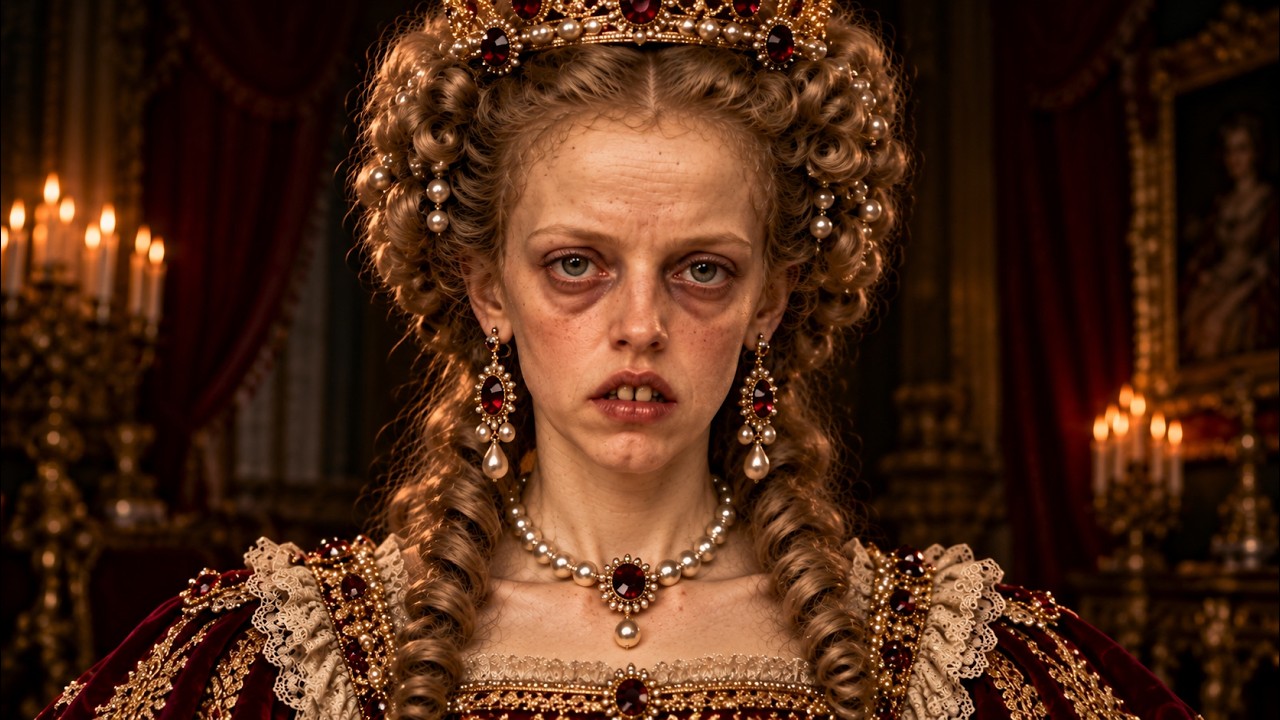
By the time she was twenty-one, she had buried three of her children and died herself. The only child she left behind would carry the highest inbreeding coefficient ever calculated for a member of the Habsburg family. Her name is familiar to anyone who has stood before one of the most studied paintings in the world. In 1656, the court painter Diego Velázquez placed a small princess at the center of *Las Meninas*, the masterpiece that hangs today in the Prado Museum in Madrid.
The painting shows the princess surrounded by her ladies-in-waiting. Velázquez painted himself on the left, brush in hand, standing before a vast canvas. If the viewer looks past all of them, toward the back wall, there is a small mirror. Two blurred faces appear within it: the parents of the girl in the center.
They are King Philip IV of Spain and his wife, Queen Mariana of Austria. Mariana was Philip’s niece. The king in the mirror had married his brother’s daughter, and the little girl in the middle of the room was their child. For this family, such a union was normal.
The Habsburgs ruled Spain, Austria, and vast stretches of Europe, and they held it all by marrying one another. Cousin to cousin, uncle to niece, generation after generation, so that the crowns would never leave the family. Every one of those marriages drew from the same small pool of blood. When geneticists later calculated the numbers for the children of Philip and Mariana, they found a level of inbreeding comparable to that of children born to a brother and sister.
One of those children was Margarita’s younger brother, who grew up to become Charles II of Spain, the last Habsburg king of the country. Margarita was born on July 12, 1651, in the Royal Palace of Madrid. She escaped the severe disabilities that would afflict her brother in his own childhood. The accounts that survive describe her as slender and of fragile constitution, but lively and intelligent.
Velázquez painted her again and again as she grew, eight times by one count. In 1659, one of those portraits, *The Girl in the Blue Dress*, was sent as a gift to the imperial court in Vienna. Within a year, Spain had promised her in marriage to the emperor who lived there. That emperor was Leopold I.
He was her mother’s brother, which made him her uncle. His mother was her father’s sister, which also made him her first cousin. By one modern genetic estimate, he was the most inbred Holy Roman Emperor ever to wear the crown. The engagement was announced in 1663, when Margarita was eleven years old.
Spain made a choice here that would cast a shadow over the family for decades. Her older half-sister had been required to renounce her rights to the Spanish throne when she married the King of France. Margarita was allowed to keep hers. Courts across Europe treated this as a political event of enormous consequence, because it meant that a Habsburg bride in Vienna might one day pass a claim to Spain and its entire empire on to her children.
For what it is worth, Spain never paid her dowry. On April 25, 1666, at fourteen, she married by proxy in the Alcázar, with another person playing the part of the groom. Then came the long journey to Austria. In late November, she met Leopold for the first time at Schottwien, on the road south of Vienna.
In December of that year, at fifteen, she married him in person. Vienna held celebrations for her that lasted nearly two years. In January 1667, Leopold took part in a massive equestrian ballet in the courtyard of the Hofburg Palace, a spectacle designed around her name, because Margarita is the Latin word for pearl. For her seventeenth birthday, the court staged an opera titled *Il pomo d’oro*, *The Golden Apple*, one of the most lavish productions of the age.
By most accounts, the marriage was happy. The two shared a love of music, and she was said to call her husband “Uncle. ” She remained Spanish to the core, surrounded by Spanish servants, and barely learned German. Then the pregnancies began, and they barely stopped.
Her first son, Ferdinand Wenzel, was born in September 1667. He died the following January, short of his fourth month. In January 1669, she gave birth to a daughter named Maria Antonia. Remember that name well, because she is the person this entire story moves toward.
A year later, in February 1670, Margarita went into early labor, and the boy she delivered, Johann Leopold, died on the day of his birth. During that birth, she made a vow. If she survived it, she would seek the expulsion of the Jews from Vienna. She did survive.
That same year, the Jewish community of Vienna was expelled. Their synagogue was demolished, and the district where they had lived was renamed Leopoldstadt, after her husband. It still bears that name today. It is a grim detail, and it shows how much weight one royal birth carried within that palace, and who ended up paying the price.
In February 1672, she gave birth to another daughter. The child lived only two weeks. Count the result: five years of marriage, four children born, three buried, and by some accounts two more pregnancies lost before they came to term. In early 1673, she was pregnant again.
She had suffered from a swelling in her throat since childhood, and that winter she contracted a chest infection on top of it. The standard German biography states that she died of suffocation. She died in Vienna on March 12, 1673, at the age of twenty-one. Other accounts attribute her death to sheer exhaustion after nearly six years of almost constant pregnancy, and the exact cause remains debated.
Then comes the cruelest sentence in her entire story. The Swedish envoy at the imperial court, Esaias Pufendorf, wrote in his reports that the people of Vienna considered her passing at the age of twenty-one a stroke of luck for the Austrian line. A young empress dies pregnant, and the talk in the corridors of the court is that the dynasty was fortunate. Leopold wept for her as the only “Margarita” of his life, and within months he was arranging his next marriage.
Her only surviving child was a four-year-old girl living in the Hofburg Palace. That girl inherited everything her mother had owned, including the claim to the Spanish throne. Her family tree was even more intricate and tangled than her mother’s. Her father was her mother’s uncle.
Her mother herself was the daughter of an uncle and his niece. If you trace the branches upward, the same people appear in different places. On her father’s side, her grandparents were Emperor Ferdinand III and Maria Anna of Spain. On her mother’s side, the same couple served as her great-grandparents.
A normal family tree has eight great-grandparents. Hers had six. By the time she was seven, the family had already chosen a husband for her. In 1676, a marriage contract was signed promising her to her mother’s brother, Charles, King of Spain.
It would have been the third uncle-niece marriage in three generations. It never happened. But for about twenty years, because Charles produced no children, the Spanish court treated this girl in Vienna as the heiress to the entire Spanish Empire. Those who met her did not describe anything monstrous.
The surviving accounts describe her as quiet and reserved, shy and delicate. She was not a great beauty, but she was striking in her own way. There is no reliable record of the famous Habsburg jaw, or any of the deformities one might expect from a family tree like hers. In 1685, at sixteen, she married Maximilian Emanuel, Elector of Bavaria, in Vienna.
As part of the agreement, she renounced her claim to the Spanish throne, everything except the Spanish Netherlands, which were promised to her new husband. The marriage went badly. The standard biography states that Max Emanuel treated her unbearably, and she could not keep his mistresses away from him. Then her body began to repeat her mother’s story.
She gave birth to three sons, and the first two did not survive infancy. In 1692, she was pregnant again when her husband left for Brussels. She refused to go with him. Instead, she returned to her father in Vienna, and on October 28, 1692, in the Hofburg Palace, she gave birth to a boy named Joseph Ferdinand.
This time the child lived. But she never regained her strength. The weeks passed. She sank into a deep depression.
On Christmas Eve of 1692, she died at twenty-three years old. The exact cause was not recorded clearly enough to be determined. The theories found online, from puerperal fever to depression, are only guesses. Before her death, she saw to one thing.
In her will, she renounced the Spanish crown yet again. She excluded her husband entirely. She left everything she owned to her infant son, offering only a few keepsakes to the Bavarians. She asked to be buried beside her mother in the Imperial Crypt in Vienna.
So how inbred was she, really? In 2013, two geneticists, Francisco Ceballos and Gonzalo Álvarez, reconstructed the Habsburg family tree across more than twenty generations and more than 4,000 people. They calculated an inbreeding coefficient for each individual. That number is the probability that the two copies of a gene a person inherits are identical because they come from the same ancestor.
For a child of unrelated parents, the number is close to zero. For a child of first cousins, it is about 0. 06. For an uncle and niece, 0.
125. For a brother and sister, 0. 25. Maria Antonia’s result came out at 0.
3053. That is the highest figure they found anywhere in the Habsburg line. Higher than her uncle Charles, who scored 0. 254.
Higher than what one would expect for the child of a brother and sister. The reason is that these ratios accumulate. Her parents were uncle and niece and first cousins at the same time, and every marriage in the generations before them drew from the same narrow circle of people. So each marriage pushed the number a little higher.
The truth must be stated because it matters: this number does not come from her DNA. No one has examined her remains. It is calculated from family trees, and part of the database behind it was built from genealogy websites, including Wikipedia. So 0.
3053 is merely an estimate on paper. But it is a peer-reviewed estimate, and no one else in that family scored higher. What the research points to is damage you cannot see in a painting. Between 1527 and 1661, nearly three out of every ten children born into the Spanish royal family died before their first birthday, at a time when ordinary Spanish villagers were losing one in five, and half of those royal children never reached the age of ten.
In a study published in 2024, the same research team examined 124 Habsburg marriages and asked what inbreeding did to the mothers. The more inbred the mother was, the younger she tended to die, and the higher her risk of dying in the four weeks after giving birth. That study cannot tell us what killed either of these two women. It describes a pattern across the whole family.
But place these two women beside that pattern. A mother who died at twenty-one while pregnant again, and a daughter who died at twenty-three two months after giving birth, after having already lost two sons. Her son’s story was short too. In 1698, her uncle Charles, still without children, signed a will naming the boy his heir.
On February 6, 1699, the boy died at the age of six. Most sources point to smallpox; the poisoning rumors were never proven. His death brought the diplomats back to the negotiating table. When Charles died in 1700, Europe fought the War of the Spanish Succession over his throne for thirteen years.
In the Imperial Crypt, the coffin of Margarita’s daughter bears a Latin inscription that mentions four things about her: her birth, her marriage, her childbearing, and her death. That was the whole life the family had planned for her. And it was the same life they had planned for the little girl in *Las Meninas*. The most inbred Habsburg ever measured was not the “bewitched king” everyone remembers.
It was his niece, the quiet girl from Vienna. We have now seen what two successive uncle-niece marriages did to a mother and her daughter. But they were only two stories in a dynasty that kept marrying within itself for generations, and the damage did not look the same on everyone.
