The discovery came on a Wyoming morning in October 1932. Two prospectors, Cecil Main and Frank Carr, were chasing a vein of quartz into a rock face in the San Pedro Mountains southwest of Casper, dry folded country of granite and sage where a man could walk for days and never cross another set of tracks. They set a charge, lit it, and stepped back. When the dust cleared, the blast had blown open a wall they never knew was there.
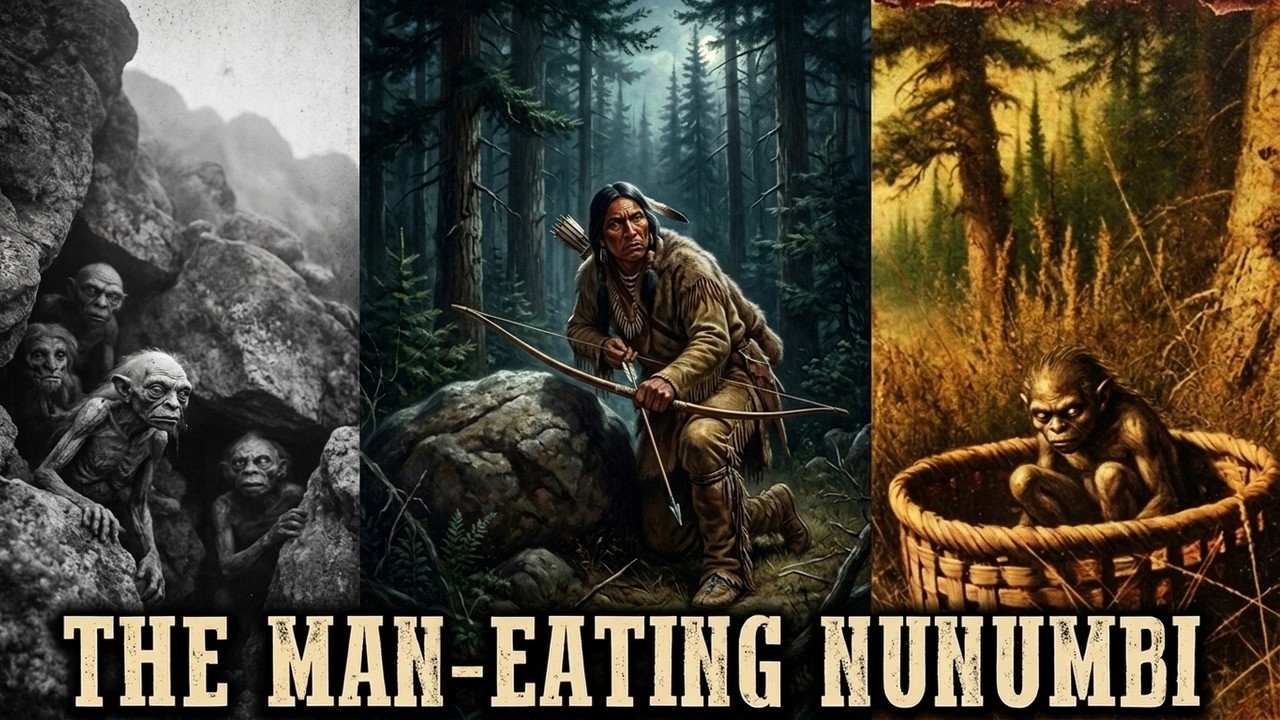
Behind it was a room, a small natural chamber perhaps fifteen feet long and four feet high, sealed off so completely that daylight had never reached it. The air inside was still and dry. They leaned in with their lamps. Something was sitting on a ledge, upright, legs crossed, arms folded, like it had chosen that spot and settled in to wait.
From foot to head it stood about fourteen inches tall. It looked like a tiny old man, but nothing about its posture or its face made ordinary sense. The skin had gone dark and hard, pulled tight over the bones like old leather left in the sun. The eyes were half open, heavy-lidded, and a low forehead gave the face a flattened look.
One deputy who saw it that day said it seemed to be staring back at whoever leaned in close. The whole thing weighed almost nothing. You could cradle it in two hands, and men did, passing it around a Casper drugstore where it went on display that same year. Word spread fast that two prospectors had blasted open a sealed cave in the Pedro Mountains and found a fully formed little man sitting inside.
Not a doll, not a carving, but flesh and bone in miniature, weathered and real. The Shoshone had spoken of little people for generations, and now here one sat on a shelf where anyone with a nickel could look. But to understand what the prospectors had actually found—and why the sight of it stopped people cold—you have to know the country that bred the legend, and the fear that came with it. There were ravines in the Wind River country that seasoned trappers would not cross, not for the best beaver run in the territory.
Men who had stared down grizzlies and Blackfoot war parties would ride an extra day rather than drop into certain draws after dark. When you asked them why, they got quiet. Sometimes the dead were found with arrows lodged in their ribs. Not war arrows—shafts too short, too thin, tipped with points no grown man’s hand had napped.
The Shoshone knew who made them, and they spoke of it only in low voices, the way you speak of something you would rather not call by its name. The country itself was hard enough to explain the fear. The Wind River Range runs about a hundred miles through west-central Wyoming, granite peaks scraping past thirteen thousand feet, with Gannett Peak the highest point in the state. To the northeast, across the Bighorn Basin, the Pryor Mountains straddle the modern Wyoming-Montana line in a maze of limestone canyons and wind-cut caves.
This was high, dry, unforgiving ground, snowbound half the year and baking the other half. For generations it had been Eastern Shoshone homeland, with Crow territory pressing in from the north and east. These were not empty lands waiting to be discovered. They were mapped in memory and song, every spring and pass and stretch of bad rock carrying a name and a story older than any wagon road.
Through the 1840s, 1850s, and 1860s, the American Indian Wars pushed white expansion hard into the West. Trappers, traders, soldiers, and surveyors came looking for pelts, for gold, for routes across the mountains. They arrived in a land already thick with older stories, and they were about to start writing some of those stories down. The earliest mentions come sideways, second-hand, scribbled by fur men who heard them from the people who actually lived there.
A trapper would note that his Shoshone guide refused a certain trail, and the reason given was a race of small beings in the high rocks. Not spirits exactly, and not children. Something that walked like people, but stood no higher than a boy’s shoulder. The accounts agree on the strange particulars.
These little ones were said to be quick, territorial, and dangerous out of all proportion to their size. They favored the caves and the broken country where a man on horseback could not follow, and they did not welcome visitors. For a long time, that was all it was. A guide’s caution, a campfire aside, a line in a ledger between the count of beaver plews and the price of powder.
Rumors passed between strangers, until one man claimed he saw them with his own eyes and gave a date. The man was a trapper named Elias Hood, working the Wind River drainage in the autumn of 1837. He kept a spare journal, mostly weights and weather. But for three nights that October, he wrote about something else.
Small figures at the tree line, no taller than a child of five or six, standing so still he first took them for stumps. On the second night, they were closer. On the third, he woke to find his snares moved and a single arrow driven into the pack beside his head. He measured it against his hand.
The shaft ran barely eight inches. The point was no bigger than a fingernail, fletched with care no child could manage. Hood broke camp before dawn and rode two days without stopping. He never wrote whether anyone believed him, and he never said what the arrow was meant to do.
He was not the only one. The people who had lived here longest had a name for what he saw. The Shoshone called them the Nunumbi—small people of the mountains and canyons, waist-high or less, said to live among the rocks and the high scrub where no one else cared to go. They were not thought of as animals, and not quite as ghosts.
They were their own kind, older than the tribes who spoke of them. The belief stretched far beyond one valley. Across the Great Basin, from the Utes to the Paiute to the Comanche who share Shoshone roots, nearly every people kept some version of the little ones. The Utes called them the Pitukup.
The Comanche spoke of the Ninnimbeah. Different names, the same waist-high figures at the edge of firelight. Some tales made them tricksters who stole meat and tangled hair in the night. Others said they guarded the springs and the game, and that a hunter who angered them would find his luck gone for good.
The Shoshone also insisted these beings could kill a full-grown warrior, and there was one weapon they feared most of all: the arrows. The Nunumbi were said to carry bows the length of a hand, firing darts so small a man could not see them in flight. A hunter might feel nothing at all, then a sting like a wasp, then a sickness that took him within days. The wound left no mark anyone could find.
On the frontier, that fit the world people already lived in. A strong man rode out well in the morning and came back gray and shaking by dusk. Fever, cramping, a limb gone stiff and cold, and no cut to explain it. When medicine failed and the healers found nothing, the small arrows offered an answer no one wanted, but everyone could picture.
The Shoshone told hunters to leave gifts at the springs, tobacco or beads, and to speak softly in Nunumbi country. Anger the little ones, and they would loose their darts at your back. A sudden death from a wound no one could find was frightening enough. The accusation whispered next was far worse.
It started with things that go missing on a frontier that swallows people anyway. A trap line gone quiet. A child who wandered from a berry patch at dusk and never answered the calling. Grief needs a shape, and out here the shape had a name already waiting.
The Shoshone spoke of the little ones taking meat, and then of the little ones taking more than meat. Elders warned children away from the rock slides and the box canyons, the narrow places where a small hunter could work close. Trappers passing through carried the warnings downstream, and each retelling added a body, a bone, a butchered look to remains the wolves had already found. By the 1830s, the word maneater rode with the stories, the way frost rides the morning.
Around one canyon, the stories converged on a single terrible season. The account that survives runs like this. A small party, trappers by most tellings, maybe six or seven men, pushed up a drainage in the Wind River high country late in the season, chasing beaver into the cold. They knew the country was called cursed.
They went anyway, because the pelts were there, and winter was coming for their pay. They meant to be gone two weeks. When the days stretched past a month, the men at the lower camp did what frontier men did: waited, and then finally climbed up to look. What they found was a camp half struck, gear scattered, a fire long dead, and fewer men than had walked in.
Two came out; some versions say three. They came out of that canyon changed, thin, silent, jumping at the wind in the pines. The men who came back alive said less than the men who did not. But one of them finally talked.
He told it plainly, the way exhausted men tell the worst things without decoration. They had made camp in the timber and slept easy. The first he knew of trouble was a companion beside him going stiff and quiet in the dark. No cry, no struggle, just a small sound, and then stillness.
By the time the others woke, the attackers were already among them, low to the ground and fast, coming from the rocks where no full-grown man could have hidden. He said they were small, waist high, quick as anything he had ever tried to shoot. He fired into the dark and hit nothing he could see. He ran because running was all that was left, downhill, tearing through brush, listening to the camp behind him go silent one man at a time.
He never looked back, and he never went back. His words could have been terror and grief talking, until searchers went back and found something small in the dirt. Near that abandoned camp was a grave, and it was too short. The digging revealed bones laid out with care, wrapped and set down the way people bury their own.
Except the whole arrangement measured less than three feet end to end. It was not the last one. Through the 1800s, ranch hands, railroad crews, and men sinking wells kept turning up the same thing across the Wind River and Sweetwater country. Small skulls, short leg bones, little pockets of stone that looked to anyone standing over them exactly like burial cairns built to a smaller measure.
Most of it got shrugged off. A child who died on the trail, people said. Bones scattered and reassembled wrong by animals. A tall tale that grew in the retelling around a fire.
For decades, these finds were dismissed as talk. Then the real discovery in the San Pedro Mountains pulled the Nunumbi out of legend and onto an examining table. Scientists lined up to explain the mummy away, and their answers contradicted each other completely. Some who examined it insisted the proportions were adult.
The teeth, they said, were worn and complete. The limbs finished. The frame that of a grown man who had simply never grown large. To them, this was a tiny person, a race the tribes had always described, dried and preserved in the dark.
Others waved that off. They pointed to the soft, unfused look of the skull and argued this was no adult at all, that time and dry mountain air had done all the work and fooled everyone. The two camps talked past each other, and neither would give ground. The mummy passed through curious hands and eventually reached people with real equipment.
The American Museum of Natural History took an interest, and the Egyptologist Henry Shapiro examined it in New York. X-rays were taken, images that could see straight through the leathered skin to the shape underneath. One test cut through the arguments and pointed at an answer no legend could survive. The X-rays showed a complete skeleton, but not a grown one.
The bones were an infant’s bones, and the skull carried a devastating tell. The top of the head was open and malformed. The brain never formed—a fatal birth defect doctors call anencephaly. A baby born this way lives hours at most.
That single finding rearranged everything. The wear that looked like a lifetime was decay. The old man’s face was the face of a child who died at birth and dried in the still air of a sealed cave. Later, in the DNA era, genetic testing confirmed it.
Human, Native American, an infant. The fanged killer of the Wind River stories, the poisoner, the man-eater feared for generations, traced back in this one case to a grief no arrow ever caused. Someone had carried a lost baby into the mountains and laid it to rest with care. The science should have closed the case, but there was a second body, and it disappeared.
The first mummy, the one from the San Pedro Mountains, ended up in a Casper drugstore window, put on display for anyone with a nickel and a strong stomach. But rumor held there was another, smaller and stranger, and that one slipped through hands like water. It passed from a rancher to a curiosity dealer, then to a man who ran it through carnival sideshows across the West. Each owner told a taller tale than the last, and each move left the trail fainter.
By the time anyone with a scientific interest came looking, the little body was simply gone. No museum log, no final buyer, no grave. A thing that had once been someone’s child became a receipt nobody kept. For decades since, collectors and researchers have tried to find where it went, and every lead dead ends in a name with no address.
While outsiders chased a lost curiosity, the people who first named the Nunumbi were saying something the scientists never wrote down. To the Shoshone, the Nunumbi were never simply monsters. They were small beings of the high country, sometimes helpers, sometimes tricksters, sometimes a warning to children who wandered too far from camp. Elders spoke of them the way other people speak of hard weather: real, respected, and best not provoked.
In those older tellings, the little people guarded certain places and punished the careless, but they were part of the land, not an appetite loose upon it. Then the stories crossed into white mouths and pens, and the guardians grew fangs. Trappers and settlers wanted a creature that matched their fear, so the Nunumbi were rewritten into cannibals stalking the passes. The poison, the man-eating, the taste for human flesh—most of that arrived with the newcomers, not the natives who knew the beings first.
The gentlest version of the story came from the people the legend was stolen from, and the ugliest came from those who sold it. Consider what the frontier already carried. Children did go missing in that country, taken by rivers, by cold, by wolves, by nothing anyone could name. Smallpox and measles moved through camps and settlements and left survivors looking for a reason.
A small monster in the hills was easier to hold than the truth that the wilderness took people and gave nothing back. Fear like that has always been sellable. A trapper telling of a poison arrow attack drank for free that night. A newspaper printing a man-eater story sold more papers than one printing a fever count.
By the twentieth century, the little mummy was doing the same work, drawing crowds to a drugstore window and a sideshow tent, a nickel at a time. The panic that once cost lives had become an act that paid rent. Strip away the profit and the panic, and a harder question remains about what the frontiersmen actually encountered. Weigh it out plainly.
The small bones under the sod were real, and medicine can account for most of them—infants lost young, and adults whose growth was cut short by conditions the frontier had no name for. The poisoned arrows were real, too, and a man dying of a gut wound could look, to a terrified survivor, like a man who had been struck down by something no taller than his knee. The Shoshone tradition was older and deeper than any of it: a genuine belief in small guardians of the mountains that white trappers heard, misheard, and then sold back with the menace turned all the way up. Put grief, sickness, misreading, and a borrowed story in one place, and you do not need monsters to explain the fear.
You only need people cold and far from home trying to name what was killing them in the dark. And that need to name the dark is exactly what refused to die. Even with the bones explained, the Nunumbi never quite left the Wind River country. Ask around the Wind River Reservation today, and the little people are still spoken of quietly and with respect.
Elders still caution children not to mock them and not to wander alone in the high rocks. The name has softened from the trappers’ man-eaters back toward the older meaning: small beings you leave gifts for, not ones you shoot at. Off the reservation, the story lives a different life in Wyoming folklore columns, in campfire retellings, in the roadside lore that clings to the San Pedro Mountains. Every few years, someone goes looking for the mummy that vanished from the drugstore window, chasing a lead through a private collection or an old estate sale, certain it is still out there in a shoebox somewhere.
The search almost never ends with an answer, and that is part of why people keep making it. The pull is the same one the trappers felt, the sense that the mountains are keeping something back. All of it—the arrows, the graves, the tiny mummy in the cave—comes down to one last accounting. The terror of a race of tiny man-eaters did not grow from monsters in the rocks.
It grew from grief over children buried too soon, from diseases that shrank and twisted the body, from remains no frontiersman knew how to read, and from a sacred Shoshone tradition that outsiders stripped for parts and sold at a nickel a look. The panic was manufactured. The dead were real. What survived all of it was not the fear, but the belief underneath—the older, gentler idea of small people who belonged to the mountains, who were here before the trappers, and who are still here after the mummy went missing.
As of today, the San Pedro mummy is still unaccounted for, and the little people are still spoken of on the Wind River.
