The page found in the Charleston County archives was small enough to be overlooked and troubling enough that those who read it wished they hadn’t. It was a single sheet dated March 1848, warped by water and sliced cleanly where words once continued. Its final intact line read: “The testimony of nine deceased cannot be admitted as their deaths occurred under circumstances the court finds—” and then nothing. The cut edge was too precise, too deliberate, a surgical removal meant to ensure whatever followed would never surface again.
For decades, historians tiptoed around the document like it carried a sickness. They suspected its missing portion hid something the county had once wanted to forget, something the ancestors of polite Charleston families hoped would stay swallowed by time. The page hinted not at a mystery, but at a truth so corrosive that even whispering it felt like stepping onto sacred ground and crushing the grass beneath your feet. Across thirteen other ledgers preserved from the same period, nine death certificates appeared with devastating symmetry, all filed within seventy-two hours, all listing the same plantation as the place of death.
All were signed by the same physician, and each one was stamped with a single chilling word under cause: executed. Plantation overseers were meticulous recordkeepers. But the ledgers from Ashborne Plantation, located twelve miles inland from Charleston, carried a peculiar violence in the way those nine names had been crossed out. Thick strokes of red ink carved across each entry, as though their erasure was more important than their existence.
They weren’t transferred. They weren’t sold. They weren’t worked to death in the rice fields. They had been removed from the world in one calculated sweep, as if their voices carried something too dangerous to remain alive.
What crime could nine enslaved men commit at the exact same moment to justify simultaneous death? What shared knowledge could terrify a man of status enough to orchestrate such perfect elimination? Those questions lingered long after explanations faded, and those who dared to investigate found themselves unsettled not by the brutality of the killings—brutality was the foundation of slavery—but by the precision. This wasn’t rage.
This wasn’t panic. This was surgical, coordinated, executed with the cool mind of someone protecting a truth that needed nine graves to conceal it. That truth lived in the story of Ashborne Plantation, its mistress who never belonged there, and the baron who believed every soul on his land was his instrument, his tool, and if necessary, his sacrifice. Ashborne spread across two thousand acres of South Carolina low country, an expanse of damp air, crooked oaks, and marshland that swallowed sound like a mouth swallowing water.
The land had been claimed in 1789 by the Vanderhorns, a Dutch family who came chasing indigo wealth and shifted easily into cotton when the world demanded it. The house itself rose from the earth like something half sunken, white columns streaked with moss, the paint constantly peeling from humidity, the air smelling of salt rot even in winter. When Wilhelm Vanderhorn inherited the estate in 1845, he inserted himself into a southern world that prized image above morality. He was not a native son of Charleston.
He wasn’t even born a baron. He had purchased the title in the fractured German states—vanity wrapped in aristocratic paper—and wore it like armor among men who traced their lineage through centuries of plantation pride. Vanderhorn arrived at Ashborne at age thirty-seven with pale, watering eyes and hands that trembled when he thought no one was looking. Those tremors had worsened since his stay in a Berlin sanatorium, where doctors prescribed rest, quiet, and laudanum for what they called nervous exhaustion.
He returned from Europe bearing not only a title but also a wife he barely knew. Margarita Vanderhorn was twenty-three, small, dark-haired, and fragile in the way wealthy society liked its women. Her father, a Bremen merchant drowning in financial collapse, had offered her hand as a lifeline to a man promising stability. Margarita arrived with trunks of lace dresses, two ladies’ maids who returned to Europe within months, and a personal physician, Dr.
Ernst Keller. The doctor stayed. The maids ran. That alone said something about the atmosphere inside Ashborne’s white walls.
Margarita suffered from chronic ailments that nineteenth-century medicine struggled to diagnose. Her body betrayed her with relentless pain, and Dr. Keller answered with his arsenal of sedatives—laudanum, tinctures, herbs that dulled her into a drifting haze. The baron’s concern wasn’t her well-being.
It was her womb, her ability to produce an heir. A planter’s wife existed to secure lineage. Without a child, especially a son, a planter’s social standing wobbled on uncertain legs. By 1847, after two years of marriage and no pregnancy, the baron’s anxiety had calcified into obsession.
Letters from that period showed increasing desperation, questions to doctors in Charleston, Baltimore, and even Philadelphia about remedies for a barren wife. Most replies recommended rest, diet, or prayer. One dared suggest the problem might lie with him. His response was so furious the recipient saved it, stunned by its venom.
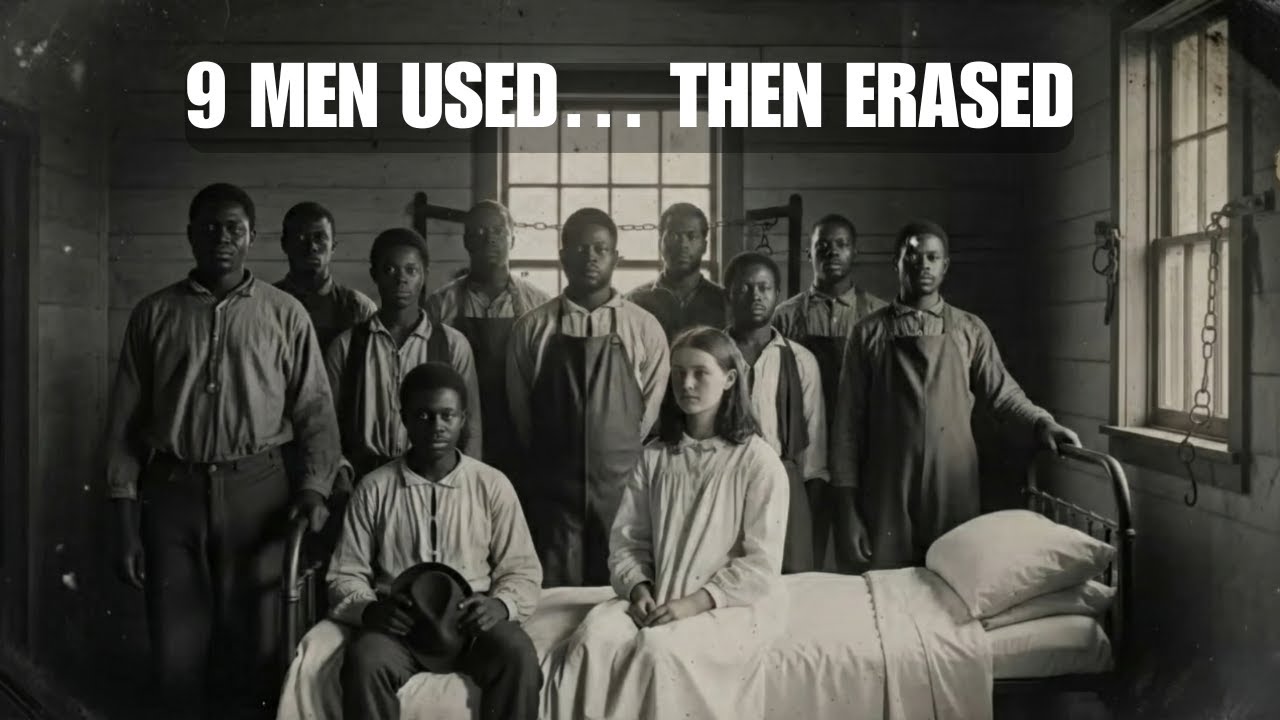
Ashborne’s enslaved population numbered around one hundred thirty, and within that population, nine men held roles unusual even for house servants. They worked in maintenance, stables, and the manor’s interior—positions requiring strength, discipline, and constant proximity to the family. These men were chosen like animals at auction, cataloged not for skill but for physical traits. In one inventory list, the baron had actually written “breeding quality.
”
The nine were Thomas Ridley, Marcus Finch, Isaiah Brennan, Daniel Pewitt, Jacob Worth, Samuel Hoit, Levi Church, Nathaniel Cross, and nineteen-year-old Robert Foster. They ate better than field hands, wore livery, and carried the unspoken burden of being close to power—a privilege that could shift into danger in a heartbeat. The winter of 1847 settled over the low country with unusual mildness. Nights hovered above freezing, and the marshes stayed alive with faint movements.
Around this time, the nine men began to vanish from common view. Not vanish completely—their work continued—but their patterns changed. One by one, each man was summoned to the manor for days at a time. They returned silent, with bruises in odd places: collarbones, inner arms, ribs—marks that didn’t match the usual violence of punishment.
They avoided eye contact. They avoided each other. The enslaved quarters buzzed with theories whispered behind closed doors. Some suspected experiments.
Others feared the baron had turned his predatory attention on them in ways usually reserved for enslaved women. But none of the usual horrors quite fit. Something new was unfolding, something no one had language for. Meanwhile, Margarita began appearing outside again, a startling change from the years she spent confined to her rooms.
She visited neighbors, attended church, smiled politely, and yet something in her expression unsettled those who met her. Women noted she seemed brighter physically, but haunted, as though her soul lagged behind her body. One visitor wrote that Margarita squeezed her hand with desperate strength when children were mentioned, her eyes silently pleading for something she couldn’t voice. Whatever was happening in that house, it was altering her, hollowing her.
By late February 1848, the whispers in the enslaved quarters gathered into a single terrible understanding, one so obscene that even speaking it aloud felt dangerous. Through fragmented comments, frightened glances, and the broken behavior of the nine men, the truth stitched itself together. The baron had forced each of them in turn to lie with his wife. Not out of lust, nor cruelty alone, but out of cold scientific calculation.
He believed his own bloodline defective. He believed Margarita’s womb was sound. And so he had turned to the men he owned, men whose bodies he valued like breeding stock, to produce the heir he wanted. Dr.
Keller monitored her cycles, scheduled the assaults, and administered heavy doses of laudanum and chloral hydrate to ensure she drifted—compliant, but conscious enough to follow instruction. The baron supervised everything from a distance that still felt intimate, measuring, recording, treating human beings like controlled variables in a monstrous experiment. When Thomas Ridley first refused, they dragged him to the manor cellar. What he saw there broke him more thoroughly than any whip.
Instruments meant not for discipline but for mutilation were laid out in precise order—tools a plantation surgeon might use in the most sadistic displays of authority. Thomas was told to choose: castration or compliance. His decision was the decision every enslaved person understood too well, the one that weighed survival against the unbearable. He chose life—if one could call what followed that.
The other eight were given the same choice. By the time each returned to the quarters after days locked inside the manor, they were hollowed men carrying the shape of a trauma none dared speak. Their silence became its own language, one that every enslaved person at Ashborne recognized instantly. Then in early March, everything shifted.
Dr. Keller confirmed Margarita’s pregnancy on March 8th. His journal entry—later found only because it was written in German—was cold in its triumph: “Conception confirmed, sixth week. Disposal protocols to commence.
”
The words sealed the fate of the nine men. Their usefulness had ended. Their existence threatened the baron’s illusion of legitimacy. And so they became liabilities, bodies to be removed before their truth could reach even the smallest corner of the world.
On March 12th, the baron gathered them in the manor’s parlor—a room they had scrubbed a hundred times but never entered as equals. He told them they would be freed. He said papers had been prepared. He said they would leave at dawn for Charleston to begin new lives.
The lie was so perfect it felt like mockery. Freed men represented wealth lost. Freed men represented risk. Freed men represented witnesses who could speak.
The nine understood instantly: freedom was not coming. Death was. That night, seated together in their quarters, the men debated whether to run. They mapped escape routes, calculated distances, weighed the dangers.
They knew the swamps. They knew patrol lines. They knew safe places where free black communities might hide them. But they also knew running would condemn others.
A runaway attempt triggered plantation-wide terror—whipping, torture, public punishment that fell on the innocent as much as the guilty. A rebellion rumor could destroy dozens of lives. And so, in the kind of quiet courage history rarely records, they formed another plan. If they couldn’t survive, they would testify.
They would carry the truth to Charleston and speak it in front of a magistrate, in front of white men, in front of anyone who could not ignore nine voices speaking in unison. Their testimony might be dismissed—enslaved people had almost no standing in court—but it would be spoken. It would live. That was their hope.
They never reached the wagon. At around four in the morning, while darkness still pressed against the low country like a weight, seven white men rode into Ashborne—planters from Middleton and Brickyard estates, neighbors, drinking companions, men who dined at the baron’s table. They had been summoned by urgent messages claiming nine slaves were plotting rebellion. Nothing ignited a planter’s fear like the word rebellion.
It justified every cruelty. It absolved every horror. The men arrived armed and ready—not for investigation, but for execution. Enslaved people were dragged from their beds and forced to gather.
They watched as the nine were bound and marched toward the live oak trees behind the manor, their branches long and thick, perfect for hanging. But the baron had underestimated something vital: the nine men’s refusal to die quietly. As the ropes were prepared, Thomas Ridley broke the silence. He shouted the truth—what the baron had done, what Dr.
Keller had orchestrated, what the winter had taken from them. He shouted for the others to join him, and they did. Their voices rose together, carrying across the plantation like a storm wind ripping through the marsh. They named dates.
They described the room. They described Margarita’s drugged state. They described the baron’s commands, threats, and sickening rationale. They forced the truth into the ears of every witness—enslaved, overseer, planter, anyone within reach of their voices.
And somewhere inside the manor, a candle flickered in a window before it snuffed out. As Margarita heard her violation shouted into the dawn, the baron panicked. He ordered the executions to proceed immediately. The violence was swift and theatrical, meant to reassert dominance, meant to drown truth beneath death.
But it was too late. Hundreds of years of oral tradition began in those final minutes. The official record claimed nine men were executed for plotting rebellion. The baron filed no detailed report.
The local sheriff marked it as suppression of a conspiracy. But the truth—what really happened that morning—spread like fire through enslaved communities. It traveled from plantation to plantation, from market to church to whispered nights between cabins. The truth lived because the nine men forced it into the open with their last breaths.
The white community responded in predictable silence, pretending not to hear what had been shouted. But in Charleston, one woman did listen. Her name was Ruth Denny, a free black seamstress who moved through the city’s households unnoticed—invisible in the way free black women often were, seen but unacknowledged. She heard the story from her cousin and understood instantly that if she didn’t put it to paper, it would be buried beneath lies.
Ruth wrote every detail she’d gathered: the men’s names, the dates, the baron’s actions, the testimony shouted beneath the live oaks. Then she carried that document to a lawyer named Edmund Berkeley. Berkeley was not a hero by intention. He was part of the same system.
He owned two enslaved people himself. But he believed the law should at least pretend to be just. Ruth waited hours outside his office, refusing to leave. When he finally read her document, something in him shifted.
The facts laid before him were too structured, too specific, too coherent to dismiss. He agreed to investigate—not out of moral righteousness, but out of fear of what it meant if planters could do anything without consequence. His decision would cost him everything. Berkeley’s investigation began quietly, almost cautiously, as though he feared the truth might bite.
He visited apothecaries in Charleston, requesting purchase logs associated with Dr. Ernst Keller. What he found chilled him: quantities of laudanum, chloral hydrate, and other sedative compounds far exceeding what any single patient would ever require. These were not therapeutic amounts.
These were control amounts, meant to keep someone subdued for weeks at a time. He uncovered another strange record: nine sets of iron restraints purchased in January 1848. They were not typical plantation shackles. These were smaller, narrower, meant for controlled medical confinement.
Then he discovered something that made the hair on his arms rise. A free black carpenter, Moses Green, had been hired to install heavy locks on an interior ground-floor room at Ashborne—locks that secured from the outside. Locks that were unnecessary unless someone inside needed preventing from leaving. When Berkeley approached Ashborne in April 1848, he expected resistance.
He did not expect the baron’s brazen confidence. Wilhelm Vanderhorn greeted him with rehearsed indignation, insisting nothing unusual had occurred. Yes, nine slaves had been executed. Rebels, he claimed.
Yes, neighbors had assisted. They responded to urgent warnings. Yes, the men had shouted accusations, but desperate slaves always lied. Berkeley attempted to push further.
He asked to speak with Margarita. The baron refused instantly, claiming she was confined to bed, too ill for visitors. Berkeley pressed harder, pointing out she was a crucial witness. The baron’s demeanor shifted.
His politeness slipped like a mask revealing sharp teeth beneath. He warned Berkeley calmly but unmistakably that Charleston’s elite protected their own, and that anyone challenging a planter’s authority would quickly find himself excluded, punished, or worse. But Berkeley had found something the baron hadn’t anticipated. At the Charleston courthouse, he uncovered Keller’s medical reference from Berlin: a letter describing Keller’s studies in “applied heredity” and “breeding optimization”—early eugenics.
Coupled with the drug records and restraining devices, Berkeley realized the baron’s actions weren’t spontaneous cruelty. They were planned, deliberate, scientific in the baron’s warped mind. Armed with this, Berkeley filed a formal complaint on April 18th. The moment the document hit the courthouse registry, Charleston society erupted.
Some planters were outraged he dared question a white man based on black testimony. Others were deeply disturbed at the implications of a planter using enslaved men as breeding instruments upon his own wife. The idea violated southern mythology at its core. White womanhood was sacred, untouchable.
If the baron had crossed that line, he had struck at the heart of planter identity itself. The court reluctantly agreed to a preliminary hearing—not a formal trial. Enslaved testimony was inadmissible, but a session to determine whether further investigation was warranted could proceed. The hearing was set for May 2nd, 1848.
In the days leading up to it, the baron mobilized every connection he had: lawyers, ministers, fellow planters, newspapers. He framed the hearing as an assault on southern order, claiming his property rights were being challenged by a radical conspiracy. Charleston society fractured between those eager to shield him and those horrified by the rumor that a white woman had been violated under her husband’s orders. On the night before the hearing, the first blow struck.
Someone broke into Berkeley’s office, stole Ruth Denny’s written testimony, and burned all related documents. Only the copies Berkeley kept at home survived. That same night, Ruth herself vanished. No investigation followed.
Free black people disappeared often in southern cities. Authorities rarely bothered to search. The courthouse on May 2nd overflowed like a pot on a fire. Nearly two hundred people crowded into a chamber meant for half that number.
The air hung heavy with the mix of sweat, perfume, and tobacco. Berkeley spoke first, presenting the scraps of evidence he still had: drug purchases, medical restraints, carpenter testimony. His argument was careful and measured. He wasn’t asking the court to believe enslaved men over their owner.
He was asking them to consider whether the baron’s actions prior to the executions aligned with his story. Why had he purchased sedatives in bulk? Why restrain men in a locked room? Why would nine men plot rebellion with no history of insubordination?
The baron’s attorney, Clayton Merrick, was a master of performance. Tall, silver-haired, dripping with contempt, he framed the entire proceeding as an attack on property rights. To accept the possibility that enslaved testimony—even filtered through white witnesses—could trigger legal scrutiny would, in his words, “invite chaos into every plantation boundary in the state. ”
The seven white men who’d witnessed the executions testified next.
They repeated the same narrative: rebellion plot discovered, urgent call from the baron, necessary violence to protect plantation and family. When asked if they heard the nine men shout accusations about Margarita and forced breeding, they admitted it, but dismissed it as lies. Then Berkeley called Catherine Mills, Dr. Keller’s former housekeeper.
Her testimony cracked the room open. She’d seen drawings in Keller’s journal—human figures measured like livestock. She’d heard him speak once while drinking about participating in a “visionary experiment. ” Merrick tried to dismiss her, calling her recollection unreliable, but the courtroom felt the shift.
Something real pulsed beneath the story. And then Dr. Ernst Keller stood. For most of the hearing, he had sat unnoticed behind the baron’s lawyers.
When he rose, pale and trembling, the baron’s expression changed—not fear, but rage tinged with something like betrayal. Keller announced he had information essential to the truth. Merrick tried to silence him, but Judge Winthrop permitted testimony. Keller’s voice, thin at first, sharpened as he recounted why he had come to America.
He believed he was treating Margarita’s chronic ailment. But the baron had something else in mind—something monstrous. He described being asked whether another man’s seed could impregnate a woman. The baron wanted control—not passion, not seduction, control.
Keller described the year of suppressing Margarita’s fertility, dosing her with compounds under false pretenses. Then he described December 1847, when the baron revealed the full plan: nine enslaved men chosen for physical attributes, used in sequence while Margarita was sedated, monitored, and coerced. The courtroom dissolved into shock. Women gasped.
Men swore. Even Judge Winthrop, usually stone-faced, looked shaken. Keller continued. He detailed the drugs administered, the cycles tracked, the restraints used, the baron’s obsession with producing a genetically improved heir.
He confessed his guilt in facilitating rape—rape of nine men with no agency, rape of a woman rendered too drugged to understand. His voice faltered when he said the most terrifying line of the day: “And the baron intends to do it again. ”
Margarita had conceived but lost the child. The baron considered the first attempt a learning experiment.
He planned to start anew. At that, the baron lunged to his feet. His lawyers restrained him as he accused Keller of perjury, claiming the doctor had fabricated everything to hide his own malpractice. But Keller had one last piece of evidence: a single journal page he’d hidden in his pocket—a record of Margarita’s pregnancy confirmation containing details only the attending physician could know.
When Judge Winthrop read it, a heavy silence settled across the courtroom. The kind of silence that feels like a held breath before a storm. The judge issued a ruling that satisfied no one yet preserved the system perfectly. The nine deaths, he said, were legal—property punished for rebellion.
But the allegations regarding Margarita warranted a separate inquest, set for May 16th. And the transcript ended with that now-infamous line: “The testimony of nine deceased cannot be admitted as their deaths occurred under circumstances the court finds—” followed by the clean, deliberate slice of missing words. What happened the night after the hearing was not a disaster of coincidence, but a sequence so synchronized it could only have been arranged by men determined to bury truth more thoroughly than they buried the nine men of Ashborne. Dr.
Ernst Keller returned to his boarding house on Queen Street at dusk. The landlady remembered his unease—how he barely touched his dinner, how his hands trembled as though the weight of his confession still clung to him. He retired early. Sometime between midnight and dawn, he died.
The coroner called it heart failure. A man of thirty-nine with no history of cardiac trouble, dead without struggle, without witnesses, without autopsy. Only his medical journals were missing—the same journals he said someone had already attempted to steal. By morning, the page he’d presented in court had vanished, too.
Keller had been silenced with the same precision the nine men had been. That same night, while Charleston slept behind shuttered windows, Edmund Berkeley’s home was violated. Thieves entered between eleven and two, moving through his study like men who knew exactly what to look for. Every surviving document connected to Ashborne—apothecary logs, depositions, personal notes—was taken.
Berkeley himself was struck with an iron object, fracturing his skull. He was found by his wife at first light, lying among torn papers and overturned lamps. Physicians saved his life, but not his mind. His injuries led to chronic pain, hallucinations, and memory loss.
He never again practiced law with clarity. His slow decline lasted two years before death overtook him, leaving behind only the fragments his widow salvaged. At Ashborne, in those same dark hours, Margarita Vanderhorn collapsed into premature labor. Whether the shock of the hearing triggered it, or whether the accumulated poison of years of sedation had weakened her body, no one could say.
Without Keller, a midwife from Middleton was summoned. The child—a boy—was born alive at six months’ term but lived only hours. Margarita refused to hold him. Witnesses later said she stared at the wall as if the infant’s existence confirmed something unbearable.
The baron, present throughout, insisted on a swift burial. Three days later, the child was placed in the family cemetery beneath a marble stone engraved simply: “Too Pure for Earth. ” No name. No legacy.
A life erased before it could anchor the truth. With Keller dead, Berkeley broken, and Margarita incapacitated, the scheduled May 16th inquest evaporated from existence. Judge Winthrop canceled it quietly, writing in his private journal that further inquiry served no purpose but to stir scandal. The transcript of the preliminary hearing, already dangerous, was filed in the county archives.
But six years later, in 1854, a mysterious fire consumed that section of the building. The night watchman swore no lamps had been lit, no candles left burning. Yet the fire erupted precisely where the Ashborne documents were stored. Only a clerk’s copy saved in another room survived.
And even those had been altered. The final page—the one that hinted at the explosion Keller had triggered—had been cut away with a blade, leaving behind a pristine edge where truth once lived. The enslaved community at Ashborne understood the message: silence was demanded. But they refused it.
Stories spread like seeds carried by wind. They told of the baron’s breeding scheme, of the nine men’s final defiance, of Margarita’s drugged compliance and shattered spirit, of Keller’s confession and its terrible price. These stories traveled far beyond Ashborne—into Charleston, Georgetown, Beaufort, even into quiet corners of Georgia’s plantations. They became living truth preserved by memory when paper could not be trusted.
Margarita remained at Ashborne after losing the child, but she was not the woman she had been. Visitors described her as a ghost—present in body, but extinguished in spirit. Her hair grayed early. Her face seemed older than her twenty-nine years.
She spoke little, moving through the house like someone waiting for time to run out. Laudanum became her only companion. She drifted through days in a haze, appearing in drawing rooms with a faint smile that never touched her eyes. In September 1849, Sarah Prescott wrote of visiting her: “She has the look of a woman whose soul has stepped out, leaving only the shell behind.
” When she died in 1851, the cause was listed as consumption, though many believed she simply surrendered to despair. The baron remarried two years later, choosing a young woman from a struggling Virginia family. Anne Elizabeth Hartwell became his second wife in name only. She lived primarily in Charleston, returning to Ashborne rarely and briefly.
Whether she sensed the darkness of the place or simply disliked her husband, she kept distance between them. Their marriage produced no children—a detail that raised questions the baron was careful to ignore. Meanwhile, enslaved families who had survived the horrors of 1847–48 were sold away. Some say the baron could not bear their presence.
Others say he feared their knowledge. Either way, the original community of Ashborne dissolved into distant plantations, carrying with them the story he tried so hard to erase. By the 1860s, the estate existed in uneasy isolation. The baron aged poorly.
His hands shook violently. His mood swung between brooding silence and sudden fury. Union troops reached Ashborne in 1865, occupying the land and freeing the last enslaved people there. On April 23rd, the baron was found dead in his study.
A pistol lay beside him. The official ruling declared suicide, but rumors of murder clung to the air like humidity. Formerly enslaved workers offered no explanation. Some said he had ended his own life, unable to bear the collapse of the world he had crafted.
Others suggested justice had finally reached him in the dark when no one was watching. Anne Elizabeth inherited Ashborne, but she never returned. She sold the property to a Baltimore company whose attempts at agricultural revival failed. The land was abandoned.
Freed families refused work there, whispering that the marsh carried voices and shadows that did not belong to the living. Eventually, the manor decayed like a body returning to soil. On March 13th, 1871—twenty-three years to the day after the executions—the house burned to the ground. No lightning.
No accident. Just flames rising in the night, devouring the last physical piece of the baron’s legacy. Neighbors arrived at dawn to find only scorched earth and blackened chimneys pointing toward an indifferent sky. No map could pinpoint the graves of the nine men.
The marsh changed over decades—tides shifting, land sinking, waters rising. Searches in the 1930s, 1960s, and 1990s yielded nothing. The boundary marked South Marsh had stretched and collapsed under centuries of natural erosion. Their bodies were lost, but their story was not.
It lived in the mouths of descendants, passed through generations who understood that history is never just what gets written. It is also what survives despite attempts to destroy it. In the decades after Ashborne’s collapse, the story of the nine men became part of South Carolina’s hidden memory, spoken in whispers, preserved in songs, recited in cautionary tales shared by elders who understood that history survives not by permission, but by insistence. Enslaved communities had always carried their own archives, built from breath and remembrance rather than ink.
What happened at Ashborne entered those oral records like a wound that refused to close. They spoke the names: Thomas, Marcus, Isaiah, Daniel, Jacob, Samuel, Levi, Nathaniel, Robert. Nine men caught in the jaws of a system that devoured truth as easily as it devoured lives. Generations repeated their story because official papers had failed to protect them, because courts had silenced them, because powerful men had cut away the part of history they feared, and because someone had to keep holding the pieces together when the record was deliberately broken apart.
By 1880, the freed children and grandchildren of those who had lived at Ashborne still carried its ghost. They avoided the land even after it had been divided and sold. Some said the marsh whispered at night, that voices rose through the reeds when the moon was thin. Others claimed they saw figures near the old boundary during fog-heavy dawns, shadows that did not move like the living.
Whether superstition or spiritual truth, these stories reflected something real: the memory of violence clung to that place with a grip stronger than time. No white owner ever stayed long on the property. Fields failed, houses collapsed, workers fled. The land seemed to reject habitation, as though it remembered what had been done upon it.
In 1889, an anonymous book surfaced in Boston titled *Legal Anomalies and Suppressions in Antebellum South Carolina Courts*. It referenced a case from 1848 involving a baron, nine enslaved men, and allegations of forced breeding. The account was brief but astonishingly accurate given how much evidence had been destroyed. The author wrote that the case threatened the very myths upon which southern identity rested—the myth of the benevolent master, the myth of white purity, the myth of moral boundaries in a system built on ownership of flesh.
He claimed the records were deliberately removed from archives to protect not only the baron but the institution of slavery itself. His words echoed what black communities had long known: the story was not simply about one monstrous man. It was about the corruption woven into the system, the ease with which entire counties could collaborate in erasing truth. Meanwhile, the last physical remnants of Ashborne disappeared into the earth.
By the early 1900s, the only structure left was the family cemetery, choked by vines and leaning tombstones. Margarita’s grave lay beside the unnamed infant. Their stones cracked under decades of weather, inscriptions fading into illegibility. It was as though the land was determined to reclaim even the traces of those whose suffering had become the center of the plantation’s horror.
The graves of the nine men, lost somewhere in the marsh boundary, were never found. Rainfall, tidal shifts, and advancing vegetation transformed the terrain so completely that not even ground-penetrating radar could locate them. Their resting place remained unmarked, but not forgotten. The absence of their graves became its own symbol—a reminder that injustice seldom leaves tidy endpoints.
The nine men had been denied identity in life, denied justice in death, and denied the dignity of stone or soil to carry their names. Yet their story endured more fiercely than the baron’s carefully manicured legacy. As the twentieth century unfolded, activists, historians, and descendants tried repeatedly to reconstruct the full narrative. In the 1960s, during the civil rights movement, interest surged.
Black communities across the South collected oral histories, understanding that the written archive was never neutral. In these projects, Ashborne resurfaced again and again—an example of the lengths to which white supremacy would go to preserve itself, even at the expense of truth. In the 1990s, scholars from the University of South Carolina launched a formal investigation, combining archaeology with oral tradition. Though they found no graves, they uncovered fragments of burned wood, nails melted by extreme heat, and pieces of marble likely belonging to the manor’s floor.
They determined the 1871 fire had reached temperatures near the point of structural disintegration—far hotter than a typical accidental blaze. It suggested accelerant, deliberate ignition, or a fire fed by layers of old pine dried into near kindling. Whether the fire was set by freed people seeking closure, by locals preserving silence, or by forces that cannot be named, no one could prove. What mattered was the result: the house that had held so many secrets was finally destroyed beyond reclamation.
The nine names survived in four places: the plantation ledger, where they were crossed out; the damaged transcript of the hearing; fragments of Berkeley’s notes preserved by his widow; and oral memory carried across generations. Together, these sources reconstructed a truth too raw for the antebellum South to confront. Their story revealed a system with no moral boundaries—a husband who saw his wife as an experiment, a doctor who mistook cruelty for science, a court that protected property over human life, and a community that chose silence over justice. But it also revealed something else: resistance in its purest form.
When the ropes were placed around their necks, those nine men understood they were already dead—that the baron had written their fate months before. Yet they chose to speak anyway. They used their final breaths not to beg for mercy, but to shout the truth loudly enough that even the powerful could not fully erase it. That is the heart of Ashborne’s legacy.
Not the baron who tried to play God. Not the doctor who hid behind science. Not the court that refused justice. It is the men whose testimony survived every attempt at destruction—men who in their last moments forced the world to hear what it wanted to ignore.
Their voices travel through time not because the system allowed it, but because truth, when spoken with one’s final breath, takes on a force no archive can bury. Their story asks us a question: how many other horrors were carved out of history with the same deliberate hand that cut the final page of that transcript? How many truths were never given witnesses bold enough to shout them into the dawn? The story of Ashborne Plantation stands as a reminder that the darkest chapters of history are often those someone tried hardest to erase, and that remembering—truly remembering—is an act of defiance against that eraser.
What those nine men suffered cannot be undone. But memory, honest and unflinching, ensures they did not die in silence. Their names remain. Their truth remains.
And because of that, the baron’s attempt at erasure failed. The system’s attempt at silence failed. The truth carried across time by those determined to tell it survived.
