On the morning of 14 April 1944, a Royal Navy crew opened the seacocks of a hollow concrete structure the size of a six-storey apartment block and watched as it went down into the shallow waters of the Hamble estuary on England’s south coast. Its concrete walls were four feet thick. Inside ran a series of watertight compartments, each closed off by a steel door and joined by pipes and valves that ran along the floor. The structure measured 180 feet in length and weighed 4,500 tons.
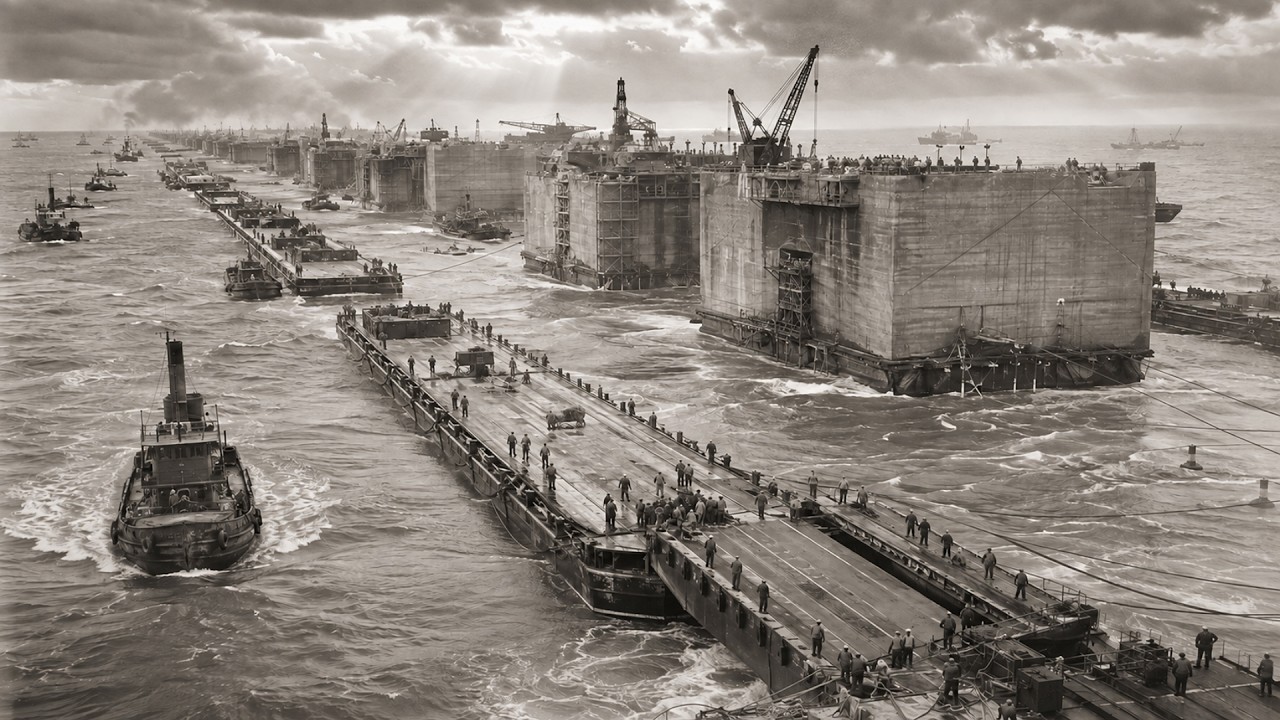
Building it had taken four months. Sinking it took fourteen minutes. Once the water had closed over the top and the final air bubbles had disappeared from the surface, the crew moved to a waiting boat and headed back to the construction site. There, another Phoenix was almost complete.
Nothing about this moment looked remarkable from above. Southampton Water was thick with military traffic, and in wartime a vessel slipping beneath the waves was hardly an unusual sight. What made it unusual was that the vessel being sunk was neither an enemy ship nor an obsolete fishing boat. It was a brand-new structure, constructed for precisely this purpose, deliberately laid on the bottom so that German reconnaissance aircraft, which flew over regularly to photograph the English coast, would not be able to see it.
Sinking it was how they hid it. The plan called for leaving it on the bed of the Hamble for six weeks, then pumping it out and towing it to France. There it would join 145 other structures of the same kind on the floor of the Bay of the Seine, where together they would make up a wall. Behind that wall, in the sheltered water, the largest amphibious invasion in history would be supplied.
The object resting on the bed of the Hamble was known as a Phoenix caisson. It was one part of a prefabricated harbour given the codename Mulberry, and Mulberry was the solution to a question Allied military planners had been wrestling with since 1942. How do you supply two million soldiers on an open beach with no port? To grasp why the question demanded an answer, you need to understand the geography of the French coast and the strategic logic behind what the Allies were trying to accomplish.
The plan to invade western Europe, launched on 6 June 1944, called for landing Allied forces on the beaches of Normandy and then driving inland through German defensive lines to liberate France, Belgium, and eventually Germany itself. The first phase of that operation, getting troops ashore, was a problem of enormous complexity that Allied planners had spent two years solving. But the second phase, supplying those troops with ammunition, food, fuel, and replacement equipment through weeks and months of continuous fighting, was a problem that received less attention in public records and was practically just as important. Modern combat forces consume supplies at a rate that is difficult to grasp without numbers.
Once fully ashore and engaged in combat, Allied forces in Normandy required roughly 15,000 tons of supplies every day. Those supplies came from Britain. They had to cross the English Channel. They had to reach the beach, and there was no port.
The closest major port to the planned landing beaches was Cherbourg, at the tip of the Cotentin peninsula, sixty miles west of Omaha Beach. Allied planners knew Cherbourg would be heavily fortified. They also knew, from intelligence reports and from the example of the 1942 Dieppe raid, which attempted a frontal assault on a fortified port and ended in disaster, that attacking a fortified port would likely cause heavy casualties and destroy the port’s facilities in the process. When the Germans abandoned Cherbourg in late June 1944, they did exactly what the planners had anticipated.
They wrecked the port so thoroughly that Allied engineers needed until late July to bring it back to minimal operational capacity. Le Havre was farther away and more heavily fortified. Brest lay 300 miles from the landing beaches. Between the invasion zone and the front lines there was no suitable port that could be expected to survive the initial fighting in working condition.
The alternative was to manage without a port. Land supplies across the open beach using landing craft, small flat-bottomed vessels built to carry troops and vehicles directly to shore from the sea. Landing craft could reach beaches that larger ships could not approach, but their capacity was limited. Each could carry only a few vehicles or a limited load of supplies.
Moving 15,000 tons a day with landing craft alone would demand more ships and more round trips than the available fleet could supply. Landing craft were also at the mercy of the weather. A storm in the Channel could halt landing craft operations for three days, leaving the invasion force short of ammunition and fuel at a moment when a German counterattack might decide the battle. The planners needed a better answer.
Winston Churchill set out the parameters for them in a memorandum dated 30 May 1942. It read, in part: “Ports for use on beaches. They must float up and down with the tide. The problem of mooring must be mastered.
Do not argue the matter. The difficulties will argue for themselves. ” The engineering teams who received that memorandum spent the next eighteen months grappling with those difficulties. The solution that had emerged by the autumn of 1943 was a prefabricated port made of five components, manufactured in Britain and assembled on the French coast in the days right after the invasion.
The outermost component was the Bombardon. It was a floating steel breakwater, cross-shaped in section, roughly 200 feet wide at its broadest dimension, moored in deep water off the beach in a line intended to absorb and dissipate the energy of incoming waves before they reached the harbour anchorage. A wave entering the Bombardon field broke into smaller, less energetic waves. The energy that reached the port was a fraction of the energy in the open sea.
The Bombardons were the first line of defence against Channel weather. Behind the Bombardons stood the Phoenix caissons, the main breakwater wall. A Phoenix was a hollow reinforced concrete box, sealed when its internal seacocks were closed, sinkable when they were opened. Their sizes varied enormously.
The smallest units were about 60 feet long and 25 feet high. The largest measured 204 feet long, 55 feet wide, and 60 feet high, weighing 6,044 tons. A 6,044-ton Phoenix was larger than most buildings in London at the time it was built. Placed in position and sunk, each one formed a section of the harbour wall.
Set in sequence, 146 of them formed a breakwater over a mile long, enclosing a harbour basin of several square miles. Inside the Phoenix breakwater, in the protected waters of the artificial harbour, ships could anchor without the wave action that would have made unloading impossible on an open coast. They transferred their cargo to landing craft and to the third component, the Lobnitz pierhead. The Lobnitz pierhead was a floating steel platform about the size of a tennis court, mounted on four hollow steel legs that could be driven into the seabed.
When the tide came in, the legs stayed fixed and hydraulic jacks lifted the platform along them. When the tide went out, the platform came back down. This meant the pierhead deck sat at a steady height above the water no matter what the tide was doing, and in the Bay of the Seine the tide could swing as much as 18 feet. A supply vessel tied up beside a Lobnitz pierhead found the same stable loading level at high water as at low water.
Cargo travelled from the pierhead to the shore over the fourth component, the floating Whale roadway. The Whale consisted of steel pontoons joined by hinged steel deck sections, allowing each section to pivot at its joints and follow the movement of the sea below. Once finished, the roadway stretched from pierhead to shore as a flexible bridge several hundred feet in length. Lorries crossed it from the pierhead to the beach just as they would an ordinary road, while the ocean shifted beneath their wheels.
The fifth component, the foundation underlying everything else, was the choice to build every part in Britain, tow it over the Channel, and put it together on a hostile coastline in the days right after the invasion. The project’s director of engineering was Brigadier Bruce White of the Royal Engineers. White was not a celebrated figure. He is not celebrated today.
He was a civil engineer whose career had been spent constructing things under hard conditions, and he had been handed a problem with no precedent in the annals of military engineering, along with roughly twelve months to crack it. The Phoenix was the core of the harbour and by far the biggest manufacturing headache. 146 reinforced concrete structures, from 60 to 200 feet long, had to be finished and ready by May 1944. Britain had no facility built to produce reinforced concrete structures of that size in the water.
Engineers combed the country’s available coastline, river estuaries, reservoirs and dry docks, and took over any site that could be adapted. Among the locations drawn into the programme were a stretch of the Thames near Tilbury, the Clyde estuary at Port Glasgow in Scotland, the dock basin at Cardiff in Wales, the Hamble estuary in Hampshire, a flooded reservoir in central England that was drained and turned into a Phoenix construction site, a former dry dock at Richborough in Kent, and more than a dozen other places. At every site a temporary cofferdam was raised in the water, the water was pumped out until the ground was dry, and then the formwork went up and the concrete pouring started. The workers who turned up at these sites in the autumn of 1943 were told they were building floating platforms for military purposes.
The supervisors of the workers and the concrete, who stayed on site longer, were told a little more. None of them learned what the structures were for, where they were headed, or when they would be needed. The Official Secrets Act was enforced at every level. Workers who pushed for answers beyond their clearance were simply told the information was not available.
Those who kept pressing were moved elsewhere. The concrete hands who built the Phoenixes worked inside cofferdams that cut down the water but never shut it out completely. Estuary sediments are soaked with water. You could pump a cofferdam basin down to working level, and water would still creep in through the clay layers between the sheet piles, or through gaps in the timber itself, or through the estuary sediments at the base.
Inside a Phoenix cofferdam the working area was wet and reeked of salt clay, lit by portable electric lamps hung on cables strung across the cofferdam walls. In winter, the temperature inside a Thames cofferdam was barely different from the temperature outside. Concrete is not poured in cold weather the way it is poured in warmth. Below a certain temperature, the hydration reaction that hardens concrete slows and then freezes, and below freezing it stops altogether.
The winter of 1943 to 1944 was cold along the English coast. The construction timetable left no room for sluggish concrete curing. Sites that kept working through December and January wrapped the formwork in hessian and straw to hold in the heat of curing, and in some cases ran portable coal heaters inside the formwork cavities to keep each pour above the minimum temperature needed for adequate strength. When frost caught a pour that had not yet gained enough strength, engineers recorded the failure, and that section was broken out and poured again.
There were re-pours. The reinforcing bars that gave the concrete its tensile strength were cut, bent and tied by hand by steel-fixing crews working ahead of the concrete teams. In a Phoenix with four-foot-thick walls, the reinforcement mesh inside those walls was tightly packed. A skilled steel-fixing crew could set and tie a section in the time the formwork crew needed to install the timber shutters, and the two crews had to coordinate precisely, since neither could work with the other in its way.
The supervisor’s job at each site was to manage that coordination across simultaneous pours of a structure being built from the bottom up in stages, each stage depending on the one beneath it having set, and the concrete had to go in as continuous lifts. A cold joint, the seam where fresh concrete meets set concrete, was a structural weak spot. In the design of a box meant to hold back the sea, any weakness in the wall was a possible failure point. Once a pour started on one of the large Phoenixes, it ran without stopping until the stage was finished.
The crews worked in shifts, twelve hours on and twelve hours off, for the whole length of the pour. In winter they worked under floodlights. They mixed concrete in conditions no modern site safety officer would allow, in cold and damp, without proper respiratory protection against the concrete dust that filled the air inside the cofferdam. At the larger sites on the Clyde and the Thames, several Phoenix units were going up at the same time.
The Clyde site at Port Glasgow built 12 units. The Thames site at Tilbury built more than 20. At these sites the concrete batching plants were permanent setups, and the supply chains for aggregate, cement and reinforcing steel were established and dependable. At the smaller sites, supply was more fragile.
Any break in supply at a single Phoenix site could set the schedule back a full week. A week lost in the spring of 1944 could not be recovered. The 146 Phoenix units held roughly 55,000 tons of concrete in total. Every ton of it was mixed by hand or in small petrol-driven mixers, poured by workers with buckets and chutes, then compacted inside the formwork with hand-held tamping bars to drive out air bubbles, and left to set under whatever shelter the site could provide.
Those who carried out this work were paid according to wartime wage controls that fixed the rates for Britain’s construction industry. Secrecy brought them no additional pay. They got nothing for the restrictions that stopped them from talking about their jobs once they left the site. They were construction workers, doing construction work.
The one thing that set their job apart was the ban on discussing what they were building. That secrecy added a layer no earlier British construction programme on this scale had ever had to contend with. By January 1944, the sites along the Thames, the Hamble and the Clyde held vast concrete structures that admitted no innocent explanation. German aerial reconnaissance over southern England was thorough and highly skilled.
Luftwaffe photo-interpretation teams had already correctly read the build-up of landing craft in the southern ports as a sign that a cross-Channel operation was close. If they also recognised the Phoenixes as prefabricated port components, they might work out that the operation did not hinge on seizing a French port, which would sharply narrow the possible landing sites. The British answer was to sink each Phoenix unit the moment it was finished and leave it on the bottom until it was wanted. A concrete structure resting on the bed of a tidal estuary was hard to identify from 10,000 feet as anything worth noticing.
Seen from that height, a Phoenix settled into the mud resembled a heap of sediment or a wrecked vessel, and neither was out of the ordinary in wartime British waters. The sinking had to be done with care. When a unit was ready for concealment, its internal seacocks were opened in a carefully controlled order, flooding the compartments from the bottom upward. The pumps that had kept the interior dry throughout construction were shut down.
The Phoenix settled at a pace set by the flooding sequence, and a wrong sequence could make the structure come to rest at a tilt, which would make refloating it harder later. A Phoenix that had settled at an angle into tidal mud had to be freed from that mud at the same angle before its attitude could be corrected, and freeing a 4,000-ton concrete box from estuary mud at an angle was no simple task. The crews who ran the sinking operations were Royal Navy personnel, trained on one of the completed Phoenix units before it was launched. The training was short because no approved procedure existed for this particular job.
The procedures were worked out by trial on the first units and refined as problems arose. When a Phoenix went down with a slight tilt because of a poorly calibrated flooding sequence, the engineers adjusted the sequence for the next unit. When a Phoenix settled into unusually sticky mud and resisted the first refloat attempt, the engineers added a compressed air step to the refloat procedures. The workers who handled these problems did not record them in official reports as problems.
They recorded them as modifications to working procedures. The Whale floating roadways were built in steel fabrication shops throughout Britain. The pontoons were welded steel boxes of standard dimensions that could be mass-produced in any facility with the right equipment. The hinged deck sections joining them demanded precise tolerances at the pivot points so the sections could flex without jamming as wave action lifted and lowered adjacent pontoons.
Steel fabrication shops that had been turning out hull components for other military programmes were retooled for Whale production over the winter of 1943 to 1944. The Lobnitz pierheads were put together from structural steel sections made in factories in Scotland and Wales. Each pierhead was a steel deck frame carried on four hollow steel legs, each fitted with a rack-and-pinion lifting system that let the deck be raised or lowered as required. The legs were meant to be driven into the seabed by a piling attachment mounted on the pierhead itself, after which the deck could be raised to whatever height the tide demanded.
The design was tested at a prototype facility off the Scottish coast in the autumn of 1943. The test confirmed that the lifting mechanism performed as designed under tidal conditions, and that the leg structure could bear the loads imposed by a supply ship moored alongside. The Bombardons were built in the steel yards on the Clyde, where working capacity and available water for final assembly were greatest. They were the last component to have its design completed, and production started later than for the Phoenix units, which meant they were finished in April and May of 1944 with less margin than any other element of the programme.
On 6 June 1944, Allied forces came ashore on five beaches along the Normandy coast and secured a foothold. The operational plan for the Mulberry harbours called for towing the Phoenix units to begin within 48 hours of the landing, before the beaches were fully secured and while German defensive positions remained active in some sectors. The tow fleet gathered in the southern English ports on 7 June. It comprised more than 150 deep-sea tugs drawn from Royal Navy resources, commercial towing companies working under the Ministry of War Transport, and vessels from the merchant fleets of several Allied nations.
Tugs were paired with caissons according to towing capacity. A 6,000-ton Phoenix needed at least two large ocean-going tugs working in tandem. The smaller units could be handled by a single tug. The Phoenix units that had been sunk in their assigned estuaries were refloated in the days immediately before D-Day.
The refloat crews worked their way from unit to unit along the estuaries, hooking up compressed air lines to the hull fittings, running the pumps, and waiting for the slow upward movement that showed the Phoenix had broken free of the mud. The mud was the main obstacle. A Phoenix that had lain in soft estuary sediments for six weeks had sunk into them across its whole underside, gripped by the suction force against the hull. Compressed air was used to break that suction at the boundary between hull and sediment before the internal pumps could build enough upward pressure to float the structure.
When the caisson came up, in most cases it came up at an angle, because the mud let go unevenly along the hull. The refloat crews levelled the tilt by flooding and pumping individual compartments in turn until the deck sat level. The tow ropes were then attached and the Phoenix was moved downstream toward the assembly anchorage. The Channel crossing took about 20 hours at a speed of 4 knots.
4 knots is walking speed. Someone walking at a normal pace covers roughly 4 knots. The crossing distance from the English assembly point to the Bay of the Seine was about 80 miles. At 4 knots, in a rough sea state with the prevailing westerly winds driving Atlantic waves into the Channel, the journey was not a comfortable one.
A Phoenix sat very low in the water. Only a few feet of deck showed above the surface. Once the waves grew at all, that deck disappeared under them. The tow crews riding with the Phoenix boxes spent nearly the whole crossing down below in the access hatches, hearing the water slam against the hull and feeling the tow ropes shudder through the structure each time the tugs altered speed or heading.
The tug masters pulling these tows were operating near the edge of what they had done before in practice. A Phoenix did not follow steadily behind its tug through cross-currents. It yawed from side to side. Each yaw put the tow load on an angle, and an angled pull on a rope created greater stress than a straight one.
The masters compensated for that angle by shortening or lengthening the rope. With visibility poor and tidal currents running across them, they steered by compass and kept in radio contact with the convoy control vessel. The convoy reached the Bay of the Seine in stages across the week from 8 June to 14 June. The pieces of the American Mulberry harbour made for the anchorage off Omaha Beach.
The British pieces made for Arromanches. Naval construction crews were already waiting at both sites. At Arromanches, naval officers who had spent months committing the positioning charts to memory ran the construction work. Every Phoenix carried a site number in the breakwater plan, and every number had its own coordinates given as compass bearings from survey markers ashore.
From a work platform, the construction officer talked the tug masters by radio onto the mark, and once the Phoenix sat over it, the seacocks were opened. Within 15 minutes it had settled. The placement had to fall inside the tidal window. Currents in the Bay of the Seine reached as much as 2 knots.
Around each slack water there was a stretch of roughly 4 hours when the current ran slowly enough for the tug to hold the Phoenix on station while it went down to the bottom. Beyond that window, the current dragged the box off line. The construction crews fitted every placement into the tidal window and completed as many in a day as the tide table and the flow of arriving Phoenixes permitted. The first Phoenix went in on 9 June.
By 14 June, enough of the breakwater stood in place that the anchorage inside the Phoenix line had partial shelter. Supply ships came into the anchorage and started unloading. Lobnitz pierheads were installed at two of the three intended spots. One Whale roadway was running all the way to shore.
Trucks were rolling over it. On 14 June the harbour was still unfinished. It functioned well enough to be of real use. The construction crews carried on working.
On 19 June 1944, the forecast for the English Channel pointed to worsening weather. By mid-morning on the 19th, waves in the open Bay of the Seine had reached 5 feet and were still climbing. By midnight, sustained winds in the Channel were above 25 knots. By the morning of 20 June, waves in exposed parts of the bay had passed 12 feet.
The tidal range, which at Arromanches routinely ran past 18 feet, made the storm’s impact on the coast even worse. The American harbour at Omaha Beach took the heaviest blow. The Bombardon barriers in the Omaha sector had gone in later than those at Arromanches and were not fully moored when the storm struck. Several barriers tore loose from their moorings during the first night and were blown and carried out to sea.
A Bombardon adrift in a storm was a 200-foot steel structure drifting with current and wind at unpredictable speeds. Three of the Bombardons that broke loose at Omaha rammed the Phoenix breakwater line. The strikes cracked two caissons and sank a third. Water poured into a breached Phoenix, it lost buoyancy, and came to rest on the seabed with its top sticking above the surface, breaking the run of the breakwater wall.
Wave energy spilled through that gap into the harbour basin. The Whale floating roadways at Omaha were not fully anchored to the shore. The beach anchors, steel stakes driven into the sand to hold the landward end of each roadway, had not been fitted to the three planned roadways when the storm arrived. The roadways, left floating free at the shore end, were seized by waves rushing through the breach in the Phoenix line and pushed toward the pierheads.
A Whale roadway, hundreds of feet of linked steel pontoons, hitting a Lobnitz pierhead at storm speed carried enough force to bend the pierhead’s leg structure. Two pierheads at Omaha were knocked out of service. The supply ships anchored inside the harbour, water that had been counted as sheltered, now lay in open water with waves above 6 feet. Most ships held on their moorings, but the motion in the anchorage during the storm was violent enough that ships could not berth safely at the damaged pierheads.
The ships stayed at anchor, and once the storm died down they discovered that the pierheads they had counted on for unloading were wrecked. The storm ran for 3 days. It eased on the evening of 22 June. Weather records put it as the worst June storm in the English Channel in 40 years.
American engineers walked the harbour at Omaha and tallied what was left. The findings were grim. Two of the Whale floating roadways had been destroyed. Two pierheads were damaged beyond any quick repair.
Three Phoenix caissons had been breached or damaged. The inshore area was partly choked with the hulks of supply ships that had grounded and broken apart during the storm. The engineers judged that rebuilding Mulberry A would take longer than the supply situation could bear. The alternative was to salvage whatever could be saved from Omaha and send it to strengthen the British harbour at Arromanches.
The recommendation was approved. Mulberry B at Arromanches had come through better than its American counterpart. The Phoenix breakwater at Arromanches was further along in construction when the storm hit, and the partial enclosure it gave cut the wave energy inside the harbour enough that the damage, serious as it was, could be repaired. Three Phoenix units were damaged.
Several stretches of Whale roadway broke loose. The Bombardon moorings held at most positions. The Royal Engineers surveyed the damage and started repairs at once. In the two weeks after the storm, the salvage operation at Omaha moved 23 intact Phoenix units and several hundred feet of Whale roadway to Arromanches.
The American harbour was shut down. The British harbour was repaired and enlarged with the salvaged components. Mulberry B ran from late June until November 1944, by which point the Allies had advanced far enough to use the major French ports. Over those five months, the harbour at Arromanches landed two and a half million soldiers, 500,000 vehicles, and 4 million tons of supplies.
The daily capacity, designed at 7,000 tons, was routinely surpassed. When the harbour was taken out of service, the Whale roadways were taken apart. The Lobnitz pierheads were removed. The Bombardon units were recovered.
The Phoenix caissons stayed where they were. Thousands of workers built the Phoenixes, spread across more than 20 locations. The labour force took in concrete pourers, steel fixers, formwork carpenters, operators of cranes and mixers, and general labourers who handled jobs that did not fall under a particular trade. Wartime wage controls set their pay.
In 1943 Britain, an unskilled construction worker earned roughly one pound and ten shillings a week as the standard rate, higher than before the war since demand for construction labour had outrun supply. These workers fell under the Essential Work Order, wartime legislation that barred workers in designated essential industries from quitting without government approval. A man sent to build a Phoenix who decided in the winter of 1943 that this was not the work he wanted could not just walk away. He had to request a transfer through the Ministry of Labour, and such requests from essential workers were rarely approved.
In practice, the choice came down to staying or producing a reason compelling enough to satisfy the ministry. The secrecy rules created a social pressure with no peacetime equivalent. These workers could not talk about their duties with anyone beyond the site. They could not tell their wives what they were building.
They could not explain to a friend in a pub how they had spent the day. For them, the Official Secrets Act was no mere formality. Breaches brought prosecution. In most cases, the mood of a country fighting a total war made further enforcement unnecessary.
After the war, most of these workers went home and went back to careers in construction. Some of them eventually came across photographs of the Normandy harbour in newspapers or documentaries and understood, perhaps for the first time, what the structures they had poured were for. The workers at the inland sites, where Phoenix units were built in a converted reservoir and then towed to the coast, may never have made that connection at all. For most of its existence, the Phoenix unit they built sat underwater.
It arrived in France already sunk, was refloated, towed across the Channel, and sunk once more. They never saw it standing in the water at Arromanches. They never saw it performing the task it had been built for. The surviving construction records in the National Archives at Kew set out the engineering of the Phoenix programme in detail.
They list concrete mix designs, sheet-pile penetration depths, seacock specifications, and internal compartment pressures. They document structural tests on the first units. They document the design changes made after early construction exposed problems. What they lack, in any systematic form, is a list of the workers’ names.
Names turn up in the records only when something goes wrong and documentation is required. Injuries are entered in accident logs when they are serious enough to need medical care or to disrupt the production schedule. Deaths are entered when they call for an administrative response. The surviving records have never yielded a total number of construction-related deaths in the Phoenix programme.
It is thought to be small given the size of the workforce and the length of the project, since building temporary cofferdams, hazardous as it is, is not as consistently dangerous as working in open water. But that is still a belief, not a known fact. The record was not kept in a form that permits an accurate count. One document is worth mentioning.
The Hamble site on the riverbank kept a foreman’s log. Fragments of it survive in a local archive in Southampton. The surviving sections cover roughly four months of construction, from November 1943 to February 1944. Across those four months, the log records concrete pour quantities, formwork setup times, curing delays, supply deliveries, and weather conditions.
It records the dates on which particular sections of two of the Phoenix caissons were finished. It records the date on which the first of those caissons was towed to its mooring position in the river. The log does not record the workers’ names. It records crew designations.
Crew A, Crew B, Crew C. The foreman, whose name is on the cover of the log, is named. The workers are not. In the February 1944 entries, a note records that Crew B was one man short for three shifts in a row after an incident in which a worker was struck by falling formwork and needed hospital treatment.
The log notes that a replacement came from the labour pool the morning after the incident, and the crew was back at full strength. The injured worker is not named. The hospital he was taken to is not named. Whether he made a full recovery, whether the injury shaped his life after the war, whether he ever learned what the Phoenix he was building was for, is not recorded.
The Phoenix that Crew B was building at the Hamble site in the winter of 1944 was finished, towed to its mooring position, sunk, then refloated, towed across the English Channel at four knots, and sunk in the Bay of the Seine. It has lain there for 80 years. The Phoenix caissons at Arromanches are still there too. For 80 years the tides of the English Channel have worked on them from every direction.
The intertidal zones, the parts of each caisson’s walls exposed to air at low tide and submerged at high tide, have been colonized by barnacles and green-brown algae that grow on any fixed surface in shallow Channel water. The reinforcing steel inside the concrete has been corroding since 1944, and where the corrosion has expanded enough to crack the surrounding concrete, pieces have spalled off and dropped away. The affected areas show as irregular patches of exposed aggregate on the caisson faces. Erosion has worn down the original profiles of the walls at the top of each unit.
Some of the caissons now stand several feet lower than they did in 1944. After 80 years of this, the Phoenixes still stand. You can see them from the beach at Arromanches. At low tide, they are not far from shore.
The grey concrete of the Phoenix walls rises above the waterline, irregular and broken at the top, coated with marine growth at the tidal zone. If you stand on the beach and look toward the northwest, you are looking along roughly the line of the breakwater. The structures you see form the main wall of a harbour that no longer works, yet has not shifted from its original position. The Arromanches 360 museum on the cliff above the beach shows original footage filmed by military cameramen in the summer of 1944.
In that footage, the Phoenix breakwater looks complete and solid, trucks move along the Whale roadways, and ships lie at anchor in the sheltered water behind the wall. You can watch that footage, then walk down from the hill to the beach and look at what remains. The gap between the two versions of the same thing is something you have to see for yourself to absorb. At Omaha Beach, the remains of the American Mulberry harbour are different in nature.
The violent seas of the 19 June storm tore apart Phoenix caissons and Whale sections and flung them onto the beach. Sand has swallowed those fragments over the years. At low tide a few emerge — grey blocks of concrete and corroded steel jutting from the sand. Others lie entirely hidden, surfacing only when the tides are unusually extreme.
No signs mark them. Nothing tells you what they are. Plenty of people visiting Omaha Beach walk right past without grasping their identity. They take them for rocks, or debris left by the fighting, or simply part of the natural shoreline.
What they actually are is the wreckage of a harbour assembled in secrecy in Britain by labourers who were never told what they were building, hauled across the English Channel under fire, and wiped out by a June storm within three days, before it could finish the job it was made for. Brigadier Bruce White, the man who ran the engineering programme, received a knighthood in 1946 for his wartime work. He survived until 1976. In his later years he was photographed at Arromanches, standing on the sand, gazing at the row of Phoenixes out in the water.
In that photograph, kept in the Imperial War Museum archive, he comes across as an old man in a coat, staring at grey concrete in grey water. He does not seem to be pondering engineering, even though engineering is what defined his life. He seems to be looking at something that resists being looked at squarely, and yet you cannot stop yourself from looking. The labourers who made the Phoenixes are absent from that photograph.
They were not at Arromanches in June 1944, apart from the handful who signed on with the construction teams that set the caissons in place. They were elsewhere — on the Clyde, the Thames, the Hamble, and the Midlands reservoirs. They were casting concrete through the winter inside formwork they were forbidden to describe to anyone beyond the cofferdam. They worked in Crews A, B, and C, under men whose names sit in the foreman’s log above their own.
The concrete they poured now rests in the Bay of the Seine. For 80 years the tides have swept over it. Barnacles have spread across its surface. Salt has eaten into the reinforcing steel within.
None of this has shifted them from where the construction crews set them in the summer of 1944. If you have ever taken the ferry from Dover to Calais, then driven south and west along the French motorways toward Normandy, you know the quality of the morning light in that region. The sky above the Calvados coast has its own shade of blue-grey, the grass in the fields along the road has its own shade of green, and the light on the water, as you crest the hill above Arromanches, differs from the light anywhere else you have been. You are gazing at a bay where men built a harbour.
The harbour is gone in the sense that it no longer functions. But it is not gone in the sense that its structure still stands. The Phoenix caissons that refloat crews pulled free of the mud of the Hamble, the mud of the Thames, and the mud of the Clyde, and towed through 20 hours of open Channel, lie in the water beneath you, sweeping around the bay in the formation the construction crews set them in during a tidal window in the summer of 1944. The men who poured the concrete are not there.
The men who tied the reinforcing steel are not there. The members of Crew B at the Hamble site, who were a man short for three shifts in February 1944, are not there. Their names never made it into the records. The record preserved what had to be preserved, which was the engineering, and the engineering lived in the concrete, and the concrete is still there.
The Channel is still there. The crews are not.
