The war did not begin at Fort Sumter in April 1861. It began decades earlier, in quiet rooms where men in powdered wigs and high collars decided that the dream of the Republic was worth more to them than the courage it would have taken to build it honestly. They made a calculation, not necessarily a cowardly one. Many of them were brilliant, principled men who genuinely believed they were buying time for something better.
But the calculation was wrong, and the price, when it finally came due, was six hundred thousand American lives. The road began in Philadelphia in the summer of 1787. The men who gathered to write the Constitution disagreed about almost everything: the strength of the federal government, the power of the president, the rights of smaller states against larger ones. But hovering over the entire convention, unspoken in the formal proceedings and everywhere in the private conversations, was the question of slavery.
The southern delegations made their position clear from the beginning: any constitution that seriously threatened slavery in the southern states was a constitution they would not sign. And without the southern states, there was no union, only a collection of separate nations vulnerable to European interference and internal collapse. James Madison, who kept the most detailed notes of the convention, understood the central tension perfectly. The real division in American society, he wrote, was not between large states and small states, not between commercial interests and agrarian ones, but between the states with slaves and the states without them.
He saw it with perfect clarity. Then he helped write a document that accommodated it. What emerged from Philadelphia was a constitution that protected slavery without ever mentioning the word. It gave slaveholders three-fifths of a person’s political weight for every enslaved individual they owned, meaning the more enslaved people a planter held, the more representation he got in Congress.
It barred the federal government from interfering with the international slave trade for twenty years. It required the return of escaped enslaved people who had fled to free states. The founders did not resolve the contradiction between “all men are created equal” and the reality of American slavery. They buried it in legal language and built a government on top of it.
The argument defenders of the founders typically make is that the union could not have been formed without these concessions, and that the union, whatever its flaws, was worth having. That is probably true. But there is a cost to that kind of pragmatism that rarely gets accounted for. When you build a nation on a deferred moral reckoning, you do not make the reckoning less severe.
You make it worse. Every year the compromise holds is another year slavery becomes more deeply embedded in the economy, the culture, and the political identity of an entire region. By 1860, the South’s commitment to slavery was not merely economic. It was existential.
Four million people were enslaved on American soil, representing billions of dollars in what southern politicians freely called their property. Anyone who threatened that property threatened everything: the whole social order, the whole sense of who southern white men were and what they deserved. The first serious warning came in 1819, when Missouri applied for statehood. The Union had been operating under a rough, informal balance: eleven free states and eleven slave states, maintaining something like parity in the Senate.
Missouri’s application as a slave state threatened to break that balance. Northern states objected. James Tallmadge, a congressman from New York, proposed an amendment that would gradually phase out slavery in Missouri. The House passed it.
The Senate did not. For two years the country fought over Missouri’s soul, and the fight was ugly enough that even the aging Thomas Jefferson, retired to Monticello and mostly removed from public affairs, was alarmed. The controversy struck him, he wrote, like a fire bell in the night, awakening him and filling him with terror. At seventy-six, he understood what the argument over Missouri really was: a preview, a rehearsal for the larger confrontation that would come when the sectional balance could no longer be maintained by the arts of political compromise.
“This momentous question, like a firebell in the night, awakened and filled me with terror,” he wrote to a friend. “I considered it at once as the knell of the Union. ”
He was right. He also did nothing about it, having spent his entire adult life doing nothing about the institution that made the question momentous in the first place.
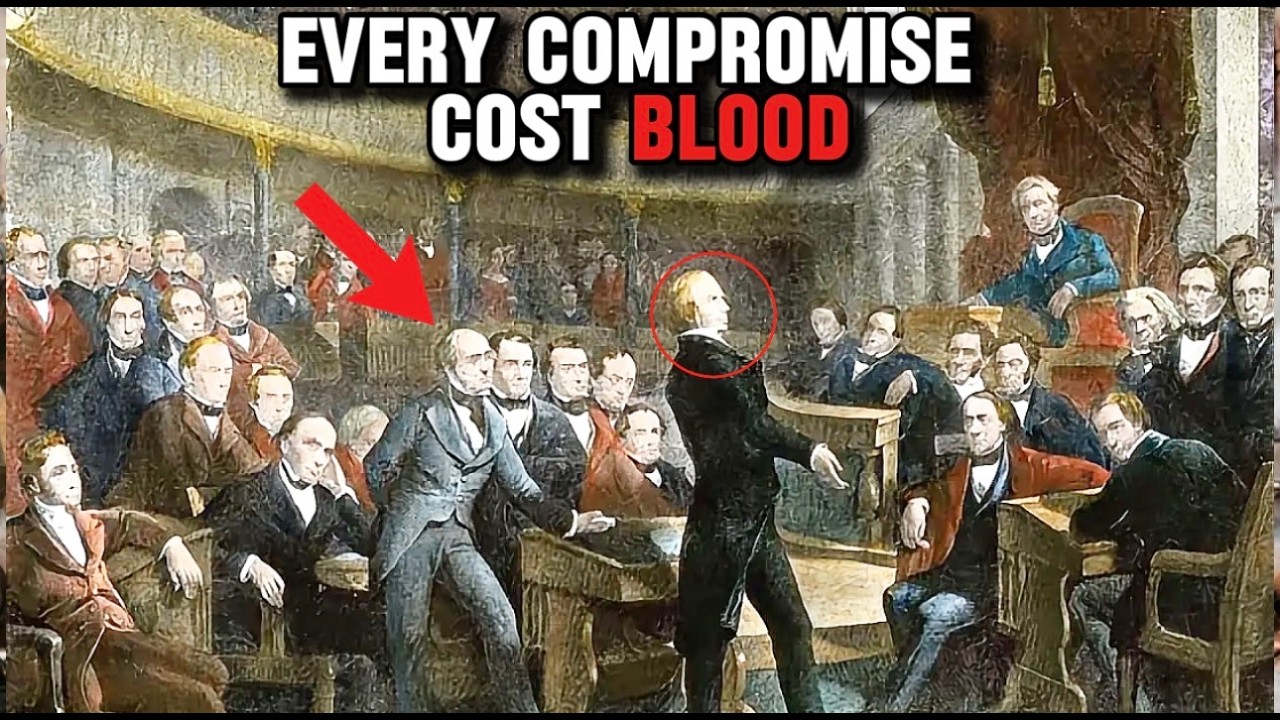
The compromise that ended the Missouri crisis was the work of Henry Clay of Kentucky, a man whose entire political career would be defined by his ability to get Americans to stop arguing long enough to pass a deal. The Missouri Compromise of 1820 admitted Missouri as a slave state and Maine, carved from Massachusetts, as a free state, restoring the numerical balance. It also drew a line across the Louisiana Territory at 36 degrees 30 minutes north latitude, declaring that slavery would be prohibited above that line in any future territories. Below the line, it was permitted.
The Union was saved. The question was deferred. Clay was celebrated as a genius and a patriot, and he probably was both. But what the Missouri Compromise actually accomplished was to take a live grenade, smooth out the pin, and hand it to the next generation.
The line across the map was not a solution. It was a postponement dressed up as a resolution, and everyone sophisticated enough to understand American politics knew it. The line only held as long as no one challenged it seriously. The 1820s passed, then the 1830s.
The country grew. Steam engines arrived. Cotton production exploded across the deep South, driven by insatiable demand from British and northern textile mills. Every bale of cotton represented the labor of enslaved people, and every dollar it generated reinforced the southern conviction that their way of life was not merely defensible but divinely ordained.
Meanwhile, in the north, a new generation of abolitionists began saying things previous generations had been too cautious or too complicit to say. They called slavery a sin, not a regrettable economic arrangement, not a complicated inheritance from another era, but a sin, a crime against humanity. And they were not quiet about it. William Lloyd Garrison launched his abolitionist newspaper, The Liberator, in 1831 and declared that on the question of slavery’s immediate abolition, he would not equivocate, he would not excuse, he would not retreat a single inch.
The South heard him. If northern public opinion shifted far enough toward abolition, the political coalition that had maintained the compromise since 1820 would crack, and cracking meant confrontation. Southern state legislatures responded by passing laws making it illegal to question slavery, to distribute abolitionist literature, or in some cases, to teach enslaved people to read. The defensiveness was, in a way, revealing.
You do not build walls against arguments you find unpersuasive. The 1830s also produced a smaller crisis that carried a large warning. South Carolina, under the intellectual leadership of John C. Calhoun, declared that it had the right to nullify federal laws within its borders, specifically a tariff it found oppressive.
Andrew Jackson responded with controlled fury, threatening military force and making clear that nullification was treason. South Carolina backed down. But what the nullification crisis demonstrated was that the South was willing to assert with full seriousness that the compact of the Union was conditional, that a state could withdraw its consent from federal authority when that authority conflicted with its interests. Jackson had forced a retreat on tariffs, but the logic of nullification was still there, sitting in the corners of southern political thought like a loaded weapon waiting for a moment serious enough to justify its use.
That moment was still twenty years away, but the rehearsal had happened. The 1840s brought the war with Mexico, and the war with Mexico brought land, enormous amounts of it, stretching from Texas to California. Suddenly the carefully maintained geographic compromise of 1820 was irrelevant. There were hundreds of thousands of square miles of new territory to be organized, and neither north nor south was willing to cede them to the other.
The question of whether slavery would be permitted in the new territories became the defining political question of the era. David Wilmot, a Pennsylvania congressman of no particular fame or distinction, attached a provision to a military appropriations bill in 1846 that would have banned slavery from any territory acquired in the Mexican War. The House passed it. The Senate did not.
Wilmot kept reintroducing it. The Senate kept killing it. The country spent three years in a state of sustained political crisis, with northern and southern politicians making increasingly extreme statements about what they would and would not accept. By 1849, with California applying for admission as a free state after the Gold Rush, the crisis had become acute enough that senators were openly discussing disunion on the Senate floor.
Henry Clay came back. He was old now, seventy-three, and ill with the tuberculosis that would kill him within two years of his last great compromise. He had spent his career as a professional peacemaker, and he made one more attempt. The Compromise of 1850 was his masterwork and his final act.
It was also, in retrospect, the moment when the accumulated pressure of four decades of deferred reckoning first became genuinely dangerous. The Compromise of 1850 was not a single piece of legislation but five separate bills. California came in as a free state. The territories of New Mexico and Utah would decide the slavery question for themselves when they applied for statehood, a concept called popular sovereignty, which sounded democratic and was, in practice, a recipe for violent conflict.
Texas surrendered its claims to parts of New Mexico in exchange for federal assumption of its debts. Slave trading was abolished in the District of Columbia, though slavery itself was not. And the South got what it had been demanding for years: a new, dramatically strengthened Fugitive Slave Act. The Fugitive Slave Act of 1850 was the provision that changed everything.
It did not merely require northern law enforcement to assist in the return of escaped enslaved people to their southern owners. It required ordinary northern citizens to do so as well. It stripped accused escapees of the right to a jury trial and denied them the right to testify in their own defense. Federal commissioners who ruled in favor of a slaveholder were paid ten dollars.
Those who ruled in favor of the accused received five. The message was not subtle. In the northern states, where many white people had been mostly indifferent to slavery as long as it stayed in the South, the Fugitive Slave Act made the institution visible and immediate in a way it had never been before. It turned northern citizens into agents of the slave system, whether they wanted to be or not.
The reaction was visceral. Northern state legislatures passed personal liberty laws designed to obstruct the federal act. Crowds gathered in Boston and elsewhere to prevent the return of accused runaways. Harriet Beecher Stowe, appalled by the act and by the stories coming out of its enforcement, wrote Uncle Tom’s Cabin, published in 1852, which sold three hundred thousand copies in its first year.
It was not great literature by technical standards, but it was devastating politics. It made slavery into a human story in the most direct possible way, and it convinced hundreds of thousands of northern readers that the Compromise of 1850 had not settled anything. It had simply made the fight uglier. There is a detail about the Compromise of 1850 that tends to get overlooked.
The man who finally got it through Congress was not Henry Clay. Clay was too ill to manage the floor fight, so it fell to a thirty-seven-year-old senator from Illinois named Stephen A. Douglas. Douglas was brilliant, relentlessly ambitious, and deeply committed to the idea that the American political process could manage any problem if clever enough men applied themselves to it.
He would prove himself catastrophically wrong about this within four years, and in doing so, he would trigger the sequence of events that made Civil War all but inevitable. In 1854, Douglas wanted to organize the Kansas and Nebraska territories. A railroad route that would benefit Illinois ran through them, so he had personal economic reasons for getting the organization done quickly. The territories fell above the Missouri Compromise line, which meant they were legally free territory.
But the southern senators whose support Douglas needed refused to vote for any organization bill that didn’t repeal the Missouri Compromise and open the territories to slavery. Douglas, convinced that the arid climate of the Great Plains would make slavery economically unworkable there anyway, agreed. He introduced the Kansas-Nebraska Act, which repealed the 1820 Compromise and substituted popular sovereignty, letting the settlers of each territory vote on slavery for themselves. The political explosion was immediate and, to Douglas’s apparent, genuine surprise, enormous.
He later said he could have traveled from Boston to Chicago by the light of his burning effigies. The Kansas-Nebraska Act did not simply repeal a geographic line. It destroyed the one durable agreement that had maintained sectional peace for thirty-four years. It announced to the northern public that there was no deal the South would permanently honor, that any compromise was subject to renegotiation whenever southern interests demanded it.
And it gave rise to a new political party. The Republican Party was born in the immediate aftermath of Kansas-Nebraska, built from the wreckage of the old Whig Party and from the northern Democrats who felt betrayed by Douglas’s capitulation. It was not, initially, an abolitionist party. Most Republicans in 1854 and 1855 would have been horrified to be called abolitionists.
What they demanded was the containment of slavery: keep it where it was, stop its expansion into new territories, and let it die its own slow death. But even this limited position was more than the South was willing to accept, and both sides understood that the containment argument had a logical terminus. If slavery could not expand, it would eventually be politically outnumbered by free states, and when that happened, the federal government would be in the hands of men who had no reason to protect it. Kansas became the proving ground.
Under popular sovereignty, both sides sent settlers: northern free soilers backed by New England Emigrant Aid Societies, and southern border ruffians crossing in from Missouri, sometimes with weapons and sometimes with the explicit intent to vote fraudulently and leave. Two competing territorial governments emerged, one pro-slavery and one free. By 1856, they were shooting at each other. “Bleeding Kansas” became the phrase that defined the political moment, proof that the popular sovereignty experiment was not a solution but a civil war in miniature.
In May of that year, a pro-slavery congressman from South Carolina walked onto the Senate floor and beat Massachusetts Senator Charles Sumner nearly to death with a metal-tipped cane. The act received a standing ovation in much of the southern press, and admirers sent the attacker souvenir canes. Sumner had given a fiery speech about Kansas. He was absent from his Senate seat, unable to sit without pain, for three years afterward.
Massachusetts left the seat empty as a demonstration of what the South had done. The country was watching itself come apart and could not stop. Into this accelerating crisis came John Brown. There have been endless arguments about whether he was a hero or a terrorist, a visionary or a madman, and those arguments are ultimately less important than what his actions revealed about the state of the Republic.
Brown had watched the murder and intimidation in Kansas and concluded that slavery would not end through politics. It was too deeply entrenched, too protected, too violent in its own defense. It would only end through violence directed against it. In 1856, in retaliation for pro-slavery attacks on the free soil town of Lawrence, Kansas, Brown led a raid that killed five pro-slavery settlers along Pottawatomie Creek.
None of the five men killed had personally attacked Lawrence. That was, in Brown’s logic, beside the point. War had already begun. He was just the only one willing to acknowledge it.
Brown spent the next three years planning something larger. In October 1859, he led a small band of men, sixteen white and five black, in a raid on the federal arsenal at Harpers Ferry, Virginia. His plan was to seize the weapons, arm the enslaved population of the surrounding countryside, and spark a general uprising across the South. The plan failed within thirty-six hours, crushed by a force of Marines commanded by Colonel Robert E.
Lee. Brown was captured, tried for treason, and hanged in December 1859. But the raid’s failure was, in a sense, secondary to its effect. In the South, it confirmed every nightmare.
Abolitionists were not merely agitating for the peaceful end of slavery. They were willing to support violent insurrection. The fact that almost no prominent northern abolitionists had known about the raid in advance was irrelevant. The fact that prominent northern intellectuals like Ralph Waldo Emerson and Henry David Thoreau celebrated Brown’s courage and martyrdom after his execution was not irrelevant.
It was terrifying. Southern newspapers and politicians spent the months after Harpers Ferry in a state of sustained alarm. Armed patrols increased. Talk of secession, which had been a rhetorical gesture for decades, began to sound like genuine planning.
What the South wanted, what it had always wanted beneath all the constitutional arguments, was a guarantee: that the federal government would protect slavery permanently, that it would never pass laws hostile to the institution, that the North would accept the moral legitimacy of what the South was doing. The Harpers Ferry raid made it clear that no such guarantee would ever be fully secure, because a part of American society, a growing part, had decided that slavery was not legitimate and would act on that conviction. The question was what the South would do when a man who shared that conviction won the presidency. The election of 1860 was, in a technical sense, not particularly close.
Abraham Lincoln won 180 electoral votes, more than enough to win, and he carried every northern state. But he received almost no votes in the deep South. He was not even on the ballot in ten southern states, and he received only 40 percent of the popular vote nationally. His election was, by the standards of democracy, legitimate.
The South had not been outvoted so much as outpopulated. The North simply had more people, more immigrants, more industrial workers, and more free farmers who voted in their economic interest. That was precisely the problem. The South was losing the demographic race, and they had known it for thirty years.
Lincoln’s election was not a surprise. It was the culmination of a trend visible to anyone paying attention. The secession movement began within weeks. South Carolina left the Union in December 1860, barely a month after the election.
Mississippi, Florida, Alabama, Georgia, Louisiana, and Texas followed by February 1861. They formed the Confederate States of America, elected Jefferson Davis as their president, and began seizing federal property within their borders. There was a last-ditch compromise effort in Washington, as there always was. This time it was led by Kentucky Senator John Crittenden, who proposed a series of constitutional amendments that would have permanently protected slavery in the existing slave states and extended the Missouri Compromise line all the way to California.
Lincoln rejected it. He had been elected on a platform of containing slavery, and he would not begin his presidency by surrendering the central promise of that platform before he had even taken office. The compromise failed. On April 12, 1861, Confederate artillery opened fire on Fort Sumter in Charleston Harbor, the last significant federal installation in South Carolina.
The garrison surrendered after thirty-four hours. No one died in the bombardment, though two Union soldiers were killed in an accidental explosion during the surrender ceremony. The war that every American statesman since 1787 had seen coming, and none had found the courage to prevent, had finally arrived. What followed is part of the known story.
Four years of industrial-scale killing, a transformation of American military technology and strategy, the deaths of soldiers from places like Shiloh, Antietam, and Cold Harbor, boys from Wisconsin and Alabama and Virginia who had nothing personally at stake in the arguments of senators, and whose names are carved into stone all over the country. More than six hundred thousand of them. Some estimates run considerably higher. But the numbers, devastating as they are, do not fully convey what the war represented in terms of the price of postponement.
Each of the major compromises before the Civil War, 1820, 1850, 1854, had bought time by making the eventual conflict worse. The Missouri Compromise preserved the institution of slavery and gave the South thirty more years to build its economy, its culture, and its political identity around it. The Compromise of 1850, with its Fugitive Slave Act, radicalized the northern public and shredded the moral neutrality that had kept many northerners from engaging seriously with the slavery question. The Kansas-Nebraska Act destroyed the last functioning bipartisan coalition capable of managing the sectional tension, created the Republican Party, and handed John Brown a grievance.
Each solution carried within it the seeds of the next larger crisis. The men who made those compromises were not villains, and with a few notable exceptions, they were not fools. Many of them understood, in their clearer moments, what they were doing. Henry Clay, who devoted his career to holding the Union together through compromise, spent his last years watching the country he loved slide toward a catastrophe he had helped to delay but not prevent.
John C. Calhoun, who spent his career forcing the slavery question into every political argument, died in 1850 convinced that the South’s only hope was either complete capitulation from the North or separation. Daniel Webster, who gave up the last of his political reputation in 1850 by supporting Clay’s compromise, was called a traitor by the northern anti-slavery movement and a patriot by moderate unionists who thought, wrongly, that the deal would last. None of them was entirely wrong, and none of them was entirely right.
The tragedy was not that they were evil. The tragedy was that they were good men trying to manage an evil institution without having the moral courage, or perhaps the political capacity, to confront it directly. And in their management, they built the pressure to a level that only catastrophe could release. The war did not come from nowhere.
It came from every room where a compromise was made, every handshake that deferred the reckoning, every statesman who accepted the moral logic of his opponent’s position as long as the acceptance could be given a constitutional veneer. It came from the accumulated weight of decisions made by intelligent people who convinced themselves that tomorrow was a better day to be honest than today. Every generation of Americans before 1861 passed the firebell down to the next. They heard it ring in the night, and they rolled over, and they told themselves they would deal with it in the morning.
Eventually, the morning came, and the fire had already spread beyond what any amount of compromise could contain. The only thing left was to let it burn.
