The ballroom at the Ambassador Hotel in Los Angeles erupted in celebration just after midnight on June 5, 1968. Robert F. Kennedy had just won the California Democratic presidential primary, and the crowd that packed the room believed they were witnessing the beginning of something tremendous—another Kennedy ascending toward the White House. Ethel Kennedy stood near her husband, eight months pregnant with their eleventh child, glowing with the same buoyant energy that had carried the campaign through months of exhausting travel.
Guests pressed forward to congratulate Bobby, to touch him, to claim a moment with the man who seemed destined to complete the work his brother had begun. The senator finished his remarks and was guided out of the ballroom through a service corridor. Shots rang out. The celebration dissolved into screaming and chaos.
Bobby crumpled onto the concrete floor of the pantry, and Ethel, her enormous belly marking the child soon to be born, rushed toward him. Within hours he lay in critical condition in a Los Angeles hospital. He died the next day, June 6, at the age of forty-two. Ethel Kennedy was a widow at forty years old, with ten children ranging in age from seventeen to barely a toddler, and an eleventh on the way.
It was the second time an assassin’s bullet had torn through her family, and the weight of it was nearly insurmountable. Yet she had no choice but to carry on. Her Catholic faith and a fierce determination to preserve Bobby’s memory guided every step she took from that moment forward. She had not always been a Kennedy.
She had been Ethel Skakel, born April 11, 1928, in Chicago, the sixth of seven children born to George Skakel, a coal magnate, and his devoutly Catholic wife, Anne Brask. The family’s fortune had grown quickly, and by the late 1920s the Skakels had settled into a sprawling estate in Greenwich, Connecticut, complete with manicured lawns, a large family home, and a rotating staff of nearly twenty. It was a life steeped in privilege, but also in responsibility, with the unspoken expectation that each child would one day honor the family name through a good marriage, philanthropic involvement, or a public role. Ethel was an adventurous, tomboyish girl who never quite fit the mold of the wealthy young lady.
She possessed a fierce independence and a love for the outdoors. She skied during snowy winters, sailed whenever the family visited their waterfront retreats, and rode horses across the estate’s grounds. She formed tight bonds with her siblings, roaming the vast property as if it were their own private kingdom. The Skakels were devout Catholics, attending Mass on Sundays and holding to certain moral expectations, but Ethel never felt stifled by tradition.
She found belonging in the blend of faith, family, and a father who spared no expense to give his children a life far beyond his own upbringing. George Skakel was commanding, successful, and generous, yet driven to ensure his children upheld the Catholic values that guided him. Her mother, Anne, balanced that with her own piety and the demanding work of raising a large brood. Ethel attended Greenwich Academy, where she did well enough academically but was far more riveted by the prospect of a tennis match or a sailing excursion.
She progressed to Manhattanville College in New York, a Catholic institution known for shaping well-mannered, thoughtful women who could navigate high society. It was there, in the late 1940s, that she struck up a friendship with Jean Kennedy, a connection that would set the course of her entire life. The Kennedys were not yet the mythologized clan they would become, but they were certainly on the rise. Joe Kennedy had made his mark in business, diplomacy, and early political ventures, and his sons were stepping forward with distinct ambitions.
Meeting Jean opened a door for Ethel into a circle bristling with political fervor, Catholic conviction, and a sense that monumental changes were on the horizon. In 1945, at one of Jean’s social gatherings, Ethel was introduced to Jean’s brother, Robert F. Kennedy. The moment seemed casual—a handshake, an exchange of polite small talk—but it became the hinge upon which her entire life pivoted.
Bobby was a few years older, the seventh child of Joe and Rose Kennedy, shaped by fierce sibling rivalries, unwavering parental expectations, and an intense, sometimes combative personality. He had attended Harvard, served in the Navy, and, like Ethel, was devoutly Catholic. He also carried the Kennedy flair for debate and intellect, and a desire for service that echoed his father’s example. Ethel was unafraid to challenge him verbally, to push back on any perceived arrogance.
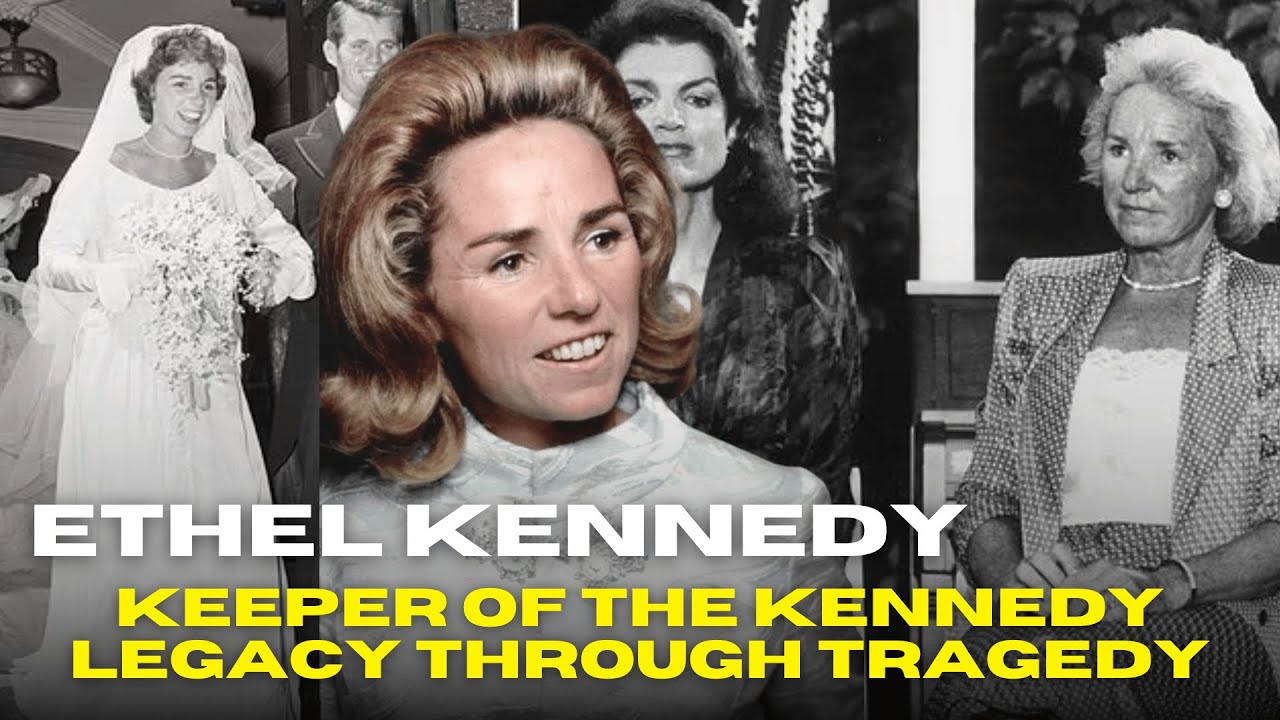
Bobby found her fearless, vivacious, and refreshingly willing to hold her ground, qualities that solidified his interest as their friendship deepened through small gatherings, weekend visits, and the teasing environment the extended Kennedy brood cultivated. On June 17, 1950, five years after their first introduction, Ethel and Bobby exchanged vows in a grand wedding ceremony in Greenwich. The event was lavish, reflecting both families’ affluence and the excitement swirling around the Kennedys. Ethel, radiant in her wedding dress, stepped into a realm where her name would soon be recognized by millions and where the responsibilities of being a political spouse would dominate her existence.
Joe Kennedy ran the family somewhat like a political operation, assigning roles to each son and expecting each daughter-in-law to serve as hostess or supporting spouse at key events. Ethel’s lively spirit harmonized with this environment. She held her own among charismatic personalities, offering remarks or laughter that could diffuse tension when debates grew intense. The couple settled into a life spanning Georgetown row houses and the Kennedy compound in Hyannis Port, Massachusetts, where Ethel’s brand of hospitality soon became legendary.
In 1951, their first child, Kathleen, was born. Over the next seventeen years, Ethel gave birth to ten more: Joseph II in 1952, Robert Jr. in 1954, David in 1955, Courtney in 1956, Michael in 1958, Kerry in 1959, Christopher in 1963, Max in 1965, Douglas in 1967, and Rory in 1968. Friends marveled at how Ethel kept up with each pregnancy while juggling a robust social life, philanthropic endeavors, and the high-profile demands of her husband’s rising political career.
She seemed inexhaustible. Her parents’ happiness at her transformation was cut short in 1955, when George and Anne Skakel died in a plane crash on their way to California aboard a company aircraft. Ethel, twenty-seven years old and reeling from the shock, was described as distraught at the Greenwich funeral, leaning on Bobby’s shoulder, tears streaming down her face—a rare public display of vulnerability. Now truly an orphan, she relied even more heavily on the Kennedys for emotional grounding.
By the early 1960s, Bobby’s political ascent accelerated alongside that of his brother, John F. Kennedy, who was elected president in 1960. Bobby became U. S.
Attorney General in 1961, and Ethel found herself at the center of Washington power. The public fascination with JFK’s youth and glamour turned politics into a cultural phenomenon, and the entire family, including Ethel, was subject to relentless media coverage. She managed it with characteristic grace and irreverence, hosting parties at Hickory Hill, their Virginia estate, that were lively and sometimes chaotic. Kids ran around the lawn playing ball or pranks while Ethel chatted with Supreme Court justices, foreign diplomats, and civil rights leaders without missing a beat.
She had no qualms about letting her children roam and express themselves, believing formality should not stifle the wonder of youth. Then came November 1963, and the assassination of President John F. Kennedy in Dallas. The nation plunged into mourning, and the Kennedys experienced heartbreak on a level unimaginable to most families.
Ethel, pregnant at the time, offered comfort to Bobby, who fell into despair at the loss of his beloved older brother. The tragedy drew him closer to his widowed sister-in-law, Jackie, as they tried to console each other. Rumors surfaced about the nature of that closeness, with some tabloids suggesting an inappropriate relationship. Ethel, stoic and confident, trusted Bobby and never allowed gossip to mar her sense of loyalty.
She stepped forward at memorials and press events, her eyes often brimming with tears but her chin held high. Bobby resigned as Attorney General in 1964 and turned his sights on a U. S. Senate seat for New York.
Ethel assumed an even more public role, attending rallies, giving speeches on his behalf, and mobilizing Catholic communities. Rumors continued to swirl—emotional entanglements with Jackie, or as some whispers insisted, an affair with Marilyn Monroe during the early 1960s. Ethel seemed above it all, once telling a close friend that gossip was the pastime of idle minds. She put her faith in her husband, focused on raising her children, and encouraged Bobby to be his best self in politics.
Her commitment bore fruit in 1964–65 when Bobby won the New York Senate seat. Her public responsibilities multiplied. She hosted fundraisers, gave occasional remarks, and supported his legislative interests, from civil rights to anti-poverty efforts. Their synergy was palpable: he was intense, morally driven, sometimes moody; she was buoyant, quick-witted, and unafraid to challenge him.
Together they radiated an energy that supporters found irresistible, and it built inexorably toward Bobby’s 1968 campaign for the Democratic presidential nomination. Ethel took to the campaign trail eight months pregnant, standing on platforms as Bobby delivered speeches to crowds enthralled by the dream of another Kennedy in the White House. The country was in turmoil, embroiled in the Vietnam War, shaken by civil unrest, and reeling from the assassination of Martin Luther King Jr. only months earlier.
Still, Ethel and Bobby believed fervently in the possibility of uniting Americans under a more compassionate vision of government. Then came the Ambassador Hotel, and the gunfire that ended it all. In the aftermath, Ethel poured her grief into founding the Robert F. Kennedy Center for Justice and Human Rights.
She launched initiatives around gun control, having seen both her husband and brother-in-law cut down by bullets. She focused on poverty issues, especially as they intersected with civil rights. Speeches and interviews from that time reveal a woman channeling heartbreak into activism even as she managed the Herculean task of raising eleven children without her partner. Behind the scenes, however, new traumas began to unfold within her own family.
David, her fourth child, born in 1955, had been especially affected by Bobby’s assassination, reportedly witnessing parts of it on television. Over the years, he slid into substance abuse, using heroin and cocaine to numb his pain. Ethel tried everything, from rehabilitation facilities to private counseling, but addiction clung to David like a relentless shadow. The tabloids pounced, turning his struggles into front-page scandals and overshadowing Ethel’s philanthropic efforts.
In the mid-1970s, a scandal from her birth family’s side erupted. Michael Skakel, a nephew from her Skakel lineage, became embroiled in the infamous Martha Moxley murder case. Martha, a fifteen-year-old neighbor, had been found bludgeoned to death near the Skakel estate in 1975. Whispers circulated for decades about possible suspects, with suspicion falling on various Skakel boys.
By 2002, Michael Skakel was tried and convicted. Ethel and her siblings were uncomfortably under the spotlight again, though she had no direct involvement. She kept silent, not wishing to add fuel to an already frenzied media circus. Her own heartbreak deepened in April 1984, when David, still battling severe addiction, was found dead in a Palm Beach hotel.
He had overdosed on a combination of cocaine, Demerol, and Mellaril. Accounts say Ethel herself discovered him, or was among the first on the scene. She arranged another funeral, wearing black, consoling family members, and refusing to blame anyone publicly. She invoked David’s struggles as a cautionary tale about vulnerabilities that exist even in prominent families.
Just when the public might have hoped for a respite, the late 1990s brought more heartbreak. Michael, her sixth child, was revealed to have had an affair with his children’s teenage babysitter, Marisa Verrochi. The scandal became tabloid fodder. Ethel, sixty-nine years old, was quietly dismayed as her son’s marriage to Victoria Gifford unraveled, but she refused to disown or publicly reprimand him, believing in forgiveness consistent with her Catholic teachings.
Then, on December 31, 1997, calamity struck again. Michael was in Aspen, Colorado, participating in an impromptu game of football on skis, a boisterous family tradition. He crashed into a tree and died instantly. Ethel arrived in Aspen as medics performed futile attempts at resuscitation.
Another coffin, another eulogy, another display of stoic composure. Throughout these family calamities, Ethel continued to promote the Robert F. Kennedy Center for Justice and Human Rights. She spoke at gatherings about social justice, attended summits on civil rights and humanitarian efforts, and maintained friendships with prominent figures.
She extended her stoicism to the wider clan, reassuring them they could remain a force for good despite the headlines depicting them as cursed. Her brother-in-law Ted Kennedy wrestled with scandals of his own, including Chappaquiddick in 1969 and health struggles later in life. When Ted died in 2009, Ethel stood in black mourning attire once again, reflecting on how time had whittled away so many of the icons of that mighty family. A bright moment came in 2014, when President Barack Obama awarded Ethel the Presidential Medal of Freedom, honoring decades of public service and acknowledging her role in continuing the philanthropic and civil rights mission sparked by her husband.
She dedicated the recognition to Bobby’s memory and the notion that each person can make a difference in the world. She had earned the nickname “the stoic widow of the Kennedys. ” Some marveled that she upheld her Catholic devotion in a modern era where tragedies often erode faith. She remained unwavering in her positions, especially on gun control, stating in multiple interviews that if America had faced the heartbreak her family had, it would understand the urgency of reform.
By the early 2000s and into the 2020s, Ethel stepped back from public events, her advanced age making travel and rigorous schedules increasingly difficult. She was sometimes spotted at Hyannis Port gatherings, a grand matriarch among the younger Kennedys, watching grandchildren and great-grandchildren step into the limelight. One such figure was Joseph Kennedy III, who carried the family name in the House of Representatives. Ethel beamed at his successes, reflecting on how the new generation tried to honor the values of public service she and Bobby had once championed.
On October 3, 2024, at the age of ninety-six, Ethel suffered a severe stroke at her Hyannis Port residence. Household staff found her unresponsive and rushed her to a hospital in Boston. Family members, including nearly all of her living children and many grandchildren, converged on the city. Doctors attempted everything possible, but her condition deteriorated over the course of a week.
On October 10, 2024, Ethel Kennedy passed away, surrounded by loved ones. Joseph Kennedy III delivered the official announcement, telling reporters that Ethel was “surrounded by love” in her final moments. On October 16, the family held a private funeral at Our Lady of Victory Church in Centerville, Massachusetts. Eulogies were delivered by grandchildren including Joseph III, and by her daughter Kerry, who recounted stories of Ethel’s humor, her boundless generosity, and her insistence that they never lose faith in humanity’s capacity for good.
The Mass concluded with a final farewell, after which Ethel’s remains were carried to Arlington National Cemetery. There she was laid to rest alongside Bobby, closing the circle on a love story that began so brightly at Manhattanville College and ended with a bullet’s sharp crack in 1968. Now, even in death, they were united at the iconic cemetery where so many Kennedys now rest.
